
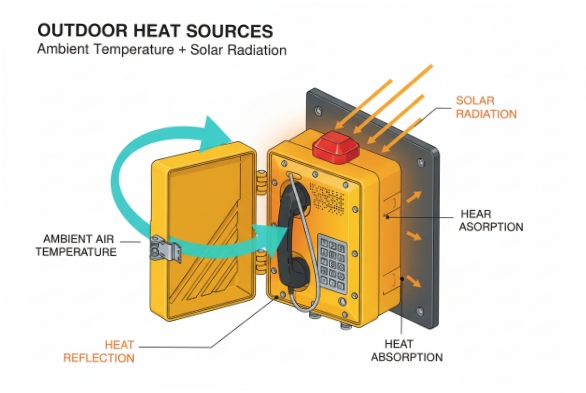
Outdoor heat makes small design mistakes expensive. A phone that works at dawn can fail at noon, and the failure usually shows up during an emergency.
Yes. Explosion-proof SIP telephones suit high-temperature outdoor sites when the Ex marking includes the right ambient range and T-class margin, and when sun load, hot-surface spacing, and cable entries are engineered as one system.
What “high-temperature outdoor” really means for Ex SIP devices?
Outdoor heat is two heat sources, not one
Outdoor temperature is only the first heat source. Solar radiation 1 becomes the second heat source, and it can push enclosure skin temperature far above ambient. A dark backplate in direct sun can turn into a heater. A phone mounted on steel can also soak heat from nearby process equipment. These effects stack.
This is why a “+70 °C ambient” label does not automatically mean safe operation next to a radiant heater. The device must stay within:
-
its ambient operating range (electronics function),
-
its certified ambient range on the Ex marking (compliance),
-
and its maximum surface temperature limit tied to T-class (ignition safety).
“T-class” is the surface temperature promise
T-class 2 is not the process temperature. T-class is the maximum temperature the device surface can reach in service. If a phone has T4 marking, the device surface must stay below the T4 limit under the stated ambient conditions. Heat soak from a nearby heater can break that promise even when the phone electronics are fine.
My field rule for outdoor Ex stations
A team can fight heat with fans and kits, but placement wins first. A phone lasts longer when it is mounted:
-
out of direct sun,
-
off hot steel with standoffs,
-
away from heater exhaust and radiant panels,
-
and with a drip-proof cable path that does not bake the gland.
A short story belongs here: a site once mounted a call station on a sun-facing tank stair tower. The phone was compliant on paper. The keypad still warped in one summer. The replacement lasted after a small sunshade and a 100 mm standoff bracket. This pattern repeats.
Quick selection and placement table
| Heat driver | What it does to the phone | Best control |
|—|—|—|
| High ambient | stresses electronics and PoE 3 | choose certified high-ambient model |
| Sun load | raises skin temp above ambient | sunshade + light finish + airflow gap |
| Heat soak from steel | drives slow overheating | standoff mount + thermal break |
| Radiant heaters | spikes surface temperature | relocate + heat shield + measured verification |
| Hot cable routes | bakes glands and jackets | reroute + higher-temp cable + guards |
A high-temperature outdoor site can still run Ex SIP 4 phones with high reliability. The design must treat heat as a system variable, not as a spec-sheet line.
The next section explains how to choose operating range and T-class when heaters and hot surfaces are nearby.
What operating ranges (e.g., −40 to +70 °C) and T-class are required near heaters?
Hot areas create two risks at once. Electronics fail from heat, and ignition safety fails from hot surfaces.
Operating range must match the worst ambient plus sun load, and T-class must stay below the ignition risk threshold while still holding margin under the marked ambient range. Near heaters, placement and measured surface temperature matter as much as the printed T-class.
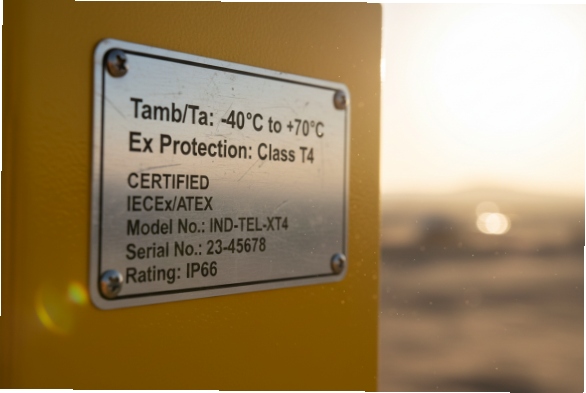
Operating range: look for “Tamb/Ta” on the Ex marking
Many Ex devices specify an ambient range as part of their certification. Outdoor sites often target a wide range like −40 to +70 °C because winter starts and summer peaks both matter. A device that is only certified to +40 °C may still “work” at +55 °C, but it may not be compliant. A compliant deployment needs the marked ambient range to include the real environment.
A practical method helps:
-
Use the site’s design ambient (peak outdoor air temperature).
-
Add a sun-load margin unless the device is shaded.
-
Confirm the Ex marking includes that ambient range.
T-class: pick the class, then defend it with placement
T-class selection starts with the hazardous atmosphere, not the weather. Still, weather and heaters can push a device surface above its limit. The safest workflow is:
1) Select a T-class that matches the gas risk in the area.
2) Keep the phone surface cool enough with spacing and shielding.
3) Verify with an infrared or contact temperature check at worst-case conditions.
A simple mental model works:
-
T-class is a ceiling for device surface temperature.
-
Hot steel and radiant heaters push the device toward that ceiling.
-
A standoff and shade pull it back down.
Near heaters: treat radiant heat as a compliance variable
A heater does not need to touch the phone to heat it. Radiant heat can raise the phone surface fast. A phone can meet its T-class in free air and still exceed it when mounted on a hot frame. This is why a “near heater” installation should include:
-
a minimum spacing plan,
-
a heat shield when spacing is tight,
-
and a temperature verification step in commissioning.
A practical T-class and ambient check table
| Check | What to confirm | What to do if it fails |
|—|—|—|
| Ex ambient range | Ta/Tamb covers worst outdoor conditions | choose extended-ambient model or relocate |
| Electronics range | handset, display, keypad rated for heat | add shade, avoid dark plastics, reduce sun load |
| T-class margin | phone surface stays under limit | add standoff + shield, move off hot steel |
| Heater adjacency | no direct radiant path | rotate mount, add barrier plate |
A team can stay conservative without overspending. The best cost control is moving the phone 1–2 meters away from the heater line of sight, then using a horn/strobe to keep it obvious.
The next section covers the physical protections that make a high-temperature outdoor phone survive daily sun and seasonal swings.
Will sunshades, UV-resistant housings, and fan/heater kits protect electronics?
Outdoor heat failures often look random. The true cause is usually sun load plus poor airflow.
Yes. Sunshades and UV-stable materials reduce solar heat gain, and fan/heater kits can stabilize internal conditions when they are certified and sized correctly. Shade and airflow gaps often provide the biggest benefit for the lowest cost.
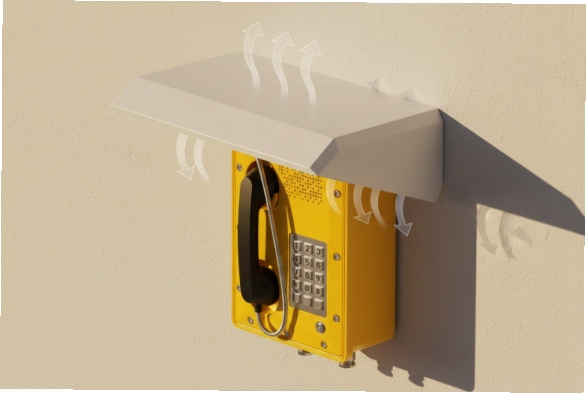
Sunshades: the simplest way to cut peak temperature
A sunshade 5 changes the whole thermal equation. A shield blocks direct radiation and lowers the enclosure skin temperature. A white or light finish also reduces absorption. A small air gap between the shield and the enclosure matters, because it lets hot air move away instead of trapping it.
A good sunshade setup has:
-
top coverage with side lips,
-
a ventilation gap behind the unit,
-
and a mount that does not create a heat bridge to hot steel.
UV resistance: treat “small plastics” as critical components
UV does not only fade labels. UV can embrittle keypad membranes, crack handset cords, and haze windows. Outdoor heat makes that aging faster. A robust outdoor build uses:
-
UV-stabilized 6 plastics for keypad and window parts,
-
laser marking or metal labels instead of printed stickers,
-
and sealed keypads that do not trap dirt and water at the edges.
Fan kits: useful, but only when the enclosure can breathe safely
Fans help when the enclosure has a controlled air path and filtration. In dusty outdoor sites, fans can pull dust and salt into the enclosure if filtration and pressure strategy are weak. For Ex equipment, any internal fan or air exchange must respect the protection concept and certification conditions. Many projects prefer passive heat control first:
-
shade,
-
airflow gap,
-
light finish,
-
and thermal isolation from hot steel.
Fans become the second step when passive control is not enough.
Heater kits: more useful for condensation than for heat
In outdoor high heat, heaters do not help the peak temperature. Heaters help the cold nights and humidity swings. A heater can reduce condensation inside a sealed station by keeping internal surfaces above dew point. This matters because a station can be both hot at noon and wet inside at midnight.
A protection choice table for outdoor extremes
| Option | What it solves | Best use case | Common mistake |
|—|—|—|—|
| Sunshade | solar heat gain | full-sun mounting | shade with no airflow gap |
| UV-stable parts | cracking and fading | exposed keypad/window | relying on stickers for labels |
| Thermal standoff | heat soak from steel | mounting on hot frames | bolting flat to metal |
| Fan kit | internal heat buildup | enclosed cabinets | pulling dust/salt into enclosure |
| Heater kit | condensation | coastal or humid nights | adding non-certified heater in Ex zone |
A phone survives outdoor extremes when passive controls do most of the work. A kit should be the final tuning tool, not the first fix.
The next section focuses on system behavior. Outdoor stations often need paging, emergency shutdown interaction, and simple call paths.
Can devices integrate with IP PBX, PAGA horns, and ESD systems outdoors?
Outdoor stations are often far from people. A simple ring is not enough. The system must pull attention fast and link to safety workflows.
Yes. Ex SIP phones can register to IP PBX, trigger and receive PAGA paging, and support ESD workflows through PLC-driven logic and callout rules, while keeping the safety trip function inside the safety system.
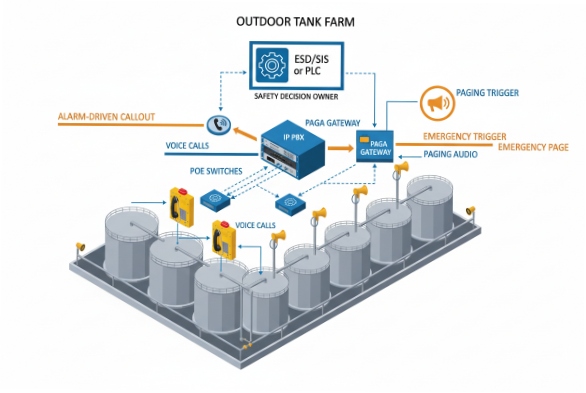
IP PBX integration: keep call paths short
Outdoor high-heat sites often include terminals, tank farms, and utility yards. Operators need one-button calling, not a directory. A robust IP PBX 7 setup uses:
-
hotline keys to the control room and security,
-
ring groups with escalation,
-
clear station naming that matches physical signage,
-
and survivability features like secondary registration or redundant PBX nodes.
If a station is remote, the PBX should show location immediately. That cuts response time.
PAGA horns: paging often matters more than the handset
Outdoor environments are windy and loud. A horn speaker or paging horn often does the real work. A SIP phone can support paging in two common ways:
-
SIP paging call to a paging gateway that feeds amplifiers and horns,
-
multicast paging where the site uses IP horn speakers.
Priority rules keep the system safe:
-
emergency announcements must override routine pages,
-
emergency calls must not be blocked by paging audio.
A plant also benefits from a test routine that checks paging under full sun and full wind, because intelligibility changes.
ESD system interface: keep the safety action separate
An ESD 8 trip must remain hardwired or safety-network based per site standards. The phone should not become the device that decides a trip. The phone can support the workflow by:
-
auto-dialing the control room when an ESD is triggered,
-
receiving a paging announcement that instructs evacuation,
-
and lighting a status indicator when an alarm input is active.
This pattern keeps safety logic auditable and keeps voice communication available.
Integration table for outdoor safety workflows
| Workflow | Owner system | Phone role |
|—|—|—|
| Emergency voice | IP PBX | hotline call and location ID |
| Yard-wide alert | PAGA 9 /paging | auto-answer page and loud playback |
| ESD trip event | SIS/PLC | trigger callout and paging via rules |
| Local beacon | PLC output | phone triggers PLC input if needed |
A good outdoor system uses the PBX for voice, PAGA for reach, and the safety system for decisions. This division keeps integration clean and keeps maintenance simple.
The last section covers the details that decide compliance and service life in hot outdoor installs: cables, glands, and spacing from hot surfaces.
What cable specs and spacing from hot surfaces ensure compliance?
Heat destroys cable jackets, bakes gland inserts, and loosens seals. A phone can be perfect and still fail because the cable route is wrong.
Use high-temperature, UV-resistant industrial cable, protect it mechanically, and maintain spacing from hot surfaces so both the cable jacket and the device surface stay within their rated limits. Verify the worst-case temperature at commissioning, not only on paper.
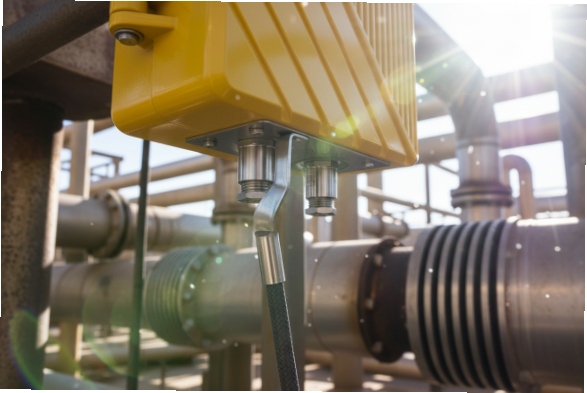
Cable specs: match temperature, UV, and oil exposure
Outdoor hot sites often include hydrocarbon exposure, wind, and sun. The cable should be selected like instrumentation cable, not office LAN cable. A strong spec includes:
-
UV-resistant jacket,
-
temperature rating that covers the hottest route,
-
oil and chemical resistance if the site has hydrocarbons,
-
and mechanical protection where vehicles can hit the run.
A safe baseline in hot outdoor work is to use cable rated 90 °C or 105 °C when routes can get hot. The real target should follow measured or modeled temperature at the cable surface, not only ambient air.
Spacing from hot surfaces: keep the measured surface temperature below limits
No universal spacing number fits every heater, because radiant intensity varies. The reliable method is simple:
-
Define a “no-mount zone” around heater faces and exhausts.
-
Use standoff brackets and shields when space is limited.
-
Measure surface temperature on the phone and on the cable after the heater runs at steady state.
-
Adjust location until the measured values sit below device and cable ratings with margin.
This approach also protects Ex compliance, because T-class depends on maximum surface temperature. If a heater drives the phone surface above its limit, compliance is gone even if the phone still works.
Glands and entries: heat accelerates sealing failures
High heat makes elastomers relax over time. A gland that seals well at 25 °C can loosen after months at 60–70 °C. This is why hot outdoor installs should use:
-
certified gland types that match the Ex protection concept,
-
stainless gland bodies for corrosion resistance,
-
inserts rated for the cable jacket and temperature,
-
correct torque and thread engagement,
-
and sealed stopping plugs for unused entries.
Drip loops and routing: stop water and heat together
A drip loop prevents water tracking into the gland. In hot outdoor sites, routing also needs to avoid “heat gutters,” where a cable runs along a hot pipe rack and absorbs heat. The best routing keeps cable:
-
away from hot pipes and exhausts,
-
supported with air gaps,
-
and protected from direct sun when possible.
A field checklist table for hot outdoor compliance
| Item | What to check | Why it matters |
|—|—|—|
| Cable rating | jacket temp rating exceeds measured route temp | prevents softening and cracking |
| UV resistance | jacket is sunlight rated | stops early embrittlement |
| Spacing | phone and cable temps stay below limits | protects T-class and life |
| Shielding | heater line-of-sight blocked | reduces radiant heating |
| Entry sealing | glands torqued, inserts intact | prevents moisture and dust ingress |
| Drip loop | loop formed before entry | blocks water tracking |
| Inspection | seasonal retorque and visual check | heat cycles loosen hardware |
High-temperature outdoor installs succeed when the project measures heat at the real mounting point and adjusts early. That small step saves years of replacement work.
Conclusion
Explosion-proof SIP phones work outdoors in extreme heat when ambient range, T-class margin, shading, integration, and hot-surface cable routing are engineered together.
Footnotes
-
Solar irradiance: The power per unit area received from the Sun in the form of electromagnetic radiation. ↩
-
Temperature classification: A rating system that categorizes hazardous area equipment based on its maximum surface temperature to prevent ignition. ↩
-
Power over Ethernet: A technology that passes electric power along with data on twisted pair Ethernet cabling. ↩
-
Session Initiation Protocol: A signaling protocol used for initiating, maintaining, and terminating real-time sessions like voice and video calls. ↩
-
Solar shading: Mechanical systems or architectural features used to control the amount of solar heat and light entering a building or enclosure. ↩
-
UV degradation: The breaking down of materials, particularly polymers, when exposed to ultraviolet radiation from the sun. ↩
-
IP PBX: A private branch exchange telephone system that uses the Internet Protocol to manage calls within an organization. ↩
-
Emergency Shutdown System: A control system designed to bring a process or facility to a safe state in the event of a critical failure or hazard. ↩
-
Public Address/General Alarm: A system used in industrial settings to broadcast voice messages and alarm tones to personnel. ↩
-
Variable-frequency drive: A type of motor controller that drives an electric motor by varying the frequency and voltage of its power supply. ↩








