
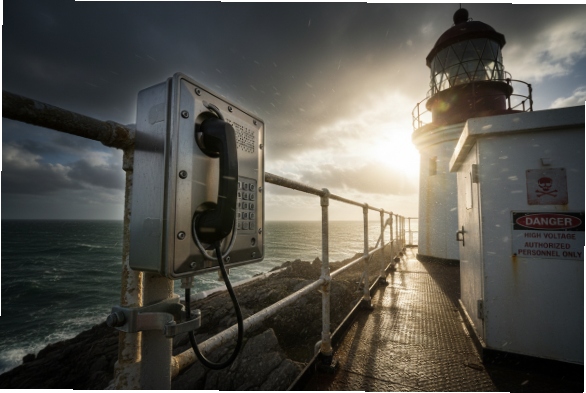
Salt wind and storms punish every weak seal and cable joint. If the only phone on a remote tower fails, response time and safety both suffer.
Yes. Explosion-proof SIP telephones can work well in maritime lighthouses when the hazard classification truly requires Ex, and the station is built like marine infrastructure: 316L/IP67 sealing, UV-stable parts, surge protection, and a power plan that survives outages.
Lighthouse deployments need two designs at once: hazardous compliance and marine survival
Where “Ex” is really needed in a lighthouse
Most lighthouse towers are not automatically hazardous locations. The Ex requirement usually comes from nearby risks like:
-
diesel generator rooms and day tanks
-
fuel transfer points and vents
-
paint and solvent storage rooms
-
battery rooms with hydrogen release risk (site-dependent)
-
small workshops where flammables are handled
So the first step is always the site’s hazardous area drawing (Zone 1/2 or Class/Div). If the phone is mounted in a normal corridor outside the classified boundary, a rugged marine SIP phone may be enough. If the phone is inside the classified boundary, then Ex is the clean answer, and it must match the marking conditions (ambient range, gas group, and temperature limits).
Why marine life is harder than industrial life
On a lighthouse, corrosion is not a “maybe.” It is daily. Salt settles, then dew wets it, then sun concentrates it. That cycle attacks:
-
cable glands and thread roots
-
hinge pins and latches
-
mic/speaker membranes
-
handset cords and strain reliefs
-
labels and keypad films
This is why a “316L housing” is only a starting point. A real marine station needs stainless hardware across the whole assembly, fewer crevices, and a cleaning plan that does not damage seals.
A simple architecture that keeps uptime high
A lighthouse phone station usually works best as a small system:
-
the phone (Ex or non-Ex depending on boundary)
-
a protected junction box or cabinet nearby
-
a surge strategy for both power and data
-
remote monitoring so faults are seen early
| Lighthouse constraint | What it breaks first | Practical control |
|---|---|---|
| Salt fog + wet/dry cycling | glands, latches, fasteners | 316 stainless glands + anti-seize practice + rinse plan |
| Wind-driven rain | keypad edges, mic ports | sealed keypad + protected acoustic membranes + hood |
| Lightning exposure | PoE ports, switches | bonding + SPDs + fiber breaks where possible |
| Remote access | slow repair cycles | monitoring + simple spares strategy |
| Power instability | reboot loops | UPS/battery + stable DC conversion |
A lighthouse station can be very reliable, but only when the design accepts that service visits are rare and weather is never friendly.
A good plan makes the phone easy to find, easy to use with gloves, and hard to kill with salt and surges.
Will marine-grade 316L, IP67, and anti-UV housings survive salt, wind, and storms?
Salt and UV do not fail devices fast in one dramatic moment. They fail them slowly, then all at once during a storm.
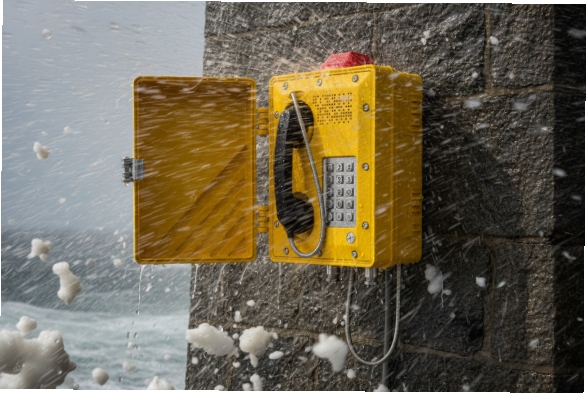
Yes. 316L housings with IP67 sealing and UV-stable external parts can survive lighthouse exposure, but only if the entry hardware, fasteners, keypad membranes, and acoustic paths are also marine-grade and designed to avoid salt-trap crevices.
What 316L does well, and where it still needs help
316L 2 stainless is a strong coastal baseline. It resists many corrosion modes better than painted steel, and it stays serviceable longer. Still, in salt fog, 316L can suffer pitting and crevice corrosion when salt paste sits in seams and under clamps. This is why the mechanical design matters:
-
smooth surfaces that rinse clean
-
minimal overlapping joints
-
consistent stainless brackets and hardware
-
controlled gasket compression
If a phone is mounted on carbon steel without isolation, galvanic couples can speed corrosion at joints. Small isolation washers and consistent bonding often help reduce that.
IP67 is only real when the entire sealing chain is correct
For lighthouse duty, IP67 3 is valuable because storms can drive water into places that never get wet inland. Still, the most common leak point is not the door seam. It is the cable entry:
-
wrong gland size for the cable OD
-
poor strain relief that works the gland loose
-
upward-facing entry that collects water
-
unused holes sealed with temporary plugs
A simple rule keeps stations dry: downward entry + drip loop + stainless gland + correct torque.
UV is a “small parts” problem
Even with a stainless body, UV hits:
-
keypad membranes
-
handset cords
-
window lenses for indicators
-
label adhesives
For long service life, prefer UV-stabilized 4 polymers and laser marking or metal labels instead of stickers. I once saw a tower station that “worked,” but the faded label made operators press the wrong key during a drill. That is still a failure.
| Component | Better lighthouse choice | Why it lasts |
|---|---|---|
| Housing | 316L with smooth finish | reduces salt retention |
| Fasteners | stainless throughout | avoids rust streaks and seized covers |
| Keypad | sealed, UV-stable membrane | prevents cracking and lifting |
| Acoustic ports | protected membranes | stops salt crust from blocking audio |
| Entry system | 316 stainless glands + plugs | stops the most common leak |
When the full station is marine-grade, storms become a test, not a disaster.
How can Ex SIP phones integrate with IP PBX, foghorns, beacons, and remote monitoring?
A lighthouse does not need office telephony features. It needs simple calling, loud alerts, and remote visibility.
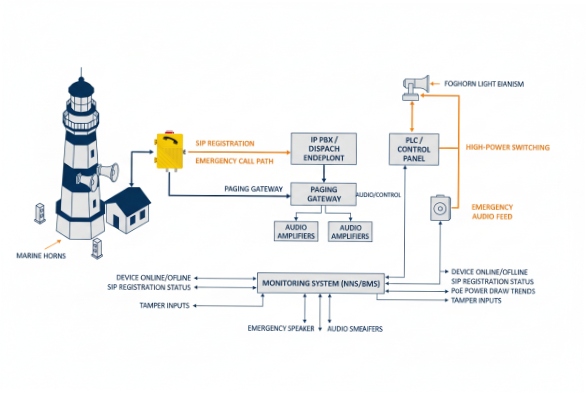
Ex SIP phones can register to an IP PBX, trigger foghorn and beacon workflows through paging and PLC logic, and report health status through standard network monitoring. The safest design keeps high-power switching and safety logic in controllers, not inside the phone.
In remote maritime sites, the winning features are basic:
-
hotline button to a staffed operations point
-
ring groups with escalation
-
clear station identity like “North Tower Entrance”
-
auto-recovery after PoE bounce
If the lighthouse has more than one station (dock gate, generator room, tower entrance), consistent naming and signage reduce confusion during incidents.
Foghorns and beacons: route control through paging and PLC
Foghorns and rotating beacons are high-power devices with strict control logic. A phone should not directly power or switch them. A cleaner integration is:
-
SIP phone triggers an event (call, paging request, or dry contact)
-
PLC or control panel decides the action and drives horn/beacon circuits
-
PBX or dispatch logs the action and notifies teams
Paging can also tie into loudspeakers or marine horns. SIP paging gateways can feed amplifiers, and multicast paging can serve IP horn endpoints when the network design supports it.
Remote monitoring: avoid “silent failure”
A lighthouse station should be monitored like critical infrastructure. Practical signals include:
-
device online/offline status
-
PBX registration state
-
PoE power draw trends (heater failure can show up here)
-
reboot counts and uptime
-
door-open tamper input (if supported)
This monitoring can feed a simple NMS dashboard or a BMS if the facility has one. Remote visibility saves trips.
| Function | Best owner system | Phone role |
|---|---|---|
| Voice calls | IP PBX 5/dispatch | hotline + ring group + location ID |
| Paging to horns/speakers | paging gateway/dispatch | trigger or receive pages with priority rules |
| Foghorn/beacon control | PLC 6/control panel | phone triggers event, PLC drives power |
| Fault visibility | NMS/BMS | status, PoE alarms, registration checks |
This approach keeps the phone simple and reliable, while still making it part of the lighthouse alert workflow.
Are solar power kits, PoE extenders, and battery backup practical for remote lighthouses?
Remote towers often have unstable mains, long cable runs, and limited space for large cabinets. Power design decides whether the phone is “always available” or “usually available.”
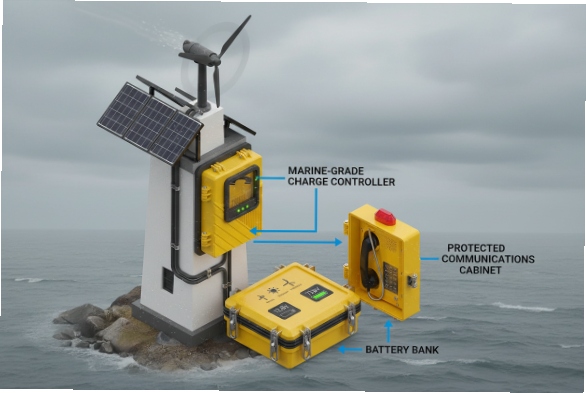
Yes. Solar + battery systems, PoE extenders, and UPS-backed PoE are all practical in lighthouse deployments, but they must be sized for winter sun, heater loads, and surge conditions, and the network should be designed for long exposed runs.
Solar and battery: plan for worst-week, not best-day
Solar works well for remote endpoints when it is sized for the darkest season. The most common mistake is ignoring “small loads” like:
-
enclosure heater
-
beacon strobe
-
PoE switch idle draw
-
radio backhaul equipment
A stable design uses:
-
a battery sized for several days of autonomy (site-dependent)
-
a charge controller rated for wind and salt exposure
-
a DC power system that stays stable in cold
-
remote reporting of battery voltage and charge state
PoE strategy: shorten copper, use fiber where possible
For long lighthouse runs, copper Ethernet becomes a surge path. A robust pattern is:
-
run fiber from the main building toward the tower or pier edge
-
place a small PoE switch in a protected cabinet near the endpoint
-
keep the final copper run short and well protected
If a single long copper run must be used, PoE extenders can help distance, but they do not fix lightning exposure. They also add additional points of failure, so it helps to keep the design simple.
Battery backup: keep emergency comms alive when everything else is down
A small UPS for the PoE switch and network gateway often provides the biggest reliability gain. It keeps the phone registered and keeps paging available during short outages. For remote sites, battery backup also helps during generator start delays.
| Power option | Best use case | Main caution |
|---|---|---|
| UPS-backed PoE | sites with mains + outages | size for real loads, test annually |
| Solar + battery | remote towers with no stable mains | winter sizing and heater draw |
| PoE extender chain | long linear routes | more failure points, surge exposure |
| Local DC power (48V) | integrated comms cabinets | needs stable conversion and monitoring |
Power is not only about keeping the phone on. It is about keeping the call path stable: switch, backhaul, and PBX reachability.
What corrosion control and lightning protection practices are required?
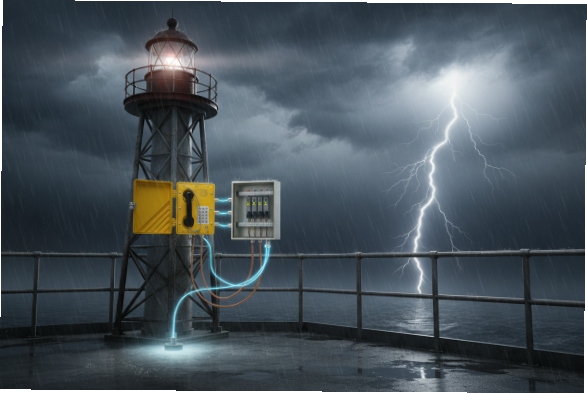
A lighthouse is one of the worst places for surges. The tower is tall, the runs are exposed, and grounding systems can be complex near water.
Use a corrosion control routine that includes freshwater rinsing and hardware inspection, and use a lightning/surge strategy built around bonding, proper grounding, and surge protective devices. Favor fiber isolation to break surge paths when possible.
Corrosion control that actually extends life
The simplest life-extender is a rinse plan. Freshwater rinse removes salt before it concentrates. A practical routine includes:
-
rinse exposed stations on a schedule (weekly to monthly by exposure)
-
inspect glands for staining, loosening, and cracked inserts
-
check latches and hinges for seizure
-
confirm bonding straps remain tight and clean
-
replace keypad membranes and acoustic covers before they fail
Stainless threads can gall, so service practice matters. Anti-seize on appropriate external fasteners often prevents “cannot open cover” events.
Lightning and surge: stop energy from using your Ethernet as a path
A strong lightning approach aims to reduce potential differences and provide preferred paths for surge energy:
-
bond all metal structures and cabinets into an equipotential network
-
protect data lines where copper must run outdoors
-
use fiber links to break electrical continuity between buildings and towers
The most common lighthouse failure pattern is “after a storm, the phone is dead and the switch is dead.” That usually means the surge came in through copper and found no better path.
Grounding practices that prevent repeat failures
Good grounding is not only a rod in the soil. It is a complete bonding story:
-
short, direct bonding conductors where practical
-
corrosion-resistant lugs and hardware
-
protected routing so bonding straps do not fatigue in wind vibration
-
periodic continuity checks, because corrosion loosens everything over time
A maintenance and protection table for lighthouse stations
| Practice | Interval | What it prevents |
|---|---|---|
| Freshwater rinse | weekly–monthly | salt paste buildup and pitting |
| Gland/plug inspection | quarterly | moisture ingress and loose entries |
| Bonding continuity check | semi-annual | floating metal and surge damage |
| Surge device inspection | annual | protection “gone” after repeated events |
| Storm-season test calls | seasonal | silent failures and routing errors |
When corrosion control and surge strategy are treated as standard operating practice, lighthouse phones become dependable even in brutal weather.
Conclusion
Explosion-proof SIP telephones can serve maritime lighthouses when Ex needs are real, marine sealing is complete, power is backed up, and corrosion plus lightning protection are engineered and maintained like critical infrastructure.
Footnotes
-
Uninterruptible Power Supply: An electrical apparatus that provides emergency power to a load when the input power source or mains power fails. ↩
-
A low-carbon version of 316 stainless steel, offering better resistance to intergranular corrosion. ↩
-
Ingress Protection rating indicating an enclosure is dust-tight and protected against temporary immersion in water. ↩
-
A material property that prevents degradation such as chalking or cracking when exposed to ultraviolet radiation from the sun. ↩
-
Private Branch Exchange: A telephone system that switches calls between users on local lines while allowing all users to share external phone lines. ↩
-
Programmable Logic Controller: A digital computer used for automation of typically industrial electromechanical processes. ↩
-
Surge Protective Device: A component used in electrical installation protection systems to limit transient overvoltages and divert surge currents. ↩








