

Municipal gas networks operate under high pressure—literally and figuratively. A minor leak in a pressure reduction station (PRS) or a valve knot can turn a routine maintenance check into a hazardous situation instantly. Reliable communication is vital, but can standard equipment survive the potential for methane buildup and harsh outdoor elements?
Yes, explosion-proof SIP telephones are essential for municipal gas networks. Engineered for Zone 1/2 and Class I Division 1/2 environments, these devices feature weather-resistant IP66/IP67 316L stainless steel housings that withstand methane exposure and corrosive odorants. They integrate directly with SCADA and ESD systems to enhance critical safety infrastructure.

The Critical Link in Gas Distribution
Managing a municipal gas grid involves monitoring hundreds of unmanned stations spread across a city. From the City Gate Station where transmission lines meet distribution networks, to the district regulator stations tucked into neighborhoods, the risk of a gas leak is always present.
In my experience at DJSlink working with utility providers, I’ve seen how "intrinsically safe" portable radios often fail to penetrate the thick concrete walls of underground regulator vaults. This leaves technicians isolated. A fixed, hardwired explosion-proof telephone provides a failsafe lifeline.
However, natural gas (primarily Methane, CH4) presents specific challenges. It is lighter than air, meaning it accumulates in roof pockets of valve houses. Equipment must be designed not just to "survive" a blast, but to ensure it never becomes the ignition source in the first place.
| Facility Type | Gas Hazard | Environmental Challenge | Recommended Protection |
|---|---|---|---|
| City Gate Station | High Pressure Leaks | Rain, Snow, Sun | Class I Div 1 / Zone 1 |
| District Regulator | Confined Venting | Dampness/Condensation | IP66 + Heater |
| Valve Station | Fugitive Emissions | Remote/Unmanned | SCADA Integration |
Which Zone 1/2 or Class I Div 1/2 ratings fit PRS and valve stations?
Regulatory compliance is non-negotiable in the gas industry. The classification depends heavily on ventilation and the proximity to potential leak points like flanges, valves, and regulators.
Pressure Reduction Stations (PRS) and valve pits often contain Zone 1 (Class I, Div 1) areas near vents and regulators where gas concentration is likely. General station interiors are typically Zone 2 (Class I, Div 2). Devices must be rated for Group IIA (Methane) or Group D to ensure safety during fugitive emissions.
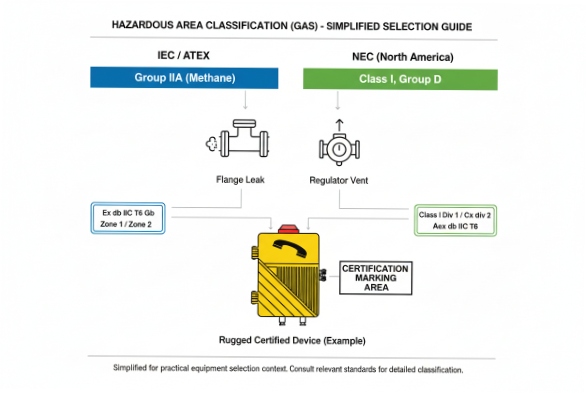
Deciphering the Gas Codes
Global standards vary (ATEX/IECEx vs. NEC), but the physics of methane remains the same.
-
Zone 1 1 / Class I Div 1:* This is the "Red Zone." It covers the immediate area around relief valves, slam-shut valves, and filter separators. If a technician is working on a regulator, a gas release is possible. A phone installed right next to the gauge panel must* have this top-tier certification (usually Ex d – Flameproof).
-
Zone 2 / Class I Div 2: This applies to the wider room or fenced enclosure. While gas isn’t expected under normal operation, a seal failure could fill the room. Many utilities standardize on Zone 1 equipment even for Zone 2 areas to simplify inventory and maximize safety.
-
Gas Groups: Natural gas falls under Group IIA (IEC) or Group D (NEC). This is actually easier to design for than Hydrogen (IIC), but the equipment must still be certified specifically for it.
Do IP66/67 316L housings handle methane, odorants, and outdoor weather?
Gas stations are often exposed to the elements or located in damp underground vaults.
Absolutely. IP66/IP67 ratings protect against driving rain and condensation in underground pits. Crucially, 316L Stainless Steel housings resist the corrosive effects of mercaptan odorants (added to gas) and general atmospheric weathering, far outlasting painted aluminum or plastic in outdoor installations.
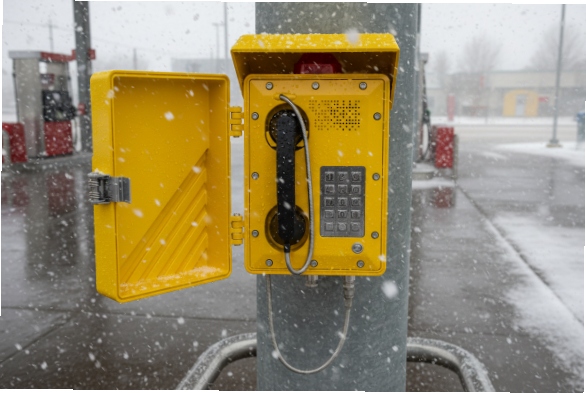
Battling the Elements and Additives
The "smell of gas" is actually an additive called mercaptan, which contains sulfur.
-
Chemical Resistance: While methane itself is not corrosive, sulfur-based odorants can attack certain rubbers and low-grade metals over time. 316L Stainless Steel 2 is impervious to this, as well as to road salts if the station is near a highway.
-
Weatherproofing: A PRS station might face -30°C winters and +40°C summers. Our phones feature silicone gaskets that maintain their seal (IP66/67) 3 across extreme temperature swings, preventing moisture ingress that causes ground faults.
-
UV Stability: Plastic phones degrade and become brittle under UV exposure. Stainless steel reflects sunlight and maintains its structural integrity (IK10 impact rating) for decades.
Can phones integrate with IP PBX, PAGA, ESD, and SCADA alarms?
In a smart grid, a phone is more than a voice device; it’s an edge node for the control system.
Yes, SIP telephones integrate with the utility’s central IP PBX and can trigger local PAGA horns for evacuation. Uniquely, they can interface with SCADA and Emergency Shut Down (ESD) systems via I/O ports, allowing the phone to broadcast automated alerts if gas detectors trip or pressure limits are breached.
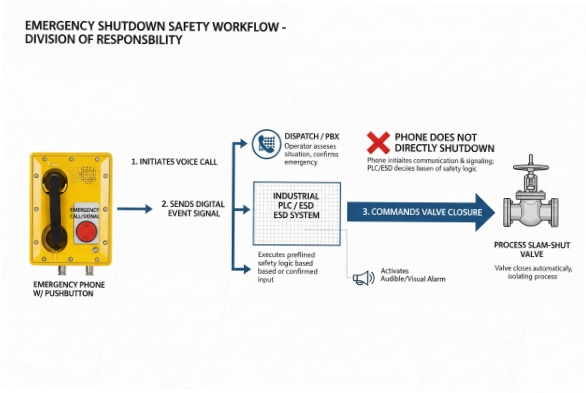
The Intelligent Edge
Integration allows for rapid response to anomalies.
-
SCADA Interfacing: The phone’s digital input can be wired to a methane detector. If gas levels hit 20% LEL (Lower Explosive Limit), the phone can automatically dial the control center and play a warning message: "Gas Alert at Station 42."
-
ESD 4 (Emergency Shut Down):** In a critical event, a technician can press a dedicated "Emergency" button on the phone. This can be programmed to not only call for help but also trigger a relay output to close a slam-shut valve locally.
-
Remote Management: Operators can ping the phone to check its status (and by proxy, the network health at that station) without sending a truck roll.
What sealing fittings, grounding, and T-class meet local codes?
Installation details are where inspections are passed or failed.
Compliance requires using certified EYS sealing fittings within 18 inches of the enclosure to stop gas migration through conduits. A dedicated external ground bond is mandatory to dissipate static charge. For methane, a T-Class of T1 is technically sufficient, but T6 is the industry standard for maximum safety margins.
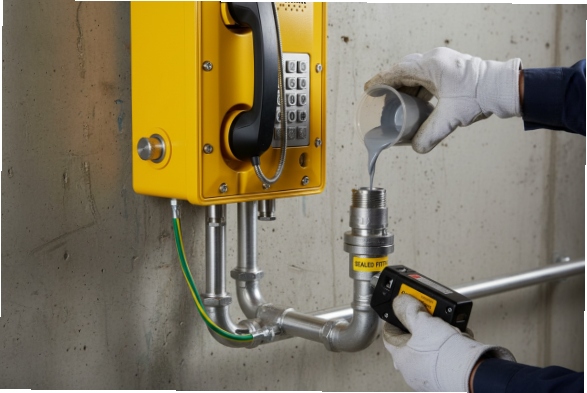
Installation Best Practices
-
Sealing Fittings (EYS): In Class I environments, gas can travel inside the conduit like water in a pipe, moving from a hazardous zone to a non-hazardous control room. You must pour a setting compound 5 into the sealing fitting to create a gas-tight barrier.
-
Grounding (Earthing): flowing gas generates static electricity. If the phone is not properly grounded to the station’s earth grid, a static discharge could ignite a leak.
-
Temperature Class (T-Rating): Methane has a high auto-ignition temperature (~537°C). However, we adhere to a T6 rating (surface temp < 85°C). This ensures that even if the station is used for other hydrocarbons in the future, the equipment remains safe.
Conclusion
Securing municipal gas networks requires equipment that respects the volatility of methane and the harshness of the outdoor environment. By choosing Zone 1/Class I Div 1 certified SIP telephones with IP67 316L housings, utilities ensure a durable, integrated communication link. These devices don’t just facilitate calls; they integrate with SCADA and ESD protocols to actively protect the infrastructure and the community.
Footnotes
-
A hazardous area classification where an explosive atmosphere is likely to occur in normal operation. ↩
-
A molybdenum-bearing austenitic stainless steel known for its corrosion resistance. ↩
-
Ingress Protection ratings defined by IEC standard 60529. ↩
-
A system designed to minimize the consequences of emergency situations, related to the release of hazardous materials. ↩
-
Fittings used in conduit systems to prevent the passage of gases, vapors, or flames. ↩








