
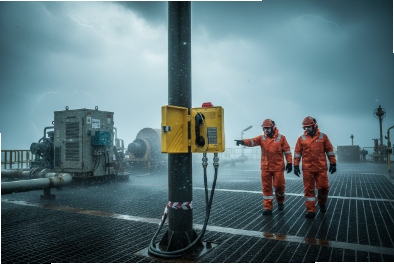
Offshore phones fail when salt, vibration, and alarms hit at the same time. Then the crew loses a voice path when it matters most.
Yes. Explosion-proof SIP telephones are suitable for offshore platforms when the Ex rating matches Zone 1/2 and IIC needs, the housing survives marine corrosion, and the network design preserves PAGA and muster priority.
Offshore-ready blueprint: what makes an Ex SIP phone survive at sea
Offshore is a combined stress test, not a single requirement
An offshore platform mixes hazards that usually live in separate specs onshore. Gas risk can be Zone 1 on one deck and Zone 2 one level up. Salt fog never stops. Storm water pushes into cable entries. Vibration shakes brackets loose. Cleaning crews use steam and chemicals. At the same time, the phone must stay reachable by the control room, the radio room, and the muster system.
A good selection starts with a simple goal: the phone must stay compliant and stay usable after years of exposure, not only during FAT. That is why the “right phone” is a package:
-
Ex certification and correct marking (Zone, gas group, T-class, Ta)
-
Marine resistance (316L or proven coating system, stainless hardware, UV-stable seals)
-
High sealing level (IP66 minimum, IP67 where flooding can happen)
-
Network resilience (VLAN, QoS, IGMP control, redundant switches on UPS)
-
Safety I/O (dry contacts for beacons, horns, and alarm triggers)
A short field story helps explain the risk. A platform once had a phone that was Ex-rated, but the wrong gland was installed. The first storm pushed water into the terminal area. The phone kept power, but audio failed and logs were wrong. The fix was not a firmware patch. The fix was correct glands, torque control, and a repeatable installation checklist.
What to prioritize by deck and by usage
| Offshore stressor | What breaks first | Spec or design focus | Simple acceptance check |
|---|---|---|---|
| Salt spray | fasteners, glands, brackets | 316L hardware, marine glands | visual rust grade + torque check |
| Vibration | mounting and cord strain relief | rigid bracket, locking washers | shake test + re-torque record |
| Washdown/ storms | cable entry seals | IP66/67 with correct plugs | post-wash call + ingress check |
| High noise | audibility and paging | loud ringer + beacon + PAGA 1 | 10 dB above ambient target |
| Network events | paging dropouts | QoS + IGMP + redundancy | ring cut test during paging |
From a manufacturer view at DJSlink, the fastest offshore approvals happen when the buyer writes requirements in this “package” style. It stops arguments between Ex, marine, and network teams.
Now, approvals decide where the phone can be installed. That is the first gate before materials, features, or pricing.
Which Zone 1/2, IIC, and marine approvals are required on topsides and modules?
Offshore teams often buy “Zone 2” hardware to save cost, then discover a location is Zone 1 after the final hazard review. That causes delays and rework.
The right approvals depend on the exact mounting point. Topsides process decks can demand Zone 1. Some modules may allow Zone 2. Hydrogen service and sour gas areas can drive IIC needs.

Match each phone location to the hazardous area classification drawing
The platform HAZID 2 and area classification drawing is the source of truth. The phone must match:
-
Zone 1 or Zone 2 (or Class/Div where used)
-
Gas group (often IIB, and IIC where hydrogen can be present)
-
T-class or maximum surface temperature
-
Ambient range (Ta), including sun load and module heat
A conservative offshore move is to standardize on a Zone 1, IIC-capable model for many decks, then use Zone 2 models only where the owner accepts it. This reduces “wrong unit in the wrong place” risk.
Typical offshore mapping that buyers use as a starting point
| Offshore location | Common classification tendency | Practical Ex target | Why |
|---|---|---|---|
| Process topsides near manifolds | Zone 1 likely | Zone 1 (EPL Gb), IIB/IIC by gas | releases can occur during normal work |
| Wellhead area | Zone 1 common | Zone 1 Gb, IIC preferred | higher ignition risk and tighter controls |
| Utility modules (ventilated) | Zone 2 often | Zone 2 (EPL Gc) or Zone 1 for standardization | easier, but still exposed to leaks |
| Accommodation corridors | usually safe area | industrial IP phone or Ex by owner policy | policy can override classification |
Marine approvals: what they usually mean in offshore projects
Offshore projects often ask for marine-related approvals or declarations because the equipment must survive a ship-like environment and pass the owner’s verification. Common requests include:
-
class society expectations (ABS, DNV, Lloyd’s) where the owner requires it
-
marine EMC and environmental expectations (often referenced through marine equipment standards)
-
documented corrosion and vibration test evidence
A simple buying rule helps: ask the vendor to provide a “marine dossier” even if the phone is not a navigation device. The dossier should include salt fog, vibration, temperature, and sealing evidence, plus a clear bill of materials for metal grade, coating thickness, and hardware grade.
Approvals tell you the phone is allowed on the deck. Next, the housing must survive the deck.
Do IP66/67, NEMA 4X, 316L housings resist salt spray, vibration, and storms?
Offshore hardware fails slowly. First you see rust stains. Then you see sticky keys. Then you see water marks inside the terminal area. After that, the phone becomes a maintenance item.
IP66/67 and NEMA 4X are strong targets offshore, but they only hold if the full assembly is designed and installed for sealing and corrosion control.

IP66/67: choose by water exposure, not by marketing
-
IP66 fits heavy rain, sea spray, and strong washdown jets.
-
IP67 adds short-term immersion.
The key is that IP rating depends on the installed state:
-
correct cable glands and washers
-
sealed unused entries
-
gasket compression maintained after service
NEMA 4X: a corrosion expectation, not only a water rating
NEMA 4X is often used as a shorthand offshore for “washdown plus corrosion resistance.” It pushes buyers to demand:
-
corrosion-resistant materials
-
sealed joints
-
consistent hardware quality
316L: the real benefit is in small parts
A 316L 3 body helps, but offshore failures often start at:
-
screws and washers
-
mounting bracket edges
-
gland locknuts
-
hinge pins and cord armor
So the spec should cover the whole assembly, not only the main housing. Mixing metals also matters. A 316L housing with low-grade plated screws will still rust and look bad fast.
Test evidence that makes sense offshore
| Offshore risk | Useful test or proof | What “pass” should mention | Common weak point |
|---|---|---|---|
| Salt spray | ASTM B117 4 or ISO 9227 | rust grade, blistering, adhesion | fasteners and seams |
| Cyclic marine exposure | IEC 60068-2-52 style | corrosion at joints and glands | crevice corrosion |
| Vibration | IEC 60068 vibration tests | no loosening, no audio fault | bracket and terminals |
| Storm washdown | IP66 5 jet test | no ingress, normal call quality | gland sealing face |
For offshore tenders, it helps to require a post-test sealing check. After salt fog and vibration, the phone should still pass IP66/67 in the same configuration. That is closer to real life.
Once the phone survives the environment, it must still connect into offshore voice and alarm systems. That is where SIP and PAGA planning decide if crews can hear and act.
Can devices integrate with IP PBX, PAGA, GMDSS bridges, and muster alarms?
A phone that works as a single endpoint is not enough offshore. Crews need group calls, paging, alarm tones, and clear escalation paths.
Ex SIP phones can integrate with IP PBX and PAGA very well. Muster alarms can be supported through paging priority and dry-contact triggers. GMDSS is a regulated safety radio system, so “integration” is usually a controlled bridge to the radio room or to dispatch, not a replacement.

IP PBX: keep routing local and resilient
Offshore networks can be isolated from shore. So the PBX or SBC should be local on the platform or within the asset network. The phone should support:
-
redundant SIP servers (primary/secondary)
-
templates for fast replacement
-
NTP sync so logs match incident timelines
PAGA: use multicast with control, or use hard triggers
Two stable patterns are common:
-
SIP multicast paging to PAGA endpoints, with QoS and IGMP snooping 6
-
Relay output from the phone to a paging controller input for a hard trigger
The second option is simple and very reliable when the network team wants paging to stay independent from VoIP traffic.
Muster alarms: priority must override routine calls
Muster messages must cut through normal use. That means:
-
paging priority rules in PBX or paging controller
-
VLAN and QoS rules for RTP and multicast
-
clear “who can trigger what” permissions
A phone can support muster workflows by:
-
triggering a relay on emergency key press
-
starting a paging group call
-
sending a DTMF trigger to a controller during a call
GMDSS bridge: define the boundary clearly
GMDSS 7 is not a SIP system. It is a maritime distress and safety radio framework. Offshore operators sometimes want a bridge so:
-
the radio room can receive platform calls
-
dispatch can patch a call to radio users via an approved gateway
-
recordings and time stamps are consistent
This is usually done through a controlled gateway or dispatch console, not by letting field phones touch GMDSS circuits directly.
| Integration target | Best method | What it achieves | Key control |
|---|---|---|---|
| IP PBX | SIP registration + failover | normal calls and groups | server redundancy + templates |
| PAGA | multicast paging or relay trigger | paging and alarms | QoS + IGMP or hardwired input |
| Muster alarms | priority paging rules | evacuation guidance | access control + audit logs |
| Radio room / GMDSS bridge | dispatch gateway | patching and coordination | compliance and permissions |
After integration, offshore uptime still depends on cabling, surge control, and corrosion discipline. That is where many platforms win or lose MTTR.
What cable armor, surge, and corrosion control practices ensure uptime offshore?
Offshore failures often come from “small” installation shortcuts. A non-marine gland, a loose bond strap, or a long copper run without surge control can create repeat faults.
Uptime offshore comes from correct armored cabling, certified glands, surge protection, strong bonding, and a corrosion plan that includes inspection and rinsing.

Cable and gland choices that match offshore reality
For exposed runs, offshore sites often use:
-
armored cable 8 where mechanical damage is likely
-
sealed glands that match armor type and cable OD
-
stainless hardware and anti-galling practice
For Ex d installations, gland choice must match the certificate and the area rules. In some designs, barrier glands are required to stop gas migration through cable construction. This is not a place to improvise.
Surge and lightning: treat every long run as a risk
Offshore storms and switching events can inject surges into:
-
copper Ethernet
-
PoE power
-
I/O wiring
A stable design often includes:
-
PoE/Ethernet surge arresters at cabinet boundaries
-
short bonding leads and a clear earthing plan
-
fiber uplinks between cabinets and modules when possible
-
UPS-backed PoE switches for critical phones
Fiber reduces surge coupling and also helps long distance runs. Many platforms use fiber as the backbone, then short copper drops to endpoints inside a module.
Corrosion control is part design, part routine
Corrosion control is not only material choice. It is also:
-
isolation pads between dissimilar metals where needed
-
correct torque and re-torque schedule
-
fresh water rinse routines in high salt zones
A simple offshore maintenance checklist prevents “slow death” failures. It should include checking the gasket line, checking gland tightness, and running a quick call and paging test.
| Practice | What to do | Why it protects uptime | Common mistake |
|---|---|---|---|
| Armored cabling | use correct armor type + clamps | stops cut and crush damage | loose clamps that rub the jacket |
| Certified glands | match cable OD and Ex type 10 | keeps Ex + IP integrity | wrong gland for armor or OD |
| Surge protection | protect PoE and long copper | prevents repeat reboots and damage | no bonding or long bonding leads |
| Fiber backbone | use fiber between cabinets | reduces surge paths | mixing fiber and copper without plan |
| Corrosion routine | rinse and inspect | slows crevice corrosion | waiting until rust appears |
Offshore projects run smoother when the vendor provides an installation pack that includes gland lists, torque values, bonding notes, and a one-page commissioning checklist. That cuts rework and keeps the phone compliant after maintenance.
Conclusion
Explosion-proof SIP telephones are suitable offshore when Zone/IIC approvals match each deck, 316L and IP66/67 protect against salt and washdown, and cabling, surge, and PAGA priority are engineered as a system.
Footnotes
-
[Public Address and General Alarm systems integrating voice and alarms for industrial safety.] ↩
-
[Hazard Identification study used to assess potential risks in industrial projects.] ↩
-
[Stainless steel grade offering superior corrosion resistance, ideal for marine environments.] ↩
-
[Standard practice for operating salt spray (fog) apparatus to test corrosion resistance.] ↩
-
[Ingress Protection rating classifying the degrees of protection provided against dust and water.] ↩
-
[Network switch feature that constrains multicast traffic to only the ports that request it.] ↩
-
[Global Maritime Distress and Safety System for maritime communication and safety.] ↩
-
[Electrical cables with a protective metal layer, requiring specialized glands for earth continuity.] ↩
-
[Micro-porous membranes allowing enclosures to breathe while blocking water and contaminants.] ↩
-
[Standardized codes indicating the safety level and intended use of explosion-proof equipment.] ↩








