
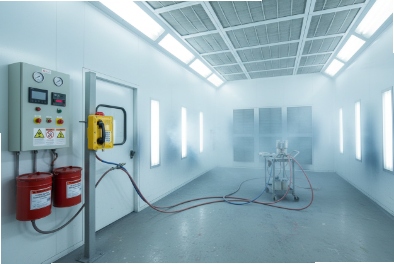
Paint shops look controlled, but solvent vapor and overspray can change the risk level in minutes. A non-rated phone can fail inspection, and a phone that cannot survive cleaning becomes a weekly maintenance ticket.
Yes. Explosion-proof SIP telephones are suitable for paint and coating shops when the Ex rating matches spray/flash-off zoning, seals and materials resist solvents and overspray, and installation uses certified flameproof glands, bonding, and the correct T-class.
Paint shop selection is about zoning, solvent chemistry, and daily cleaning reality
Paint and coating shops create shifting vapor zones
Unlike a steady-state process unit, paint shops shift between:
-
spraying periods with active aerosol and solvent vapor 1
-
flash-off and drying periods with high solvent evaporation
-
cleaning and purge cycles
-
maintenance where covers open and ventilation may be altered
That means zoning is not only about “the building.” It is about specific areas:
-
inside spray booths 2
-
flash-off tunnels and rooms
-
paint mix and solvent storage rooms
-
solvent recovery or waste handling corners
-
areas around exhaust ducts and filter housings
The phone must be usable with PPE and noise
Paint shops are noisy and require PPE. Operators often wear:
-
gloves and respirators
-
hearing protection
-
anti-static clothing and footwear
So the phone should be:
-
simple to use (hotline and SOS key)
-
loud enough or paired with beacons and PAGA horns
-
easy to clean without damaging seals
Selection must include the full installation system
Most failures and inspection findings come from:
-
wrong glands or missing seals at cable entries
-
poor bonding and static control
-
wrong T-class in warm, enclosed areas
-
incorrect placement inside a stricter zone than expected
A “paint shop phone” should be specified as a package: phone + certified glands + bonding instructions + cleaning compatibility.
A quick paint shop spec map
| Area | Main hazard driver | Practical phone target | Notes |
|—|—|—|—|
| Spray booth perimeter | high vapor + overspray | Zone 1 / Div 1 by study | place outside booth if possible |
| Flash-off zone | solvent evaporation | Zone 1 or Zone 2 depending on ventilation | check Ta and T-class |
| Mixing room | open solvents and transfers | Zone 1/2 by layout | add chemical-resistant seals |
| General corridor | abnormal vapor only | Zone 2 / Div 2 or rugged phone | easiest for call points |
This keeps the project grounded: correct rating first, then durability and integration.
Next, the key compliance question: what ratings fit spray and flash-off zones?
Which Zone 1/2 or Class I Div 1/2 ratings fit spray/flash-off zones?
Spray areas can be one of the most stringent hazardous spaces in a factory because solvent vapor and aerosols are present during normal operation. Flash-off zones 3 can also be classified if ventilation does not keep vapors below defined thresholds.
Many paint spray and flash-off areas require Zone 1 (EPL Gb) or Class I Div 1 near active spraying and solvent evaporation, while surrounding areas may be Zone 2 (EPL Gc) or Class I Div 2 depending on ventilation and enclosure. The final rating must follow the facility’s hazardous area classification for spray booths, flash-off tunnels, mixing rooms, and exhaust/filter areas.
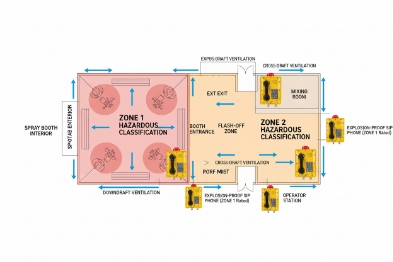
Practical guidance by paint shop area
| Paint shop location | Why vapors exist | Safer starting requirement |
|—|—|—|
| Near spray booth openings | solvent vapor + aerosol during normal work | Zone 1 Gb / Div 1 |
| Inside flash-off tunnel | evaporation peaks after spraying | Zone 1 or Zone 2 per ventilation study |
| Paint mixing and solvent handling | open container transfers | Zone 1/2 by layout |
| Filter housings/exhaust plenums | vapor transport and deposits | zone per study, often conservative |
Gas group selection: follow the solvent list
Gas group 4 and T-class must match the solvents used:
-
many coating lines use mixed solvents across products
-
the worst-case solvent can govern the group requirement
-
owners often standardize to reduce mistakes across booths
The best practice is to tie the phone requirement to:
-
the solvent SDS list 5 for the shop
-
the area equipment schedule issued by the safety team
Temperature class and ambient range matter more than people expect
Flash-off zones and enclosed booths can be warm. If the phone is mounted near lighting, ducts, or heated air, local ambient can rise. A device can be rejected if:
-
the T-class is not strict enough for the area schedule
-
the Ta range is too narrow for shop conditions
With rating selected, the next question is durability. Paint shops attack equipment with overspray, solvents, and cleaning.
Will IP66/67, solvent-proof seals survive overspray and cleaning?
Paint shops kill seals. Overspray builds up. Solvents attack elastomers. Cleaning routines can force water and chemicals into small gaps.
Yes. IP66/IP67 enclosures can survive paint shop conditions when gaskets, keypad materials, and cable entry seals are compatible with the solvents used, and when the device is installed with the correct glands and maintained without damaging sealing faces.
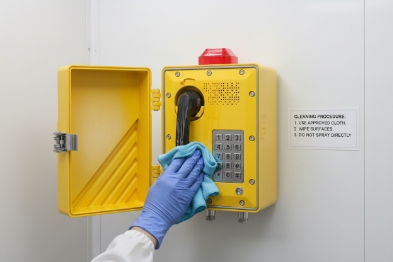
IP66 vs IP67 in paint shops
-
IP67 adds protection against temporary immersion and long exposure to pooled water.
Many coating lines choose IP66 as baseline and use IP67 in:
-
low mounting points
-
areas with frequent deep cleaning
-
places where hoses point directly at devices
Solvent-proof is not a label, it is a compatibility requirement
Instead of asking for “solvent-proof,” it is safer to request:
-
gasket and keypad material compatibility with the site solvent list
-
resistance to cleaning agents and degreasers used in booths
-
stable label/window materials that do not haze or crack
Overspray: protect the interface
-
block key travel
-
foul hookswitch movement
-
cloud windows and indicators
-
create sticky surfaces that collect dust
A practical design uses:
-
sealed keymat
-
smooth faceplate geometry for easy wipe-down
-
minimal crevices
-
optional protective hood or recess mounting where allowed
| Paint shop exposure | What fails first | Better requirement |
|—|—|—|
| Solvent vapor | gasket swelling | chemical-resistant seals |
| Overspray buildup | keypad and hookswitch | sealed keymat + protected cradle |
| Cleaning jets | glands and seams | IP66/67 + correct entry system |
| Warm air | Ta limits | wide Ta range and placement discipline |
Once the phone survives the environment, it must integrate with the shop’s voice and alarm systems. Paint shops often use horns, beacons, and E-stops at booth exits.
Can phones integrate with IP PBX, PAGA horns, beacons, and booth E-stops?
A paint shop emergency response depends on quick paging and visible signals because workers wear PPE and noise is high.
Yes. Ex SIP telephones can register to an IP PBX for hotline and group calling, trigger PAGA horns via paging servers or controller inputs, activate beacons through relay outputs, and interface with booth E-stop workflows via PLC or safety I/O—without being wired into the E-stop safety loop itself.
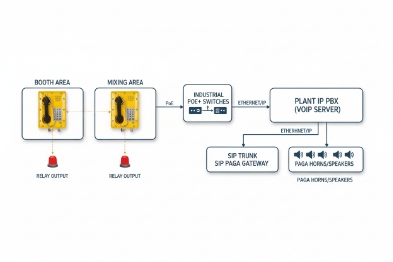
PBX integration: emergency routing and logs
PBX features that help in paint shops:
-
one-touch hotline to the line leader or control room
-
escalation if no one answers
-
call logs aligned with NTP for incident review
-
role-based call permissions if needed
PAGA horns: keep paging stable under load
Two stable methods:
-
multicast paging 8 with VLAN/QoS and IGMP snooping
-
relay trigger to a horn controller input for predefined tones
The relay-trigger pattern is popular for alarm tones because it is simple and predictable.
Beacons and strobes: improve visibility through PPE and smoke
A phone relay output can trigger:
-
a local strobe at the call point
-
a beacon controller input that drives multiple indicators
-
a horn + strobe combo controller for a zone
E-stops: safety integrity first
E-stops 9 are safety functions. The phone should not be in series with the E-stop loop. The safe model is:
-
E-stop drives safety shutdown through safety relays/PLC
-
phone receives an input to indicate “E-stop active” and auto-call dispatch
-
phone provides a relay output to signal “call point active” to a PLC input
| Need | Best interface | What to test |
|—|—|—|
| Emergency call | SIP hotline | call setup during busy network |
| Alarm tone | paging group or relay trigger | priority paging vs routine calls |
| Visible alert | relay to beacon controller | latching and reset behavior |
| E-stop awareness | PLC I/O mapping | event-to-call latency and logs |
Integration works best when voice has its own VLAN and QoS, and paging multicast is controlled so it does not flood the plant network.
Finally, safe operation depends on installation: flameproof glands, grounding, and the right T-class. This is where audits focus.
What flameproof glands, grounding, and T-class ensure safe operation?
In paint shops, inspectors and auditors pay close attention to cable entries and bonding because solvents and static make these areas sensitive.
Safe operation requires certified flameproof (Ex d/Ex db) glands that match cable type and the device certificate, robust equipotential bonding to control static and surges, and a T-class (plus Ta range) that remains compliant in warm, enclosed spray/flash-off environments.
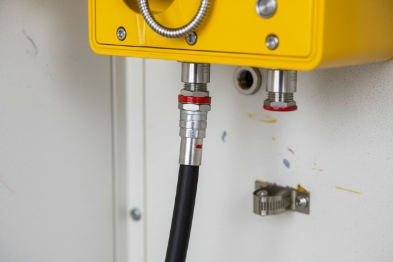
Flameproof glands: match cable build and certificate conditions
For Ex d enclosures, the gland system must be:
-
certified for the same protection concept and zone level
-
matched to armored or unarmored cable
-
sized for the actual cable OD
-
sealed per the certificate conditions (barrier sealing where required)
Paint shops often have frequent maintenance. So the gland choice should also support repeatable re-termination without losing sealing integrity.
Grounding and bonding: control static and noise
Static control in paint areas is critical. A compliant installation includes:
-
a short bond from the phone earth stud to the local equipotential bar 10
-
corrosion-resistant lugs and hardware
-
continuity checks recorded during commissioning
-
shield termination rules for Ethernet that avoid ground loops
Bonding also improves surge behavior, which matters in long cable runs across a large paint facility.
Paint shops can run warm. Flash-off tunnels and enclosed booths can push local ambient higher than the general building temperature. The selection method should be:
-
follow the area equipment schedule required T-class
-
verify phone nameplate T-class and Ta range
-
avoid placing the phone near hot ducts, lights, or heated air outlets
Audit-ready checklist
| Audit item | What passes | Common failure |
|—|—|—|
| Ex marking | zone/div, group, T-class, Ta | missing Ta or wrong T-class |
| Cable entry | certified glands and plugs | industrial glands or open entries |
| Bonding | short equipotential bond | paint under lug, no continuity record |
| Cleaning compatibility | documented materials | seals swell or crack over time |
| Functional tests | hotline + paging + relay test | no proof of workflow under load |
A paint shop project becomes smooth when the buyer requests this checklist upfront. It avoids late-stage rework and keeps the emergency communication path reliable after cleaning cycles.
Conclusion
Explosion-proof SIP telephones suit paint and coating shops when spray/flash-off zoning drives correct Zone/Div and T-class selection, IP66/67 and solvent-compatible seals handle overspray and cleaning, integrations support PBX/PAGA/PLC workflows, and certified glands and bonding pass audits.
Footnotes
-
Hazards associated with volatile organic compounds in industrial settings. ↩
-
Controlled enclosed environments designed for spray painting operations. ↩
-
Areas where solvents evaporate from coatings between application layers. ↩
-
Classification of gases based on their ignition properties. ↩
-
Documents providing detailed information on chemical properties and hazards. ↩
-
Standard defining protection levels against dust and water jets. ↩
-
Paint particles that miss the target and settle elsewhere. ↩
-
Efficient network transmission method for mass notification systems. ↩
-
Emergency mechanisms designed to shut down machinery immediately. ↩
-
Common grounding point ensuring equal voltage potential across systems. ↩








