
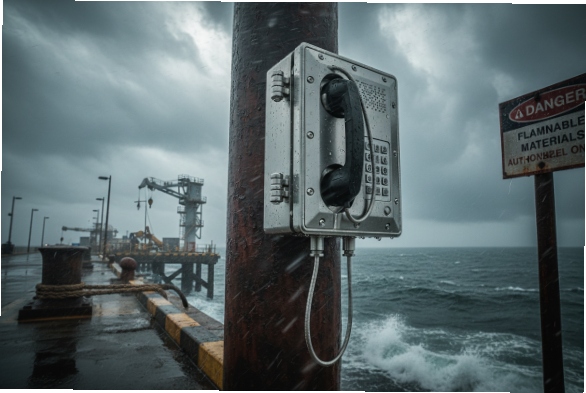
Salt spray and storms do not forgive weak hardware. One corroded gland or one flooded keypad can leave a pier without emergency calling.
Yes. Explosion-proof SIP telephones are suitable for seaside piers and terminals when Ex certification matches the hazard zone and the build is truly marine-grade: 316L/NEMA 4X or better, IP66/IP67 sealing, correct glands, and lightning-aware grounding.
Coastal terminals demand a “corrosion + uptime” design, not only an Ex label
Start with the two-layer requirement: hazardous approval + marine survivability
On a pier or terminal, “explosion-proof” solves only one part of the problem: ignition control in a classified area. The coast adds the bigger day-to-day killer: chloride corrosion plus wind-driven water. A phone that is perfect for a refinery can still die early on a dock if the cable entry is plated brass, if the bracket is mild steel, or if the keypad edge traps salt paste.
A good coastal specification treats the phone as a complete station:
-
the Ex marking matches your Zone/Div map (if the terminal handles fuels or chemicals),
-
the enclosure survives salt spray, UV, and hose-down,
-
the cable, gland, and connectors are marine-grade,
-
and the network has surge and lightning protection for long exposed runs.
Build the station around service reality
Piers are maintained by people wearing gloves, working in wind, and often doing fast repairs at night. The station should be easy to wash, easy to inspect, and hard to loosen. A sealed keypad, big call button, and bright visual indicators reduce failed calls. A bracket that allows a quick handset replacement without fighting seized screws is also a real win.
A fast “fit for pier” checklist
| Station element | Minimum that works | Better for long coastal life |
|---|---|---|
| Housing | 316L 1 stainless or NEMA 4X 2 enclosure | 316L + marine coating/passivation + smooth finish |
| Sealing | IP66 3 dust/water jet protection | IP66/IP67 + sealed keypad + protected acoustic membrane |
| Cable entry | certified gland matched to Ex concept | 316 stainless gland + strain relief + sealed plugs |
| Cabling | outdoor-rated jacket | tinned copper + UV/oil resistant marine jacket |
| Surge/lightning | basic grounding | bonded network + SPDs + fiber isolation where possible |
A coastal station is “suitable” when it stays compliant and still works after a year of storms and salt fog. The next sections break down the exact choices that decide that outcome.
Do 316L/NEMA 4X, IP66/IP67 housings resist salt spray, UV, and storms?
Salt air attacks seams and small parts first. If seals and plastics are weak, the phone becomes a maintenance item instead of a safety tool.
316L and NEMA 4X-style enclosures, paired with IP66/IP67 sealing, are strong baselines for docks because they address hose-directed water, windblown rain, and corrosion exposure. Long life still depends on UV-stable parts and salt-trap-free geometry.
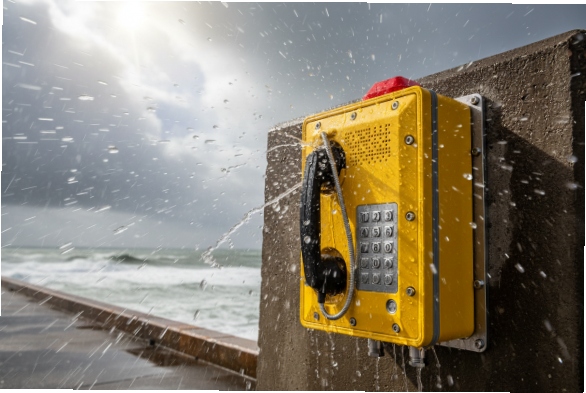
What NEMA 4X and IP66/IP67 really protect against
NEMA 4X is widely used as a coastal target because it is intended for outdoor use and adds corrosion resistance expectations, with protection against water such as hose-directed spray and weather exposure. IP66/IP67 helps by keeping dust out and blocking water jets (IP66) and temporary immersion (IP67). Together, they cover the most common dock conditions: wind-driven rain, wave splash, and washdown.
Still, the coast adds two hidden stressors:
-
UV + heat that ages keypad films and labels
-
wet-dry salt cycling that concentrates chlorides in crevices
So a “marine-ready” phone needs:
-
UV-stabilized 4 keypad membranes and windows
-
smooth faceplates that do not trap salt paste
-
protected mic/speaker membranes that are easy to rinse
-
stainless fasteners that do not seize during service
Marine coatings and finish details that matter
A coating can help, but the wrong coating can also chip and trap salt underneath. In practice, a smoother stainless finish plus fewer crevices often beats thick paint on complex geometry. If a coating is used, it should be a true marine system applied with proper surface prep.
A durability table that helps spec writing
| Exposure on piers | Common failure | Better product detail |
|---|---|---|
| Wind-driven rain + washdown | water tracks into seams | controlled gasket compression + correct fastener torque |
| UV + sun | membrane cracks, labels fade | UV-stable parts + laser marking/metal label |
| Salt paste in crevices | pitting at bracket edges | smooth finish + reduced crevice design + stainless bracket |
| Splash + immersion events | flooded entry path | IP67 entry strategy + downward entry + drip loop |
A phone that meets these details will handle storms better and stay readable and usable under glare and salt film.
Now the next question is what usually decides the real service life: glands and cable.
Are marine-grade glands and tinned copper cabling required on docks?
Many dock phone failures are not “phone failures.” They are entry and cable failures that kill the network first.
Marine-grade glands and tinned copper cabling are strongly recommended on docks, and often effectively required by owner standards, because plain copper and standard connectors corrode quickly in salt spray and cause intermittent faults.
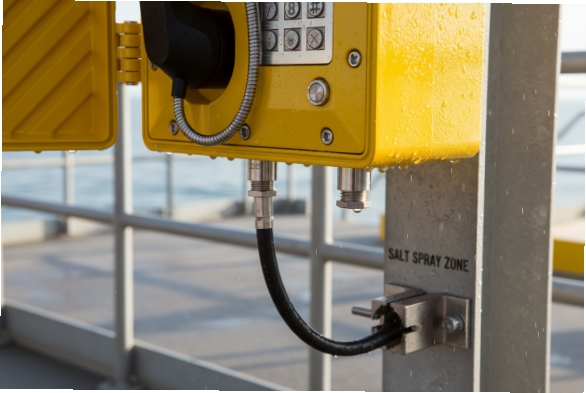
Why glands matter more than the housing
On a pier, the cable entry sees the worst combination: salt spray, mechanical movement, and thermal cycling. Plated brass glands can pit and seize. Mixed-metal adapters can set up galvanic corrosion. Once the gland loses sealing pressure, moisture enters and the station starts to “randomly” drop.
A marine-first gland strategy usually includes:
-
316 stainless glands and stopping plugs
-
correct insert for the exact cable outer diameter
-
strain relief close to the entry so the cable never pulls the gland
-
downward-facing entry or a small hood
-
sealing all unused entries with certified plugs (same protection concept)
If the phone is Ex d, select glands that match the flameproof concept and certificate conditions. If the phone is Ex e / Ex ec, match the increased safety requirements. The gland is part of compliance, not an accessory.
Why tinned copper is the dock baseline
Salt and moisture creep into stranded conductors. Tinned copper resists corrosion better than bare copper strands. Many marine wiring practices reference ABYC 5-style expectations and UL 1426-type marine wire, which is common in harsh marine applications. For long pier runs, tinned conductors reduce green copper oxide buildup and reduce long-term voltage drop issues.
A practical cable choice for docks
For PoE/SIP endpoints on exposed piers, a strong baseline is:
-
UV-resistant jacket rated for outdoor use
-
corrosion-resistant conductor (tinned copper preferred)
-
gel-filled or water-block options for wet ducts (when needed)
-
shielded cable when heavy motors and VFDs are nearby
-
armored or conduit protection in traffic zones
| Dock wiring item | Minimum that survives | Better for terminals |
|---|---|---|
| Ethernet/PoE cable | outdoor UV jacket | marine-rated tinned copper + water-block option |
| Terminations | standard RJ45 | sealed M12 or protected RJ45 in a sealed box |
| Glands | general IP gland | 316 stainless certified gland matched to Ex concept |
| Strain relief | none or loose clamp | fixed clamp within short distance of entry |
| Junction points | open splices | sealed junction box with corrosion-rated terminals |
When cable and glands are correct, the phone stops “mysteriously” dropping offline after storms.
Next is integration. On terminals, a phone is rarely just a phone. It is part of paging, alarms, and often radio workflows.
Can phones tie into IP PBX, PAGA horns, beacons, and VHF interfacing?
A pier needs fast voice, loud paging, and clear escalation. In bad weather, people rely on horns and strobes more than ringers.
Yes. Ex SIP phones can register to an IP PBX, trigger and receive PAGA paging, drive beacon workflows through PLC/alarm modules, and interface to VHF via radio gateways or dispatch consoles that bridge SIP audio to radio.
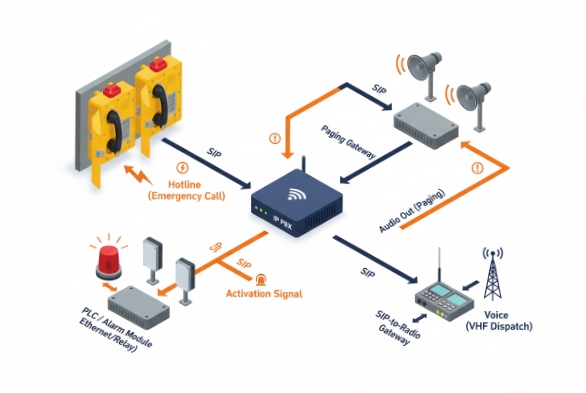
IP PBX: keep call paths short and location-clear
Dock operations need “one action” calling. The PBX 6 setup should favor:
-
hotline keys to operations, security, and EHS
-
ring groups with escalation (no single point of failure)
-
station names that match pier maps (“Pier 2 Loading Arm South”)
-
auto-recovery after PoE bounce
This reduces time lost during emergencies and makes drills consistent.
PAGA horns and paging: the real alert layer on open decks
Wind and distance reduce normal ring audibility. PAGA 7 horns solve that. A clean pattern is:
-
PBX sends SIP paging to a paging gateway that feeds amplifiers and marine horns
-
paging zones follow pier layout (berth zones, gate zones, terminal yard zones)
-
emergency paging priority overrides routine announcements
For storm conditions, it helps to confirm horn output and strobe visibility at real worker positions on the pier.
Beacons and strobes: let PLC own switching
A phone should not directly power high-current strobes in the field. A better method:
-
phone button or relay triggers a PLC input
-
PLC drives beacon circuits and logs events
-
PBX triggers callouts and paging messages
This keeps safety logic deterministic and serviceable.
VHF interfacing: bridge, do not “mix”
VHF is still common for marine operations. SIP-to-radio bridging is typically handled by:
-
a radio gateway that converts SIP audio to radio PTT and receive audio
-
a dispatch console system that bridges talk groups
-
an analog interface device where approved
A good dock workflow keeps radio rules intact while allowing a SIP station to reach dispatch who can then transmit on VHF.
| Integration need | Best owner system | Typical method |
|---|---|---|
| Emergency call | IP PBX | hotline + ring group + location ID |
| Area warning | PAGA/paging | SIP paging gateway to horns |
| Visual alerts | PLC/alarm panel | PLC drives strobes, phone triggers event |
| VHF coordination | radio gateway/console | SIP-to-radio bridge with PTT control |
Once integration is planned, the last big risk on piers is lightning and surge. Long outdoor runs on metal structures are a perfect antenna for surges.
What lightning protection and grounding meet coastal codes?
Lightning does not need a direct hit. Induced surges can still kill PoE ports and phones across a pier.
Use a bonded grounding system, surge protective devices on power and data where appropriate, and pier-appropriate practices aligned with NFPA 780 concepts and NEC grounding/bonding rules. In marinas and docking facilities, NEC Article 555 requirements also affect electrical design around docks.
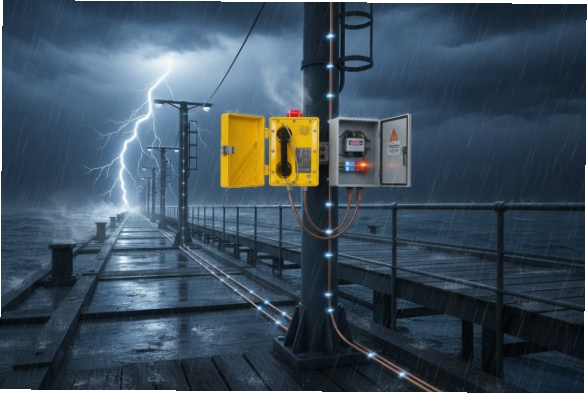
Grounding and bonding: one equipotential story
The most important lightning rule is simple: reduce potential differences during a surge. NFPA 780 8 focuses on safeguarding against lightning hazards, and NEC 9 rules call for bonding lightning protection system grounds to the building/structure grounding electrode system. On a pier, that means bonding metal structures, equipment cabinets, and cable shields into a coherent equipotential network.
A common failure is “isolated grounds” on different pier segments. During a surge, those segments rise to different potentials and the data cable becomes the equalizer. That destroys Ethernet ports.
Data and PoE surge protection strategy
A practical pier strategy uses layers:
-
fiber backbone to the pier where possible (breaks the electrical path)
-
surge protection at the pier entry cabinet on power feeds
-
PoE/data protectors on copper runs that remain exposed
-
shielded cable bonded correctly at the right points (avoid random shield grounding)
The clean goal is to give surge energy a preferred path to the bonding system instead of through the endpoint.
Docking facility code context
For marinas and docking facilities, NEC Article 555 10 covers key safety requirements for dock electrical systems, especially around ground-fault protection and disconnecting means. Even if the SIP phone system is not shore power, it often shares routes and cabinets. So the phone design should respect the same corridor, cabinet, and bonding discipline used for dock electrical infrastructure, and it should be reviewed with the site electrical authority.
A lightning and grounding table for practical design reviews
| Risk point | What goes wrong | Better control |
|---|---|---|
| Long copper runs on pier | induced surges on data/PoE | fiber where possible + SPDs at boundaries |
| Separate grounds on segments | Ethernet becomes bonding path | single equipotential bonding strategy |
| Cabinet entry points | surge enters through power feed | panel SPDs + correct bonding to electrode system |
| Poor shield handling | noise and surge coupling | consistent shield bonding practice |
| Storm maintenance | corrosion loosens lugs | inspection and torque schedule for bonds |
When grounding and surge protection are designed as part of the pier infrastructure, Ex SIP phones stay online after storms instead of becoming the first casualty.
Conclusion
Explosion-proof SIP phones fit seaside piers when Ex compliance, marine corrosion control, tinned wiring, and lightning-aware bonding are engineered together, not purchased as separate parts.
Footnotes
-
A low-carbon version of 316 stainless steel, highly resistant to corrosion and widely used in marine applications. ↩
-
A standard defining enclosure types for electrical equipment, where Type 4X indicates protection against corrosion, windblown dust, and rain. ↩
-
Ingress Protection rating indicating an enclosure is dust-tight (6) and protected against powerful water jets (6). ↩
-
A material property that prevents degradation such as chalking or cracking when exposed to ultraviolet radiation from the sun. ↩
-
American Boat and Yacht Council, setting safety standards for the design, construction, equipage, repair, and maintenance of boats. ↩
-
Private Branch Exchange: A telephone system that switches calls between users on local lines while allowing all users to share external phone lines. ↩
-
Public Address/General Alarm: A system used to broadcast voice messages and alarm tones in industrial and marine settings. ↩
-
Standard for the Installation of Lightning Protection Systems. ↩
-
National Electrical Code: A standard for the safe installation of electrical wiring and equipment in the United States. ↩
-
The section of the National Electrical Code that covers Marinas, Boatyards, and Commercial and Noncommercial Docking Facilities. ↩








