
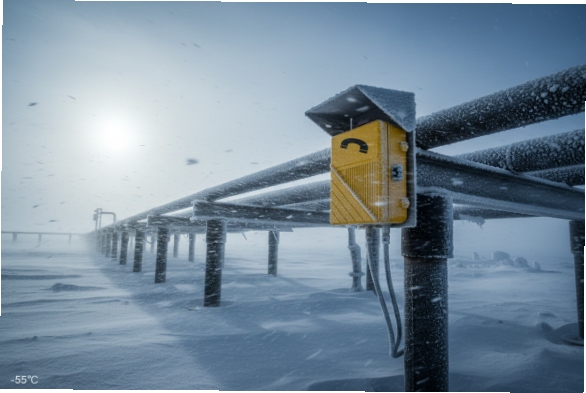
Arctic cold turns small gaps into leaks and normal plastics into brittle parts. If an emergency phone fails, crews lose the fastest way to call for help.
Yes. Explosion-proof SIP telephones can be suitable for severe cold regions if the Ex certificate covers the true ambient range (like −40/−55 °C), icing is managed, and cabling, glands, and gaskets are selected for arctic service.
What changes in severe cold deployments?
Cold attacks mechanics first, then electronics
In my experience, “cold failures” usually start outside the PCB 1. Gaskets shrink, keypad edges lift, and cable jackets stiffen. Then moisture sneaks in during a thaw, and the next freeze locks it into ice. After that, the device may still power up, but audio and keys become unreliable.
Ice forms where warm air meets cold metal
A phone on a cold pole can form ice even on a dry day. Warm breath from a user can freeze on the mic port. Wind-driven snow packs into seams. If the handset cradle fills with ice, the hook-switch may not release. So a cold-region phone needs a design that avoids ice traps, not only a low-temperature rating.
Certification and compliance have one key line: Ta
For hazardous areas 2, the Ex marking often includes an ambient temperature range (Ta). A phone that is “tested to −40 °C” but only certified for −20 °C is a paperwork problem. A phone that is certified for −55 °C but installed with the wrong gland can also fail inspection. Arctic success needs both: correct certificate and correct installation.
Plan for maintenance with gloves and storms
A station can be technically perfect and still fail in real use if people cannot operate it with gloves. Big buttons, clear labels, and hands-free calling matter more in cold than in normal climates. A small personal note belongs here: one winter site had a beautiful stainless station, but the tiny keypad was useless with thick gloves. The next revision used a large emergency button and auto-dial. Response time improved on the first drill.
| Arctic risk | What it causes | Best practical control |
|---|---|---|
| Gasket shrink | leaks during thaw | low-temp gasket compound + controlled compression |
| Cable stiffness | cracked jacket, broken pairs | arctic-rated cable + correct bend radius |
| Ice buildup | stuck handset, blocked mic | anti-ice geometry + heater option + ice-safe cleaning |
| Condensation | corrosion, random reboots | sealed entries + desiccant upstream + conformal coating |
| Human factors | missed calls, slow response | big button + hands-free + clear indicators |
If the station is placed well and built as a system, severe cold becomes manageable. Next comes the most direct question: do −40/−55 °C electronics and door heaters actually keep calls reliable?
Do −40/−55 °C rated electronics and door heaters ensure call reliability?
Severe cold can make phones appear “dead” even when power is present. Keypads harden, speakers lose output, and LCDs get slow.
Low-temperature rated electronics are necessary, and certified heaters can help a lot, but reliability depends on the full thermal path: enclosure, seals, PoE power budget, and how ice and condensation are handled during warm-up cycles.
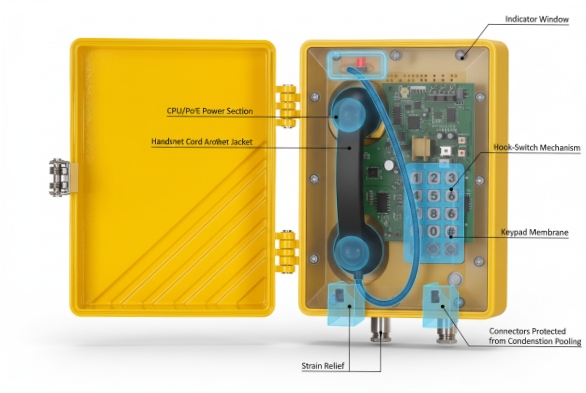
What the −40/−55 °C rating must cover
A real arctic rating should apply to:
-
keypad membrane and hook-switch parts
-
speaker and microphone components
-
cable strain relief and handset cord
-
any display or indicator window
If only the electronics are rated and the keypad is not, the phone still fails in daily use.
Heaters help, but they create two new rules
A heater can keep the inside above a safe threshold, so the keypad stays flexible and the mic does not ice as fast. Still, heaters in hazardous areas must be part of the certified design. Also, heaters can raise the phone’s surface temperature. That ties back to T-class. In other words, a heater can solve cold-start issues and still create a compliance risk if it pushes surface temperature beyond the allowed limit for the gas group.
So the arctic heater approach should follow three steps:
1) use only factory-certified heater options or certified accessories
2) size the heater for the enclosure volume and wind exposure
3) confirm the heater does not break T-class under worst-case ambient and fault conditions
Cold-start power and PoE reality
At very low temperature, power supplies can draw more current during start-up. Long cable runs also increase voltage drop. This matters with PoE. A good outdoor arctic design often keeps switches in a heated cabinet and uses shorter copper runs to endpoints, or uses fiber closer to the station and then short copper to the phone.
A simple commissioning test that catches most issues
-
leave the station unpowered at the coldest expected temperature
-
power it up and measure boot time, audio, and key response
-
place a test call with gloves on
-
trigger any indicators and confirm visibility in snow glare
| Control | Why it helps in −40/−55 °C | What to verify |
|---|---|---|
| Low-temp certification (Ta) | keeps compliance clean | Ex marking shows the ambient range |
| Certified heater option | improves usability and reduces icing | surface temperature stays within T-class |
| Heated cabinet for switches | stabilizes network and PoE | phones remain registered during cold snaps |
| Cold-start test | reveals weak parts fast | calls connect and audio stays clear |
A low-temperature rating and heater can deliver reliable calling, but only when they are treated as part of the whole system. Next is the physical fight with ice and brittleness: enclosures and handsets.
Will IP66/NEMA 4X enclosures and anti-ice handsets resist icing and brittleness?
Arctic sites punish seams and small parts. Wind packs snow into gaps, and ice locks moving parts in place.
Yes. IP66 sealing and NEMA 4X-style outdoor enclosures are strong baselines for severe cold, and anti-ice handset design reduces operational failures, but long-term success depends on low-temperature plastics, ice-tolerant mechanisms, and entry sealing that stays tight during thermal cycling.

IP and NEMA solve different parts of the problem
IP66 4/IP67 focuses on dust and water ingress resistance. It does not promise that a latch remains operable when ice forms. NEMA 5 Type definitions often include expectations around outdoor conditions like rain, snow, and external ice. For arctic builds, it helps to specify both: a high IP rating plus an enclosure type meant for outdoor ice and corrosion.
Anti-ice handset and cradle details that matter
The handset itself should avoid thin plastic that becomes brittle. A better arctic handset design uses:
-
thicker walls and impact-resistant material
-
a cord jacket that stays flexible at low temperature
-
a cradle shape that sheds snow instead of collecting it
-
a hook-switch that still works when a thin ice film is present
Hands-free call stations also perform very well in extreme cold because they remove the “handset iced to the cradle” failure mode. A single large emergency button and full-duplex audio can be more reliable than a handset in freezing rain.
Sealed keypad and labels must survive cold + UV
Cold and UV are a bad mix. A keypad membrane that is fine at −10 °C can crack at −40 °C after months of UV exposure. That is why arctic phones should use UV-stable materials, and labels should be engraved or laser marked instead of printed stickers.
Ice management is also placement
A station under a small hood, away from roof drip lines, and off the wind’s main direction gets less ice. A simple standoff bracket can also reduce ice bridging from a cold steel structure into the enclosure seams.
| Icing failure | What it looks like | Better design choice |
|---|---|---|
| Handset stuck | cannot lift or returns wrong | hands-free option or anti-ice cradle geometry |
| Mic blocked | speech sounds muffled | protected acoustic membrane and drain path |
| Keypad cracks | keys stop responding | low-temp UV-stable membrane and sealing |
| Latch frozen | service impossible | ice-tolerant hardware and maintenance grease plan |
Arctic enclosures can stay reliable, but the design must assume ice is normal, not rare. Next is the system layer: PBX, paging, and remote fault monitoring.
Can phones integrate with IP PBX, PAGA, and remote monitoring for faults?
In severe cold, the first symptom is often “phone offline,” not “phone broken.” Remote monitoring saves truck rolls and keeps safety coverage visible.
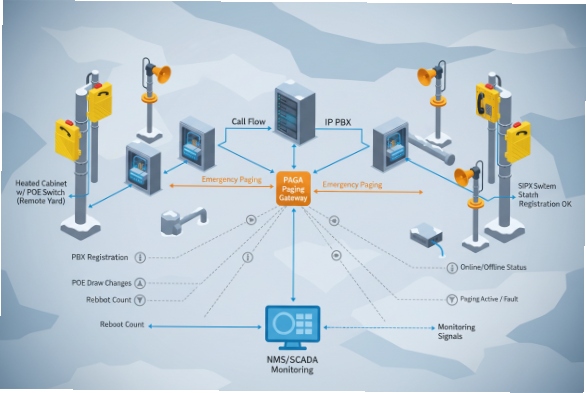
Yes. Ex SIP phones can integrate with IP PBX for calling, PAGA for paging to horns and speakers, and remote monitoring through network management (online status, registration state, PoE alarms) and optional I/O for fault indications.
IP PBX: keep the call flow simple
Arctic sites need simple actions because gloves, wind, and noise make complex dialing slow. A clean PBX 6 design uses:
-
hotline auto-dial to the control room
-
ring groups with escalation
-
location-based naming that matches the site map
-
optional auto-answer paging for emergency announcements
For remote yards, a survivable call strategy matters. If the WAN drops, local calling should still work where possible, or the station should fall back to a local gateway.
PAGA: paging is often the primary alert in storms
When visibility is low, horns and beacons are the most reliable attention tools. A SIP 7 phone can:
-
trigger a paging call via PBX or dispatch
-
receive and replay a paging message locally
-
integrate with paging gateways that drive marine horns and speaker circuits
Priority rules should be tested. Emergency paging should override routine paging. Emergency calls should not be blocked by paging audio.
Remote monitoring: watch the right signals
A practical monitoring list for cold sites includes:
-
device online/offline status (ping and SNMP 8 where supported)
-
PBX registration state
-
PoE power draw changes (a heater failure can show up as a sudden drop)
-
reboot counts and uptime
-
input status for door open, fault relay, or local alarm
This monitoring can feed the site SCADA 9 or a simple NMS 10 dashboard. The goal is to see a station degrade before it becomes a blind spot.
| Need | Best owner system | What to implement |
|---|---|---|
| Emergency voice | IP PBX | hotline + ring group + location ID |
| Site-wide alert | PAGA/dispatch | paging to horns, priority rules |
| Fault visibility | NMS/SCADA | SNMP/online checks + registration status |
| Maintenance triggers | CMMS workflow | alarms create tickets automatically |
Integration is the easy part when the physical layer is stable. The hard part is still the field build: arctic cable, glands, and de-icing practices.
What arctic cabling, gasketing, and de-icing practices are required?
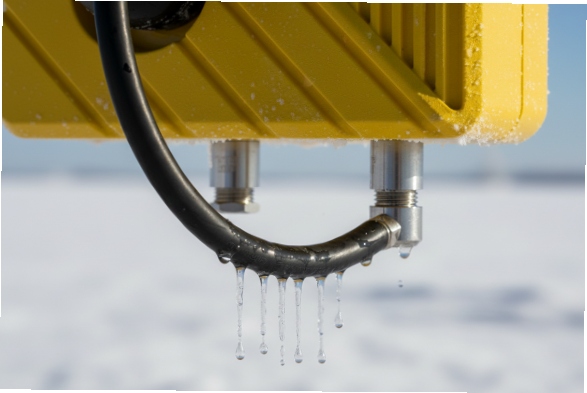
Many arctic “device failures” are actually cable failures. The phone is fine, but the jacket cracks, water enters, and the link dies.
Use arctic-rated cabling with cold-bend performance, low-temperature gasket compounds, certified glands matched to the protection concept, and de-icing practices that avoid damaging seals or voiding Ex integrity.
Arctic cabling: jacket choice matters
A cold-rated Ethernet or multi-pair cable should state:
-
minimum operating temperature and cold-bend performance
-
UV resistance for outdoor exposure
-
oil and chemical resistance if the site has hydrocarbons
-
mechanical protection needs (armored or conduit)
Cold-bend is important because installers bend cable at low temperature. A cable that passes cold-bend testing is less likely to crack during installation and vibration.
Glands: match Ex concept and keep water out
In hazardous locations, cable glands must match the protection concept (like Ex d or Ex e) and the cable type. In arctic sites, glands also need:
-
stainless bodies for corrosion resistance
-
inserts that remain flexible at low temperature
-
correct torque and thread engagement
-
certified stopping plugs for unused entries
A gland that seals at +20 °C can loosen after repeated thermal cycling. That is why arctic installs should include a torque check schedule.
Drip loops and routing: the cheapest reliability upgrade
A drip loop just before entry stops meltwater from tracking into the gland. It should be standard practice in snow and freezing rain zones. Routing should also avoid:
-
cable runs directly under drip lines
-
low points where water pools and refreezes
-
tight bends at the station entry where the jacket is stiffest
Gasketing and service practice
Gaskets must stay elastic in deep cold. Silicone and fluorosilicone are common low-temperature choices in many sealing applications, while some general rubbers become hard and leak. For service, it helps to:
-
clean ice with warm air or warm water where allowed
-
avoid metal tools that scratch flamepaths and sealing lips
-
use approved lubricants sparingly on external mechanisms
-
replace any cracked membrane or hardened gasket early
A field checklist that works in arctic maintenance
| Item | What to do | Why it extends life |
|---|---|---|
| Cable | use cold-bend rated cable, protect from impact | prevents jacket cracking and water ingress |
| Glands | stainless, certified, correct insert and torque | prevents leaks and inspection failures |
| Drip loop | form loop before every entry | stops meltwater tracking |
| Hood/shield | add small hood where wind-driven snow is heavy | reduces icing and UV exposure |
| De-icing | use gentle methods, no scraping | avoids seal damage and Ex risk |
| Inspection | seasonal torque and visual checks | catches loosening before failure |
Arctic deployment is not only a product choice. It is a discipline. When cable, glands, and de-icing routines are correct, Ex SIP phones become stable safety tools in severe cold.
Conclusion
Explosion-proof SIP phones work in severe cold when Ta and T-class are respected, icing is engineered out, and arctic cabling, glands, and maintenance routines are treated as part of the safety system.
Footnotes
-
Printed Circuit Board: A board that connects electronic components using conductive tracks, pads, and other features etched from copper sheets. ↩
-
Locations where fire or explosion hazards may exist due to flammable gases, vapors, mists, or combustible dusts. ↩
-
Power over Ethernet: A technology that passes electric power along with data on twisted pair Ethernet cabling. ↩
-
Ingress Protection rating indicating the enclosure is dust-tight and protected against heavy seas or powerful jets of water. ↩
-
National Electrical Manufacturers Association standards for electrical enclosures in North America. ↩
-
Private Branch Exchange: A private telephone network used within a company or organization. ↩
-
Session Initiation Protocol: A signaling protocol used for initiating, maintaining, and terminating real-time sessions. ↩
-
Simple Network Management Protocol: A standard protocol for collecting and organizing information about managed devices on IP networks. ↩
-
Supervisory Control and Data Acquisition: Systems used for monitoring and controlling industrial processes. ↩
-
Network Management System: An application that manages, monitors, and maintains a network. ↩








