
Single-homed SIP is a single point of failure. When the registrar drops, a hazardous-area phone can go silent at the worst moment.
Some explosion-proof SIP telephones support dual registrations or server redundancy, but behavior varies by firmware. The safe path is to specify the failover mode (concurrent vs successive), prove DNS SRV/keepalive features, and validate recovery in FAT.
Dual-registration and failover are real features, but they are not one feature
Dual registration vs “fallback” are different designs
Dual SIP registration can mean two different things:
-
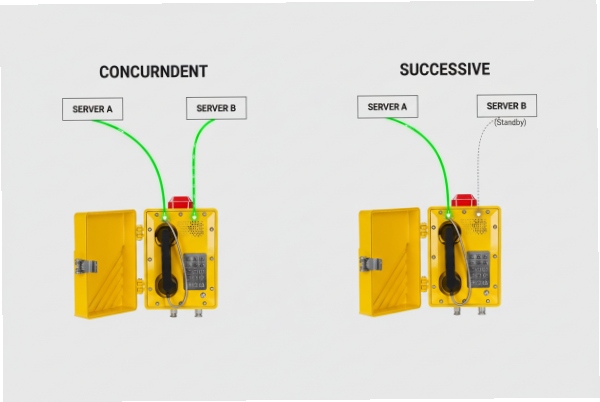
Concurrent registration: the phone registers to two servers at the same time and can move calls quickly if one fails.
-
Successive registration: the phone registers to the primary first, then tries the secondary if the primary fails.
Both can work. The difference matters because concurrent registration can conflict with some DNS-based recovery features in certain SIP stacks. Some vendors explicitly warn not to mix “dual registration” with other failover mechanisms unless the design is understood.
DNS SRV and SIP Outbound are separate layers
A phone can support DNS SRV for finding servers, yet still fail to keep a NAT binding alive. A phone can also support keepalives, but not fully implement SIP Outbound behaviors.
So I treat availability as a stack:
1) Discovery: DNS SRV/NAPTR logic and priority/weight handling
2) Registration: single, concurrent, or successive registration logic
3) Flow health: keepalive method and failure detection timers
4) Recovery: what happens after power loss, link flap, or DHCP change
A quick “what to ask before you buy” table
| Requirement | What to request in writing | What to prove in FAT |
|—|—|—|
| Dual registration | concurrent vs successive mode | live failover within a defined time |
| DNS SRV | SRV (and NAPTR if needed) behavior | phone resolves SRV and follows priority |
| Keepalive | OPTIONS / CRLF / UDP keepalive method | NAT binding stays open, inbound calls keep arriving |
| Recovery | retry timers + backoff behavior | stable re-registration after reboot/link loss |
If this structure is set early, the rest becomes a clean integration project instead of a guessing game.
The next sections answer the exact questions that usually decide success in a real refinery network.
A stable redundancy story keeps operators calm and makes audits easier.
Do dual SIP registrations exist on explosion-proof SIP telephones?
Dual registration is often requested, but not always implemented the same way. A checkbox in a web UI can hide big limitations.
Yes, some explosion-proof SIP telephones support two SIP accounts or two registration targets. The critical detail is whether they register concurrently to a primary and fallback server, or only switch after failure.
What “dual registration” may mean on the device
A vendor may describe dual registration as:
-
two SIP accounts (Line1/Line2)
-
one account with two registrars (primary/secondary)
-
one registrar plus one outbound proxy
-
DNS SRV list with failover
These are not the same feature. Two accounts can be useful for dispatch plus normal calling, but it may not create true registrar redundancy. True redundancy is about the same identity surviving a registrar failure.
What I specify as “pass criteria”
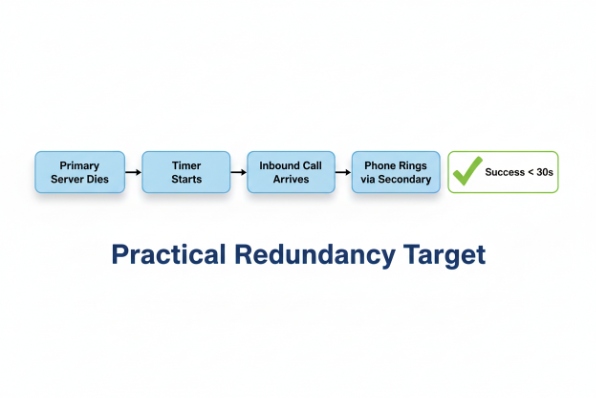
A practical redundancy target for hazardous-area phones is:
-
inbound calls still arrive within an agreed failover time after the primary registrar is unavailable
-
outbound calls succeed without manual reboot
-
when the primary returns, the phone either fails back cleanly or stays on secondary based on policy
The real limitation most teams miss
Some SIP stacks do not support all combinations at once. For example, a “dual registration” feature can conflict with DNS SRV fallback features, depending on how the phone handles recovery and re-registration timers.
A field-friendly validation table
| Mode | Strength | Weak point | Best use case |
|—|—|—|—|
| Concurrent registration | fast failover | can reduce advanced features on fallback | high-availability call handling |
| Successive registration | simple logic | slower failover window | small sites, low call volume |
| Two SIP accounts | flexible dial plans | not true redundancy unless designed | dispatch + admin lines |
| DNS SRV only | no extra config | depends on DNS, TTL, caching | clustered servers and SBC farms |
Dual registration can be a great tool, but it must match the SIP platform design. The next question is how failover actually triggers and whether it is automatic.
Can primary/secondary servers fail over automatically?
Many systems only fail over after a long timeout. Operators experience it as “dead air,” even if the phone is technically “redundant.”
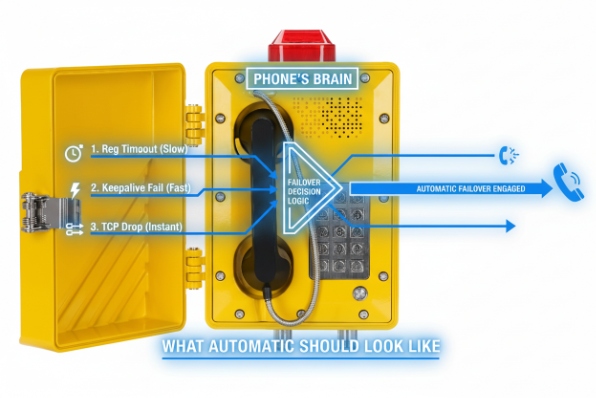
Automatic failover is possible, but only if the phone can detect a failed registration flow and has a defined retry/failover policy. DNS SRV can help discovery, and keepalives can help fast failure detection.
What “automatic” should look like on a phone
Automatic failover should be driven by:
-
registration failures (no response, auth reject, transport failure)
-
keepalive failures (OPTIONS no reply, CRLF flow failure, UDP keepalive strategy)
-
transport-level failure (TCP/TLS connection drop)
A robust device uses more than one signal. Relying only on registration expiry can make failover slow.
Timing matters more than marketing
A good failover spec states real numbers:
-
registration expiry time (for example 300–3600 seconds)
-
retry timer (for example 30 seconds)
-
maximum time to switch to secondary after primary failure (for example 30–90 seconds)
If the site has strict uptime needs, a survivable design usually places an SBC cluster or registrar cluster in front of the PBX, then phones register to the cluster name through SRV records.
A failover test that catches real issues
In FAT, I like this sequence:
1) Register the phone to primary and confirm inbound/outbound calls.
2) Drop the primary registrar network (hard down, not just a soft stop).
3) Measure time until inbound calls work again via secondary.
4) Place outbound calls during the transition.
5) Restore primary and observe failback behavior.
A simple failover acceptance table
| Test | Pass condition | What often fails |
|—|—|—|
| Primary outage | phone switches within target time | long “stuck registered” state |
| Inbound call during outage | call still arrives after failover | NAT binding expired |
| Outbound call during outage | call completes without reboot | DNS cache not refreshed |
| Primary return | stable failback or stable stickiness | flip-flop between servers |
If the phone cannot prove stable automatic failover under real network conditions, it should be treated as single-homed and protected with upstream redundancy.
Next is the DNS question, because many teams assume SRV means “full SIP server location support,” and that is not always true.
Are DNS SRV and SIP Outbound fully supported?
SRV is widely used, but implementation detail decides whether failover works. SIP Outbound is even more inconsistent across endpoints.
DNS SRV is commonly supported for locating SIP servers, but not every endpoint supports every part of the full DNS discovery path (like NAPTR). SIP Outbound (RFC 5626) is a specific behavior set that many enterprise stacks support on servers, but endpoints vary in real-world support.
DNS SRV: what to specify, not what to assume
I treat DNS SRV support as a checklist:
-
does the phone query SRV records for the SIP domain?
-
does it respect priority and weight order?
-
how does it cache results and for how long?
-
does it also support NAPTR when TLS discovery is required?
Some SIP implementations explicitly support SRV and A records but do not implement NAPTR lookups. That matters if the enterprise depends on NAPTR to steer transport selection.
SIP Outbound (RFC 5626): what it adds
SIP Outbound is not just “keepalive.” It is a full design that:
-
uses persistent connections initiated by the client
-
includes mechanisms for multiple flows to registrars
-
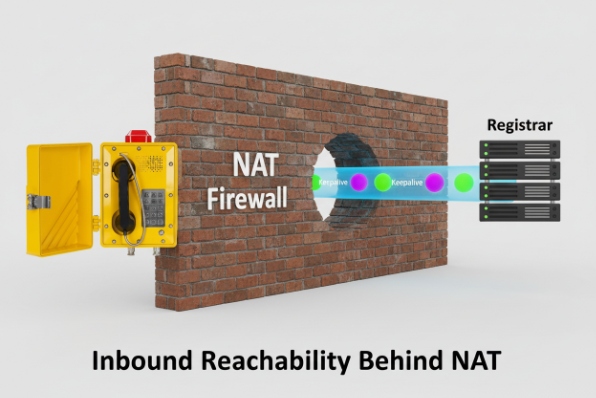
defines keepalive behavior to keep NAT bindings open
-
uses reg-id and instance-id concepts for routing to the right client flow
This can be powerful in remote sites behind strict firewalls. It can also be unnecessary if the network is simple and the registrar is reachable directly.
A practical way to write the requirement
Instead of asking “does it support SIP Outbound,” I ask:
-
does the phone maintain inbound reachability behind NAT?
-
which keepalive types are available (CRLF, OPTIONS, UDP keepalive, STUN)?
-
can it hold a TCP/TLS connection open and recover cleanly after drop?
A discovery and outbound table for procurement
| Feature | What it solves | What to request |
|—|—|—|
| DNS SRV | server discovery + simple failover | SRV order handling and cache behavior |
| NAPTR | transport discovery (TLS preference) | confirm if supported/needed |
| SIP Outbound | inbound reachability through NAT | proof of reg-id/flow behavior if claimed |
| CRLF keepalive | keep TCP/TLS flow alive | interval control and failure detection |
| OPTIONS keepalive | SIP-level heartbeat | interval and timeout control |
This approach avoids vague “supported” statements and pushes the vendor into testable commitments.
Now the real operational question: what happens after power loss or a network flap. This is where “dual registration” systems often behave badly.
Does registration persist across power or network recovery?
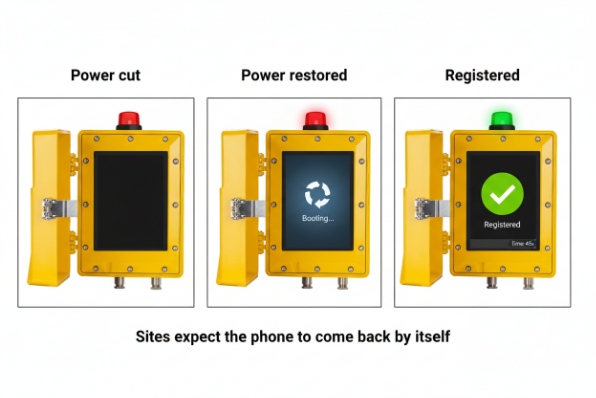
Sites expect the phone to “come back by itself.” A phone that needs manual reboot is not acceptable in remote ATEX areas.
Configuration should persist across power cycles, but SIP registration itself does not “persist” as a live state. After recovery, the phone must re-register, rebuild NAT bindings, and re-learn SRV targets if needed. The success depends on retry timers, DNS caching, and keepalive policy.
What should be stable across reboots
A well-designed Ex SIP phone should keep:
-
SIP credentials and server addresses
-
redundancy mode settings
-
keepalive settings
-
DHCP/static network settings
-
certificate material for TLS if used
That part is simple. The hard part is the live re-registration behavior under unstable networks.
What commonly breaks recovery in the field
-
DNS caching outside your control: the phone may resolve SRV, but the ISP or local DNS cache can delay changes.
-
Aggressive firewalls: TCP idle timers drop flows silently, so inbound calls stop until a keepalive runs.
-
Backoff behavior: a phone may increase retry intervals after failures, which slows recovery.
-
IP changes: after DHCP renewal, the phone must refresh registration and re-open NAT bindings fast.
How to force predictable recovery
I prefer a simple policy:
-
keep registration expiry moderate (not extreme)
-
set a clear retry timer
-
enable a keepalive that matches transport (CRLF for TCP/TLS, UDP keepalive for UDP, or OPTIONS if the platform wants SIP-level checks)
-
use DNS SRV with sane TTL, but do not rely on ultra-low TTL alone
A recovery FAT that protects commissioning
| Scenario | What to do in FAT | Pass condition |
|—|—|—|
| Power cycle | remove power, restore | phone re-registers and receives calls |
| Link flap | disconnect uplink 60 seconds | stable recovery without manual reboot |
| DHCP change | force DHCP renew | re-registration occurs cleanly |
| Registrar fail | stop primary registrar | phone moves to secondary and stays reachable |
If this is proven in FAT, onsite SAT becomes fast.
The last question is keepalive, because “enabled” is not enough. The keepalive type must match the transport and the SBC policy.
Is keepalive via SIP OPTIONS or CRLF enabled?
Keepalive is the difference between “works on day one” and “stops receiving calls after a few hours behind NAT.”
Many SIP stacks support keepalive, but the method varies: SIP OPTIONS pings, CRLF keepalives for TCP/TLS (as used in SIP Outbound behavior), or small UDP keepalive packets. The right choice depends on the registrar/SBC policy and the network path.
CRLF keepalive: best aligned with TCP/TLS flows
CRLF keepalive is a lightweight method used to keep connection-oriented SIP transports alive. It is described as part of RFC 5626 1 behavior, where a server responds to a CRLF keepalive on the existing connection. This is useful when firewalls drop idle TCP/TLS sessions.
SIP OPTIONS: a clear SIP-level heartbeat
OPTIONS is easy for SBCs and PBXs to monitor. It can also be used as a server health check. It has higher overhead than CRLF, but it is visible in SIP logs, which helps troubleshooting.
UDP keepalive: sometimes not “SIP” at all
Many endpoints send tiny UDP packets to keep NAT pinholes open. This can work well for remote phones, but it depends on firewall rules and is less visible in SIP traces.
How I choose keepalive in harsh networks
-
If the site uses TCP/TLS, I prefer CRLF keepalive or a TCP keepalive strategy aligned with SBC policy.
-
If the site uses UDP, I prefer UDP keepalive or OPTIONS, depending on what the registrar expects.
-
If the platform is strict about SIP-level monitoring, I use OPTIONS with clear intervals and timeouts.
A keepalive decision table
| Transport | Best-fit keepalive | Why it works |
|—|—|—|
| UDP | UDP keepalive or OPTIONS | keeps NAT mapping and shows health |
| TCP | CRLF or TCP keepalive | prevents silent idle-drop failures |
| TLS | CRLF + stable cert policy | keeps secure flow alive |
| Mixed/SBC-heavy | OPTIONS | easiest for monitoring dashboards |
Keepalive must be tested under loss and firewall timers
A FAT should include:
-
capture traffic for 30–60 minutes
-
confirm keepalive interval is as configured
-
confirm inbound calls still arrive after idle periods
-
confirm failover is not blocked by “stale” registrations
If the phone’s keepalive cannot be tuned, a network-side SBC can sometimes compensate, but it is better when the endpoint behaves predictably.
Conclusion
Dual SIP registration is possible on some Ex SIP phones, but it must be specified as a mode and proven in FAT. DNS SRV, keepalive type, and recovery behavior decide real uptime.
If you want a procurement checklist or a FAT template for your SIP platform, reach out:
Jason Mark — info@sipintercommanufacturer.com — www.sipintercommanufacturer.com (DJSlink)
Footnotes
-
IETF standard defining methods for managing client-initiated connections in SIP. ↩








