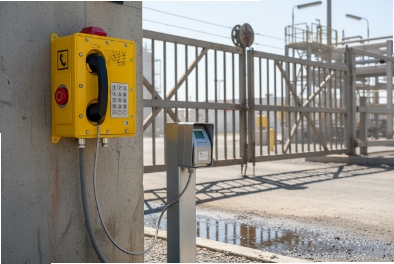

A hook switch looks small, but it decides whether calls start, end, and log correctly. In plants, one flaky hook event can create real downtime.
Yes, many explosion-proof telephones can use magnetic hook switches, usually a sealed reed or Hall sensor with a handset magnet. This improves sealing and reduces wear, but it must be specified for EMC, vibration, and certification scope.
Going magnetic without losing Ex and IP performance
Magnetic hook switches 1 are common in harsh environments because they remove the classic weak point: a moving lever that must pass through a sealing surface. A magnetic design keeps the “sensing” element inside the sealed enclosure, and it uses a magnet embedded in the handset or cradle area. When the handset is on-hook, the magnetic field changes. The phone reads that change as on-hook. When the handset is lifted, the field drops and the phone reads off-hook.
In real installations, hook switch issues are rarely about “does it work today.” They are about what happens after years of vibration, hose-down cleaning, and repeated calls. A mechanical micro-switch can wear, bounce, or stick. A magnetic reed switch 2 can also fail, but it usually fails for different reasons: over-current welding, wrong magnet distance, or stray magnetic fields near high-power equipment.
The strongest approach is to treat the hook switch as part of a complete system spec. The hook type, magnet grade, mounting gap, debounce logic, and EMC plan must match the site. This is also where Ex compliance matters. Even if a magnetic hook is technically better, it cannot be swapped freely. In Ex d or Ex e products, the hook circuit and its mechanical construction are part of the certified design. That means a “simple” change may require a controlled variant and updated documentation.
What controls long-term reliability
- No external lever penetration at the seal line
- Stable magnet-to-sensor gap across temperature and vibration
- Low current through reed contacts, with proper protection
- Firmware debounce that matches the handset movement profile
- EMC immunity so large motors and radios do not create false off-hook events
Quick comparison used in many tenders
| Hook switch type | Strength in hazardous plants | Typical weakness | Best use case |
|---|---|---|---|
| Magnetic reed | Fully sealed sensing, low wear | Sensitive to gap and magnetic noise | Outdoor IP66/67 endpoints, washdown areas |
| Hall sensor | No contact wear, stable switching | Needs power and proper filtering | High-cycle sites, smart diagnostics |
| Mechanical micro-switch | Simple and familiar | Wear, bounce, sealing complexity | Controlled indoor areas, lower washdown risk |
A magnetic hook is not automatically “better.” It is better when it is specified and tested for the real plant conditions.
What hook-switch types are available—magnetic reed vs. mechanical micro-switch—and which is more reliable in hazardous areas?
A phone can be certified and still feel unreliable if hook detection is noisy. Operators then lose trust and start using workarounds.
Explosion-proof telephones can use magnetic reed switches, Hall sensors, or mechanical micro-switches. In harsh hazardous areas, magnetic designs often win because they reduce moving parts and simplify sealing, while mechanical switches can still be strong in controlled environments.

Reliability is not only the switch itself. It is the full loop: handset motion, mounting stiffness, contact current, and sealing design. In hazardous plants, the most common failures are caused by vibration and water, not by “electrical defects.” That is why magnetic hooks are popular. The sensing element sits inside the sealed chamber. There is no external lever shaft, no boot that cracks, and no gap that grows over time.
A Hall sensor 3 is an electronic sensor that detects magnetic field changes. It has no mechanical contacts, so there is no contact wear. It can also provide more stable switching points and diagnostics. The tradeoff is that it needs power and correct filtering, and it should be protected from ESD and surges.
A mechanical micro-switch is familiar and can be very robust in clean environments. It gives a clear mechanical click and stable actuation when properly mounted. In harsh areas, the problems start when the lever is exposed to dirt, ice, or repeated impact, and when the sealing design must accommodate that moving part.
Selection guide based on site profile
| Site condition | Preferred hook type | Why it tends to work |
|---|---|---|
| Outdoor washdown, IP66/67 | Magnetic reed or Hall | Sealed sensing, fewer leak paths |
| High vibration (tunnels, offshore) | Hall or tuned reed + strong mount | Better stability with filtering and rigid geometry |
| Heavy EMI (VFD rooms) | Hall with filtering, or reed with strong hysteresis | Better immunity when specified correctly |
| Clean indoor control rooms | Mechanical micro-switch | Simple, low cost, easy service |
How are magnetic hook specs defined—operate/release Gauss, hysteresis, debounce, and EMC immunity?
A magnetic hook that is not specified is a gamble. It might work in the factory and fail near a motor starter or a radio room.
Magnetic hooks are specified by operate and release thresholds (Gauss), hysteresis, mechanical gap tolerance, firmware debounce time, and EMC immunity. Good specs prevent false triggers and make behavior repeatable across temperature and vibration.

The first spec is the switching threshold. For a reed switch, this is often described as “operate” and “release” sensitivity. For a Hall sensor, it is a field threshold and an internal switching curve. The goal is a clean on-hook/off-hook decision across manufacturing variation and field variation.
EMC immunity 4 is the other big factor. In plants, strong magnetic fields can exist near transformers, large motors, and high-current busbars. Radios also create noise that couples into wiring. A solid design uses:
- shielded routing inside the enclosure
- RC filtering and ESD protection on sensor lines
- stable ground reference on the mainboard
- firmware that rejects impossible rapid state changes
Magnet choice is part of the spec
Magnet strength changes with temperature and aging. Also, the magnet can crack if it is poorly mounted. A good spec states:
- magnet material and grade
- max temperature rating
- mechanical retention method inside handset/cradle
- corrosion protection if moisture is present
Do magnetic hooks maintain IP66/67 sealing and Ex d/Ex e certification without external levers?
A hook switch is a mechanical detail that can decide whether the enclosure stays sealed. It also can decide whether the delivered unit still matches the certificate scope.
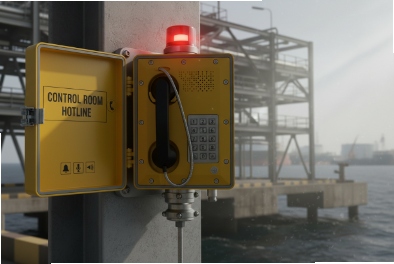
Magnetic hook switches can help maintain IP66/67 because sensing stays inside the enclosure and no external lever penetrates the seal line. Certification is still design-controlled: the hook method and its parts must match the certified construction, or be treated as an approved variant under ATEX/IECEx.

From a sealing view, magnetic hooks are a strong match for IP66/67 sealing 5 design goals. A mechanical lever often needs a shaft, boot, or moving interface. Even when that interface is well designed, it can become a long-term leak risk under hose-directed water, ice, and vibration.
From an Ex view, the rule is strict: the hook switch design is part of the certified product. Ex d and Ex e enclosures 6 have specific construction controls. Even if the hook does not “look important,” changing it can alter internal wiring routes and sealing interfaces.
Practical design details that protect both IP and Ex needs
- Keep the sensor and magnet fully inside the certified boundaries
- Avoid any external moving parts that can be used as pry points
- Use a captive handset cradle that does not distort the gasket line
- Keep wiring away from cover joints and flame paths
- Use strain relief so vibration does not pull sensor leads
Can magnetic hook events trigger SIP auto-dial, recording, or beacon relays via HTTP/SIP APIs?
A hook switch is more than a hang-up detector. In emergency workflows, off-hook can be a trigger for the whole response chain.
Yes. Off-hook/on-hook events can trigger SIP actions like hotline auto-dial, call recording start/stop signals, and paging. They can also trigger relay outputs for beacons and send HTTP API events, if the phone firmware supports event rules and the site security policy allows it.

In industrial VoIP, many deployments use “hotline” behavior. When the handset is lifted, the phone automatically calls a predefined number or group. This is common in refineries, tunnels, and emergency stations because it removes user steps. A magnetic hook is a clean trigger because it can detect handset lift reliably without relying on a mechanical lever that may stick.
Hook events can also support call recording workflows. Some systems start recording automatically when a call is established, but some want a local trigger or a “call start” event posted to a platform via an HTTP API 7. A phone that can send event hooks can:
- post an HTTP event when off-hook occurs
- post another event when the call connects
- post a final event when the handset returns on-hook
A simple event mapping used in many emergency stations
| Trigger | Condition | Action | Field value |
|---|---|---|---|
| Off-hook | handset lifted | auto-dial emergency group | faster emergency call |
| Off-hook | after X seconds no answer | retry or call backup group | higher response rate |
| In-call | call answered | turn on steady beacon | visual confirmation |
| On-hook | handset returned | stop beacon + send event log | clean closeout record |
Conclusion
Yes, magnetic hook switches are supported and often improve sealing and reliability. The key is correct Gauss specs, EMC filtering, and controlled certification variants. Contact info@sipintercommanufacturer.com.
Footnotes
-
An explanation of how hook switches manage the connection state between a telephone and the network. ↩ ↩
-
Learn about the operation and benefits of using sealed reed switches for reliable signal switching in harsh environments. ↩ ↩
-
A technical guide to how Hall sensors detect magnetic fields to provide non-contact electronic switching. ↩ ↩
-
Understanding how electronic devices resist electromagnetic interference to ensure stable operation near high-power industrial equipment. ↩ ↩
-
Standardized ratings for enclosure protection against dust and high-pressure water jets or temporary immersion. ↩ ↩
-
Overview of flameproof and increased safety protection concepts for electrical equipment used in explosive atmospheres. ↩ ↩
-
Documentation on using web APIs to integrate communication devices with third-party automation and security platforms. ↩ ↩