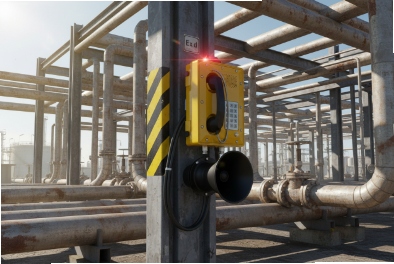
A refinery can be fully staffed and still lose voice when one small SIP service 1 fails. That gap turns a safety phone into a dead button when it matters most.
Yes. Many explosion-proof SIP telephones support failover proxies (primary/secondary, DNS SRV, or outbound-proxy/SBC anchoring). But “works on site” depends on one thing: how fast the phone detects a dead path and how cleanly the SIP edge (usually an SBC) takes over routing during partial failures.
What “SIP failover” actually means in plants
In industrial networks, a phone can be “registered” and still be unusable because:
-
the outbound route is dead while the registrar still answers,
-
TCP/TLS sockets half-die (looks connected, but packets don’t flow),
-
DNS caches keep endpoints pinned to a bad target,
-
reboot storms overload registrars after power restoration,
-
WAN outages remove the only call control path.
So the goal is not “re-register eventually.” The goal is:
-
fast failure detection (seconds, not minutes),
-
fast cutover (try the next proxy without stuck states),
-
slow/controlled failback (avoid ping-pong),
-
local survivability (emergency calls still work with WAN down).
Three failover patterns that work in real deployments
Pattern A — Phone-driven primary/secondary (simple, predictable)
The phone is configured with Proxy/Registrar A and Proxy/Registrar B (IP or FQDN). It tries A first, then B when A is declared unreachable.
Best when:
-
you want deterministic behavior,
-
DNS governance is weak,
-
you need quick commissioning without complex DNS/SBC logic.
Risk:
- timer differences across phone models can produce inconsistent cutover times in a mixed fleet.
Pattern B — DNS SRV/NAPTR discovery (flexible, but needs governance)
Phones query SRV records 2 (e.g., _sip._udp.domain / _sips._tcp.domain) and try targets by priority/weight.
Best when:
-
you control DNS TTL, caching, and monitoring,
-
you want to move services without touching endpoints,
-
endpoints are known to follow SRV behavior reliably.
Risk:
-
SRV only tells the phone where to try—it does not define when to give up.
Failover speed still depends on transport and timeout logic.
Pattern C — Outbound proxy anchored to an edge SBC 3 (most “plant-grade”)
Phones point to a local/edge SBC as outbound proxy (and often registrar). The SBC routes upstream to redundant core call servers and can keep critical calling local.
Best when:
-
you want centralized control of timers, routing, TLS, NAT, and policy,
-
you want local survivability during WAN outages,
-
you want to tune one box instead of 500 phones.
Risk:
- if the SBC becomes a single point of failure, you must deploy it redundantly (pair/cluster).
A baseline configuration that tends to survive bad days
| Layer | What to set | Typical starting choice | Why it helps |
|---|---|---|---|
| Registrar/Proxy list | Primary + secondary (or SRV) | A + B as FQDN/IP | Predictable cutover path |
| Outbound proxy | Set when SBC exists | Edge SBC FQDN/IP | One trusted hop, simple firewalling |
| Transport | Choose per environment | UDP on LAN / TLS on managed paths | Balances speed vs security |
| Keepalive | SIP reachability + socket health | OPTIONS 30–60s + TCP keepalive/CRLF on TCP/TLS | Detects dead paths early |
| Failure decision | Tight time budget | 2–6s per target | Users don’t wait 30s in emergencies |
| Failback policy | Slow return to primary | 2–10 minutes | Prevents ping-pong after maintenance |
| Retry backoff | Fast first, then back off | 5–10s then exponential to 60–120s | Avoids registration storms |
Rule of thumb: fail over fast; fail back slowly.
DNS SRV priority + timers: the common traps (and how to avoid them)
DNS SRV can prioritize registrars and proxies, but successful failover depends on TTL 4 + failure detection.
What to verify in the endpoint (in a lab, with packet captures):
-
Does it do SRV lookup for the specific field (proxy vs registrar vs outbound proxy)?
-
Does it honor priority first, then weight?
-
Does it re-query DNS after failure (or does it loop on a cached list)?
-
Does it have sane transport timeouts (UDP retransmits, TCP connect timeout)?
Suggested starting ranges that avoid “dead button” and avoid “flip-flop”:
| Item | Recommended starting range | Why |
|---|---|---|
| SRV TTL | 30–120 seconds | Faster recovery when targets change |
| UDP “give up” budget per target | 2–6 seconds | Keeps call setup responsive |
| TCP connect timeout | 2–4 seconds | Default OS timeouts are often too long |
| Failback delay to primary | 2–10 minutes | Avoids ping-pong |
| Re-registration backoff cap | 60–120 seconds | Prevents storms after power return |
If the phone gives you poor timer control, move the logic to the SBC.
Primary/secondary + outbound proxy: what “redundancy” really means
Buyers often say “redundancy,” but these are different controls:
-
Registration redundancy: can I bind to a working registrar quickly?
-
Call routing redundancy: can INVITEs be routed when one proxy is down?
-
Health detection: does the device/SBC quickly detect a dead route?
A clean, operator-friendly model is:
| Function | Best place | Preferred method |
|---|---|---|
| Routing redundancy | SBC | multiple upstream routes + health checks |
| Registration redundancy | Device or SBC | A/B registrars or local registration on SBC |
| Health detection | Both | OPTIONS (service) + socket keepalive (transport) |
| Failover decision | SBC (preferred) | consistent behavior fleet-wide |
OPTIONS vs TCP keepalive / CRLF keepalive
-
SIP OPTIONS confirms the SIP service responds (great for logs/troubleshooting).
-
TCP keepalive / CRLF keepalive (on TCP/TLS) helps detect dead sockets and keep stateful paths alive.
-
Many plants run OPTIONS 30–60s with a 2–4s timeout.
Avoid 5–10s OPTIONS for big fleets—it becomes noise during normal operation.
TCP/TLS failover: why it sometimes looks “registered but dead”
With TCP/TLS you also have connection state. A path can break without closing the socket cleanly (especially across firewalls/TLS 5 failover). The phone may believe it is still connected and stop trying alternatives.
What makes TCP/TLS resilient in practice:
-
short connect timeouts,
-
periodic keepalive at transport level,
-
periodic SIP keepalive (OPTIONS) at application level,
-
a clear “drop and rebuild” rule when probes fail.
Power cycles and reboot storms
After power restoration, hundreds of endpoints can hammer registration. “Plant-grade” behavior is:
-
quick first attempts,
-
randomized retries,
-
exponential backoff.
A practical target:
-
first retry 5–10s,
-
then back off to a 60–120s cap,
-
registration expiry commonly 300–600s for field endpoints (varies by policy).
TLS pitfalls that break failover
Failover can “work” but TLS validation fails because:
-
different hostnames are used on failover nodes without matching certificate SANs,
-
SNI/certificate chain mismatches,
-
time is wrong after reboot (NTP 6 unreachable) causing certificate validation failures.
If TLS is required, stable time sync is not optional. Provide reachable NTP in the voice/OT management design.
Edge SBC local survivability: the difference between “redundant SIP” and “operational continuity”
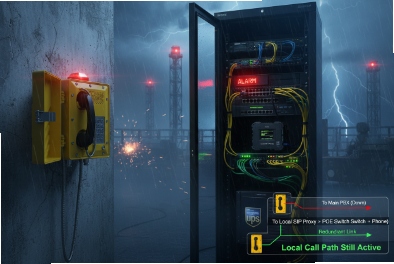
If the WAN is down, cloud failover is irrelevant. For safety endpoints, local survivability is usually the real requirement.
An edge SBC can provide survivability when it can:
-
anchor registrations locally (phones register to the SBC),
-
route critical calls locally with a local dial plan,
-
route emergency calls to on-site responders or local gateways,
-
keep paging available locally (SIP paging groups and/or multicast bridging).
Survivability matrix for planning
| Capability | Works with WAN down? | Where it lives |
|---|---|---|
| Phone-to-phone/site calling | Yes | local registration on SBC |
| Emergency dialing to local responders | Yes | SBC dial plan + local routing |
| PSTN fallback (if required) | Yes | local gateway/trunk |
| Paging groups | Yes | SBC / local paging server |
| Multicast paging | Yes | network + endpoints (IGMP/QoS) |
Best practice: treat “emergency call path” as local-first when the site has on-site responders, then overflow to central when WAN is healthy.
FAT/SAT tests that prove failover is real (not marketing)
Run these as scripted tests with captures and timestamps:
1) Proxy A hard down (power off A): call should complete via B within target.
2) Half-dead path (block return traffic / firewall drop): verify keepalive detects failure and switches.
3) DNS SRV target switch (change SRV priority/weights): verify endpoints re-resolve and move within TTL policy.
4) WAN down (pull WAN uplink): verify local survivability (emergency + local calling + paging).
5) Reboot storm (power cycle PoE switch 7 feeding many phones): verify no registrar collapse; recovery within expected window.
6) TLS failover (swap to secondary TLS proxy): verify cert/SNI/time don’t break recovery.
Suggested acceptance targets (adjust to your site):
-
call setup still works under failure within 2–10 seconds (operational),
-
emergency call path remains functional with WAN down (survivability),
-
no oscillation (failback delay enforced),
-
clear logs (syslog/SNMP/ACS) showing state changes and cause.
Tender wording that prevents “checkbox failover”
Use language that forces proof:
-
“Endpoint shall support primary/secondary proxy/registrar and/or DNS SRV (RFC 3263) with documented behavior.”
-
“Endpoint shall provide keepalive (SIP OPTIONS and/or TCP keepalive) and configurable timeouts to declare a path failed within X seconds.”
-
“System shall demonstrate failover and controlled failback (no ping-pong) in FAT/SAT with packet captures.”
-
“Where WAN outages are possible, solution shall include local survivability for emergency dialing and paging via edge SBC or equivalent.”
-
“Vendor shall provide Wireshark traces for REGISTER/INVITE under normal and failed states, including timers and retry logic.”
Conclusion
Yes—explosion-proof SIP phones can support failover proxies in real deployments. The designs that actually hold up in refineries and tunnels are the ones that combine:
-
fast, predictable failure detection (OPTIONS + transport keepalive),
-
tight, tested timeouts and backoff,
-
slow failback to avoid oscillation,
-
and (for safety workflows) an edge SBC survivability plan that keeps emergency calling and paging alive even when the WAN disappears.
Footnotes
-
Learn how SIP protocol manages session initiation and signaling for reliable enterprise VoIP communication. ↩ ↩
-
A guide to using SRV records for automated service discovery and redundant server location in SIP environments. ↩ ↩
-
Understand how Session Border Controllers enhance security and manage traffic flow in complex industrial networks. ↩ ↩
-
Explore how Time to Live settings affect the speed and efficiency of DNS record updates and failover. ↩ ↩
-
Discover how Transport Layer Security ensures encrypted and authenticated communication for industrial phone systems. ↩ ↩
-
Technical details on using Network Time Protocol for accurate clock synchronization across distributed industrial devices. ↩ ↩
-
Insights into Power over Ethernet standards for delivering both data and power to remote industrial endpoints. ↩ ↩