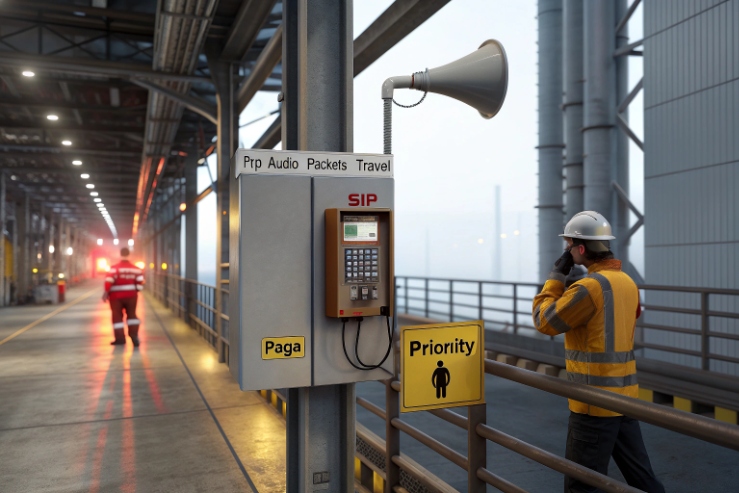
In a refinery, the network gets busy at the worst time. A normal call can block an emergency call, and paging can turn into noise instead of action.
Yes. Explosion-proof SIP telephones can support voice prioritization, but it works only when the phone, PBX/PAGA rules, and network QoS are designed together with clear priority levels and fail-safe behavior.
Voice prioritization is a system, not a single checkbox
What “priority” really means in industrial voice
Priority can mean different things on different sites. Some plants want emergency calls to “jump the line.” Some want high-level paging to override low-level paging. Some want alarms to trigger both audio and strobes. These are not the same. A phone can be very capable, but it cannot invent policy that the PBX, PAGA, and switches do not enforce.
A practical way to define voice prioritization 1 is to split it into four layers:
-
Call control priority (PBX policy): who can call whom, and what happens when lines are busy.
-
Paging priority (paging levels): which paging streams can override others.
-
Network priority (QoS): how traffic is queued and protected during congestion.
-
Workflow priority (integration): who is allowed to trigger actions, and what happens when parts fail.
What an Ex telephone contributes
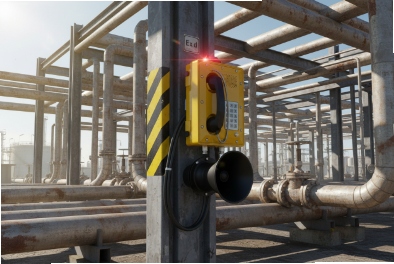
The explosion-proof SIP telephones 2 are usually responsible for:
-
tagging traffic (VLAN, 802.1p, DSCP)
-
honoring paging “levels” and auto-answer rules
-
running emergency hotlines and key macros
-
triggering local I/O (relay for beacon/strobe) if hardware exists
-
generating clean logs so incidents can be proven later
The PBX and the network still decide if “preemption” is allowed, and if high priority actually wins under load.
A simple priority model that scales
| Priority level | Typical use | Allowed initiators | Expected behavior |
|---|---|---|---|
| P1 (Emergency) | SOS, fire, security emergency | whitelisted groups only | override pages, fast ring strategy, beacon on |
| P2 (Critical Ops) | control room paging, plant dispatch | ops roles | can override normal paging |
| P3 (Normal Voice) | day-to-day calls | all users | no override rights |
| P4 (Info) | routine announcements | limited roles | lowest queue, no override |
Where projects fail
Most failures come from unclear ownership. A network team trusts DSCP, but the access switch rewrites it. A PBX supports paging, but endpoints do not auto-answer for that stream. A fire panel triggers an event, but the trigger is not whitelisted, so it is blocked during a real alarm. These issues are easy to prevent when the priority model is written down and tested as a workflow.
A good build makes priority boring. It behaves the same every time, even when links are congested and operators are under stress.
This is where the real questions start: how priorities are implemented, how QoS enforces them, how third systems tie in, and how to configure it at scale.
How are call priorities implemented—emergency override, preemption, and multicast paging levels on SIP PBX/PAGA?
When people say “priority,” they often mean “make it work even if the target is busy.” That is a policy question, not a ringtone question.
Call priority is usually implemented by PBX roles and call routing (emergency override), optional preemption features that depend on the PBX, and paging levels implemented as separate paging groups or multicast streams with clear override rules.

Emergency override: the reliable baseline
Emergency override usually means the PBX routes the call differently:
-
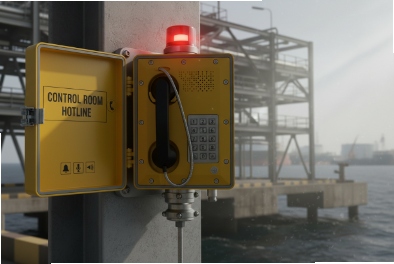
emergency hotline 3 auto-dial to an emergency group
-
priority ring strategy (ring many endpoints at once)
-
overflow to a backup group if not answered
-
optional “always ring” behavior even when DND is set (policy-based)
On the phone side, the emergency key should be locked by provisioning. It should not be changeable by end users. In my deployments, a long-press emergency trigger reduces accidental calls and keeps audits clean.
Preemption: define it carefully
Preemption can mean:
-
interrupt a lower-level paging stream
-
barge into an active call (rare and sensitive)
-
force a busy endpoint to release (depends on platform and policy)
Many SIP platforms can do priority queues, but not true forced call release. So the requirement must be written as a testable behavior, not a vague word. A safe tender line is: “Emergency paging shall override lower-level paging, and emergency calls shall follow defined busy-handling and overflow rules.”
Multicast paging levels: simple and effective
Multicast paging 4 priority is easier to control than call preemption. Most plants use one of these patterns:
-
Multiple paging extensions: each extension maps to a priority level.
-
Multiple multicast groups: each group is a “paging level” with its own multicast IP and port.
-
PAGA zones: each zone has defined priority rules and a known trigger path.
On the phone, “paging level” is often implemented by:
-
auto-answer allowed list
-
volume behavior on paging
-
override rules (stop low stream when high stream starts)
| Implementation method | What the PBX does | What the phone must do | Why it works well |
|---|---|---|---|
| Paging extensions | call a paging group | auto-answer and play audio | easy to manage in PBX |
| Multicast groups | send to multicast IP | join groups and prioritize | fast, low PBX load |
| PAGA gateway | trigger PAGA device | optional local relay or page join | ties into plant speakers |
The strongest approach is to treat “priority” as an emergency workflow, then run a real test: normal page active, then emergency page starts, and the site confirms what is heard, what is logged, and what outputs trigger.
Can QoS/DSCP and LLDP-MED enforce priority for SIP/RTP across industrial switches and VLANs?
A PBX can mark a call “emergency,” but if RTP is dropped during congestion, the result is still failure. Network QoS is where priority becomes real.
Yes. QoS works when SIP and RTP are marked with DSCP and the network maps those marks to protected queues. LLDP-MED can help push voice VLAN and QoS policy at the edge, but the switch must enforce a trust boundary and consistent queue mapping.

DSCP is only useful when the network honors it
Priority needs a consistent path:
-
phone marks SIP and RTP
-
access switch decides whether to trust or remark
-
uplinks preserve the marking
-
core queues protect low latency for RTP
A common plant rule is “trust at the phone port only for known devices.” This is where 802.1X, MAB, or port profiles help. If any random device can claim high QoS/DSCP 5 marking, QoS becomes meaningless.
LLDP-MED helps reduce human error at the edge
-
voice VLAN ID
-
L2 priority and DSCP policy
This matters in hazardous areas because swaps are frequent, and the person swapping the unit may not be a VoIP engineer. Plug-and-play reduces mistakes. Still, LLDP-MED must be allowed on the port, and the phone must be configured to accept it.
VLAN design makes QoS and security easier
A dedicated voice VLAN helps because:
-
ACLs can be tight and simple
-
multicast paging control is clearer
-
QoS policy is consistent per VLAN
-
troubleshooting becomes faster
If voice and control traffic share the same VLAN, DSCP policy and multicast policy get messy, and priority becomes hard to prove.
| QoS item | Recommended practice | What to verify on switches |
|---|---|---|
| SIP marking | lower than RTP | SIP is stable, but not starving data |
| RTP marking | highest voice queue | low jitter under load |
| Paging multicast | defined class | paging stays clear during congestion |
| Trust boundary | only trusted ports | rogue devices cannot claim priority |
What should be tested on industrial switches
Industrial switches 7 from Hirschmann, Moxa, and similar vendors often support QoS and VLANs, but the default settings vary. A clean test includes:
-
a congestion test (generate load)
-
confirm RTP DSCP on the wire
-
confirm queue counters increment on the expected queue
-
confirm paging audio remains clear
-
confirm behavior after port bounce and power restore
When this passes, “priority” is not marketing. It is enforced behavior across the wire.
Do priority rules integrate with VMS/PAGA and fire panels—whitelists, priority multicast addresses, and fail-safe behaviors?
Priority is not only voice. In real incidents, voice is tied to cameras, alarms, and paging. Integration must be controlled, or it becomes unsafe.
Yes. Priority can integrate with VMS/PAGA and fire systems using whitelisted triggers, dedicated priority paging groups or multicast addresses, and fail-safe rules that keep emergency calling working during partial outages.

Whitelists: the simplest control that works
In industrial networks, the safest rule is “only approved sources can trigger priority.” That includes:
-
SIP paging initiators (specific extensions)
-
multicast paging senders (specific switchports or IPs)
-
HTTP/MQTT/API triggers (specific tokens and IPs)
This prevents accidental misuse, and it makes audits easy. It also prevents a compromised endpoint from becoming a plant-wide paging tool.
Priority multicast addresses: clear and scalable
For multicast paging, priority can be implemented by:
-
one multicast group per priority level
-
ACLs that allow only approved senders to those groups
-
phone rules that override lower-level groups when higher-level traffic arrives
This creates a clean hierarchy. It also makes commissioning simple because each group has one purpose.
Fire panels and safety triggers: keep interfaces simple and compliant
Many fire panels provide dry contacts or relay outputs. The safe pattern is:
-
fire panel drives a supervised interface or approved relay module
-
that module triggers a known “emergency” input on a controller or phone I/O
-
phone or controller triggers SIP autodial and PAGA zones
-
local beacon output can be latched for visibility
If the trigger is in a hazardous area, the input loop often needs an Ex i method with isolation. This is not the place for “creative wiring.”
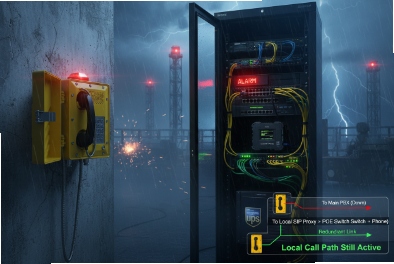
Fail-safe behavior: plan for partial failure
A plant-grade design assumes failures:
-
PBX unreachable
-
one VLAN trunk down
-
multicast blocked on one segment
-
time server down
Fail-safe options include:
-
redundant SIP registrar/proxy
-
local SBC at the site for survival calls
-
local relay outputs for ring and emergency states
-
fallback paging method (SIP paging if multicast fails, or vice versa)
| Integration point | Priority control | Fail-safe idea | Proof item |
|---|---|---|---|
| VMS | whitelist + event mapping | local event log + retry | correlated timestamps |
| PAGA | priority zones + triggers | secondary trigger path | test scripts and logs |
| Fire panel | supervised relay interface | hotline to local desk | acceptance records |
| Security desk | role-based paging rights | backup operator group | PBX policy export |
When integration is done with whitelists and defined fallback, the system stays predictable under stress.
How are priority and paging queues configured at scale—auto-provisioning templates, API, and PBX policies?
A single phone can be tuned by hand. A fleet cannot. If priority rules drift, operators stop trusting the system.
At scale, PBX policies should own priority roles, queues, and paging groups. Auto-provisioning templates should own phone settings like DSCP, VLAN, paging auto-answer, and emergency keys. APIs and webhooks should be used for event workflows, not for constant base configuration changes.

PBX policies: make them the source of truth
The PBX should define:
-
who can initiate emergency calls and pages
-
paging groups per zone and per priority level
-
busy handling and overflow targets
-
secondary registrar/proxy behavior if used
This keeps governance centralized. It also fits audits and change control.
Provisioning templates: stop drift and speed swaps
Provisioning should lock:
-
VLAN tags and LLDP-MED accept rules (if used)
-
DSCP values for SIP and RTP
-
multicast group list and priority order
-
auto-answer rules per paging level
-
emergency hotline number(s) and timers
-
relay output behavior (ring, in-call, emergency latch)
In my view, the best template strategy is one “global base” plus site overlays. The overlay only changes what must vary, like server addresses and zone groups.
API and event automation: use it for actions, not ownership
APIs, MQTT, and webhooks are excellent for:
-
sending a call event to VMS to pop cameras
-
triggering a beacon test workflow
-
pushing a maintenance ticket when registration fails
They are risky for permanent settings because retries and partial failures can create inconsistent device state. The safe approach is: templates own configuration, APIs trigger actions.
A rollout method that works in industrial networks
| Step | What is decided | Tooling | Result |
|---|---|---|---|
| 1 | Priority model and roles | PBX policy | clear rules and permissions |
| 2 | VLAN/QoS enforcement | switch templates | trust boundary and queue mapping |
| 3 | Endpoint behavior | provisioning templates | consistent paging and emergency keys |
| 4 | Integration actions | APIs/webhooks | controlled workflows with whitelists |
| 5 | Proof | FAT/SAT scripts | repeatable acceptance tests |
What “done” looks like
A “done” priority system has:
-
documented levels (P1–P4 or similar)
-
a test plan that proves override behavior
-
end-to-end QoS mapping that is measurable
-
whitelists for who can trigger priority
-
rollback plans for provisioning and PBX policy changes
That is the difference between a phone that “supports priority” and a system that actually performs under stress.
Conclusion
Yes, voice prioritization is supported, but it must be designed across PBX policy, QoS, paging levels, and secure integrations. For OEM planning, email info@sipintercommanufacturer.com.
Footnotes
-
Technical guide on implementing Quality of Service to manage network traffic priorities. ↩ ↩
-
Overview of safety standards for electrical equipment used in hazardous industrial environments. ↩ ↩
-
Standard practices and technologies for implementing dedicated emergency communication systems. ↩ ↩
-
Explanation of IP multicast technology for efficient data delivery to multiple destinations. ↩ ↩
-
Details on the DSCP architecture for providing quality of service in IP networks. ↩ ↩
-
Specifications for the Link Layer Discovery Protocol used to manage media endpoint devices. ↩ ↩
-
Information on ruggedized networking hardware designed for harsh industrial operating conditions. ↩ ↩