A hazardous-area phone can look certified and rugged, yet still fail to register on the PBX when the project goes live. That mismatch creates delays, rework, and safety risk.
Yes, most modern explosion-proof telephones support the SIP protocol, because the Ex rating protects the hardware while SIP runs as a standard VoIP stack, but the real result depends on transports, PBX interoperability, codecs, and secure provisioning.
What “SIP support” really means in hazardous areas?
SIP is standard, but the field environment is not
SIP is a mature and widely used VoIP signaling protocol. Many explosion-proof telephones are built on the same SIP 2.0 1 foundation as enterprise IP phones. That means basic functions like registration, inbound and outbound calls, DTMF, and codec negotiation usually work well. The difference is not the SIP standard. The difference is the site. Refineries, offshore decks, mines, and tank farms often have long cable runs, noisy EMI zones, strict VLAN rules, and occasional power events. These conditions expose weak SIP implementations fast.
A useful way to define “SIP support” is to split it into four layers:
1) Signaling transport: UDP, TCP, or TLS
2) Session media: RTP, SRTP, and codec handling
3) Survivability: failover proxy, re-registration, and keepalive
4) Management and security: provisioning, certificates, and network access control
When a datasheet says “SIP supported,” it often means only Layer 1 and Layer 2 at a basic level. A project needs Layer 3 and Layer 4 to reduce truck rolls. A phone that registers once in a lab is not the same as a phone that stays stable after a cabinet switch reboot or a WAN blip.
A buyer-focused checklist prevents 80% of integration pain
The fastest way to avoid surprises is to ask for evidence, not promises. A short test plan and a feature confirmation list usually give better results than long marketing documents.
| What to confirm | Why it matters | What to test in FAT |
|---|---|---|
| UDP/TCP/TLS support | Different PBXs prefer different transports | Register and call on each transport |
| Outbound proxy and failover | Keeps calls working during partial outages | Kill proxy A and observe switchover |
| DTMF methods | IVRs and dispatch systems depend on it | Test RFC2833 and SIP INFO |
| Codec set | Determines audio quality and bandwidth | G.711 + wideband call, then fallback |
| Provisioning and security | Saves time on large deployments | HTTPS provisioning + cert validation |
A solid SIP phone in a hazardous area should behave like a predictable network endpoint. It should recover after power cycles. It should keep configuration. It should log enough detail for troubleshooting. Those points are where real projects succeed or fail.
The next sections break down the exact SIP transports and features, mainstream PBX interoperability, codec and DTMF behavior, and provisioning and security options that matter in industrial networks.
If the goal is a phone that stays reliable for years, each section is worth treating as a procurement requirement, not a “nice feature.”
Which SIP transports and features are supported—UDP/TCP/TLS, SIP 2.0, registrar/proxy modes, keepalive, and NAT traversal?
A phone can “support SIP” and still struggle behind NAT or during proxy outages. That usually happens when the transport and keepalive behavior are not planned.
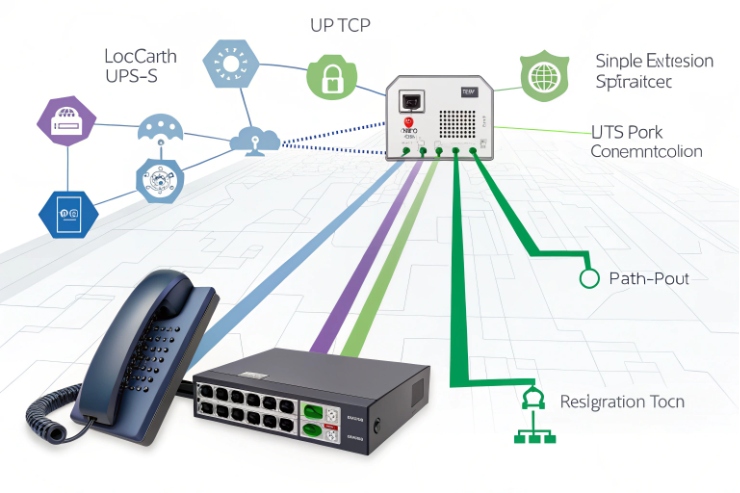
Most explosion-proof SIP telephones support SIP 2.0 with UDP and often TCP, many support TLS, and strong models add registrar/proxy modes, outbound proxy, keepalive, and practical NAT traversal features, with SBC-based traversal preferred in industrial sites.
UDP, TCP, and TLS are not equal in harsh networks
UDP is common and simple. It also depends heavily on NAT timeouts and retransmit timers. TCP can reduce some NAT issues because a connection stays open, but dead sockets can hide outages if keepalive is weak. TLS adds encryption and stronger policy control, but it also adds certificate handling and time sync requirements. In industrial deployments, TLS often performs best when an SBC or edge proxy terminates TLS locally, so field phones do not chase remote certificate changes across a WAN.
A practical feature set looks like this:
-
UDP for broad compatibility
-
TCP or TLS for controlled networks and compliance needs
-
Configurable outbound proxy so the phone always sends signaling to a known hop
-
Clear timers for registration, retry, and failover
Registrar/proxy behavior decides stability during failure
Phones can register to a registrar and route calls through a proxy. In many PBX designs these are the same server. In survivable designs they are separate. The phone should support:
-
primary and secondary server entries
-
optional DNS SRV support if the network policy allows it
-
a failback delay so it does not “ping-pong” between servers
Keepalive is the difference between fast failover and slow mystery outages. Common keepalive options are:
-
SIP OPTIONS 2 to verify SIP reachability
-
CRLF keepalive or TCP keepalive to keep NAT bindings and detect dead connections
NAT traversal is often solved better by architecture than by STUN
Some phones support STUN, ICE, or TURN. These can help in complex NAT environments. In industrial sites, the simplest and most reliable approach is often:
-
put phones on a voice VLAN
-
use an SBC-based traversal 3 or outbound proxy
-
avoid random NAT behavior between cabinets and core
When STUN exists, it usually helps with discovering public mapping. ICE and TURN add more complexity. They are more common in soft clients than in rugged endpoints. For hazardous-area phones, a stable SBC design is often the cleanest answer.
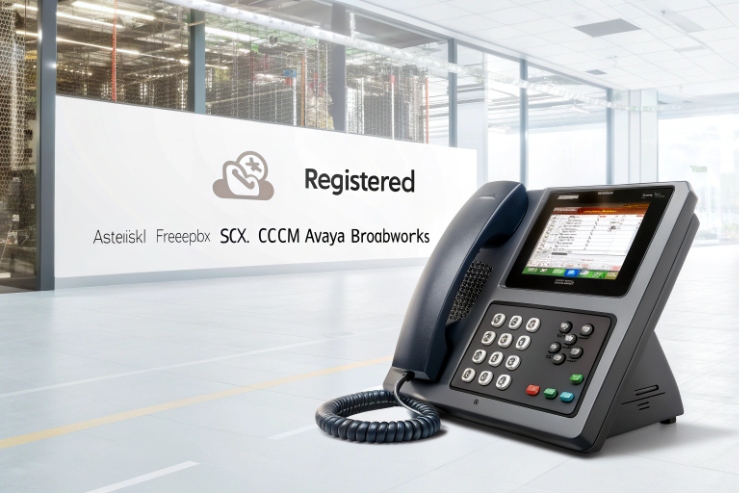
Are mainstream PBXs compatible—Asterisk/FreePBX, 3CX, Cisco CUCM, Avaya, and BroadWorks—with registration and failover?
Many sites run a mainstream PBX, then assume any SIP endpoint will behave the same. The last 10% of interoperability is where projects lose time.
Most SIP explosion-proof telephones can register and call on mainstream PBXs like Asterisk/FreePBX, 3CX, CUCM, Avaya, and BroadWorks, but best results come from matching transport, authentication, DTMF mode, codec policy, and failover design to each platform.
Registration and authentication are usually the easy part
Basic SIP registration uses digest authentication and common headers. That means registration often works quickly across platforms. The harder issues are:
-
how the PBX expects NAT handling (rport, symmetric RTP, contact rewrite)
-
whether the PBX wants TCP/TLS only
-
what the PBX does when re-registrations happen during load
-
how the PBX handles multiple registrations for the same extension
A good deployment standardizes one method: one extension per phone, controlled registration intervals, and clear retry rules after failure.
Failover is usually enforced by architecture, not by endpoint magic
Most enterprise PBXs do not rely on endpoints to “figure it out” during an outage. They rely on:
-
redundant PBX nodes
-
SBCs that route to available nodes
-
DNS SRV where supported and controlled
-
survivability gateways for WAN outages
The explosion-proof phone should support:
-
two registrar/proxy entries or an outbound proxy
-
fast re-registration after power cycles
-
stable behavior after a server returns (slow failback is usually better)
Interoperability differences to plan for
Mainstream PBXs differ in practical ways:
-
Some prefer Asterisk 4 / FreePBX contexts for customized call routing.
-
Some rely on SIP INFO for special applications.
-
Some enforce TLS versions and cipher policies.
-
Some prefer certain SDP ordering and codec offers.
-
Some require specific headers for paging or auto-answer.
Compatibility is real when it survives drills and maintenance windows. A simple FAT test is to simulate the exact failure you fear: reboot the proxy, drop the uplink, and confirm the phone returns to service without manual reboot.
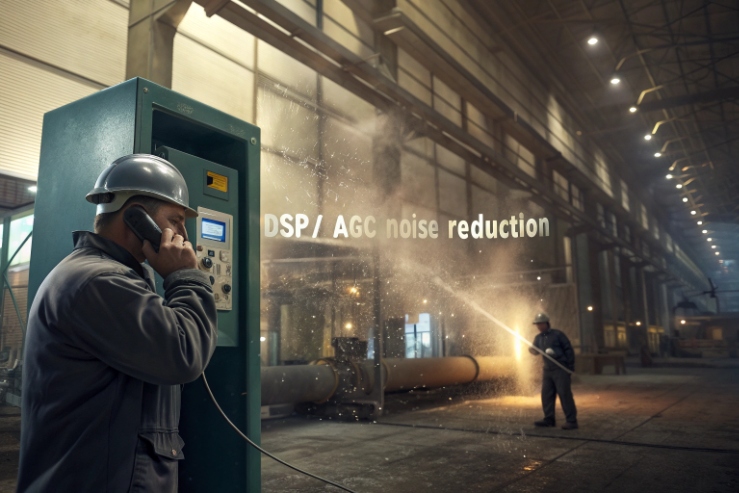
Do codecs and DTMF meet enterprise needs—G.711, G.722, Opus, RFC 2833/4733, SIP INFO, and SDP negotiation?
Audio quality is not a “nice extra” in hazardous areas. Wind, PPE, and machinery noise make clarity the difference between a useful call and a useless one.
Most explosion-proof SIP telephones meet enterprise needs with G.711 and often G.722, many support multiple DTMF methods like RFC2833/4733 and SIP INFO, and some support Opus, but codec policy should match the PBX to avoid transcoding surprises.
Codec strategy should match bandwidth and clarity goals
G.711 is the most universal and is often the safest baseline. It uses more bandwidth but is simple and stable. It improves clarity in many environments because it provides G.722 5 wideband audio. Opus can provide excellent quality and adapt well, but not every PBX uses it by default, and some systems require licensing or specific configuration for transcoding.
In industrial networks, the strongest approach is:
-
Offer G.711 first for maximum compatibility if the network is stable and bandwidth is not tight.
-
Offer G.722 next for better intelligibility when both sides support it.
-
Offer Opus only when the PBX and SBC support it cleanly and you have tested it.
DTMF is a project requirement, not a preference
DTMF is critical for IVRs, dispatch workflows, paging triggers, and test calls. The best default for many PBXs is RFC2833 6/4733. SIP INFO can be needed for some legacy systems or special workflows. A good phone should allow selection per account, not only globally.
SDP negotiation should be predictable
SDP is where calls can fail silently. Codec ordering, ptime, and payload types matter. A phone should:
-
present a clean codec list in a known order
-
support ptime settings that match the PBX policy
-
handle fallback cleanly when the far end rejects a codec
A useful commissioning test is simple: place a call, run a DTMF menu, then switch codecs and repeat. This avoids the worst field complaint: “Calls connect, but the menu does not work.”
How are provisioning and security handled—HTTPS auto-provisioning, TR-069, certificate management, SRTP/DTLS, and 802.1X?
Large industrial deployments fail when each phone is configured by hand. They also fail when security policy is added late and breaks registration.
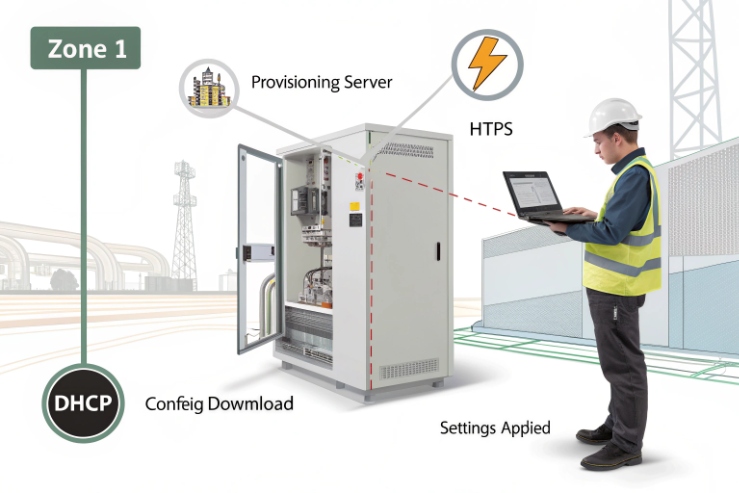
Provisioning and security work best when phones support HTTPS auto-provisioning, controlled certificate handling, and SRTP where needed, while 802.1X and VLAN policies are aligned with the site switch profile and SBC design.
Provisioning must be repeatable and audit-friendly
For 50, 200, or 1,000 phones, manual setup creates inconsistent results. A robust approach uses:
-
HTTPS provisioning server with per-device config files
-
DHCP options or manual URL to point to the server
-
staged templates: site defaults plus per-phone overrides
-
version control and rollback plan for configs
TR-069 7 is common in carrier CPE, and some voice endpoints support it, but it is not universal in industrial phones. The safer approach is to treat it as optional and rely on HTTPS provisioning as the baseline.
Certificate management is the real gate for TLS stability
TLS is only stable when certificates are managed simply:
-
use a clear CA trust model (private CA or public CA)
-
define how device certs are loaded or generated
-
ensure time sync (NTP) is reliable so cert validation does not fail
-
set renewal procedures that do not require field visits
For many hazardous sites, the best architecture is to terminate TLS at the edge SBC. That limits certificate complexity in the field and keeps the phone configuration stable.
Media security and practical SRTP expectations
SRTP is widely used to protect RTP audio. DTLS-SRTP is more common in WebRTC-style systems than in classic desk phones. Many enterprise SIP deployments still use SRTP with SDES keying when supported. The project must choose one method that the PBX and endpoints support consistently, then test it under failover conditions.
Provisioning and security succeed when they reduce operational work. The safest target is a phone that can be replaced in the field, powered up, and automatically rejoin the voice system with the correct policy, without a laptop on the deck.
Conclusion
Explosion-proof telephones commonly support SIP, but reliable deployment needs the right transports, PBX-aligned codecs and DTMF, survivable failover design, and secure provisioning that fits industrial VLAN and SBC policies.
Footnotes
-
A signaling protocol for initiating, maintaining, and terminating real-time sessions including voice and video calls. ↩ ↩
-
A diagnostic method used to query the capabilities of a SIP server and verify its active status. ↩ ↩
-
A network element that protects and regulates IP communication flows in complex telecommunications infrastructures. ↩ ↩
-
An open-source framework for building communications applications like PBX and VoIP gateways for enterprise use. ↩ ↩
-
An industry-standard wideband speech codec that provides superior audio quality compared to traditional telephony. ↩ ↩
-
A technical standard for carrying DTMF digits and other telephony signals over RTP packets. ↩ ↩
-
A technical specification defining an application layer protocol for remote management of end-user devices. ↩ ↩