
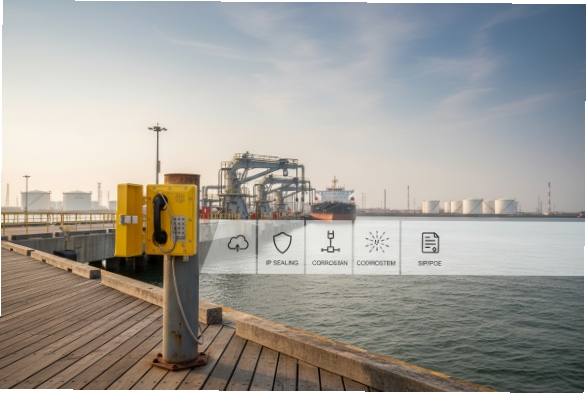
A wrong hazardous-area phone can fail in the first storm, or worse, fail during an emergency call when people need it most.
Select an explosion-proof telephone by matching the site zone and gas group, then locking down corrosion protection, IP sealing, SIP/PoE integration, and a complete ATEX/IECEx document pack before approving any supplier.
A selection method that stays reliable in the field?
Buying an explosion-proof telephone 1 is not only about “Ex marking.” In an oil & gas terminal, the phone lives in salt spray, vibration, heat cycles, and high noise. It also lives inside an emergency workflow that includes IP PBX, dispatch consoles, and PAGA paging. My selection method follows a simple order: safety fit first, survival second, integration third, and evidence last. This order prevents a common mistake where a team chooses a phone that is certified, but not usable after six months outdoors.
Step 1: Start from the hazardous-area classification, not from product catalogs
The terminal owner should have hazardous-area classification 2 drawings for the jetty, tank farm, and loading area. Those drawings define Zone and gas group exposure. The phone spec must follow that data, not the other way around. If the drawing is not available, the project is already at risk, so the phone cannot be specified correctly.
Step 2: Treat corrosion and sealing as a separate “system”
Explosion protection does not stop corrosion. Corrosion changes fastener strength, gasket compression, and cable entry sealing. So the enclosure material, coating system, cable glands, and IP rating must be evaluated together, as one weather-exposure package.
Step 3: Prove emergency calling works end-to-end
A telephone that registers to the PBX is not enough. Emergency calling needs hotline logic, priority, paging integration, and clear audio at high noise levels. The phone should support remote health checks and alarms so downtime is found early.
| Selection layer | What I lock first | What I verify next | Typical buyer mistake |
|---|---|---|---|
| Safety fit | Zone, group, temperature, marking | Certificate scope and options | Buying “IIC” without checking temperature/ambient limits |
| Survival | Material, IP, corrosion system | Cable entry and mounting | Choosing painted aluminum for marine exposure without a proven coating system |
| Integration | SIP, PoE, QoS, dispatch, PAGA | Test calls and paging tests | Accepting “SIP compatible” without a real interoperability test |
| Evidence | Certificates, QA approvals, reports | Spare parts and change control | Approving a supplier without a controlled BOM and spares list |
This framework keeps selection practical. It also makes approvals easier, because each decision links to one clear risk: ignition safety, outdoor survival, emergency readiness, or audit readiness.
A terminal phone program works best when the spec reads like a risk plan. The next sections turn this into concrete checklists for zone ratings, corrosion, SIP integration, and supplier documents.
Which hazardous-area zone and gas group ratings should be matched for jetty, tank farm, and loading-arm locations?
If the zone is wrong, the phone becomes a compliance problem and a safety risk, even if it works perfectly.
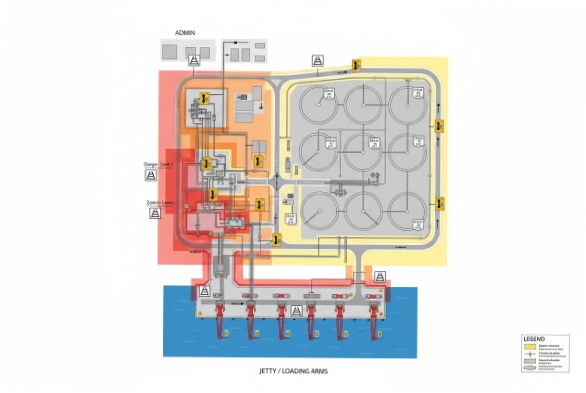
Match the telephone’s ATEX/IECEx rating to the site’s hazardous-area drawing: loading arms and release points often require Zone 1, while many surrounding areas are Zone 2. Gas group and temperature limits must match the products handled.
Map locations to “release likelihood,” not to distance alone
In terminals, hazardous zones are shaped by where vapors can be released and where they can collect. A jetty and loading arms see frequent connection and disconnection, drain operations, and vapor handling. These areas often drive the most demanding zone requirement. Tank farms can vary. Close to vents, pumps, sampling points, and manifolds, the zone can be stricter. Along tank bunds and walkways farther away, the zone is often less strict, but it still depends on the site study.
The phone spec should be written per location group, not as one blanket rating. It is common to buy one model for Zone 1 and use it everywhere, but that can raise cost without adding value. It is also common to buy Zone 2 phones and later discover that some phones must be in Zone 1. That creates rework.
Choose equipment group and category the easy way
For most oil & gas terminals (not mining), the selection is Group II equipment. Then category follows the zone:
If dust hazards exist (grain handling nearby, sulfur, powders), then dust zones apply too, but most terminal telephone discussions focus on gas/vapor.
Gas group and temperature: do not guess
Gas group (IIA/IIB/IIC) depends on the flammable atmosphere. A safer procurement approach is to specify the highest credible group for the location if the hazard data is mixed or unclear. Many buyers choose IIC to cover more gases, but that must still match the certificate and temperature limits. Temperature class (or maximum surface temperature) must be compatible with the site ignition temperature data and the worst-case ambient.
| Terminal area | Typical hazard drivers | Common zone outcome (site-dependent) | What to specify in the RFQ |
|---|---|---|---|
| Jetty walkway near loading arms | Frequent coupling, vapor exposure, wind shifts | Zone 1 near release sources, Zone 2 in surrounding areas | Define exact mounting points and request Zone 1 option for the critical points |
| Loading arms and manifolds | Product transfer, drains, seals, vents | Often Zone 1 at the arm and manifold area | Group II, Cat 2G, suitable gas group, defined temperature limits |
| Tank farm near vents/pumps | Breathing vents, pump seals, sampling | Mixed: Zone 1 at specific equipment, Zone 2 around | Split spec by “near equipment” and “general area” |
| Control building exterior | Lower release likelihood but outdoor exposure | Often non-hazardous or Zone 2 | Decide based on drawings, then match category |
In my experience, the quickest way to avoid disputes is to ask the EPC or owner for the classification drawing reference for each phone point, then copy that reference into the RFQ line item. That makes the compliance chain clean from day one.
What enclosure, IP rating, and anti-corrosion materials are needed for salt spray, humidity, and offshore weather exposure?
A phone can be Ex-certified and still die early from corrosion, water ingress, or UV damage. Terminals punish weak material choices.
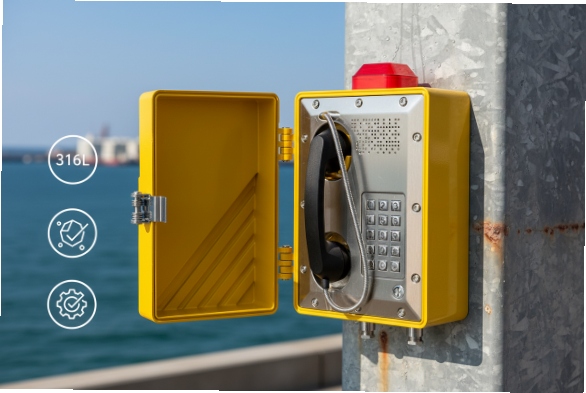
For jetties and offshore-like exposure, use high sealing (often IP66/IP67 or better), marine-grade anti-corrosion materials like 316L stainless steel or proven coated alloys, and hardware that resists salt spray, humidity, and sun.
IP rating: treat washdown and wind-driven rain as the baseline
On a jetty, water hits from every angle. Rain is often horizontal. Salt crystals form in gaps and work like sandpaper. A practical minimum is IP66 5 for strong water jets and dust tightness. For wave splash, flood risk, or aggressive washdown, IP67 (temporary immersion) can be valuable. Some projects ask for even higher washdown performance, but the real win is not only the number. It is how the cable entry and gasket system keep that rating for years.
Enclosure materials that survive marine exposure
Material choice is the biggest life-cycle cost driver. In salt spray, bare carbon steel is not acceptable. Common options include:
-
316L stainless steel 6 for enclosure and fasteners when budgets allow
-
Marine-grade aluminum only with a proven coating system and controlled repairs
-
GRP or reinforced polymers when UV stability, impact resistance, and antistatic needs are met
-
Stainless steel hardware for all exposed screws, hinges, and brackets
Keypad membranes and handset cords should be UV and chemical resistant. Gaskets should resist swelling from hydrocarbons and cleaning chemicals.
Anti-corrosion design details that matter
A strong spec calls out small details because those details fail first:
-
Drain paths to prevent water pooling
-
Isolation washers to avoid galvanic corrosion between dissimilar metals
-
Captive screws to reduce lost hardware in maintenance
-
Protected microphone and speaker openings that do not trap salt
-
Conduit entries and glands rated for marine use, not only for Ex
| Exposure condition | Failure mode seen in terminals | Best enclosure choice | Spec notes to include |
|---|---|---|---|
| Salt spray at jetty | Fastener seizure, pitting, paint blister | 316L stainless or proven marine coating | Require stainless external hardware and coating process control |
| High humidity + heat | Condensation, internal corrosion, keypad swelling | Sealed enclosure with moisture control | Ask for breathing concept if used, and limits for Ta |
| UV + sun load | Fading, brittle plastics, gasket hardening | UV-stable materials and gaskets | Require UV resistance and long-life gasket material |
| Washdown / storms | Water ingress at glands, speaker openings | High IP with certified entry system | Cable glands must be part of the approved system |
My rule is simple: if the phone is on a jetty or near sea air, corrosion protection becomes the main problem, not SIP. A supplier that cannot describe its coating process, gasket materials, and hardware grades is not ready for this environment.
How should SIP compatibility, PoE power, and integration with IP PBX, dispatch, and PAGA broadcasting be evaluated for emergency calling?
In an emergency, the phone must connect fast, sound clear, and reach the right team. Interoperability testing is where most project risk hides.
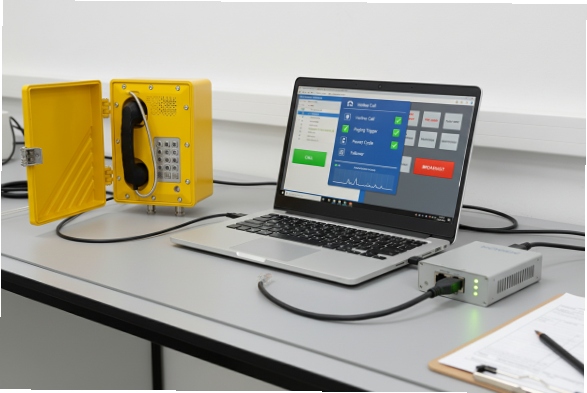
Evaluate SIP phones by running real call flows on the target IP PBX and dispatch system, confirming PoE and power backup behavior, and testing paging or PAGA integration with priority and failover.
SIP compatibility: focus on the emergency features, not only registration
A phone can register and still fail emergency expectations. The testing should cover:
-
Hotline or auto-dial to a control room or dispatch group
-
Priority call handling, busy override, and call queue behavior
-
DTMF transport and keypad reliability for IVR or dispatch prompts
-
Caller ID and location labeling for fast response
-
Failover registration to a secondary PBX or SBC, if used
Codec support should match the network policy. G.711 is simple and common for emergency clarity. Wideband codecs can be helpful but should not be forced if the network is not stable.
PoE power and backup: treat power events as normal, not rare
On terminals, power events happen. So the phone should behave well when PoE flaps or switches reboot. A clean evaluation checks:
-
PoE class compatibility with the site’s switches
-
Boot time to “ready to call”
-
Behavior during PoE loss and restore
-
Local power options if PoE is not reliable, such as 24V DC where allowed
-
Integration with UPS-backed network switches for emergency availability
Dispatch and PAGA integration: test the real paging path
Emergency calling often links to:
-
Dispatch consoles for group calling and recording
-
External strobe and horn activation for noisy areas
Integration can be SIP 8-based paging, multicast paging, or gateway-based interfaces into PA controllers. The key is to test priority and audio clarity. Paging in a high-noise jetty area needs enough loudness and the right speaker or horn design. It also needs clean echo control and microphone pickup if hands-free is required.
Network readiness: QoS and segmentation are part of phone selection
A phone test must include VLAN tagging support, QoS markings, and stable DHCP/DNS behavior. If the network is segmented between OT and IT, then routing and firewall rules must be validated for SIP and media.
| Integration target | What to test | Pass criteria for emergency use | Common miss |
|---|---|---|---|
| IP PBX | Registration, hotline, failover | Call connects fast and reaches the correct group | No test of failover or busy conditions |
| Dispatch console | Group call, caller ID, location labels | Dispatcher sees clear identity and can call back | Location labeling not standardized |
| PAGA / paging | Paging trigger, priority, audio level | Paging is audible in high-noise areas | Paging works in lab but not outdoors |
| Power + network | PoE 9 reboot, switch failover | Phone returns to service without manual steps | Phone needs manual re-register after power cycle |
A strong acceptance test is short and realistic: place a hotline call, verify caller identity, trigger a page, cut PoE power, restore it, and repeat. If the phone passes this sequence, it is usually ready for real operations.
Which certification and factory documents should be requested, including ATEX/IECEx, QAN/QAR, test reports, and maintenance spares, before approving a supplier?
Many suppliers can show a certificate image. Fewer can prove controlled production, traceability, and spare parts that match the certified build.
Request full ATEX/IECEx certificates with schedules, the matching quality approvals (QAN for ATEX, QAR for IECEx where applicable), test reports for IP and corrosion, a controlled spare-parts list, and a clear change-control process before supplier approval.
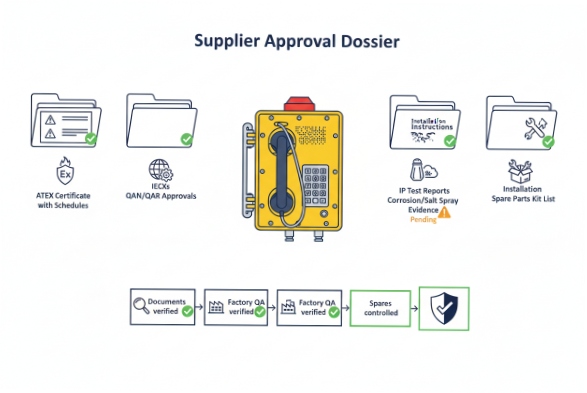
Certificates: ask for the full set, not only the cover page
For hazardous-area telephones, the certificate package should include:
-
ATEX certificate and marking details for EU projects
-
IECEx certificate for global projects and common acceptance
-
Certificate annexes or schedules that define options, cable entries, ambient limits, and special conditions
-
Installation and safety instructions that match the certificate
The annex matters because it often lists the allowed glands, conduit adapters, and assembly rules. If the site uses a different cable entry, the Ex concept can be broken even if the phone body is correct.
Production quality approvals: QAN/QAR are not “nice to have”
A compliant product also needs controlled production. Quality approvals show that the factory is audited for ongoing conformity, not only for a one-time prototype test. This is where many low-cost suppliers fail. A buyer should verify the factory name and address, the scope, and the current validity period. It is also smart to check that the approval scope includes the product type and protection concept.
Test reports: demand proof that matches terminal reality
Terminals need evidence for:
-
Ingress protection testing (IP rating)
-
Corrosion resistance evidence (coating system, salt spray performance, material grades)
-
EMC and functional safety behavior for stable calling (as applicable)
-
Temperature rise and ambient limits, especially for sun exposure
-
Mechanical impact resistance for outdoor use
Even when reports are not legally required for every project, they reduce risk and help with owner acceptance.
Spares and maintenance: control what can be replaced
A spare part that looks identical can still break compliance or sealing. The supplier should provide:
-
A recommended spare parts kit per 50 or 100 phones
-
Part numbers tied to certified revisions
-
Service limits and what must be returned to the factory
-
A clear policy for firmware updates and hardware substitutions
| Document or item | Why it matters in terminals | What to check | Approval decision rule |
|---|---|---|---|
| ATEX/IECEx certificates + schedules | Proves zone suitability and conditions | Model name, marking, options, Ta | Reject if schedules do not match the ordered configuration |
| QAN 10/QAR (factory QA approval) | Proves controlled production and audits | Factory address, scope, validity | Reject if factory differs or scope is unclear |
| IP and corrosion evidence | Predicts life in salt spray and storms | IP method, coating process, material grade | Reject if no real evidence for marine exposure |
| Installation instructions | Prevents wrong glands and wrong mounting | Cable entry rules, torque, warnings | Reject if entry rules are missing or vague |
| Spare parts list + kits | Reduces downtime and prevents wrong substitutions | Part numbers, revision control | Reject if spares are “generic” without traceability |
| Change-control statement | Protects ongoing compliance | Firmware policy, component substitutions | Reject if supplier cannot explain change approval flow |
The cleanest supplier approval is not based on promises. It is based on a document pack that matches the exact ordered model, plus a spares plan that keeps phones working without uncontrolled substitutions.
Conclusion
Match zone and gas group first, then design for marine corrosion, prove SIP and PAGA performance by testing, and approve suppliers only with full certificates, QA evidence, and controlled spares.
Footnotes
-
Specialized communication device designed to contain internal explosions and prevent ignition of hazardous atmospheres. ↩
-
Systematic method of analyzing environments where explosive gas atmospheres may occur to define safety requirements. ↩
-
Hazardous area where an explosive atmosphere is likely to occur in normal operation. ↩
-
Hazardous area where an explosive atmosphere is not likely to occur in normal operation and only for short periods. ↩
-
Ingress Protection rating indicating the enclosure is dust-tight and protected against powerful water jets. ↩
-
Low-carbon austenitic stainless steel with molybdenum, offering superior corrosion resistance in chloride-rich environments. ↩
-
Public Address and General Alarm system used for emergency broadcasting in industrial plants. ↩
-
Signaling protocol used for initiating, maintaining, and terminating real-time sessions like voice calls. ↩
-
Technology that passes electric power along with data on twisted-pair Ethernet cabling. ↩
-
Quality Assurance Notification, a mandatory audit for manufacturers producing Category 1 and 2 ATEX equipment. ↩








