
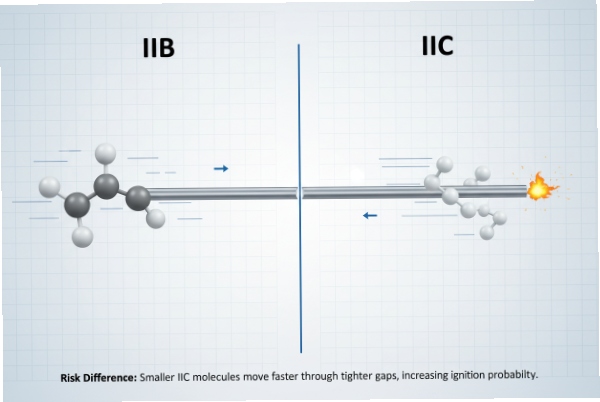
Selecting the wrong gas group looks harmless until commissioning. Then the inspector asks for IIC proof, the glands do not match, and the phone gets pulled off the wall.
IIC is the most demanding gas group, covering hydrogen and acetylene. IIB is less demanding, covering gases like ethylene. For Ex telephones, IIC usually means tighter flamepath and accessory controls, stricter gland selection, and more careful certificate matching.
What actually changes when you move from IIB to IIC?
The risk difference is about easier ignition and faster flame transmission
IIC 1 gases ignite more easily and can push flame through smaller gaps. That is the core reason IIC is harder than IIB. In real projects, this shows up as stricter mechanical control on any flameproof joint and entry path. A telephone may look the same on the outside, but the certified construction details matter more for IIC.
The design impact is often mechanical, not only electrical
For an Ex d 2 telephone, IIC affects:
-
cover fit and fastener control,
-
entry design, including how adapters and plugs are allowed,
-
internal components that could raise surface temperature.
For SIP phones 4, this can also influence how the vendor sets power limits, ringing loudness, and thermal margins. Even if the PCB is the same, the certified configuration may be different.
The procurement impact is strict accessory discipline
The biggest field failures happen at:
-
adapters/reducers,
-
“simple” add-ons like alarm beacons or headset ports.
An IIC telephone must be installed with parts that keep the IIC claim true. That means matching thread type, gland concept, and certificate conditions, not only matching the hole size.
| Topic | Typical IIB reality | Typical IIC reality | What I tell site teams to do |
|---|---|---|---|
| Gas severity | Medium | Highest | Do not guess the gas group |
| Ex d flamepath tolerance | Less demanding | More demanding | Protect cover joints like precision parts |
| Gland sensitivity | High | Very high | Buy glands as part of the certified system |
| Paperwork scrutiny | Moderate | Strong | Require nameplate photo + marking section match |
If this sounds strict, it is strict. IIC is where “close enough” stops working. Once that baseline is clear, selection becomes easier because the logic is simple: match the site gas group, then match the certificate.
A lot of confusion comes from gas names and examples, so I keep the next decision anchored to representative gases and ignition behavior.
What gas groups and ignition risks separate IIC from IIB, and how does that impact Ex telephone selection?
If the gas group is wrong, the best phone becomes the wrong phone. That mistake is expensive because it usually appears after installation work is already done.
IIC covers the most severe Group II gases, commonly hydrogen and acetylene. IIB covers less severe gases, commonly ethylene. IIC requires more conservative Ex d construction and stricter control of entries and accessories, so the telephone, glands, and plugs must be verified as IIC together.
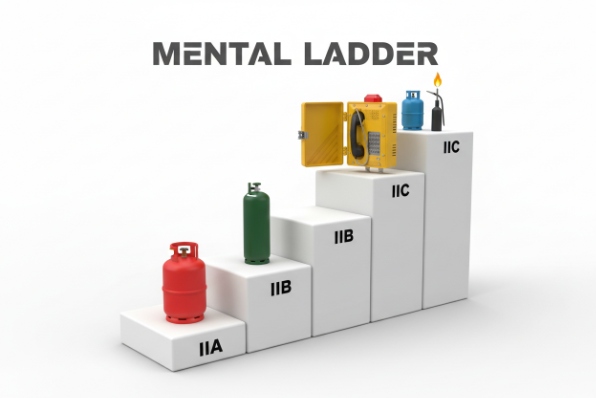
The practical gas-group ladder most engineers use
When a site talks about Group II gases, a simple mental ladder helps:
-
IIA is the least severe (often linked to propane-type gases).
-
IIB is more severe (often linked to ethylene-type gases).
-
IIC is the most severe (often linked to hydrogen and acetylene).
This ladder is not a chemistry lesson. It is a procurement control. If the hazard study says hydrogen 7 can be present, the phone should be IIC, even if it is rare. Hydrogen blending projects and “future fuel” upgrades are a common reason IIC shows up where people did not expect it.
How the ignition risk changes the selection logic
In my selection work, IIC changes decisions in three places:
1) Where the phone is mounted
If the phone is near potential releases, vents, sampling points, or loading arms, I push for the right group even if the zone is only Zone 2. Group and zone are separate. A Zone 1 8 area with hydrogen needs IIC-rated equipment. A Zone 2 area might still need IIC if hydrogen is possible, even if gas presence is rare.
2) How the cable entry is planned
IIC means the entry is treated as a critical interface. The gland must be suitable for Ex d and for IIC, and it must match thread type and installation method. This is where projects fail most often.
3) How “extras” are approved
Handset ports, headset ports, external alarm outputs, and even label materials can trigger extra checks if they change temperature rise or sealing behavior. IIC is not the place to allow random accessories.
| Selection input | What changes when the site is IIC | Why it matters |
|---|---|---|
| Site gas list | Hydrogen/acetylene triggers IIC | Small-gap flame transmission risk |
| Zone | Zone does not replace gas group | Zone is frequency, group is severity |
| Installation parts | Glands/plugs must be IIC-suitable | Entry is a common weak point |
| Maintenance | Cover and joints need stricter care | Flamepath damage kills compliance |
If a buyer wants one rule, I use this one: gas group is decided by the worst credible gas, not the most common gas. That keeps audits clean.
Can an IIC-rated explosion-proof telephone be installed in an IIB area, and when is over-specifying justified?
A plant wants to standardize. The finance team wants fewer SKUs. The safety team wants fewer mistakes. Over-specifying can help, but it should be a choice, not a reflex.
Yes, an IIC-rated telephone can be installed in an IIB area because IIC is more demanding. Over-specifying is justified when gas composition can change, reclassification is likely, equipment may be relocated, or standardization reduces installation errors more than it raises cost.
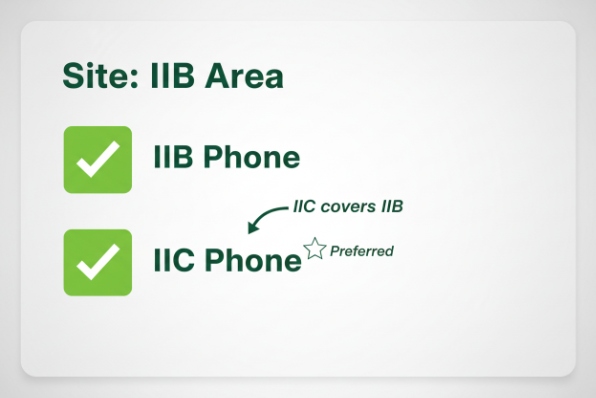
When over-specifying IIC is a smart move
I usually support IIC standardization in these cases:
- Future fuel or process changes
Hydrogen blending, new catalysts, or new solvent packages can change the gas list. A phone lasts many years. The process often changes sooner.
- Mixed contractors and high turnover
If the site has many crews, a single “safe everywhere we need” phone reduces wrong installs. That also simplifies spare handsets and spare glands.
- Equipment relocation is common
Emergency phones and wall phones get moved during expansions. A phone that remains compliant after relocation prevents repeat purchasing and repeat approvals.
- Cross-border projects
A project might start as IIB in one region and later replicate into IIC sites. A single approved design saves time.
When over-specifying is not worth it
Over-specifying can be wasteful when:
-
the site gas list is stable and audited,
-
budgets are tight and the phone count is large,
-
the IIC variant forces a higher T-class 9 limit or derating that reduces performance.
Sometimes an IIC version runs hotter or needs a lower power limit to keep the same T-class. That can affect loudness, amplifier headroom, or accessory drive capability. The certificate will show if there is a derating or a special condition.
Over-specifying still needs correct accessories
This is the part people forget. Installing an IIC phone in an IIB area is fine only if the accessories used still keep the phone within its certified construction. If a team installs cheap IIB glands on an IIC phone because “the area is only IIB,” the phone installation becomes hard to defend. The phone is still IIC-certified, but the installed entry parts may not be.
| Over-spec reason | Benefit | Hidden cost | How I keep it controlled |
|---|---|---|---|
| Future process change | Avoids retrofits | Higher unit price | Approve one BOM early |
| Standardization | Fewer install errors | Training still needed | One label-reading checklist |
| Relocation | Less re-approval work | Risk of wrong glands | Lock gland part numbers |
| Mixed zones | Less confusion | More certificate review | Store marking photos in QA file |
Over-specifying is justified when it lowers total risk and total labor. It is not justified when it only raises the PO price and does nothing for safety or uptime.
What Ex marking details change between IIB and IIC for SIP explosion-proof phones, including gas group, T-class, and EPL?
Small label differences drive big compliance differences. One letter on the nameplate can change which plant areas can use the phone.
Between IIB and IIC, the gas group marking changes (IIB vs IIC). T-class and EPL may stay the same, but they can change because certification testing may require different thermal limits or configurations. The certificate marking line is the final reference, not the brochure.
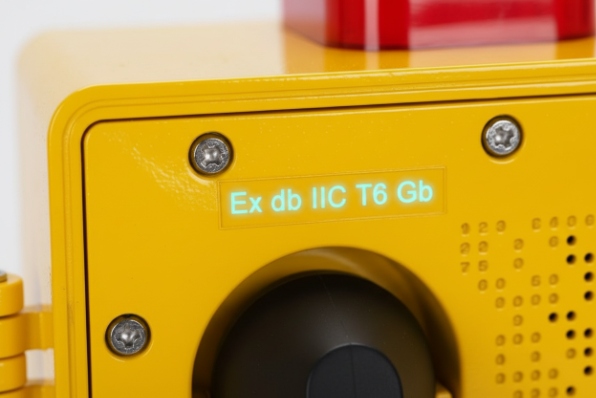
What usually changes
On the gas marking line, the obvious change is:
… IIB …becomes… IIC …
For a SIP phone, a common Ex d gas marking pattern looks like:
Ex db IIB T6 Gb
versus
Ex db IIC T6 Gb
If the product uses combined concepts (for example with an Ex e terminal chamber or Ex i interfaces), the group still appears in the gas marking line, but the protection concept string changes too.
What may change even if the group is the only requested change
I always tell buyers to expect possible knock-on changes:
-
T-class may shift (example: T6 becomes T5) if the IIC configuration runs closer to limits.
-
Ta range may narrow if heat rise margins are tighter.
-
“X” conditions may appear if the manufacturer must control glands, adapters, or assembly steps more tightly for IIC.
This is why “same phone, just change IIB to IIC” is not a safe assumption unless the certificate and test report support it.
EPL is usually linked to zone intent, not group
EPL for gas often stays at Gb for Zone 1 products and Gc for Zone 2 products. Gas group does not automatically change EPL. But a vendor might offer IIC only in a certain EPL or protection concept. That is a commercial and certification choice, not a physics rule.
| Marking element | What changes IIB → IIC | What might change | What must never be guessed |
|---|---|---|---|
| Gas group | IIB to IIC | None | Never assume equivalence without certificate |
| Protection type | Often same (Ex db) | Could change if design differs | Must match certificate marking line |
| T-class | Often same | Can change with thermal limits | Must match certificate and Ta |
| EPL | Often same (Gb) | Could change by product family | Must match zone requirement |
If the phone also carries dust protection, the dust line does not “inherit” IIC. Dust has its own group (IIIA/IIIB/IIIC) and its own temperature format (°C). This is a common misread on combined G/D phones.
Which certificates and procurement checks confirm true IIC compliance for telephones, including scope, “X” conditions, glands, and nameplate consistency?
IIC failures in procurement are usually paperwork failures, not engineering failures. The phone might be real, but the delivered configuration and installation parts do not match the certificate scope.
Confirm true IIC compliance by matching the nameplate marking to the certificate marking section, checking the certificate scope for the exact model variant and entries, reading all “X” conditions, locking approved IIC cable glands and stopping plugs, and verifying production quality scope (QAN/QAR) covers the actual factory.
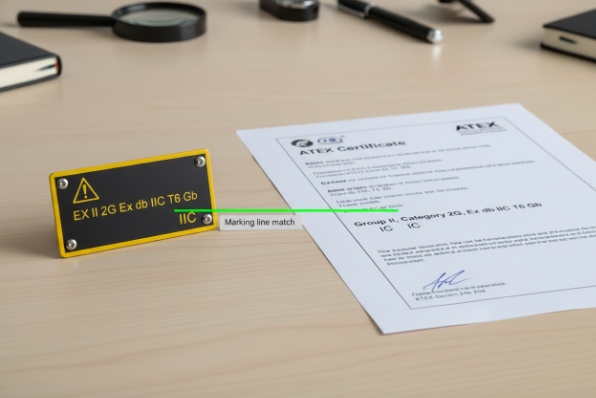
The certificate checks that matter most
Procurement should collect the certificate set and then verify these items:
1) Marking line match
The nameplate should match the certificate “Marking” section character-by-character, including:
-
IIC, -
protection concept (Ex db, or combined concepts if present),
-
T-class,
-
EPL (often Gb),
-
Ta range if shown,
-
suffix
Xif present.
2) Scope and variants
The certificate scope must cover:
-
enclosure material and size,
-
number of entries and thread types,
-
optional ports (headset, alarm terminals),
-
accessories that affect heat or sealing.
3) Special conditions (“X”)
If the certificate number ends with X, special conditions must be treated like requirements. Common IIC-related condition themes include:
-
limits on adapters and reducers,
-
exact gland types and sealing methods,
-
rules for blanking plugs and unused entries,
-
maintenance instructions to protect flamepaths.
Cable glands and stopping plugs are part of IIC compliance
For Ex d telephones, IIC is where I push the team to buy the glands as part of the phone package, not as a local add-on. The right checks are:
-
gland protection concept suitability (Ex d where needed),
-
gas group suitability (IIC where required),
-
correct thread type and engagement,
-
correct sealing method and washers,
-
certified stopping plugs for unused entries.
A phone can be IIC on paper and still leak or fail audit if the wrong plug or wrong gland is installed. This is not theoretical. It is the most common field failure I see.
Production quality scope prevents “certificate drift”
A buyer should also confirm the supplier’s production quality coverage for the relevant scheme and factory site. If manufacturing shifts to a different location without coverage, the paperwork chain becomes weak. For OEM/ODM projects, change-control is critical because small changes can break IIC assumptions:
-
enclosure machining,
-
surface finish at joints,
-
coating thickness,
-
entry hardware substitution,
-
thermal component substitutions.
| Procurement checkpoint | Evidence to request | Pass rule |
|---|---|---|
| IIC marking | Nameplate photo + certificate marking section | Exact match, no missing symbols |
| Delivered configuration | Model code + entry thread list | Covered by certificate scope |
| “X” conditions | Certificate schedule + manual pages | Site can comply with every condition |
| Glands and plugs | Part numbers + gland certificates | Suitable for Ex d and IIC and correct threads |
| Zone fit | Area classification drawing | EPL and T-class fit Zone 1/2 needs, via Gb or equivalent ATEX 10 category |
| QA scope | Production quality records + factory address | Factory and product scope are covered |
For high-scrutiny sites, I also recommend a simple incoming inspection step: take a clear photo of every nameplate and store it with the certificate PDF and the gland part numbers. That makes audits faster and reduces “he said, she said” later.
Conclusion
IIC is stricter than IIB because the gases are more severe. IIC phones can run in IIB areas, but only with certificate-matched parts, glands, and disciplined label verification.
Footnotes
-
Gas group classification for the most easily ignited gases like hydrogen. ↩
-
Flameproof protection method where the enclosure contains the explosion. ↩
-
The interface gap allowing gas cooling to prevent external ignition. ↩
-
Voice over IP signaling protocol used in modern industrial telephony. ↩
-
Mechanical cable entry devices essential for maintaining Ex integrity. ↩
-
Certified plugs used to seal unused cable entries in Ex enclosures. ↩
-
A high-risk IIC gas often driving the need for stricter equipment ratings. ↩
-
A hazardous area where explosive gas is likely to occur in normal operation. ↩
-
Classification system defining the maximum surface temperature limits. ↩
-
European framework regulating equipment for explosive atmospheres. ↩








