
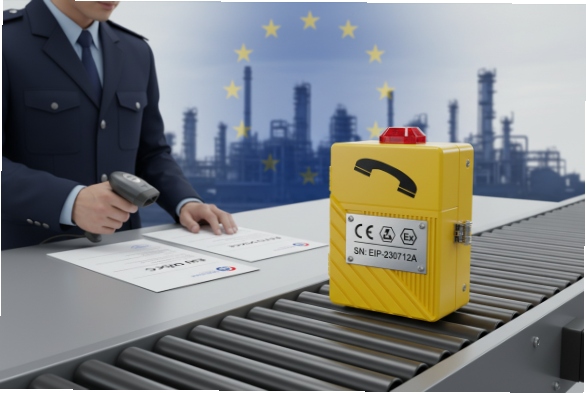
A hazardous-area phone purchase can look simple until the first EU customs check or a site audit blocks installation. Then the project stops.
Directive 2014/34/EU (ATEX “equipment” directive) is the legal gate for explosion-proof telephones in the EU. If the phone is intended for potentially explosive atmospheres, it must meet ATEX essential safety requirements, follow the right conformity route, and carry correct CE + Ex marking.
The connection between ATEX law and the phone on your wall
In real projects, Directive 2014/34/EU 1 is not a “paperwork topic”. It decides if the product can be placed on the EU market, and if it can be used on a classified site without creating a legal and safety problem. The directive is aimed at equipment and protective systems intended for use in potentially explosive atmospheres. That includes electrical equipment like an explosion-proof SIP telephone, when it is sold and marketed for Zone use.
There is also a second ATEX directive that buyers often mix up. The “workplace” directive is about how the employer classifies zones and manages risk on site. The “equipment” directive is about the product design, marking, and conformity assessment. When a refinery or chemical plant says “Zone 1” or “Zone 21”, they are speaking the workplace language. When a manufacturer marks a phone “II 2G …” they are speaking the equipment language. Both must match.
The directive also matters for branding and changes. Many buyers assume that only the original factory owns compliance. That is not always true. If a distributor sells the phone under a new brand, or changes the product in a way that can affect compliance, that party can become responsible like a manufacturer.
A simple way to map the directive to telephone procurement
| Directive concept | What it means for a hazardous-area telephone | What to check during procurement |
|---|---|---|
| “Intended use” | The phone is marketed for explosive atmospheres | Zone statement, gas/dust group, temp class |
| Conformity assessment route | Not all categories use the same route | Zone → category → whether a notified body 2 is involved |
| Marking and traceability | Nameplate must be correct and durable | CE + Ex, notified body number (when applicable), serial traceability |
| Change control | Changes can trigger certificate updates | Firmware, components, enclosure, cable glands, labels |
A clean purchase spec starts with the zone and hazard data, then asks the supplier to prove the Ex marking and documents match that exact use case.
If this foundation is clear, the next questions become easy: does the phone need ATEX, what marking is needed, which documents matter, and what happens when OEM branding or parts change.
Does an explosion-proof telephone sold into the EU need ATEX compliance under Directive 2014/34/EU?
A phone can be “rugged” and still fail EU compliance. The risk is buying a product that looks Ex-proof but has no valid ATEX route.
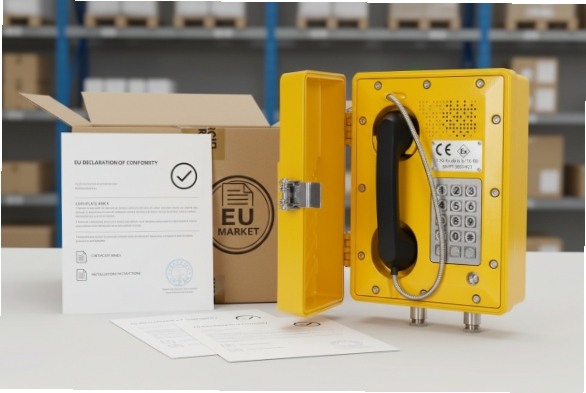
Yes, if the telephone is intended for use in potentially explosive atmospheres and is placed on the EU market, it needs ATEX compliance under 2014/34/EU, including the correct conformity assessment, EU Declaration of Conformity, and Ex marking.
When ATEX applies to telephones
ATEX applies when the telephone is equipment intended for potentially explosive atmospheres. “Explosion-proof telephone” is already a strong signal of intended use. Even if the phone is installed by a system integrator later, the legal trigger is typically the act of placing it on the market as ATEX equipment.
It also matters if the device is “complete equipment” or a “component”. A complete telephone for Zone installation is treated as equipment. Some accessories can be treated as components or non-Ex accessories, but that must be stated clearly in the product documentation and installation instructions. If a part sits inside the hazardous area boundary, it can become part of the explosion protection concept, even if it looks like “just an accessory”.
Borderline cases buyers should not ignore
Some common traps show up in audits:
-
A vendor sells an “ATEX enclosure phone” but the internal electronics are changed later without a controlled process.
-
A spare part (handset, keypad, cable gland) is substituted with a look-alike part that changes ingress protection 3, creepage distances, or surface temperature behavior.
-
The phone is certified for gas only (G) but installed in dust zones (D), or the other way around.
A quick decision table for buyers
| Scenario | ATEX 2014/34/EU needed? | Why it matters |
|---|---|---|
| Phone is marketed and labeled for Zone 1/2 or Zone 21/22 | Yes | Intended use is explosive atmospheres |
| Phone is standard industrial phone used outside classified zones | No (for ATEX) | Not intended for explosive atmospheres |
| Phone is part of a larger certified assembly | Usually yes for the phone, plus assembly assessment | The system still needs a compliant technical file |
| Only a spare part is sold | Depends | If it is safety-critical, it must match the certified design |
On my side, the safest procurement habit is simple: if the phone will be mounted in a hazardous area, the buyer should demand an ATEX-ready document pack before issuing the PO. It prevents painful rework later.
Which ATEX group, category, and Ex marking should be specified for Zone 1/2 or Zone 21/22 telephone use?
Many RFQs only say “ATEX phone”. That is not enough. Zone drives category, and category drives the conformity route and the marking.
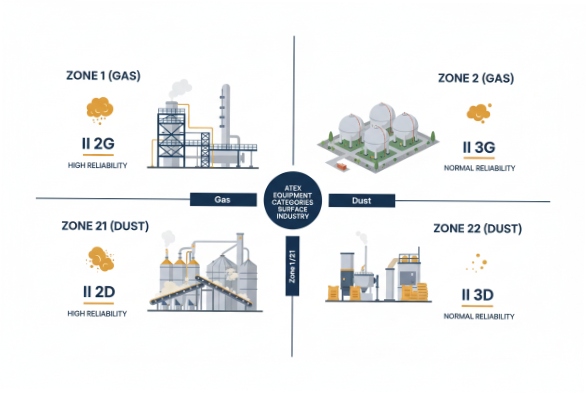
For surface industries, Zone 1 typically needs Group II, Category 2G equipment, and Zone 2 needs Group II, Category 3G. For dust, Zone 21 typically needs Category 2D and Zone 22 needs Category 3D. The exact Ex protection concept and full marking must match the certificate and site hazard data.
Start with the “Group” and “Category”
For most industrial sites (not mining), buyers specify Equipment Group II. Then category aligns with zone:
-
Zone 1 → Category 2 (gas)
-
Zone 2 → Category 3 (gas)
-
Zone 21 → Category 2 (dust)
-
Zone 22 → Category 3 (dust)
This “zone-to-category” rule is the core that keeps procurement honest. After that, the marking must include whether it is gas (G) or dust (D), or both.
Then define gas/dust groups and temperature limits
A telephone marking is never “one-size-fits-all”. The correct choice depends on:
-
Gas group (often IIA / IIB / IIC; IIC is the most demanding)
-
Dust group (often IIIA / IIIB / IIIC; IIIC is the most demanding)
-
Temperature class or max surface temperature (must be below the ignition temperature of the atmosphere)
-
Ambient range (Ta) and mounting conditions (sun load, enclosure heat, cable entry type)
Typical marking patterns used for explosion-proof telephones
The exact protection concept depends on the design. Telephones are often certified with flameproof enclosures (Ex d 4 / Ex db), increased safety (Ex e / Ex eb), intrinsic safety (Ex i), or dust protection by enclosure (Ex t). A dual gas + dust product may show two markings on the nameplate.
A practical table to copy into an RFQ
| Site area | Minimum ATEX category to request | Typical EPL language seen in certificates | Example style of marking (illustrative only) |
|---|---|---|---|
| Zone 1 (gas) | II 2G | Gb | II 2G Ex db IIC T6 Gb |
| Zone 2 (gas) | II 3G | Gc | II 3G Ex ec IIC T6 Gc |
| Zone 21 (dust) | II 2D | Db | II 2D Ex tb IIIC T80°C Db |
| Zone 22 (dust) | II 3D | Dc | II 3D Ex tc IIIC T80°C Dc |
The safe way to use this table is to treat it as a starting frame, not the final answer. The final answer must match the site’s gas/dust type, ignition temperature, and the supplier’s valid certificate. If a supplier cannot show a certificate that matches the requested marking, the marking should not appear on the product label.
What compliance documents should be requested, including EU Declaration of Conformity and notified-body certificates for 2014/34/EU?
Missing documents create the worst kind of downtime: the phone is physically installed, but it cannot be accepted by safety or the customer.
Request the EU Declaration of Conformity, the EU-type examination certificate (when required), and the notified-body quality assurance evidence for production. Also ask for instructions, safety notes, and traceability data that match the exact model and marking.

The “must-have” documents for a telephone project file
For buyers and integrators, the document pack should be checked like a bill of materials. A complete pack usually includes:
-
EU Declaration of Conformity (DoC) for 2014/34/EU (often combined with other directives where applicable)
-
EU-type examination certificate (common for Category 2 electrical equipment)
-
Production quality assurance evidence tied to the manufacturing site (often shown as a QAN or module approval under a notified body)
-
Marking schedule / nameplate drawing that shows the exact Ex marking and any notified body number
-
Installation and safety instructions (including cable entries, torque, allowed glands, and maintenance limits)
-
Technical file references (buyers do not always receive the full technical file, but the manufacturer must have it ready for authorities)
Why Category 2 phones usually involve a notified body
For a Zone 1 (Category 2) explosion-proof telephone, the conformity route often includes EU-type examination and a production control module that involves notified body oversight. This is where buyers often see a notified body number connected to the quality system and production audits.
Zone 2 (Category 3) products can have a simpler route, but the buyer still needs a proper DoC and correct marking. A “simple route” does not mean “no proof”.
A buyer-friendly checklist table
| Document | Who issues it | What to check (fast) | Red flags |
|---|---|---|---|
| EU Declaration of Conformity (2014/34/EU) | Manufacturer | Correct legal entity name, model, marking, standards list | Different model name than the nameplate |
| EU-type examination certificate (if applicable) | Notified body | Matches category, protection concept, and options | Certificate is for a different enclosure or revision |
| Production QA / QAN / module approval | Notified body | Manufacturing site, scope, surveillance status | Different factory address than the product label |
| Instructions + safety notes | Manufacturer | Glands, mounting, Ta range, service limits | No cable entry rules, no warnings about substitutions |
| Nameplate / marking drawing | Manufacturer | Same as delivered label | Label shows extra claims not in the certificate |
The practical rule used in many NOC-driven industrial projects is: no document pack, no shipment release. It prevents arguments after the goods arrive.
How do OEM branding, firmware changes, or spare-part substitutions impact ongoing 2014/34/EU compliance and factory quality audits?
A small change can break the compliance chain. The danger is not only safety. It is also legal liability and failed surveillance audits.
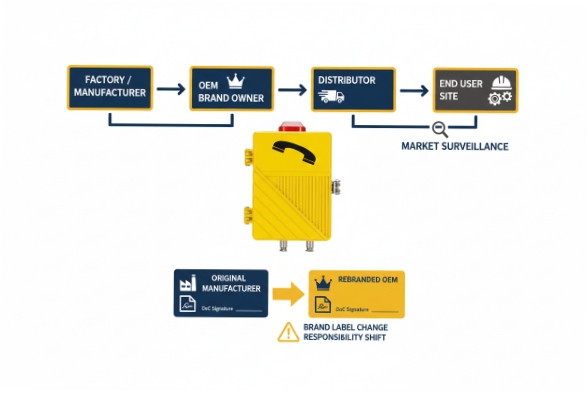
OEM branding or product changes can shift “manufacturer” responsibility to the branding party, and design or part changes can require certificate supplements, updated DoC, and notified-body review. Strong change control and spare-part discipline protect ongoing compliance.
OEM branding: when a brand owner becomes “the manufacturer”
Under the ATEX equipment directive logic, if an economic operator places a product on the market under its own name or trade mark, that operator can be treated as the manufacturer for obligations. That means the brand owner may need to hold and control the compliance file, not only the factory. This is where many private-label projects fail, because the branding party wants only a logo change but does not want the legal role.
A clean OEM setup should define:
-
whose name is on the DoC
-
who controls the technical documentation
-
who answers market surveillance authorities
-
which factory and quality system are locked for production
Firmware changes: “software” can still be safety-relevant
In SIP phones, firmware is not only UI. It can control:
-
power behavior and thermal load (PoE handling, CPU load)
-
audio amplifier duty cycle
-
watchdog resets and recovery loops
-
peripheral control (keypad scan, LEDs, relays)
If firmware changes can affect surface temperature, fault behavior, or protection concept assumptions, it can become safety-relevant. Even when the hardware stays the same, a firmware revision may need a controlled impact assessment, and sometimes notified body visibility, depending on the certificate conditions.
Spare-part substitutions: the silent compliance killer
The most common field mistake is using “almost the same” parts:
-
cable glands not matching the certificate conditions
-
a handset cord with different material behavior
-
a keypad membrane with different sealing performance
-
a speaker or mic with different power draw
In hazardous areas, spare parts should be controlled like safety devices. A certified bill of materials and approved vendor list is not bureaucracy. It is uptime and legal protection.
A change-control table that keeps audits calm
| Change type | Risk to 2014/34/EU compliance | What to do (practical) |
|---|---|---|
| Brand label / nameplate entity change | High | Confirm who signs the DoC and who holds the technical file |
| Firmware update | Medium to High | Do a safety impact review, version control, keep release notes tied to serial ranges |
| Enclosure material or thickness change | High | Treat as design change, expect certificate update or supplement |
| PCB component substitution | Medium to High | Evaluate ignition risk, thermal behavior, creepage/clearance, then document |
| Cable gland / entry change | High | Only use approved entries per instructions and certificate |
| Supplier / factory change | High | Confirm the notified-body production QA scope covers the new site |
From experience, the smoothest long-term ATEX programs treat the phone like a controlled product family. Each variant has a defined marking, a controlled BOM, a locked factory route, and a rule for what counts as a “major change”. That is how surveillance audits stay routine instead of turning into a stop-ship crisis.
Conclusion
Directive 2014/34/EU sets the legal rules for explosion-proof telephones in the EU, and the right marking, documents, and change control keep projects compliant and running.
Footnotes
-
The key European Union legislation regulating equipment for use in explosive atmospheres. ↩
-
An organization designated by an EU country to assess the conformity of certain products before being placed on the market. ↩
-
Ratings indicating the degree of protection provided by mechanical casings and electrical enclosures against intrusion, dust, accidental contact, and water. ↩
-
A type of protection where the enclosure can withstand an internal explosion of a flammable mixture. ↩








