
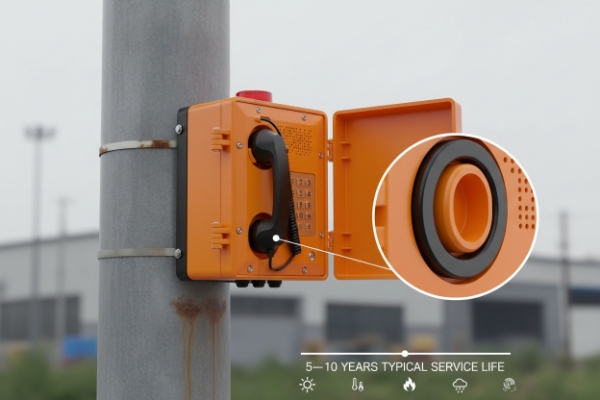
When it comes to ensuring long-term performance for weatherproof telephones, the sealing rings play a crucial role in maintaining the enclosure’s integrity. But how long will they actually last?
The service life of weatherproof telephone sealing rings (gaskets and O-rings) typically ranges from 5 to 10 years, depending on material quality, environmental exposure, and maintenance practices.
When I install or recommend sealing rings, I always factor in environmental conditions 1, material quality, and routine maintenance checks. A properly selected and maintained sealing ring can extend the life of the weatherproof telephone far beyond the average.
Which gasket materials last longest in coastal UV and ozone?
Some materials hold up much better than others when exposed to UV rays, salt spray 2, and ozone in harsh coastal environments.
For coastal UV and ozone exposure, silicone and EPDM are the longest-lasting materials for sealing rings, offering strong resistance to environmental factors.
Why silicone and EPDM excel in coastal environments
-
Silicone:
-
Great for UV and ozone resistance
-
Flexible and maintains elasticity even in high temperatures
-
Performs well in extreme cold 3, making it versatile for various climates
-
Resists hardening and cracking from UV exposure
-
Typically used in environments where high resistance to sunlight and temperature fluctuations is required
-
-
EPDM (Ethylene Propylene Diene Monomer):
-
Known for its excellent ozone resistance 4, weather, and UV resistance
-
Handles high temperatures better than silicone in some applications
-
More chemically resistant compared to other elastomers like neoprene
-
Commonly used in outdoor and coastal environments for sealing applications
-
In coastal areas, these materials can last up to 10 years or more with minimal degradation, but their lifespan is highly dependent on installation quality and regular maintenance.
How do compression-set and TR10 tests predict field lifespan?
Testing methods like compression-set and TR10 provide valuable insights into how sealing rings will perform over time under real-world conditions.
Compression-set and TR10 tests simulate the effects of prolonged compression, temperature cycling, and mechanical stress, helping predict how long a sealing ring will maintain its elasticity and sealing ability.
Key testing methods
-
Compression-Set Test:
-
Measures how much the material loses its ability to return to its original shape after being compressed for extended periods.
-
The higher the compression set 5, the more likely the seal will lose elasticity and form cracks or leaks.
-
This test is particularly important for seals that experience frequent closure and reopening, like on weatherproof telephone enclosures.
-
-
TR10 Test (Temperature Resistance 10):
-
Assesses how a material performs after being exposed to extreme temperatures for a set duration.
-
This test is crucial in predicting how well the material will stand up to outdoor extremes such as sun exposure, hot and cold climates, and the thermal cycling 6 that weatherproof telephones often experience.
-
Both tests help ensure that the sealing rings maintain their integrity under stress, and that they can reliably preserve the IP rating for the long term. Materials that perform well in these tests are more likely to withstand the stresses they’ll face in real-world applications.
What maintenance interval preserves IP protection over years?
Sealing rings may be durable, but routine inspection and timely replacement are crucial to preserve their effectiveness and maintain the weatherproof telephone’s protection.
Manufacturers typically recommend inspecting and possibly replacing sealing rings every 5 years in demanding environments to maintain reliable IP66/IP67 performance.
Why maintenance matters
-
Wear and tear: Sealing rings can degrade over time from environmental stress 7 like UV exposure, heat, moisture, and mechanical forces.
-
Cracking and loss of elasticity: Over time, the materials may start to crack, flatten, or lose their elasticity, allowing moisture 8, dust, or other contaminants to penetrate the enclosure.
-
Routine inspection: Checking the condition of the seals—looking for cracks, hardness, and deformation—is key.
-
Replacement when needed: When cracks or flattening appear, replacing the seals promptly ensures the telephone’s protection continues without interruption.
By sticking to a maintenance schedule that includes checking and replacing seals, the telephone will continue to meet its environmental protection standards.
Are spare gasket kits and part numbers available?
For efficient repairs and long-term maintenance, having access to spare gasket kits and specific part numbers is essential.
Manufacturers often provide spare gasket kits and part numbers for easy replacement, allowing operators to keep weatherproof telephones sealed and functioning.
The importance of having spares on hand
-
Spare kits: Spare gasket kits 9 typically include multiple sealing rings of various sizes and materials that match the original parts, ensuring compatibility with the specific telephone model.
-
Part numbers: Manufacturers provide part numbers that make ordering replacements quick and simple, ensuring that the correct components are selected for future repairs.
Having these spares on hand reduces downtime and ensures the telephone remains operational without the need for a full replacement. The ability to replace seals quickly also minimizes the risk of environmental damage during the period when the seals are worn out but not yet replaced.
Conclusion
Sealing rings in weatherproof telephones typically last between 5 to 10 years, depending on material, environmental conditions, and regular maintenance. Choosing high-quality gaskets, performing routine inspections, and replacing worn seals are key practices for ensuring long-lasting IP protection 10.
Footnotes
-
Explains how external factors like temperature and humidity impact material longevity. ↩
-
Describes the corrosive effects of saline environments on industrial components. ↩
-
Details material performance challenges in low-temperature operating environments. ↩
-
Discusses the ability of rubber materials to withstand degradation from ozone exposure. ↩
-
Defines the permanent deformation of a material after release from stress. ↩
-
Explains the stress placed on materials by alternating high and low temperatures. ↩
-
Overview of failure modes caused by environmental factors acting on plastics and rubbers. ↩
-
Describes the impact of water vapor ingress on enclosure integrity. ↩
-
Examples of component kits used for maintenance and repair of sealing interfaces. ↩
-
Official standard defining levels of sealing effectiveness against intrusion. ↩








