
Fake explosion-proof certificates are flooding the market, putting your industrial site at risk of catastrophic ignition and legal liability. Don’t trust a PDF blindly; learn the precise steps to validate authenticity and ensure your hazardous area equipment is genuinely safe.
To verify explosion-proof telephone certificates, cross-reference the certificate number with the issuing body’s public database (e.g., IECEx On-Line, NANDO). Inspect the physical label for specific marking strings matching the certificate, including the Notified Body number, gas/dust groups, and temperature class. Ensure the specific model variant and accessories are explicitly listed in the certificate’s schedule.
Understanding the Stakes in Hazardous Area Certification
In the world of industrial telecommunications, "close enough" is dangerous. At DJSlink, we frequently see competitors claiming "compliance" without valid certification. True certification is not just a piece of paper; it is a rigorous third-party validation of the device’s ability to contain an internal explosion without igniting the surrounding atmosphere.
When sourcing VoIP solutions for oil rigs, chemical plants, or grain silos, the certificate is your primary insurance policy. A valid certificate confirms that the manufacturer—whether it’s DJSlink or another reputable brand—has passed destructive testing and maintains a Quality Assurance Notification (QAN) 1 for their production facility.
Below is a breakdown of the critical components you must understand when reviewing these documents.
| Component | Purpose | Criticality |
|---|---|---|
| Certificate Number | Unique ID for tracking and validation. | High |
| Standards Applied | Lists specific EN/IEC standards (e.g., 60079-0). | High |
| Schedule of Limitations | Often denoted by an "X", lists usage restrictions. | Extreme |
| Manufacturer Name | Must match the actual producer, not just the brand. | High |
Verifying these documents requires a keen eye for detail and knowledge of global standards. Let’s break down the specific elements you need to check to ensure you aren’t installing a ticking time bomb.
Which marks—ATEX, IECEx, NEC/CEC—must appear on labels?
Confusing labeling standards can lead to deploying the wrong equipment in a Zone 1 or Division 1 area, inviting regulatory fines or accidents. You must identify the correct regional marking strings to ensure the device is legally compliant for your specific geography.
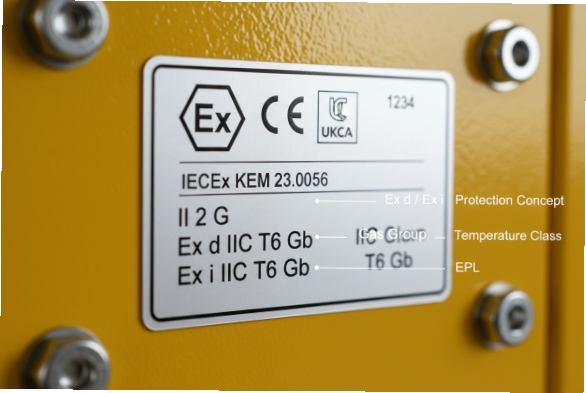
The label must display the specific Ex marking string relevant to the region: the Hexagon Ex symbol and CE/UKCA mark with the Notified Body number for ATEX (Europe), the IECEx certificate number for global use, or the Class/Division/Group markings for NEC/CEC (North America). These must match the certificate exactly.
Decoding the Alphabet Soup of Safety Marks
When I look at an explosion-proof telephone, the label is the first thing I check. It tells the story of where the device can go. A certificate is useless if the product label doesn’t bear the corresponding marks.
ATEX vs. IECEx vs. North American Standards
-
ATEX (Europe): Look for the distinctive Ex hexagon logo. It must be accompanied by the CE mark and, crucially, a four-digit number (e.g., 0081). This number identifies the Notified Body 2 that audits the factory. If that number is missing, the ATEX claim is self-declared and likely invalid for Zone 0 or 1.
-
IECEx (International): This is often simpler. It relies on a Certificate of Conformity (CoC). The label must show the IECEx certificate 3 number (e.g., IECEx PTB 12.0001).
-
NEC/CEC (North America): You will rarely see "Zone" terminology alone. Look for "Class I, Division 1" or "Class I, Zone 1". The logo of the Nationally Recognized Testing Laboratory (NRTL) like UL 4, FM 5, or CSA 6 is mandatory.
The Marking String Breakdown
You need to verify that the string on the paper matches the steel plate.
| Element | Example | Meaning |
|---|---|---|
| Protection Concept | Ex d or Ex db |
Flameproof enclosure 7. |
| Gas Group | IIC |
Acetylene/Hydrogen (Most severe). |
| Temp Class | T6 |
Surface temp < 85°C. |
| EPL | Gb |
High protection level (Zone 1 8). |
Critical Thinking Insight: A common trick by unscrupulous manufacturers is to use a certificate for an empty enclosure and apply it to a complete telephone. An enclosure certificate (denoted by a "U" suffix on the cert number) is not valid for a finished product. The label on a DJSlink phone, for example, covers the entire assembly, including the handset and electronics.
Do certificates list model variants, glands, and accessories?
Ignoring the fine print about accessories and specific model numbers is a frequent cause of inspection failures. A certificate for a base model does not automatically cover every modified version or third-party cable gland attached to it.
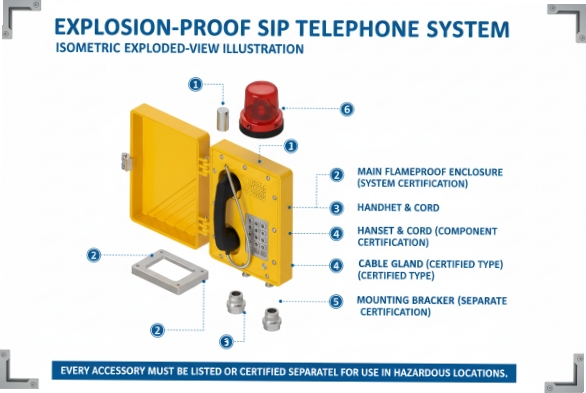
Yes, a valid certificate’s "Schedule" or "Description of Equipment" section explicitly lists all covered model variants and permissible accessories. If a specific handset, horn speaker, or cable gland is not listed or certified separately, the entire assembly’s certification is void.
The "System" Approach to Certification
An explosion-proof telephone is a system. You cannot simply swap the armored cord or the cable gland without consulting the documentation.
Analyzing the Schedule
The main page of the certificate is just the cover. The real data is in the Schedule.
-
Model Nomenclature: The certificate will define the naming convention (e.g., "Model DJS-EX-01 followed by A, B, or C"). If your device is "DJS-EX-01-Z" and "Z" isn’t explained in the schedule, it is uncertified.
-
Cable Glands: This is the most common point of failure. The entry threads (e.g., M20x1.5) are tested. The glands used must be certified to the same or higher standard (e.g., Ex db IIC) and typically need to be listed in the instruction manual referenced by the certificate.
-
Specific Conditions of Use ("X"): If the certificate number ends in an "X" (e.g., IECEx … 001X), you must read the specific conditions.
-
Example: "Clean only with a damp cloth" (to prevent static).
-
Example: "Do not install in areas with high vibration."
-
Example: "The flameproof joint is not intended to be repaired."
-
Accessory Compatibility Table
| Accessory | Requirement | Common Pitfall |
|---|---|---|
| Cable Glands | Must be Ex certified separately (Component cert). | Using generic IP66 glands instead of Ex d glands. |
| Stopping Plugs | Must be Ex certified. | Leaving a cable entry open or using plastic plugs. |
| Horn Speaker | Must be certified as a complete unit or system. | Adding a non-Ex horn to an Ex phone. |
At DJSlink, we ensure that our "One-stop solution" includes the correct, certified glands and accessories so integrators don’t accidentally void the warranty or safety rating during installation.
Where to check Notified Body or ExCB public databases?
Relying on a PDF sent by a vendor is risky; documents can be photoshopped. You need an independent source to confirm that the certificate is currently valid and has not been suspended or withdrawn.
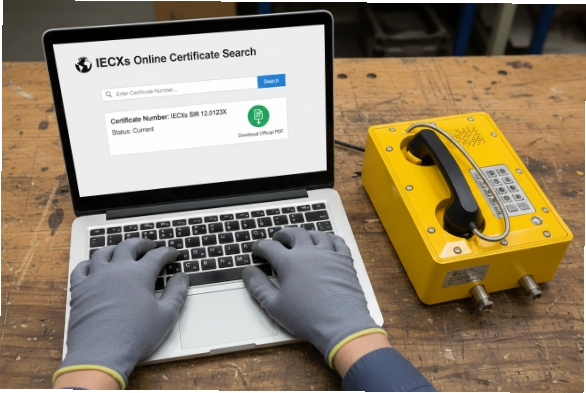
You should verify certificates on the official websites of the issuing schemes: the IECEx On-Line Certificate of Conformity System for international certs, the EU NANDO database for ATEX Notified Body validity, and specific NRTL directories (like UL Product iQ or FM Approvals) for North American listings.
The Truth Is Online
I always tell my clients: "Trust but verify." The digital footprint of a certificate is harder to forge than a PDF.
IECEx Online Database
This is the gold standard for transparency.
-
Go to the IECEx website.
-
Enter the certificate number (e.g., IECEx TUR 20.0001).
-
Check Status: It should say "Current." If it says "Suspended" or "Cancelled," do not install the product.
-
Download the Original: Compare the PDF on the website with the one the vendor gave you. Check for altered dates or model numbers.
ATEX and NANDO
ATEX is slightly more fragmented because it’s a directive, not a single certification body.
-
Check the Notified Body: Use the European Commission’s 9 NANDO database. Search for the 4-digit number on the label (e.g., 0123). Confirm they are authorized for the "Equipment and Protective Systems Intended for Use in Potentially Explosive Atmospheres Directive."
-
Check the Cert Issuer: Go to the specific Notified Body’s website (e.g., TUV, DNV, SGS). Most have a "Certificate Checker" tool.
North American NRTLs
-
UL Product iQ: Requires a free account. Search by the manufacturer’s name or file number (usually starting with E).
-
FM Approvals / CSA Group: Public directories available.
Why This Matters for DJSlink Clients
We provide our certificate numbers upfront. We want you to check them. It proves that our ISO-certified manufacturing process is audited regularly. If a vendor hesitates to give you the cert number before purchase, walk away.
What change control requires updated certification?
Manufacturers often tweak products, but unauthorized changes to materials or design can silently destroy the explosion-proof properties. You need to understand which modifications trigger a mandatory re-certification to ensure ongoing compliance.
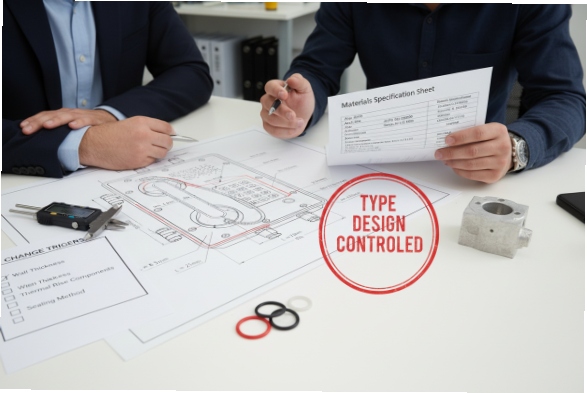
Any change affecting the "Type Design" requires updated certification. This includes altering the enclosure material (e.g., changing aluminum alloy composition), modifying flame path dimensions, changing internal electronic components that affect thermal rise, or updating the IP sealing method. Cosmetic changes usually do not require re-certification.
The Invisible Risks of "Minor" Changes
In my 15 years in this industry, I’ve seen manufacturers try to cut costs by swapping a supplier for a rubber O-ring or thinning a casting wall. In the Ex world, this is illegal unless validated.
The QAN/QAR Connection
Certification isn’t just about the prototype; it’s about the Quality Assurance Notification (QAN) for ATEX or Quality Assessment Report (QAR) for IECEx.
-
Auditors visit the DJSlink factory annually.
-
They check if the product being built today matches the drawings filed five years ago.
What Triggers a Re-Cert?
| Change Type | Example | Impact | Action Required |
|---|---|---|---|
| Material | Changing from SS304 to SS316. | Low | Notification / File Update. |
| Enclosure | Reducing wall thickness by 1mm. | Critical | Full Re-test & New Cert Issue. |
| Electronics | Changing a capacitor in an IS circuit. | Critical | Re-calculation & Validation. |
| Cosmetic | Painting the housing a different color. | None | None (if paint is not static-generating). |
How You Can Spot Issues
As a buyer, you can’t see the internal drawings. However, you can:
-
Check the Revision Number: If the product manual mentions "Rev 5.0" but the certificate references drawings from "Rev 1.0", ask for a Declaration of Conformity 10 that links them.
-
Visual Inspection: If the casting looks rougher or the glass looks thinner than the sample unit, question it.
-
Ask for the DoC: The Declaration of Conformity is the manufacturer’s legal promise that the specific serial number you bought aligns with the active certificate.
Conclusion
Verifying explosion-proof telephone certificates is a non-negotiable step in industrial safety. It requires checking the markings against regional standards, validating the specific model and accessories in the schedule, confirming the certificate’s status in public databases, and understanding the rigor of change control. At DJSlink, we believe transparency is part of safety. Always demand valid, verifiable documentation—your life may depend on it.
Footnotes
-
Learn how Quality Assurance Notifications (QAN) ensure manufacturing processes meet strict ATEX safety requirements. ↩
-
The official EU definition of a Notified Body and their critical role in product compliance assessment. ↩
-
Visit the official IECEx website to check global explosion-proof equipment certification info and validity. ↩
-
Use the UL Product iQ database to verify if products meet North American safety standards (free account required). ↩
-
FM Approvals provides third-party certification for industrial/commercial products, focusing on property loss prevention. ↩
-
CSA Group offers globally recognized testing, inspection, and certification services to ensure product safety. ↩
-
Deep dive into the design principles of flameproof enclosures (Ex d) and how they contain internal explosions. ↩
-
Definition of a Zone 1 hazardous area: a place where an explosive gas atmosphere is likely to occur in normal operation. ↩
-
Search and verify the qualifications and status of authorized Notified Bodies via the EU Commission’s NANDO database. ↩
-
Detailed guide on the EU Declaration of Conformity (DoC) and how manufacturers sign and assume responsibility for compliance. ↩