

Outdoor housings fail when coating is thin. UV and salt find edges. A clear thickness spec stops early corrosion and costly field returns.
Most aluminum housings run 60–120 µm total powder film. Use 80–100 µm for typical outdoor sites, and 100–140 µm for coastal or chemical zones with primer + topcoat, verified by gauges and test panels.
…The coating system behind the number
Powder thickness is not just a single target. It is a whole system goal. The housing sees sun, rain, dust, and handling every day. The coating must block moisture and salts. It must also stay flexible enough to handle small impacts. In real outdoor sites, edges and corners fail first. They get less film build, and they take more abrasion. That is why an “average thickness” can look fine on paper but still fail in the field.
In my projects, the best approach is to define a range and a tolerance, then lock the process that can hold it. A common outdoor range is 60–120 µm total film for a single-coat powder system. Many teams aim near 80–100 µm to balance coverage and appearance. For harsh salt air or heavy industrial dust, a duplex system works better. That means an epoxy primer powder plus a UV-stable topcoat powder. The combined build often lands around 110–160 µm, but it must be controlled. …Very thick powder can show orange peel, pinholes, or weak edges if cure is not right.
Thickness also depends on powder type. A standard polyester can chalk sooner under strong UV. A superdurable polyester 1 holds gloss longer. A pure epoxy powder has great barrier protection but it will chalk in sun. That is why epoxy is better as a primer, not the exposed top layer in outdoor installs.
Measurement matters as much as the target. A magnetic induction or eddy-current gauge on aluminum gives quick readings, but it needs calibration on known shims. It also needs enough points on flat areas and edges. A simple rule helps: measure on real parts and also on a flat test panel run with the same batch. That keeps the target honest.
| …Item to control | Why it matters outdoors | What to write in the spec |
|---|---|---|
| Total film thickness | Barrier life and edge protection | Target range + min at edges |
| Cure schedule | Adhesion and long-term durability | Metal temperature + time |
| Resin family | UV stability and chalking rate | Superdurable polyester topcoat |
| Edge build | First failure location | Edge radius + minimum µm |
| Measurement method | Stops “good-looking” failures | Gauge type + calibration + sampling plan |
If thickness is the headline, the coating system is the story. The next sections break the story into thickness, tests, pretreatment, and finish choices.
A thickness number is easy to print on a datasheet. A thickness plan is what keeps the phone working after years of sun, salt, and cleaning.
Which powder-coat thickness range (µm) and tolerance ensure long-term outdoor corrosion resistance?
Thin coating looks fine on day one. After a season, edges start to dull. Then corrosion creeps under chips. The right thickness range slows that chain.
For most outdoor aluminum housings, specify 80–100 µm total film with a controlled tolerance, and require higher builds like 100–140 µm when salt, chemicals, or frequent washdowns are expected.
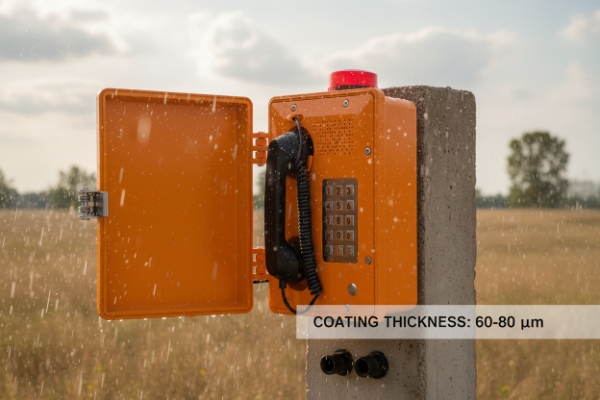
Thickness should match the exposure level. Many outdoor telecom and safety sites are not true marine sites. They still see strong UV, rain, and dust. In that case, a single-coat superdurable polyester at about 80–100 µm 2 is a practical baseline. It gives enough barrier to protect aluminum from staining and filiform corrosion. It also keeps the finish smooth and easy to clean. If the site sits near the sea, or it sees de-icing salts, fertilizer dust, or chemical mist, a higher build is safer. That often means 100–140 µm total, or a primer + topcoat system with a combined build above 110 µm.
Tolerance is where many specs get weak. “Average 80 µm” is not enough. …A good spec sets a target range and a minimum. It also sets a local tolerance across the part. …This matters because some areas will be thin. Corners, sharp bends, and inside pockets lose powder during spray. A simple design change helps a lot: add edge radius. A rounded edge holds film better and reduces early chipping.
Sampling rules keep suppliers honest. …Measure at several points on the housing, not only on one flat side. Record mean, minimum, and spread. Many teams use a practical control band like ±10–20 µm around the target on main surfaces, and a clear minimum at edges. The exact numbers depend on the part shape, the powder, and the spray line. The key is to make “thin spots” visible in the acceptance plan.
One more point: thickness alone does not replace pretreatment. Aluminum can still corrode under a thick coat if the surface was not cleaned and converted well. Thickness slows the attack. Pretreatment prevents the start.
| Outdoor exposure | Typical powder system | Practical thickness target |
|---|---|---|
| General outdoor (sun + rain) | Single-coat superdurable polyester | 80–100 µm |
| Dusty desert (abrasion + UV) | Single-coat superdurable polyester, harder finish | 80–110 µm |
| Industrial (chemical mist) | Epoxy primer + polyester topcoat | 110–160 µm total |
| Coastal (salt air) | Epoxy primer + superdurable polyester topcoat | 120–170 µm total |
| Frequent cleaning (washdown) | Tough topcoat + good edge radius | 90–140 µm |
A strong thickness spec is a range, a minimum, and a measurement plan. That is what turns “weatherproof” into long-life.
Does the finish meet ISO 12944 classes and ASTM D3359/D3363 with required salt-fog hours?
A thick coating can still peel if adhesion is weak. A glossy coating can still chalk if the resin is wrong. Tests turn claims into proof.
Use ISO 12944 as the exposure language, then prove the coating with adhesion (ASTM D3359), hardness (ASTM D3363), and corrosion tests like salt-fog (ASTM B117 or ISO 9227) plus scribe evaluation and, for severe sites, cyclic corrosion.
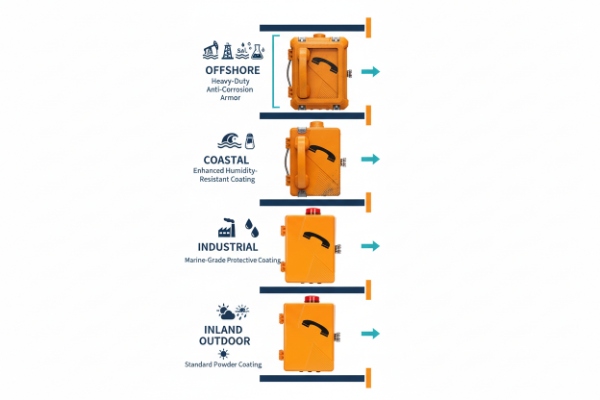
ISO 12944 3 is often used to describe corrosion environments and paint system durability. Many buyers ask for “C3” or “C5” class language because it is familiar. Even though the standard is widely used for steel structures, the environment classes still help when writing a site requirement. The important step is to connect that class language to actual test evidence on the exact coating system used on the housing.
For adhesion, ASTM D3359 4 cross-hatch testing is common. A strong finish often targets 4B or 5B, but the real value is consistency across production runs and after aging. …Hardness is often checked with ASTM D3363 5 pencil hardness. This is not the same as impact toughness, but it helps confirm cure and surface resistance to scratches. Powder coatings can land anywhere from HB to 2H or higher, depending on formulation. The housing needs a balance. Too soft scratches easily. Too hard can chip on impact.
Salt-fog hours are often requested. Salt spray tests like ASTM B117 6 or ISO 9227 are easy to run, so buyers like them. Still, salt-fog is a harsh, steady exposure. It does not match real outdoor cycles. A better spec adds a scribe and creep requirement and, for high-end projects, adds cyclic corrosion testing. Cyclic tests include wet-dry and UV segments. They better reflect outdoor damage growth near chips.
A useful way to write the spec is: define the environment target, then define minimum tests and pass/fail rules. Include evaluation around scribes, edges, and fasteners. That is where failures start.
| What you want to prove | Common test | What to accept on parts |
|---|---|---|
| Adhesion | ASTM D3359 | No flaking beyond the cut area, strong rating target |
| Surface hardness | ASTM D3363 | Meets minimum pencil hardness without brittle feel |
| Corrosion resistance | ASTM B117 / ISO 9227 | Limited underfilm creep from scribe, no blistering |
| UV durability | Gloss/color retention checks | Controlled chalking and color shift within limits |
| Impact resistance | Impact test aligned to IK goals | No widespread chipping at typical hit points |
The goal is not to collect standards. The goal is to show the finish still protects the housing after UV, heat, and salt exposure, and after simple impacts during use.
What pretreatment is applied—chromate-free conversion, epoxy primer, or anodize plus topcoat—for adhesion?
Powder sticks well when the surface is clean, converted, and stable. Without pretreatment, even a thick coat can lift at edges after seasons of heat and moisture.
Use a controlled pretreatment line: clean, rinse, deoxidize, then apply a chromate-free conversion coating before powder. For harsh sites, add an epoxy powder primer under a UV-stable polyester topcoat, or use anodize plus topcoat when appearance and edge durability are critical.
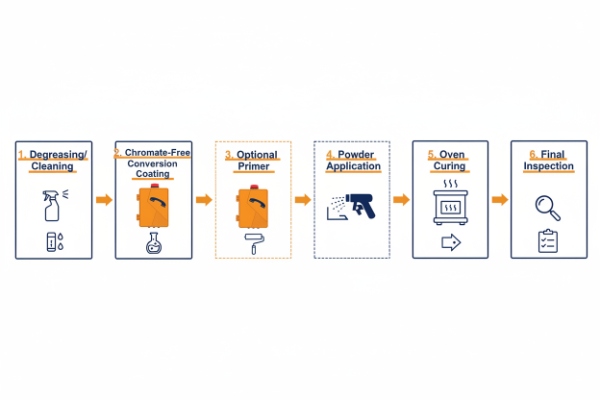
Pretreatment is where outdoor durability starts. Aluminum forms oxides quickly. Those oxides can be uneven. Oils from forming and machining also sit on the surface. Powder coating does not like either. A strong process removes oils, removes loose oxides, and builds a conversion layer that bonds well to powder.
Many modern lines use chromate-free conversion 7 coatings. …These often use zirconium or titanium-based chemistry. They improve adhesion and corrosion resistance without hexavalent chromium. The process still needs strict control. …Rinse quality matters. Dry-off matters. If water spots remain, they can create weak points. If the metal goes into powder with moisture trapped in joints, pinholes can form during cure.
For severe corrosion exposure, a primer helps. An epoxy powder primer adds barrier strength and improves edge protection. It also improves adhesion under stress. But epoxy chalks under UV, so it should not be the exposed layer in direct sun. A superdurable polyester topcoat over epoxy gives both barrier and UV resistance. This duplex system is common in high-end outdoor hardware because it balances protection and appearance.
Anodizing is another path. Anodize forms a hard oxide layer that resists wear. It can also improve paint adhesion if sealed and topcoated correctly. Anodize plus powder topcoat can be strong, but it adds cost and needs good process control. It is most useful when abrasion is high and finish life is long.
A good spec does not only name the chemistry. It defines the sequence and control checks. It also defines cure by metal temperature, not only oven air temperature.
| Pretreatment route | Strengths | When it fits best |
|---|---|---|
| Chromate-free conversion + single coat | Good adhesion, cost-effective | General outdoor deployments |
| Conversion + epoxy primer + polyester topcoat | Best barrier + UV stability | Coastal, industrial, frequent cleaning |
| Anodize + powder topcoat | High wear resistance, strong base | Abrasive sites, long service life targets |
| Poor or skipped pretreatment | Fast early failure | Never acceptable outdoors |
If adhesion is the goal, pretreatment is the foundation. Powder thickness is the wall. UV-stable topcoat is the roof.
How do color, gloss, and texture influence UV durability, IK impact rating, and maintenance?
A coating can be thick and still age poorly if the finish choice is wrong. Color and gloss change heat and chalk visibility. Texture changes cleaning and abrasion behavior.
Resin chemistry drives UV life, but finish choices still matter. …Light colors and IR-reflective pigments reduce heat. Gloss and texture change how chalking shows, how easy cleaning is, and how chips form after impacts tied to IK handling.

UV durability starts with resin selection. A superdurable polyester topcoat usually holds color and gloss longer than a standard polyester. Epoxy is strong for corrosion barrier, but it will chalk fast in sun. That is why epoxy belongs under a UV-stable topcoat for outdoor housings. Once resin is correct, finish choices tune real-world behavior.
Color affects temperature. …Dark colors absorb more solar energy. That can push enclosure temperatures higher. Higher temperature speeds aging of seals, keypads, and cords. Light colors reduce that load. If a project requires dark branding, IR-reflective pigments [^8] can help. They reflect near-infrared energy, which is a big part of heating, even when the color looks dark to the eye.
Gloss affects appearance over time. High gloss often shows scratches and chalking sooner, but it is easier to wipe clean. Matte hides small surface defects and fingerprints. Still, matte finishes can hold dirt more and can look “burnished” in high-contact zones. Texture is useful to hide casting marks and orange peel. But texture can trap dust and salt. In sandy or coastal sites, that trapped dirt can stay wet longer and can increase staining. For maintenance, smoother finishes clean faster and need less water and less scrubbing. Less scrubbing means less abrasion.
IK impact rating 8 is mainly a housing design issue, not a coating issue. Still, coating choice can affect chip behavior. …Very thick or very hard coatings can chip at sharp edges during impacts. This is another reason to radius edges and avoid brittle over-build. If the phone is expected to take knocks, a finish with good flexibility and chip resistance is safer than a very hard, brittle film.
| Finish choice | UV and heat effect | Impact and wear effect | Maintenance effect |
|---|---|---|---|
| Light color (high reflectance) | Lower surface temperature | Less thermal stress on seals | Easier to keep stable over time |
| Dark color (standard pigments) | Higher surface temperature | More stress on plastics and cords | Dirt hides better, but aging can speed up |
| IR-reflective pigments | Lower heat without changing color | Helps protect internals | Often higher cost, needs supplier control |
| High gloss | Gloss loss shows chalking sooner | Scratches show more | Wipes clean easily |
| Matte | Hides small scratches | Can polish in touch zones | Can hold dirt more |
| Texture | Hides defects | Can trap grit and wear faster | Harder to clean in dusty sites |
Finish choices should match the site. For desert sun and wind, light colors and smoother finishes reduce heat and simplify cleaning. For heavy industrial sites, a texture can hide wear, but the cleaning plan must be real.
Conclusion
Set a full coating spec: pretreatment, primer/topcoat, thickness range, and tests. Choose color and texture for sun and cleaning, and the housing stays protected for years.
…Footnotes
-
Details the benefits of super durable polyester powder, including superior UV and weather resistance compared to standard polyester. ↩
-
Provides standard thickness ranges for various outdoor powder coating applications to ensure protection. ↩
-
Explains the corrosion classification system (C1 to C5) and durability ranges defined by ISO 12944. ↩
-
Describes the standard test method for rating the adhesion of coatings to metallic substrates using tape. ↩
-
Details the test method for determining film hardness using pencil leads of known hardness. ↩
-
Outlines the standard practice for operating salt spray (fog) apparatus to test corrosion resistance. ↩
-
discusses the benefits and application of chromate-free conversion coatings for aluminum.[^8]: Explains how IR-reflective powder coatings reduce surface temperature by reflecting near-infrared radiation. ↩
-
Defines the IK rating system for impact protection of electrical enclosures. ↩








