
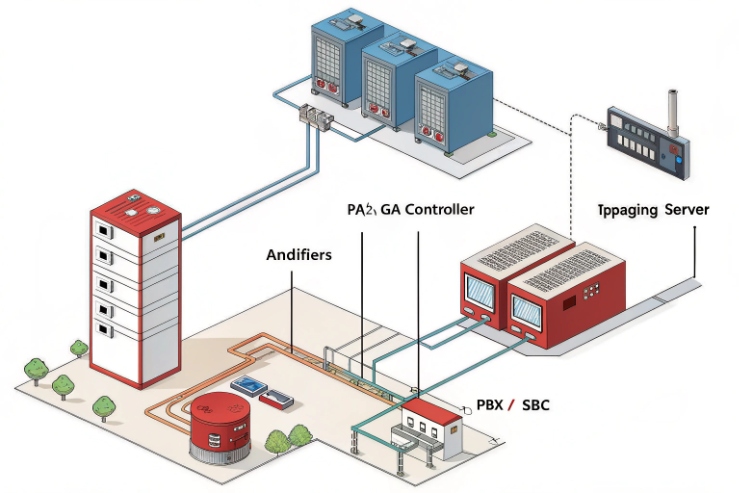
A plant can have loud speakers and strong SIP phones, yet an SOS still gets buried under routine paging. That gap creates confusion when the site needs one clear voice.
Emergency broadcast interruption works when paging can preempt calls, endpoints can auto-answer, multicast is controlled, and PBX rules enforce a clear SOS hierarchy with QoS end-to-end.
A practical interruption blueprint for hazardous sites?
The goal is not “louder,” the goal is “always first”
Emergency paging has one job: deliver a clear alert even when the network is busy and people are already talking. That means the design must control three things at once: call handling, paging delivery, and user behavior. In hazardous areas, the phone itself is only one part of the chain. The PA/GA systems 1 , PBX, switches, and amplifiers decide what gets heard.
A stable blueprint uses layered interruption. First layer is call preemption logic on the PBX or PAGA controller. Second layer is endpoint behavior such as forced auto-answer and barge-in. Third layer is network behavior such as multicast controls and QoS. The last layer is a fail-safe backstop such as a local relay that triggers a beacon or siren when the paging path fails.
Many projects fail because they pick only one method. For example, multicast paging alone cannot preempt a handset call unless the endpoint is configured to accept override audio. A forced auto-answer alone can still fail if the paging server is down. The best results come when the emergency workflow has at least two delivery paths: a paging path plus a direct call path to dispatch, both triggered by SOS.
Build an interruption hierarchy that people can remember
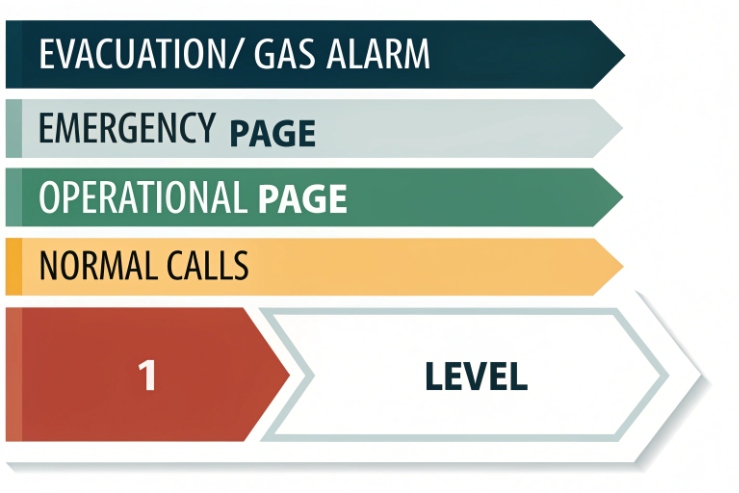
A plant must define a simple priority ladder that stays the same across shifts:
-
Tier 1: Life safety (SOS, gas alarm, evacuation)
-
Tier 2: Operational urgent (process upset, security incident)
-
Tier 3: Routine (general announcements, maintenance paging)
This ladder must map to real system settings. It must also map to how audio behaves during an override. Some sites want a full mute of normal audio. Some sites want ducking. The choice depends on policy, but the rule should be consistent.
| Layer | Tier 1 behavior | Tier 2 behavior | Tier 3 behavior |
|---|---|---|---|
| Active calls | Preempt or barge-in | Optional ducking | No interruption |
| Paging delivery | Emergency multicast + fallback | Normal multicast | Normal multicast |
| Endpoints | Forced auto-answer | Auto-answer on certain devices | Manual answer only |
| Alarms | Relay to PLC + VMS pop-up | Optional | No |
| Logging | Mandatory | Recommended | Optional |
How can emergency paging preempt ongoing calls—barge-in, forced auto-answer, or multicast override on PAGA/SIP?
Emergency paging fails when it behaves like a normal call. Normal calls ask permission. Emergencies must take priority.
Emergency paging can preempt ongoing calls using three practical methods: barge-in 2 at the PBX or paging server, forced auto-answer 3 on endpoints, and multicast override where devices accept priority streams.
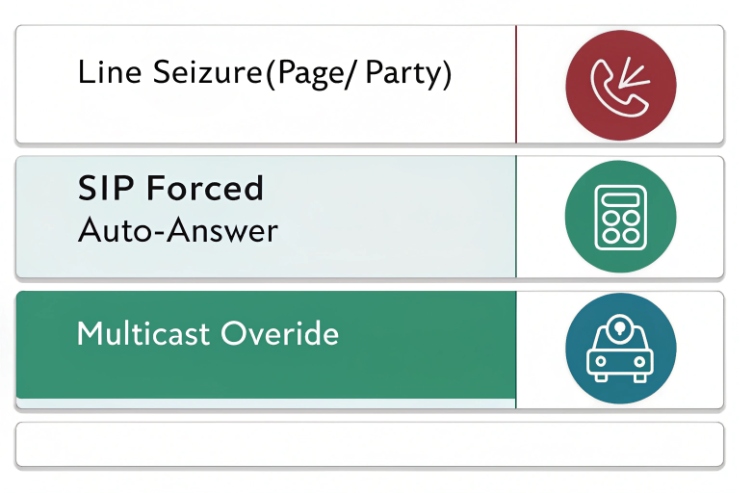
Barge-in: interrupt the audio path on purpose
Barge-in works when the system can inject emergency audio into endpoints even if they are in a call. Some systems do this by forcing an intercom page on top of the call audio. Some do it by terminating the call and starting an emergency page. The right choice depends on policy. In control rooms, a hard cut can be acceptable. On deck or in process areas, ducking can be safer because the operator may be coordinating on an active call.
Forced auto-answer: remove the human delay
Auto-answer is a big win for emergency paging. The paging server sends a special header or call type that endpoints accept without the user picking up. This is common for SIP paging groups. For explosion-proof telephones, auto-answer is most useful on dispatch consoles and key operation rooms.
Multicast override: make the network do the heavy lifting
Multicast paging is efficient because one stream can reach many endpoints. It also avoids call setup storms during emergencies. Still, multicast override only works when endpoints are configured to listen to a priority multicast group and to treat it as higher priority than normal audio.
Which PBX settings enable priority paging—Asterisk/FreePBX, 3CX, or CUCM dial plan and Resource-Priority?
Priority paging works only when the PBX treats emergency traffic as a different class. If it shares the same dial plan and the same paging group, it will behave like normal traffic.
Priority paging rules are set through dedicated dial plan matches, special paging groups, and Asterisk/FreePBX 4 contexts when the platform can use them.
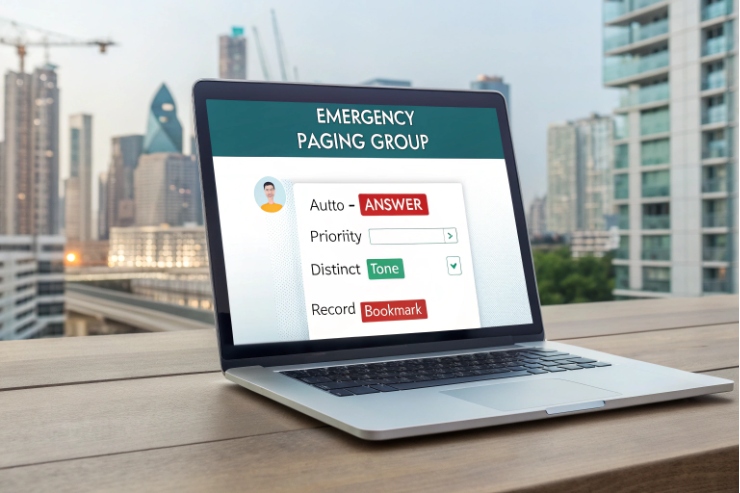
Asterisk/FreePBX: separate contexts and keep emergency logic readable
Asterisk can do almost anything, but emergency designs should stay simple. The most reliable pattern is to create an Emergency Page extension routed to a dedicated paging app. Resource-Priority headers can identify emergency calls, allowing proxies to treat them with higher precedence.
3CX and CUCM: use precedence policy features
3CX deployments succeed when emergency paging is isolated into dedicated groups with distinct notification sounds. For large enterprises, CUCM provides structured multilevel precedence and preemption (MLPP). This allows endpoints to honor priority levels during peak load, ensuring life safety communications are never blocked by routine office traffic.
What fail-safe rules apply—mute vs ducking levels, call resume behavior, and SOS override hierarchies?
Interrupting audio is a safety decision. Some sites want the emergency message to fully replace all other audio. Other sites want partial ducking so operators can still hear a supervisor call.
Fail-safe rules should define a clear SOS override hierarchy following ATEX/IECEx standards 5 for safety, choose mute or ducking per zone, and define whether calls resume or end.
Mute vs ducking: choose by role and risk
A practical rule is to apply different behavior by endpoint type. Process area speakers often require a full mute so the emergency message is clear over ambient noise. Dispatch endpoints may prefer ducking so the operator can maintain coordination during the incident.
SOS hierarchy: prevent loops and conflicts
A clean hierarchy prevents collisions by ensuring SOS overrides all other paging and routine alerts. Only one active Tier 1 page should exist per zone at a time. The system should require supervisor acknowledgement to stop Tier 1 paging, preventing accidental cancellation during a crisis.
How should QoS and multicast be designed—DSCP, VLAN voice profiles, jitter buffers, and redundant paging servers?
Emergency interruption is useless if packets arrive late. Voice, paging, and events must stay smooth even when the network is busy.
QoS and IP multicast 6 should be designed with a voice VLAN, consistent DSCP markings, and IGMP control to prevent network flooding during wide-area alerts.
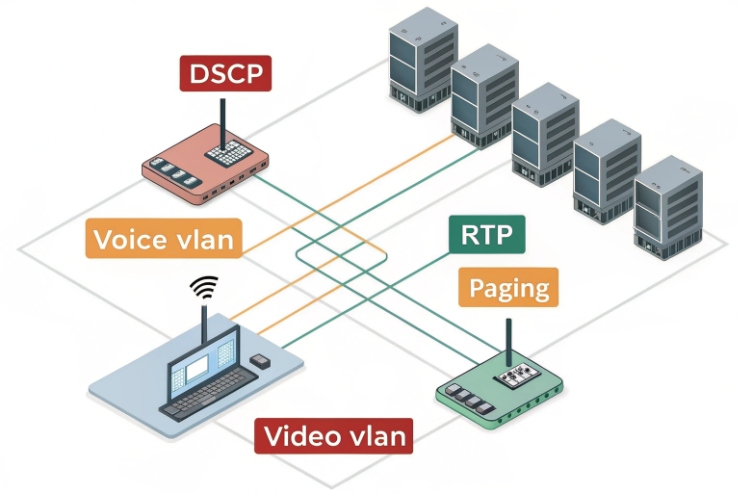
DSCP and VLAN: protect the emergency stream end-to-end
A simple marking plan ensures Quality of Service (QoS) 7 across all switches. By marking RTP as DSCP EF and signaling as CS3 or CS5, the network can prioritize emergency audio during congestion. This is critical on remote cabinets with limited uplinks where routine data traffic might otherwise block safety signals.
Redundant paging servers and failover behavior
A single paging server is a single failure point. A robust design includes primary and secondary servers with automated health checks. This ensures that if the main server fails, the failover unit takes over the multicast groups immediately, maintaining the ability to interrupt routine broadcasts.
Conclusion
Emergency broadcast interruption works when PBX priority rules, endpoint auto-answer, multicast control, and QoS align, with clear SOS hierarchies and redundancy that survives real offshore and refinery network stress.
Footnotes
-
Learn about Public Address and General Alarm systems designed for safety and evacuation communication in critical industrial environments. ↩ ↩
-
Understanding how the barge-in feature allows authorized personnel to join or interrupt active calls during urgent operational scenarios. ↩ ↩
-
A guide to configuring SIP endpoints to automatically connect incoming pages, ensuring immediate delivery of emergency voice messages. ↩ ↩
-
Official resource for Asterisk, the leading open-source framework used to build powerful and flexible industrial communication systems. ↩ ↩
-
Explore international safety standards for equipment used in explosive atmospheres, ensuring compliance and protection in hazardous plant zones. ↩ ↩
-
Technical overview of multicast technology for efficient, simultaneous audio delivery to multiple network endpoints without overloading the infrastructure. ↩ ↩
-
How network mechanisms prioritize time-sensitive voice and paging traffic to maintain clarity and stability during periods of congestion. ↩ ↩








