Navigating the complex landscape of hazardous area certifications can feel like decoding a secret language. Choosing the wrong certification scheme for your industrial telephones can lead to rejected shipments, costly compliance failures, and legal liabilities in your target market.
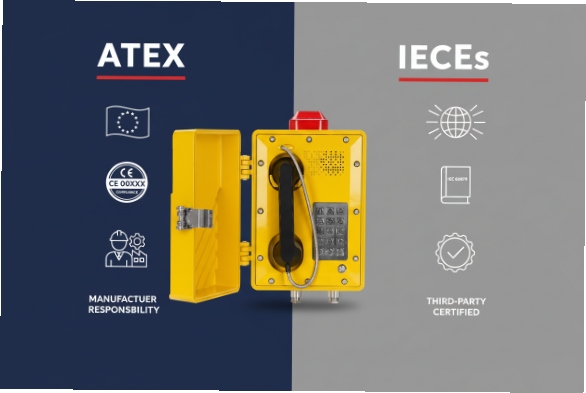
The primary difference is that ATEX is a mandatory EU directive driven by law, whereas IECEx is a voluntary international scheme driven by standards. ATEX allows self-certification for lower risks (Zone 2) and requires a Quality Assurance Notification (QAN), while IECEx requires third-party certification for all zones and uses a Quality Assessment Report (QAR).
The DNA of Certification: Law vs. Standard
At DJSlink, we manufacture thousands of explosion-proof telephones annually for global clients. A frequent confusion we encounter is the assumption that ATEX and IECEx are interchangeable. They are not. They are siblings with different personalities.
ATEX 1 (Atmosphères Explosibles) is rooted in European Union law. Its primary goal is the free movement of goods within the EU. It places responsibility heavily on the manufacturer. If an accident occurs in France, the investigation follows EU directives.
IECEx 2 (International Electrotechnical Commission System for Certification to Standards Relating to Equipment for Use in Explosive Atmospheres) is a voluntary global scheme. Its goal is to facilitate international trade by having one single set of standards (IEC 60079 series) that everyone agrees on. It is generally stricter because it does not allow the "self-certification" loopholes that ATEX does for less hazardous areas.
| Feature | ATEX | IECEx |
|---|---|---|
| Nature | EU Law (Directive 2014/34/EU) | Voluntary International Scheme |
| Zone 0/1 (High Risk) | Notified Body Certificate Required | Certification Body (ExCB) Certificate Required |
| Zone 2 (Low Risk) | Manufacturer Self-Declaration Allowed | Third-Party Certificate Always Required |
| Focus | Safety & Free Trade in EU | Global Mutual Recognition |
Understanding these nuances is critical when specifying equipment for global projects. Let’s dive into the specifics.
Do both schemes accept the same protection concepts?
Engineers often wonder if a "Flameproof" phone in Germany means the same thing in Australia. Fortunately, the technical engineering behind the safety is largely harmonized, but the administrative wrapper differs.
Yes, both schemes rely on the same IEC 60079 series of standards, so protection concepts like Flameproof (Ex d), Intrinsic Safety (Ex i), and Increased Safety (Ex e) are technically identical. However, ATEX references the "EN" (European Norm) version of these standards, while IECEx references the original IEC standards.
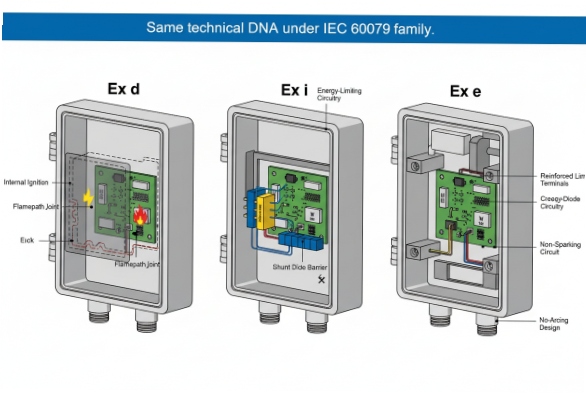
Same Engineering, Different Label
When we design a DJSlink explosion-proof phone, we design it to meet the IEC 60079 standards first.
-
Harmonization: The European standards (e.g., EN 60079-1 for Flameproof) are virtually identical to the international standards (IEC 60079-1).
-
Common Concepts:
Critical Insight: While the concepts are the same, the edition of the standard might differ. The EU might be slower to adopt the newest IEC standard, or vice versa. A gap in standard editions can sometimes cause certification headaches if a product complies with the latest IEC standard but the valid EN standard is older.
How do file numbers, QAN/QAR, and markings differ?
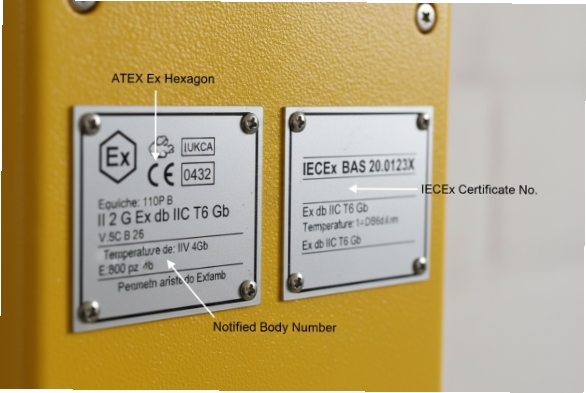
You can spot the difference between an ATEX and IECEx product just by glancing at the paperwork and the label. Knowing these codes is essential for incoming quality control (IQC) at your facility.
ATEX uses a "Quality Assurance Notification" (QAN) and requires the CE mark with a Notified Body number, while IECEx uses a "Quality Assessment Report" (QAR) and displays a specific IECEx certificate number (e.g., IECEx PTB 12.0001). ATEX certificates often include an "X" or "U" suffix similar to IECEx, but the marking string always starts with the distinct Ex hexagon.
The Paper Trail of Safety
Documentation is where the administrative divergence is most visible.
1. Factory Audit Documents
Before we can sell a phone, our factory is audited.
- ATEX: We receive a QAN 5 (Quality Assurance Notification)**. This proves our production system complies with ATEX requirements.
- IECEx: We receive a QAR (Quality Assessment Report). This is an online report listed on the IECEx website.
- Note: Often, one audit can generate both documents if the auditor is qualified for both.
2. Label Markings
| Scheme | Key Visual Identifier | Certificate Format Example |
|---|---|---|
| ATEX | CE Mark 6 + 4-digit NB Number + Ex Hexagon | TUV 13 ATEX 1234 X |
| IECEx | "IECEx" prefix | IECEx TUR 13.0001X |
DJSlink Advice: If you see a CE mark without the 4-digit number next to it on an "explosion-proof" device, it is likely only self-declared for Zone 2 or not certified by a Notified Body at all.
Which regions legally recognize each scheme?
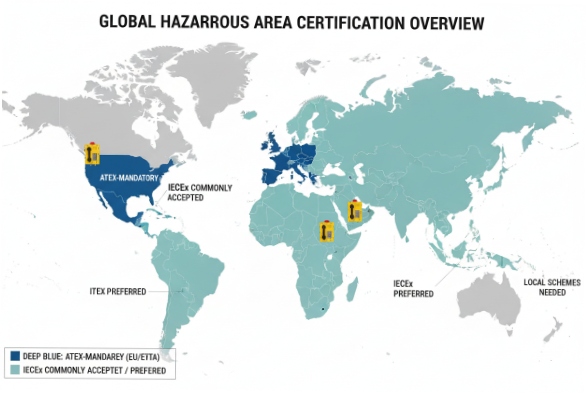
Your project’s location dictates which certificate you need. Sending an ATEX-only phone to a site in Dubai might result in the equipment being rejected by the local inspector.
ATEX is legally mandatory in the European Union (EU) and accepted in EFTA countries. IECEx is legally recognized in countries like Australia, New Zealand, and Singapore, and is preferred in the Middle East, while serving as the basis for national certifications in Brazil (INMETRO), China (CCC), and Korea (KCs).
The Passport for Your Equipment
Think of certification as a passport.
- EU (The Home of ATEX): You must have ATEX. IECEx is not a legal replacement, though it helps.
- North America: Neither is king here. You need NEC 7 / CEC (UL/FM), though IECEx is gaining traction for "Zone" classifications.
- Rest of World (The IECEx Advantage):
- Australia/NZ: IECEx is directly accepted.
- Middle East / Africa: Generally prefer IECEx as it is international and English-based.
- China/Brazil/Korea/India: These countries have their own national schemes (CCC 8, INMETRO 9, KCs, PESO), but they strongly base their standards on IECEx. Having an IECEx test report (ExTR) makes getting these local certificates much faster and cheaper (the "Fast-Track" process).
Strategic Tip: At DJSlink, we usually recommend IECEx for global distributors because it is the most versatile "master key" to unlock other local certifications.
Can one certificate support the other’s approval?
If you have one, do you have to start from scratch to get the other? This is a million-dollar question for manufacturers and buyers looking for dual-certified products.
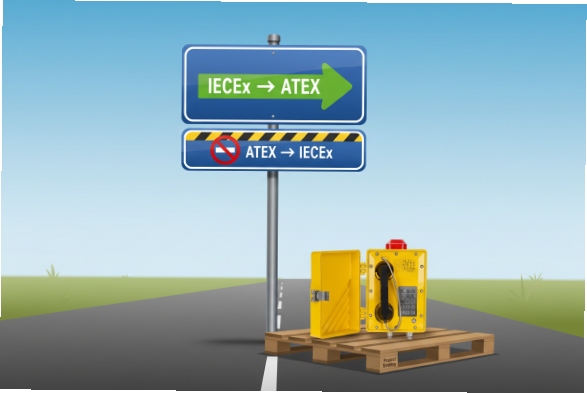
Yes, an IECEx Test Report (ExTR) is commonly used to support an ATEX certification application, significantly reducing time and cost. However, the reverse is rarely true; ATEX documentation cannot typically be used to obtain IECEx certification because IECEx does not recognize the EU-specific legal aspects of ATEX.
The One-Way Street
The "IECEx first" strategy is the industry standard for efficient certification.
-
The Golden Path (IECEx -> ATEX):
- We test the telephone according to IEC standards.
- We get an IECEx ExTR (Test Report) and Certificate.
- We submit this ExTR to an EU Notified Body 10.
- Since the standards are harmonized, the Notified Body reviews the report, adds the specific EU legal documentation, and issues the ATEX Certificate.
- Result: Two certificates for little more than the price of one testing session.
-
The Dead End (ATEX -> IECEx):
- If a product is tested only for ATEX, the report might reference EN standards or include self-declarations that IECEx does not accept.
- Converting this to IECEx usually requires a full re-test and a new factory audit (QAR).
Why this matters to you: When buying from DJSlink or any supplier, ask if the product is "dual-certified." A product with both ATEX and IECEx covers 90% of the world’s markets (excluding North America), giving you maximum inventory flexibility.
Conclusion
While ATEX and IECEx share the same technical DNA regarding protection concepts, they serve different masters: EU law versus global trade standards. ATEX requires QAN and CE markings for Europe, while IECEx uses QAR and is the global passport for hazardous areas. For the most versatile solution, look for dual-certified telephones that leverage the "IECEx first" approach, ensuring your equipment is welcome in virtually any hazardous location worldwide.
Footnotes
-
The EU directive 2014/34/EU covering equipment and protective systems intended for use in potentially explosive atmospheres. ↩
-
The International Electrotechnical Commission System for Certification to Standards Relating to Equipment for Use in Explosive Atmospheres. ↩
-
A protection method where the enclosure can withstand an internal explosion without igniting the surrounding atmosphere. ↩
-
A protection method applied to electrical equipment that does not produce arcs or sparks in normal service. ↩
-
Quality Assurance Notification, required for manufacturing ATEX certified equipment. ↩
-
Conformité Européenne, a certification mark indicating conformity with health, safety, and environmental protection standards. ↩
-
National Electrical Code, a standard for the safe installation of electrical wiring and equipment in the United States. ↩
-
China Compulsory Certification, a mandatory safety mark for many products imported, sold or used in the Chinese market. ↩
-
National Institute of Metrology, Quality and Technology, the Brazilian regulatory agency. ↩
-
An organization designated by an EU country to assess the conformity of certain products before being placed on the market. ↩