
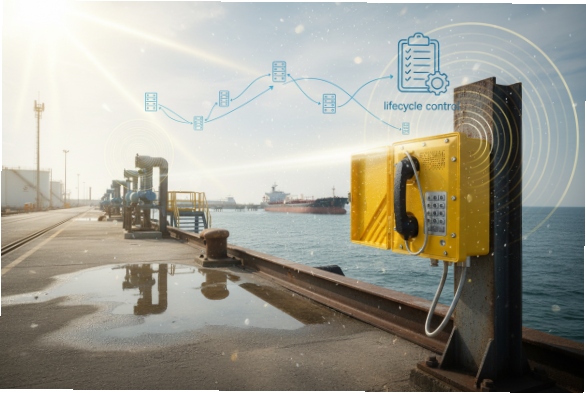
When a terminal phone fails, it is never “just a phone.” It can stop operations, slow emergency response, and trigger long safety discussions.
Explosion-proof telephones 1 in terminals face four hard challenges: harsh marine weather, weak edge networks, extreme noise, and strict ATEX/IECEx lifecycle control that must stay valid after years of maintenance.
The real failure forces behind “random” terminal phone outages?
Most terminal issues look random only because the failure chain is hidden. The chain often starts with weather, then moves into sealing and corrosion, then hits the network, and ends as poor audio or missed calls. A phone can be perfectly certified and still fail daily work if the site is a jetty with salt fog and heavy rain. It can also pass all bench tests and still sound useless in wind and pump noise. So the right way to think about challenges is to group them into forces that act on the device every day.
Marine exposure works like a slow grinder
Salt spray 2 does not “damage” devices in one day. It breaks coatings, creeps into gaps, and locks fasteners. It also turns small sealing problems into big ones. On a jetty, wind-driven rain can push water into places that would stay dry on a wall in a plant room. UV then hardens gaskets and key membranes. After that, keypad failures and audio port clogging start.
Terminals spread across wide areas. Cables are long, cabinets are far apart, and the “last 50 meters” is usually the dirtiest part of the network. PoE drop, VLAN mistakes, and QoS gaps all show up as call drop, choppy audio, or one-way voice. LTE backup can help, but it can also add jitter and NAT issues.
Emergency voice must stay clear in noise and wind
A normal desk phone design is weak outdoors. Wind hits the mic and creates low-frequency rumble. Ambient noise masks speech. People shout, but shouting can reduce clarity. Without the right handset design, speaker power, and acoustic tuning, the call connects but the message fails.
Compliance is not a one-time event
ATEX/IECEx 3 compliance can be lost by “simple” maintenance choices. A wrong cable gland, an unapproved spare keypad, or a firmware change without control can put the whole device out of compliance. A terminal needs a lifecycle plan, not only a purchase.
| Challenge force | What it breaks first | How it shows up on site | What teams often do wrong |
|---|---|---|---|
| Salt + rain + UV | Coatings, gaskets, keypad | Sticky keys, water ingress, corrosion | Choose IP rating but ignore gland system |
| Long edge networks | PoE margin, QoS, VLAN | Choppy audio, drop calls, reboots | Blame SIP server before checking power and cable |
| Noise + wind | Mic clarity, speaker reach | “Call is connected but useless” | Add volume only and ignore intelligibility |
| Lifecycle control | Ex integrity, traceability | Audit failure, stop-use order | Swap parts like a normal phone |
These forces explain why a terminal needs more than an Ex label. It needs an outdoor survival design, a network plan, an audio plan, and a compliance plan that stays strong for years.
A good selection and maintenance program starts by accepting these forces. The next sections break them down into clear risks and clear countermeasures.
How do salt spray, UV exposure, and heavy rain impact corrosion resistance, sealing, and keypad durability on jetty installations?
Salt air and sunlight do not “test” a phone. They attack it every hour, even when no one touches it.
Salt spray drives corrosion and fastener seizure, UV hardens gaskets and keypad membranes, and heavy rain finds weak cable entries and audio ports, so sealing and material choices decide whether the phone survives the jetty.
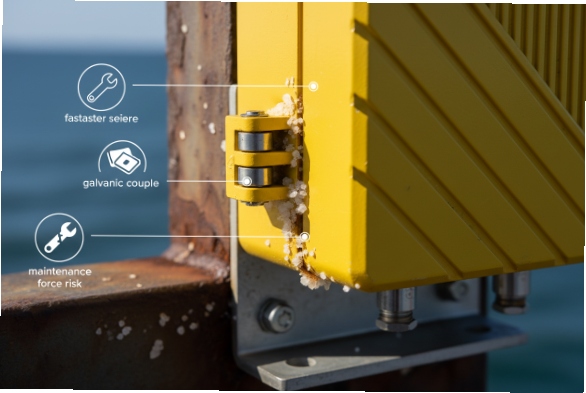
Salt spray: corrosion is more than rust
Salt carries ions that speed up corrosion. It also creates galvanic problems when different metals touch. A common failure is not the enclosure itself. It is the hinge pin, the mounting bracket, the keypad frame, or the small screws that start to seize. Once a screw seizes, maintenance becomes forceful. Force breaks paint. Then corrosion accelerates. Another common failure is corrosion under a label or under a gasket lip. It stays hidden until sealing is already weak.
For jetty use, corrosion resistance needs a complete approach:
-
316L stainless 4 enclosure or a proven marine coating system
-
stainless external hardware, hinges, and brackets
-
isolation washers or design steps to limit galvanic coupling
-
clear rules for touch-up and coating repair after installation
UV exposure: it ages elastomers and plastics first
UV damage is quiet. A gasket can look fine but lose elasticity. Keypad membranes can harden and crack at the edges. Handset cords can become brittle. The result is slow water ingress, then internal corrosion, then keypad errors. UV also fades labels. In an emergency, a faded label can waste seconds.
A practical UV plan includes:
-
UV-stable gasket compounds
-
UV-resistant keypad membrane and handset materials
-
etched or durable labels that survive cleaning and sun
Heavy rain and wave splash: sealing fails at entries and openings
Most water ingress starts at cable glands, conduit adaptors, and audio ports. Wind-driven rain pushes water sideways and upward. If a phone uses a breathable vent, it must be designed for marine use, or it will become a water path. Condensation is also common when warm humid air meets a cooler enclosure. If condensation cannot escape, it collects on electronics.
A strong site design treats the gland as part of the phone, not a separate purchase. It also uses drip loops, correct mounting angles, and simple rain shields where allowed.
| Jetty stress | What fails | Site symptom | Practical countermeasure |
|---|---|---|---|
| Salt fog | Fasteners, brackets, seams | Seized screws, pitting, loose mounts | 316L hardware, anti-galvanic design, coating control |
| UV | Gaskets, keypad, labels | Hard keys, cracks, faded ID | UV-stable materials, durable marking |
| Wind-driven rain | Cable entry, mic/speaker ports | Intermittent faults after storms | Approved glands, IP-rated port design, drip loop |
| Condensation | Internal contacts | “Random” reboots and audio issues | Better sealing, controlled venting, periodic inspection |
This is why jetty phones must be specified as a marine system. The Ex rating keeps ignition risk low. The corrosion and sealing design keeps the phone alive.
What network issues—long cable runs, PoE voltage drop, VLAN/QoS gaps, and LTE backup instability—most often degrade SIP call quality at terminals?
Terminal networks are not office networks. Distance, cabinets, and shared traffic all punish voice.
The most common terminal problems are long copper runs near limits, PoE voltage drop margin loss, missing VLAN/QoS rules, and unstable LTE backup links that add jitter, NAT issues, and changing latency.
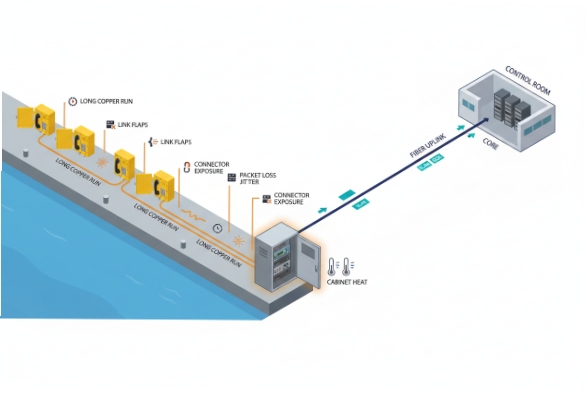
Long cable runs: “it links” does not mean “it is healthy”
Many terminal phones sit near the far edge of copper. The link may come up, but signal quality is weak. Water in conduits, salt in connectors, and sharp bends increase loss. A phone may then downshift speed, flap link, or show packet errors that are not obvious to the PBX team.
A clean approach is to reduce long copper in exposed zones:
-
use fiber to field cabinets
-
keep active devices in safer, controlled enclosures when possible
-
use quality outdoor-rated cable and correct termination practices
PoE voltage drop: power problems look like SIP problems
Voice issues often start as power instability. If PoE voltage drop 5 at the phone dips under load, the phone can reboot or the CPU can throttle. The PBX sees “unregistered.” People blame SIP. The real cause is cable resistance, switch budget, or poor connectors. PoE margins also shrink when temperature is high or when multiple devices share a small PoE budget.
The fix is not complex:
-
check PoE class and switch budget per port
-
keep cable runs within safe limits and use correct gauge
-
use UPS-backed PoE switches for emergency availability
-
watch reboot patterns and link flaps as power clues
If voice traffic shares a busy network without QoS, packet delay and jitter rise. Calls then sound robotic or drop. VLAN mistakes are common after maintenance. A phone might still register, but RTP may be blocked or shaped wrongly. Another issue is firewall rules that allow SIP but block media ports, which causes one-way audio.
A practical terminal plan includes:
-
SBC or gateway policies that keep NAT and media stable
LTE backup: useful, but often unstable for real-time voice
LTE 8 links can change latency minute by minute. They can also sit behind carrier NAT. SIP keepalives may help, but audio still suffers when jitter spikes. LTE is best used as a planned backup path with clear expectations, not as a silent “always good” link.
For LTE, it helps to:
-
test voice during peak hours, not only in the lab
-
use stable VPN or SBC methods that handle NAT well
-
keep codec choice conservative when the link is weak
| Network risk | What it does to SIP/VoIP | Common field sign | Best control |
|---|---|---|---|
| Long copper at edge | Packet errors, link flaps | Choppy audio, re-registrations | Fiber to cabinets, better cabling practices |
| PoE margin loss | Reboots, unstable performance | “Phone is dead” after storms | PoE budget checks, UPS, cable gauge control |
| VLAN/QoS missing | Jitter and loss under load | Audio breaks during busy shifts | Voice VLAN, QoS trust and policies |
| LTE backup instability | Variable delay and NAT issues | Calls connect but audio is weak | SBC/VPN plan, conservative codecs, real-hour testing |
In terminals, call quality is a systems problem. SIP phones need strong network basics. Without that, even the best hardware sounds bad.
How can extreme ambient noise and wind be mitigated using noise-canceling handsets, high-SPL speakers, or horn solutions while keeping speech intelligible for emergencies?
Loudness alone does not solve emergencies. A louder wrong sound can still be unclear.
The best approach combines a noise-canceling handset mic, wind-resistant design, high-SPL speakers for hands-free, and horn or beacon solutions for alarm use, with tuning focused on speech intelligibility.
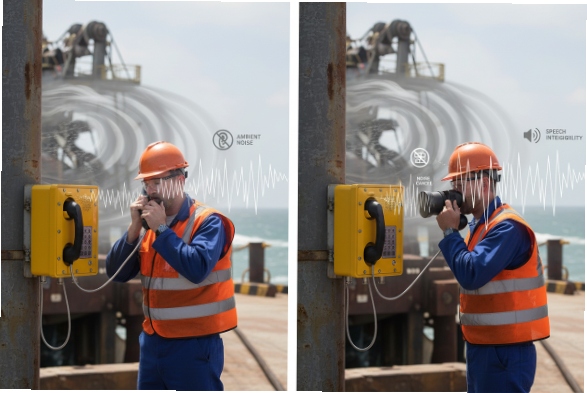
Noise and wind attack speech in different ways
Ambient noise masks speech. Wind adds low-frequency rumble that confuses the mic and compresses speech. Many people respond by shouting. Shouting can reduce clarity because it overloads the mic and makes consonants less clear. So the goal is not only higher volume. The goal is a higher speech-to-noise ratio and stable mic behavior in wind.
Noise-canceling handsets: the first choice for clear emergency voice
A handset puts the mic close to the mouth and away from wind. A good noise-canceling 9 mic uses dual-mic or directional pickup to reduce background noise. For jetty work, the handset should also have a wind screen and strong sealing at the mic port. Push-to-talk can also help in high noise, because it reduces accidental noise bursts.
What to verify in tests:
-
intelligibility when the user speaks normally
-
intelligibility when wind is present
-
how the mic behaves with PPE and masks
High-SPL speakers: needed for hands-free and group use
Hands-free mode is useful when the caller’s hands are busy. In high-noise areas, a higher sound pressure level is needed. Still, high SPL can cause feedback or echo. A good design uses echo control and careful acoustic paths. It also uses frequency shaping that favors speech bands, not only bass.
Horn solutions: best for alerting and paging, not for two-way talk
Horn speakers work well for alarms, tones, and paging into noisy zones. They can also support one-way instructions during emergency response. For two-way talk, horns are less ideal because they can increase echo and reduce privacy. The better pattern is:
-
use a phone for two-way emergency calls
-
use horns or PAGA speakers for paging and alerting
-
link them by SIP paging, multicast, or gateway integration where allowed
| Mitigation tool | Best use | Strength | Limit |
|---|---|---|---|
| Noise-canceling handset | Two-way emergency calls | High clarity in noise and wind | Needs user to pick up handset |
| Wind-resistant mic design | Outdoor calling | Reduces rumble and clipping | Must be proven in real wind |
| High-SPL speaker | Hands-free calling | Better audibility | Can add echo if not tuned |
| Horn speaker / PAGA | Paging and alarms | Cuts through noise | Not ideal for two-way talk |
A terminal acceptance test should always include real noise. A simple test is to stand near pumps or loading operations, place a call to dispatch, and check if words are understood without repeating. If that test fails, the phone is not ready for emergencies, even if it is certified.
Which ATEX/IECEx documents, QAN/QAR controls, maintenance routines, and spare-part rules are needed to keep explosion-proof telephones compliant over the full lifecycle?
Compliance can fail slowly, then fail suddenly in an audit. The root cause is often uncontrolled maintenance.
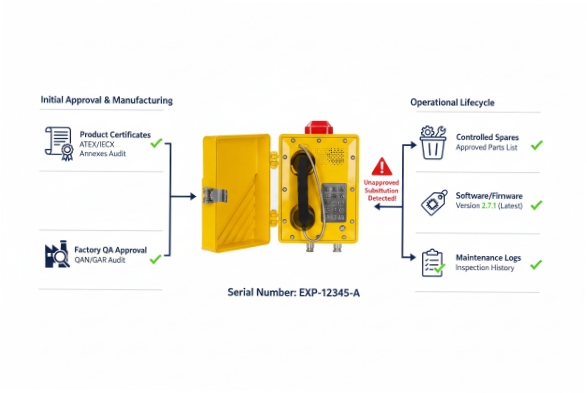
A full lifecycle plan needs valid ATEX/IECEx certificates and schedules, factory QA controls like QAN/QAR, documented maintenance routines, and strict spare-part substitution rules tied to the certified bill of materials.
Documents that must match the delivered model
A terminal should keep a clean document pack per phone model and per variant. The key items include:
-
ATEX and/or IECEx certificates with annexes that list options and special conditions
-
EU Declaration of Conformity for EU projects
-
installation and safety instructions that define cable entry rules and service limits
-
nameplate and marking details that match the certificate
The annex matters because it often lists allowed cable glands and conduit entries. If the site uses a different entry, the Ex integrity can be broken, even if the phone body is correct.
QAN/QAR controls: the “proof of controlled production”
Explosion-proof products need controlled manufacturing. Quality approvals show that production is audited and traceable. The terminal team should verify:
-
factory name and address on the quality approval
-
scope that covers the protection concept used in the phone
-
validity and surveillance status
-
traceability from serial number to production batch
This matters when spare parts and replacements are ordered later. Without production control, the “same model” can drift.
Maintenance routines that protect Ex integrity and uptime
A terminal should treat these phones like safety devices:
-
periodic inspection of cable glands, conduit seals, and mounting
-
check gasket condition and door closure torque feel
-
check keypad operation and membrane condition
-
check handset cord strain relief and hook switch action
-
verify call function with a test call schedule
-
review logs for reboots and link flaps, since power faults are common
Maintenance should also include cleaning rules. Some solvents and cleaners can damage key membranes and gaskets. A short approved-cleaner list helps.
Spare-part rules: prevent “look-alike” substitutions
The biggest lifecycle risk is unapproved substitutions:
-
replacing a cable gland with a non-approved type
-
installing a keypad membrane that is not the certified part
-
swapping a handset cord with a different material
-
making firmware changes without impact review
A strong spare program defines:
-
approved part numbers tied to the certified revision
-
a minimum spare kit per site
-
who is allowed to replace what
-
which repairs must return to the factory
| Lifecycle control | What it protects | What to keep on file | What breaks compliance most often |
|---|---|---|---|
| ATEX/IECEx cert pack | Zone suitability and conditions | Certificate + annex + instructions | Wrong gland or wrong option used |
| EU DoC (EU sites) | Legal conformity | DoC matching model and marking | DoC does not match nameplate |
| QAN/QAR 10 | Controlled production | Valid approval with factory address | Factory change without updated approval |
| PM routine | Uptime and sealing | Inspection records + test call logs | Ignored gasket and gland wear |
| Spare rules | Ex integrity | Approved parts list + revision control | “Equivalent” parts installed in the field |
The lifecycle goal is simple: keep the phone as the certified design, keep sealing and corrosion under control, and keep a record trail that is easy to show in audits.
Conclusion
Terminal failures come from weather, weak edge networks, and noise, then audits add pressure. A strong program uses marine design, voice-grade networking, intelligible audio, and strict ATEX/IECEx lifecycle control.
Footnotes
-
Hazardous area communication devices designed to contain internal explosions. ↩
-
Accelerated corrosion test method used to evaluate the corrosion resistance of materials and coatings. ↩
-
Global and European certification standards for equipment used in explosive atmospheres. ↩
-
Marine-grade stainless steel with molybdenum for superior corrosion resistance in chloride environments. ↩
-
Loss of electrical potential along a wire which can cause device failure if excessive. ↩
-
Virtual Local Area Network used to segment and prioritize traffic types like voice. ↩
-
Network mechanisms to prioritize critical traffic like voice to prevent jitter and loss. ↩
-
Wireless communication standard often used for backup connectivity in remote terminals. ↩
-
Audio technology using active or passive methods to reduce unwanted ambient sound. ↩
-
Quality Assurance Notification/Report required for manufacturers of Ex equipment. ↩








