Dust hazards get ignored until a layer builds up, heat rises, and a “certified” device becomes the weak link. That is how small labels turn into big incidents.
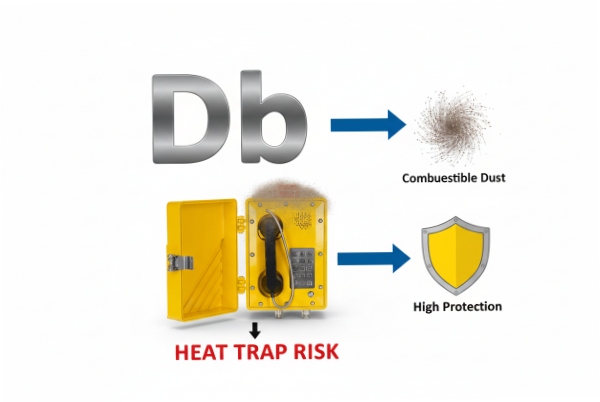
“Db” is the Equipment Protection Level (EPL) for combustible dust atmospheres that indicates a high level of protection, typically suitable for Zone 21 and also acceptable for Zone 22 when the full marking and certificate match.
Understanding “Db” on dust-rated Ex telephones
“D” is dust, and “b” is the protection level
On hazardous-area nameplates, the first letter tells the atmosphere type. “D” means combustible dust. The second letter is the protection level inside the EPL system. The common set is Da, Db, Dc. These levels describe how likely the equipment is to become an ignition source when dust is present.
Db sits in the middle. It is not the highest level, but it is strong enough for many industrial dust locations. When a heavy-duty telephone is installed near conveyors, bagging lines, mills, or bulk handling, dust clouds can happen during normal work. Dust layers can also settle on the phone body and trap heat. Db is meant for that kind of reality.
Dust ratings behave differently than gas ratings
Gas ratings often focus on flame propagation and ignition energy. Dust ratings add another problem: dust can insulate the surface. That means the phone can run at an acceptable temperature in a clean lab, but get hotter in the field once a layer forms. Dust can also enter enclosures and create internal heating or tracking paths. That is why dust marking includes a maximum surface temperature in °C, not a “T-class” like gas.
A practical way to stay safe is to read Db as two questions:
1) Is the phone protected well enough for where dust can be present?
2) Is the surface temperature low enough even when dust layers are expected?
A fast map that helps during specification reviews
| EPL (Dust) | Protection level | Typical dust zone fit | Common marking style clue |
|—|—|—|—|
| Da | Very high | Zone 20 (also 21, 22) | Often paired with Ex ta |
| Db | High | Zone 21 (also 22) | Often paired with Ex tb |
| Dc | Enhanced | Zone 22 | Often paired with Ex tc |
When a buyer asks, “Is Db good enough?”, the right answer is never “yes” by itself. It becomes “yes” only after the zone, dust group, surface temperature, and certificate conditions line up.
Now let’s pin down exactly what EPL Db indicates, so the label is read the same way by engineering, EHS, and inspectors.
A clear shared definition saves time later, because cable glands, mounting choices, and cleaning plans all depend on the zone intent.
What Equipment Protection Level does “Db” indicate for combustible dust atmospheres?
A dust-rated phone can still be rejected if the wrong EPL is chosen. The rejection usually happens when Zone 21 equipment is supplied for a Zone 22 area, or the other way around.
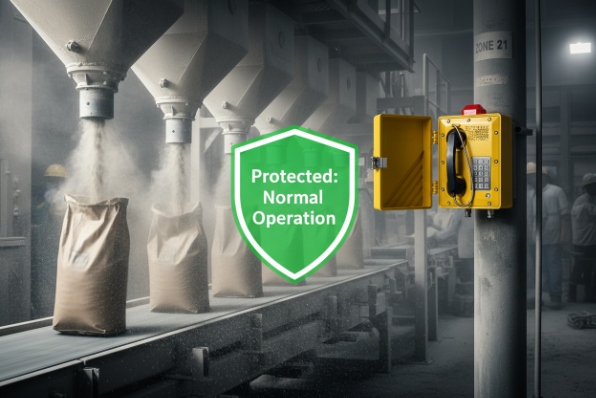
“Db” indicates a high level of protection for combustible dust, intended for use where dust clouds are likely in normal operation (typically Zone 21), and it can also be used in Zone 22 because it exceeds the minimum level there.
What “high level of protection” means in practice
For a telephone, “high level” is not a marketing line. It means the design and testing show the product is unlikely to ignite dust in normal service and under expected disturbances. In real projects, “expected disturbances” can include things like minor component failures, temperature drift, vibration effects on seals, or wear on cable entries over time. The exact fault expectations depend on the protection concept used.
Most dust-rated industrial telephones use protection by enclosure 1 (Ex t). That focuses on limiting dust ingress and controlling external surface temperature. Some designs may also combine methods if there are internal circuits that need additional control.
How Db relates to common ATEX category language
Many teams speak in ATEX categories during procurement. A useful cross-language reminder is:
This is not a shortcut for compliance, but it helps procurement and engineering speak the same language when comparing datasheets and tenders. The real pass/fail point is still the certificate marking and the installation standard used on site.
A simple cross-reference table for fast screening
| Item | Db-focused meaning | What to verify on the phone |
|—|—|—|
| Atmosphere | Combustible dust | Marking includes D and a dust protection concept |
| Protection level | High | Nameplate shows Db, not Dc, for Zone 21 intent |
| Typical zone | Zone 21 | Area classification matches the zone selection |
| Typical ATEX category link | Often II 2D | ATEX marking supports the same intent when ATEX applies |
In my day-to-day quoting, the mistake I see most is treating Db as “the dust version of explosion-proof” and stopping there. A more reliable approach is to treat Db as one piece in a chain. The next piece is zone mapping, because the same phone may be moved from a process area (Zone 21) to a perimeter storage area (Zone 22) during plant changes.
That movement is where mistakes happen, because the label stays the same but the risk profile changes.
So the next section focuses on how Db maps directly to Zones 21 and 22, and what that means for where an Ex telephone is allowed to be installed.
How does “Db” map to dust Zones 21 and 22 for Ex telephone installation?
Zone labels sound simple, but dust zones get reclassified often. Operations change, cleaning schedules change, and ventilation changes. Then a “safe” location becomes questionable.
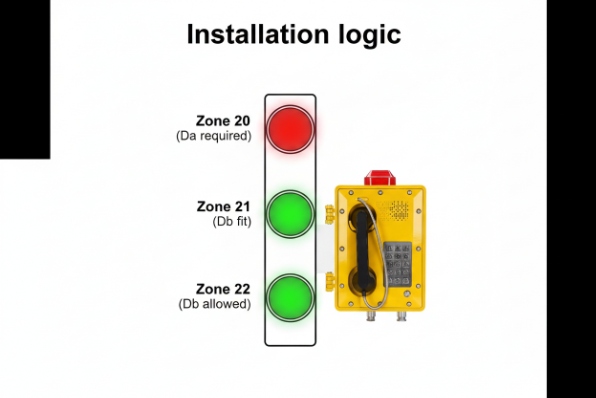
Db is typically intended for Zone 21, where combustible dust clouds can occur during normal operation, and it is also suitable for Zone 22, where dust clouds are not expected in normal operation or occur only briefly. Db is not intended for Zone 20.
The zone meaning that matters for telephones
A telephone is usually mounted at human height, near walkways, equipment skids, or loading points. That placement matters because dust clouds often form at transfer points and during bag dumping. If the phone is in a Zone 21 area, the design must assume dust clouds may happen as part of normal work.
Zone 22 is often the “surrounding” area. Dust is present as a layer, and clouds might happen only during abnormal events, like a spill or a maintenance activity. A Db-rated phone generally exceeds the minimum for Zone 22, but installation still needs to match the certificate conditions.
Zone 20 is the most demanding. It assumes a dust cloud is present continuously, for long periods, or frequently. A Db phone is not the correct choice there. If the project has Zone 20, it usually pushes toward Da 5 equipment and stricter temperature control.
Installation logic that reduces compliance risk
A safe selection rule is:
-
Install Db equipment in Zone 21 when the rest of the marking matches the dust type and temperature requirements.
-
Install Db equipment in Zone 22 when it still matches the dust group and surface temperature requirements, and when site practices accept higher-than-minimum EPL equipment.
-
Do not install Db equipment in Zone 20 unless the phone is also marked Da for dust (which is uncommon for rugged telephones).
A practical mapping table for project documents
| Dust zone | Typical dust presence | Minimum EPL usually expected | Can a Db phone be installed? |
|—|—|—|—|
| Zone 20 | Continuous or frequent dust cloud | Da | No, not unless it is also marked Da |
| Zone 21 | Likely dust cloud in normal operation | Db | Yes, when full marking and certificate match |
| Zone 22 | Dust cloud unlikely or brief | Dc (or higher) | Yes, Db is higher than Dc when other details match |
For field teams, I also recommend writing the zone and required surface temperature on the installation drawing next to the device tag. That small detail prevents “helpful” swaps during commissioning.
Now we move to the part inspectors care about most: Db must be supported by the rest of the Ex marking. Without the protection type, dust group, and surface temperature, “Db” is not enough to prove suitability.
So the next section breaks down exactly which marking elements should appear with Db on a telephone nameplate, and how to read them as a complete sentence.
Which Ex marking details must accompany “Db”, such as Ex t, dust group, and maximum surface temperature?
A nameplate that only shows “Db” creates false confidence. A correct Ex label is structured. Each piece answers a specific safety question.
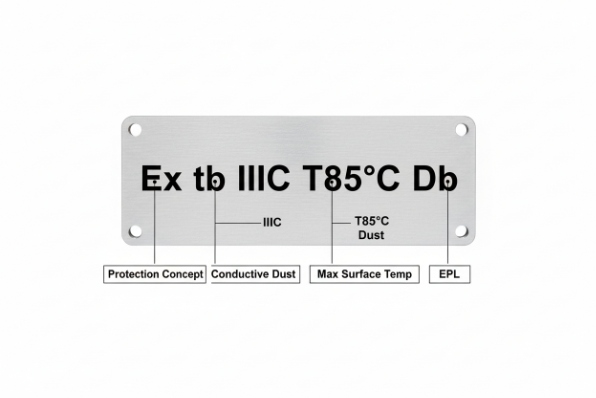
With “Db,” the marking should include the protection type for dust (commonly Ex t with level “tb”), the dust group (IIIA/IIIB/IIIC), and a maximum surface temperature expressed in °C, often along with ambient range and any special conditions.
The dust protection concept you should expect to see
For dust, many certified telephones use Ex t (protection by enclosure). Within Ex t, the letter can reflect the level:
-
Ex ta often aligns with Da
-
Ex tb often aligns with Db
-
Ex tc often aligns with Dc
So, if the phone claims Db, it is common to see Ex tb on the nameplate. If you see Db without a clear dust protection concept, treat it as incomplete until the certificate confirms the marking.
Dust group: IIIA, IIIB, IIIC
Dust group 6 indicates the nature of the dust hazard:
-
IIIA: combustible flyings (larger particles)
-
IIIB: non-conductive dust
-
IIIC: conductive dust
A phone marked IIIC is generally the most demanding dust group among these. If the site dust is conductive, IIIC is often required. If the site dust is non-conductive, IIIB may be sufficient. This is not a guess. It should match the site hazard study.
Maximum surface temperature must be shown in °C
Dust marking commonly uses a temperature like T85°C or T120°C. This is the maximum permitted surface temperature under rated conditions. It must be compared against the dust ignition characteristics and any dust layer assumptions used in the certification.
In outdoor installations, ambient temperature can drive the decision. A phone that is safe at Ta -20°C to +40°C may not be safe at Ta +55°C in direct sun. The correct approach is to check the ambient range printed on the nameplate and listed on the certificate.
A nameplate “sentence” example and what each part means
A common combined dust marking line can look like:
- Ex tb IIIC T85°C Db
| Marking element | Example | What it answers |
|—|—|—|
| Protection concept | Ex tb | How dust ignition risk is controlled by enclosure protection level |
| Dust group | IIIC | What dust type severity the device covers |
| Max surface temp | T85°C | How hot the surface can get at worst case |
| EPL | Db | Which dust zone protection level is targeted (Zone 21 intent) |
For telephones, it is also smart to look for related details nearby on the label or datasheet, such as:
-
enclosure IP rating 7 (dust ingress control depends on this in practice)
-
cable entry thread and gland requirements
-
any “X” special conditions that require specific installation steps
The label gives the summary. The certificate gives the rules. The next section focuses on verification, because Db on a nameplate is only trustworthy when it matches the official ATEX/IECEx paperwork and when the factory quality system keeps the build consistent.
This matters even more for OEM/ODM projects, where branding changes are easy but compliance control must stay strict.
So the last section lays out a practical cross-check method that buyers and integrators can apply without slowing the project down.
How can “Db” be cross-checked with ATEX/IECEx certificates and the supplier’s production quality assurance records?
A supplier can print “Db” on a label in one day. True compliance requires controlled design, controlled production, and controlled changes. That is where audits and quality records matter.
Cross-check “Db” by matching the exact nameplate marking to the ATEX/IECEx certificate marking section, confirming the supplier’s production quality assurance coverage (such as IECEx QAR or ATEX quality modules), and enforcing change-control so OEM/ODM modifications do not break certified construction.
Step 1: Match the nameplate marking to the certificate wording
The cleanest method is strict matching. The phone label should match the certificate marking line exactly, including:
-
Ex t level (such as Ex tb)
-
dust group (IIIA/IIIB/IIIC)
-
maximum surface temperature in °C
-
EPL Db
-
ambient range and any special conditions
If the certificate lists multiple variants, the label must match the specific variant being shipped. This is where OEM/ODM labels can accidentally drift, because marketing edits text while engineering assumes the marking stays fixed.
Step 2: Validate production quality assurance coverage
For IECEx, a common expectation is that the manufacturing site is covered by a quality assessment process (often referenced through QAR-type documentation or an equivalent quality assurance scheme within the certification framework). For ATEX, production quality assurance can be controlled through the conformity assessment modules that apply to the equipment category. The point is simple: the factory that builds the phone must be recognized and monitored under the correct framework, not just “ISO in general.”
For buyers, the practical check is:
-
the documents must show the manufacturing location, scope, and validity
-
the product family should be included in scope
-
the supplier should be able to explain how Ex-critical steps are controlled on the line
Step 3: Confirm change-control for OEM/ODM modifications
OEM/ODM work is normal in B2B. It is also where Ex compliance can be damaged by small “harmless” changes. Any of these can affect Db compliance:
-
enclosure material or wall thickness
-
gasket material, gland sealing parts, or cable entry thread type
-
PCB layout, power components, or thermal paths
-
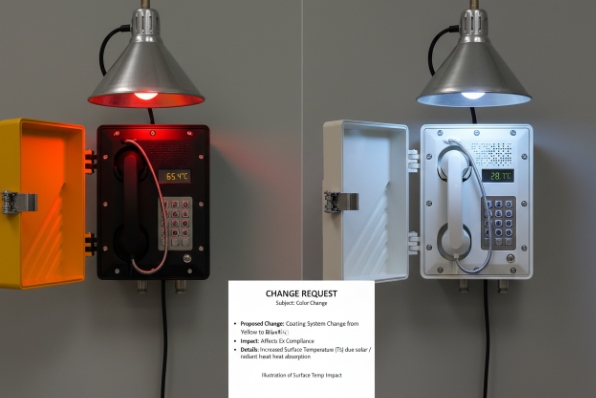
coating systems and external color (heat absorption can change surface temperature)
-
speaker and amplifier changes that affect heating
A reliable practice is to require a documented change process that triggers a certification impact review before release. In my projects, the safest rule is: if a change touches enclosure, seals, heat, or entries, it is treated as Ex-impacting until proven otherwise.
A buyer-friendly verification checklist
| Verification item | What to request | What “good” looks like |
|—|—|—|
| IECEx/ATEX certificate | Current certificate + annex/schedule | Marking line matches the nameplate exactly |
| Certificate conditions | “X” conditions and installation notes | Installer can follow them with available glands and tools |
| Production QA evidence | Site coverage and scope | Factory and product scope are clearly included and current |
| Label artwork control | Label revision record | No label edits without compliance review |
| Change-control log | ECO/ECR records | Ex-impacting changes have formal assessment and approval |
When this checklist is in place, Db on the nameplate becomes a dependable technical claim, not a decorative stamp.
Conclusion
“Db” is the dust EPL for Zone 21 intent, and it stays valid only when Ex tb marking, dust group, surface temperature, certificates, and factory quality control all match.
Footnotes
-
Protection method where the enclosure prevents dust ingress and limits surface temperature. ↩
-
Hazardous area classification where an explosive dust atmosphere is likely to occur in normal operation. ↩
-
Hazardous area classification where an explosive dust atmosphere is not likely to occur in normal operation. ↩
-
Hazardous area classification where an explosive dust atmosphere is present continuously or for long periods. ↩
-
Equipment Protection Level for dust atmospheres with a very high level of protection. ↩
-
Classification of dust based on its conductive properties and particle size. ↩
-
Rating indicating the level of protection against dust and water ingress. ↩