
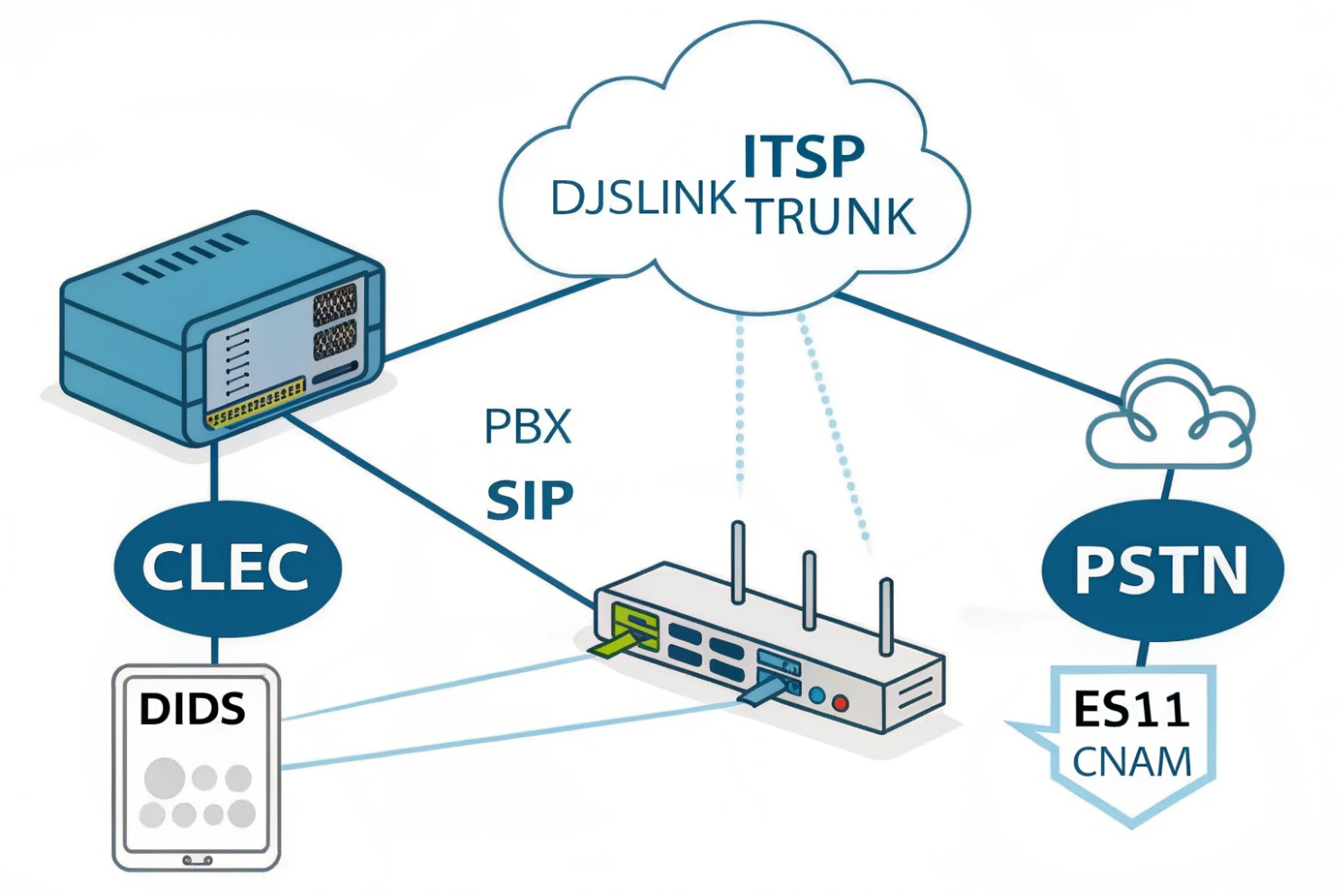
If your numbers will not port or 911 fails, the whole VoIP project stalls. A CLEC is often the hidden piece that controls local telephony.
A CLEC is a regulated competitive local phone carrier that provides local numbers, PSTN interconnect, and services like SIP trunks, porting, E911, and caller ID databases. Many ITSPs are CLECs or partner with them to deliver DIDs and routing to your PBX.
Where a CLEC sits in your VoIP stack
A VoIP deployment looks simple on diagrams. A phone registers to a PBX. The PBX connects to a SIP trunk 1. Calls go out. In real life, local numbers and local interconnect rules sit behind that trunk. A CLEC is the carrier that plays in that regulated local exchange layer. This is why CLEC details show up during number ordering, porting, and emergency calling.
What a CLEC actually “owns” in practice
A CLEC may own network facilities, or it may lease and resell parts of the local network. Either way, it typically controls the service logic tied to local numbers in a given footprint, such as rate centers. That control includes how inbound calls reach your SIP trunk, how porting is executed, and which databases get updated for caller identity and emergency routing.
CLEC vs your PBX responsibilities
Your PBX controls extensions, features, and call handling. The CLEC controls local number resources and interconnection. When something breaks, it matters which side owns the failure.
| Layer | Owner | Examples | What you troubleshoot first |
|---|---|---|---|
| Endpoints | You | SIP phones, intercoms, softphones | VLAN/QoS, firmware, credentials |
| Call control | You | IP PBX, dial plan, routing rules | SIP traces, codec, call flow |
| Local PSTN access | CLEC or ITSP | DIDs, local interconnect, LNP | call completion, DID mapping |
| Databases | CLEC + ecosystem | NPAC/LRN 2, LIDB/CNAM 3, E911 | port status, CNAM, address records |
| Long distance routes | ITSP + carriers | termination paths, global routing | route quality, carrier blocks |
A CLEC matters most when your deployment needs local numbers, reliable inbound delivery, emergency services, and predictable porting. When the plan is “all users use new numbers and never call 911 from the system,” the CLEC still exists, but it will not be the first topic on day one.
Now the big confusion starts: people call everyone a “carrier.” That hides who does what and slows down fixes.
Some clarity here saves weeks later.
How does a CLEC differ from ILEC, ITSP, and carrier?
When a port fails or inbound calls route wrong, the wrong vendor often gets blamed. The fix comes faster when each role is clear.
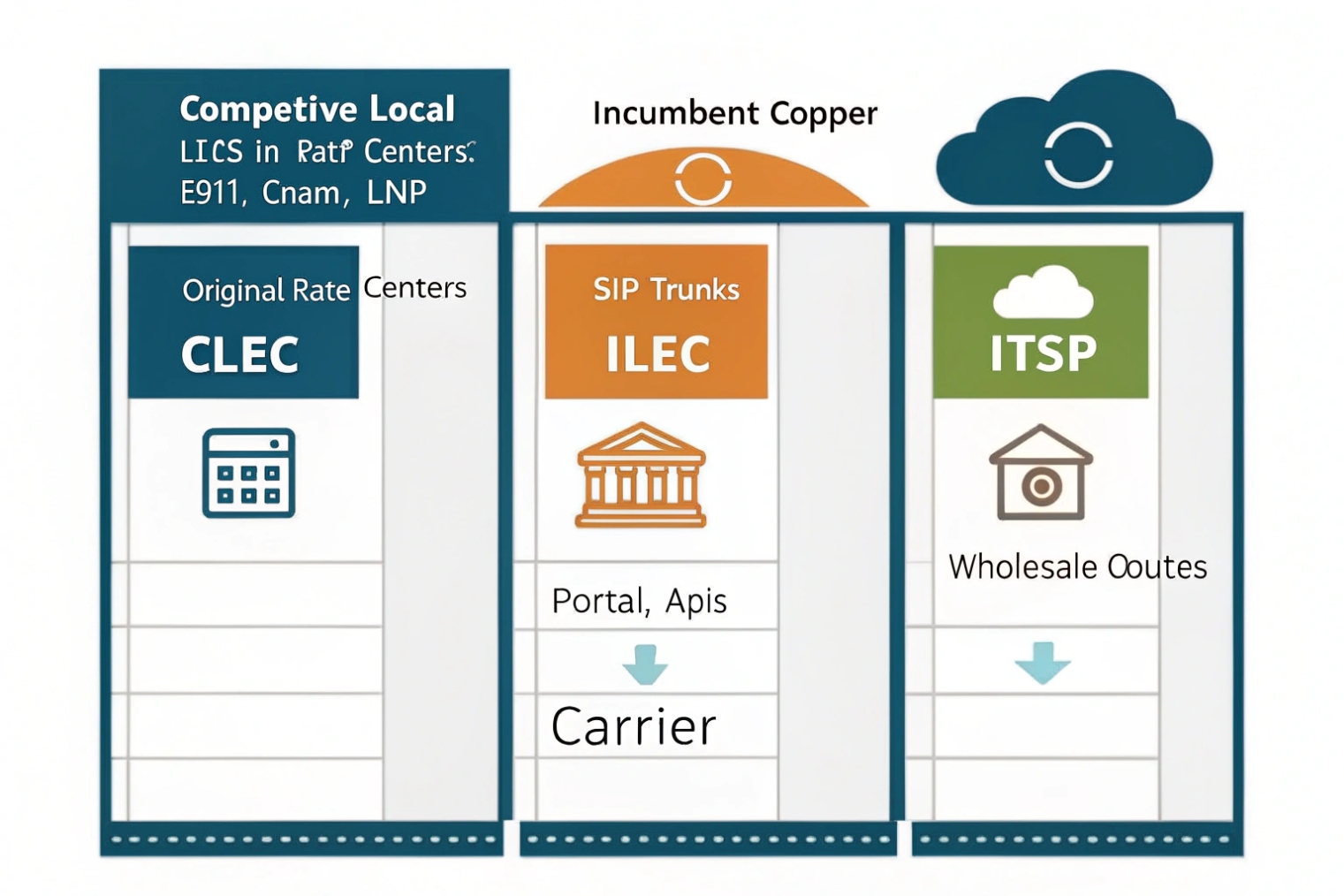
A CLEC competes in local exchange services, an ILEC is the incumbent local carrier in that area, an ITSP sells SIP trunks and call routing, and “carrier” is a broad term that can include CLECs, ILECs, and upstream networks.
CLEC vs ILEC
An ILEC is the incumbent local exchange carrier. It is the traditional local phone company in a region. A CLEC is a competitive local exchange carrier 4 that can also provide local service in that region. In many markets, CLECs can obtain number blocks, interconnect locally, and resell or build facilities to reach customers.
The key idea is not “who has more fiber.” The key idea is “who is authorized to provide local exchange service and manage local numbers.”
CLEC vs ITSP
An ITSP is an internet telephony service provider. It often sells SIP trunks, hosted voice, and APIs. The ITSP may be a CLEC, or it may partner with one. Many ITSPs buy local numbers and local interconnect from a CLEC and then present it to you as “our DIDs.”
So when you “buy SIP trunks,” you might be buying:
- SIP trunk service from an ITSP
- local number and porting capability from a CLEC behind that ITSP
CLEC vs carrier
“Carrier” is a generic term. It can mean a CLEC. It can mean an ILEC. It can also mean a long-distance carrier or a wholesale transit provider. In troubleshooting, this term is too wide. It is better to say:
- local carrier (CLEC/ILEC)
- SIP trunk provider (ITSP)
- upstream carrier (termination partner)
| Term | What it really means | What it usually controls | Why you care in VoIP |
|---|---|---|---|
| ILEC | Incumbent local carrier | legacy local network footprint | last-mile constraints, legacy ports |
| CLEC | Competitive local carrier | local numbers, interconnect options | DIDs, porting, E911, CNAM |
| ITSP | SIP trunk/VoIP provider | SIP edge, routing, portals/APIs | trunks, global routing, support |
| Carrier | broad term | could be any of the above | can hide real ownership |
A clean mental model helps: the CLEC is the local number and local interconnect engine. The ITSP is the SIP wrapper and routing product. Sometimes they are the same company. Often they are not.
What services do CLECs provide—SIP trunks, DIDs, E911, CNAM?
A VoIP project can look “done” when phones register. It is not done until numbers ring, caller ID looks right, and emergency calling is correct.
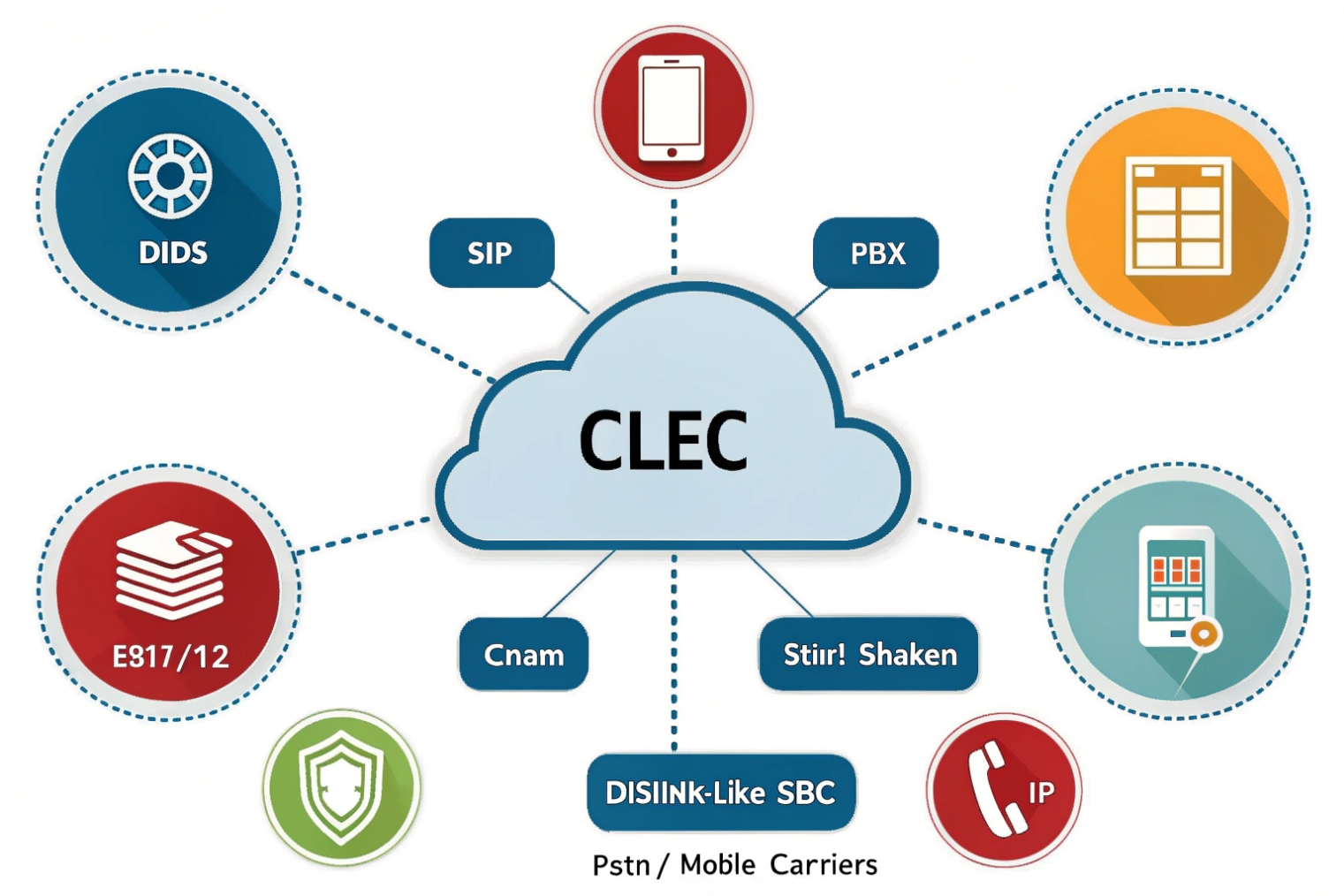
CLECs commonly provide local DIDs, inbound origination to your SIP trunk, outbound termination routes, E911 address binding, and caller identity services like CNAM hosting and database interactions. Many also provide portals and APIs for provisioning and call records.
Local numbers and inbound origination
A CLEC can allocate numbers in specific rate centers and deliver inbound calls to your SIP infrastructure. The inbound mapping usually ties a DID to a trunk or to a SIP registration. Your PBX then handles the rest: IVR, queues, ring groups, and users.
Outbound termination and routing
Many CLECs also terminate outbound calls, either directly or through partners. Quality and pricing vary by destination and route choice. Some providers offer least-cost routing. Others offer quality-based routing. This matters for call completion and answer rates.
E911 and emergency services
Emergency calling is not a checkbox. It is a data problem. The CLEC (or the CLEC behind your ITSP) often binds each DID to a service address. That record must match the actual location that should be sent to the PSAP. For multi-site deployments, this becomes a process, not a one-time setup.
CNAM and caller identity
CNAM behavior is messy because caller name display depends on the terminating network. Still, CLECs often handle the upstream part: storing CNAM records, supporting dips, and enforcing caller ID policies. Identity also links to newer anti-spoofing methods like STIR/SHAKEN call authentication 5 in some markets. A CLEC can influence attestation and number authorization.
| Service | What the CLEC does | What you still must do |
|---|---|---|
| DIDs | allocate and manage numbers | assign routing in PBX |
| SIP origination | deliver inbound calls | ensure trunk reachability |
| Termination | route outbound calls | set dial plan and policies |
| E911 | bind numbers to addresses | keep addresses accurate |
| CNAM | publish or store name data | set correct outbound CLI |
| Fraud controls | rate limits and thresholds | restrict dial plans and roles |
A practical approach is to treat CLEC services as “telephony plumbing.” When the plumbing is correct, the PBX features shine. When the plumbing is wrong, the PBX looks broken even when it is fine.
How do CLECs handle number porting, LNP, and FOC dates?
Porting is where most VoIP timelines slip. People assume it is a simple database change. It is a multi-party workflow with rules and deadlines.
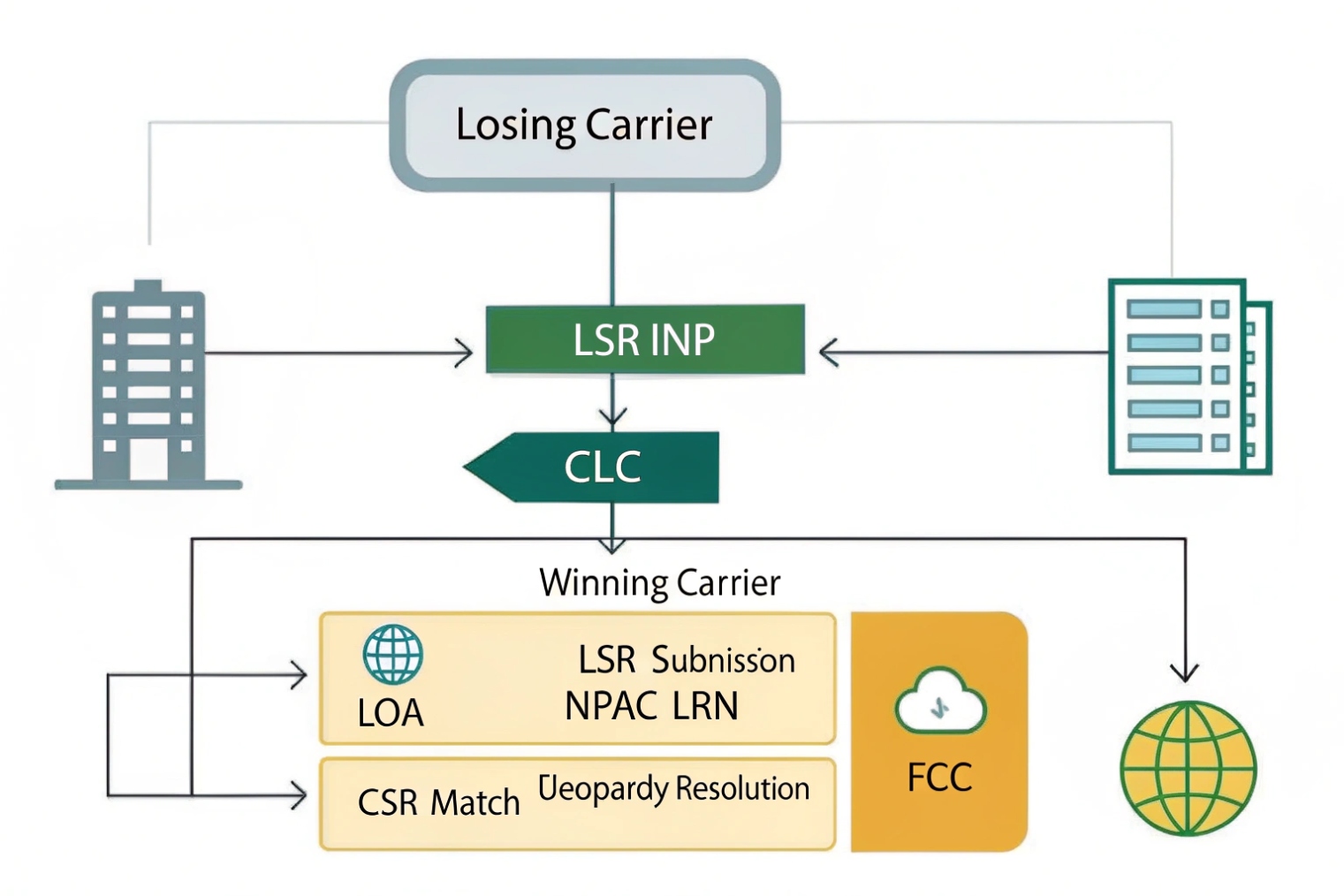
CLECs handle LNP by submitting port requests, validating carrier records, coordinating with the losing carrier, and committing a FOC (Firm Order Commitment) date for the cutover. Delays often come from mismatch in account data or pending services on the number.
What “LNP” means in daily work
Local Number Portability (LNP) 6 is the regulated process that allows you to move numbers between carriers. The destination carrier (often the CLEC) drives the request, but the losing carrier must validate the records and accept the cutover.
A typical workflow looks like this:
- You provide a LOA (Letter of Authorization) and current account details.
- The CLEC submits the port request to the losing carrier.
- The losing carrier validates the info.
- The carriers agree on a FOC date and time window.
- The number “cuts” to the new carrier, and routing updates follow.
Why ports get rejected or delayed
Ports often fail for simple reasons:
- business name mismatch
- service address mismatch
- wrong account number or PIN
- the number is in a pending order state
- the number is part of a complex account (hunt group, PRI, bundled services)
This is why a clean CSR (Customer Service Record) matters. In many cases, the fastest path is to request the CSR from the losing carrier and match it exactly.
FOC and cutover planning
A FOC date is the committed cutover date. It is not the day you “start porting.” It is the day the number should move. A safe cutover plan includes:
- temporary call forwarding as a fallback
- after-hours cutover when possible
- clear test calls before and after cut
- a rollback plan if inbound routing fails
| Porting term | Meaning | Who controls it | What you can do to speed it up |
|---|---|---|---|
| LOA | permission to port | you + new carrier | sign correctly, match entity name |
| CSR | source account record | losing carrier | request it early |
| LNP request | formal port submission | new carrier/CLEC | provide complete docs |
| FOC | committed cutover | losing carrier accepts | avoid changes during port window |
| Jeopardy | port delay notice | either carrier | respond fast with corrected data |
A short story placeholder: one multi-site port failed because the “service address” in the old carrier record was a billing warehouse, not the real office. The fix was simple, but it cost a week because no one checked the CSR early.
For project planning, porting is a schedule risk. It deserves its own checklist and its own owner.
What SLAs, pricing, and taxes should I expect from a CLEC?
Many teams focus on per-minute price, then get surprised by fees, taxes, and terms that impact uptime and support.
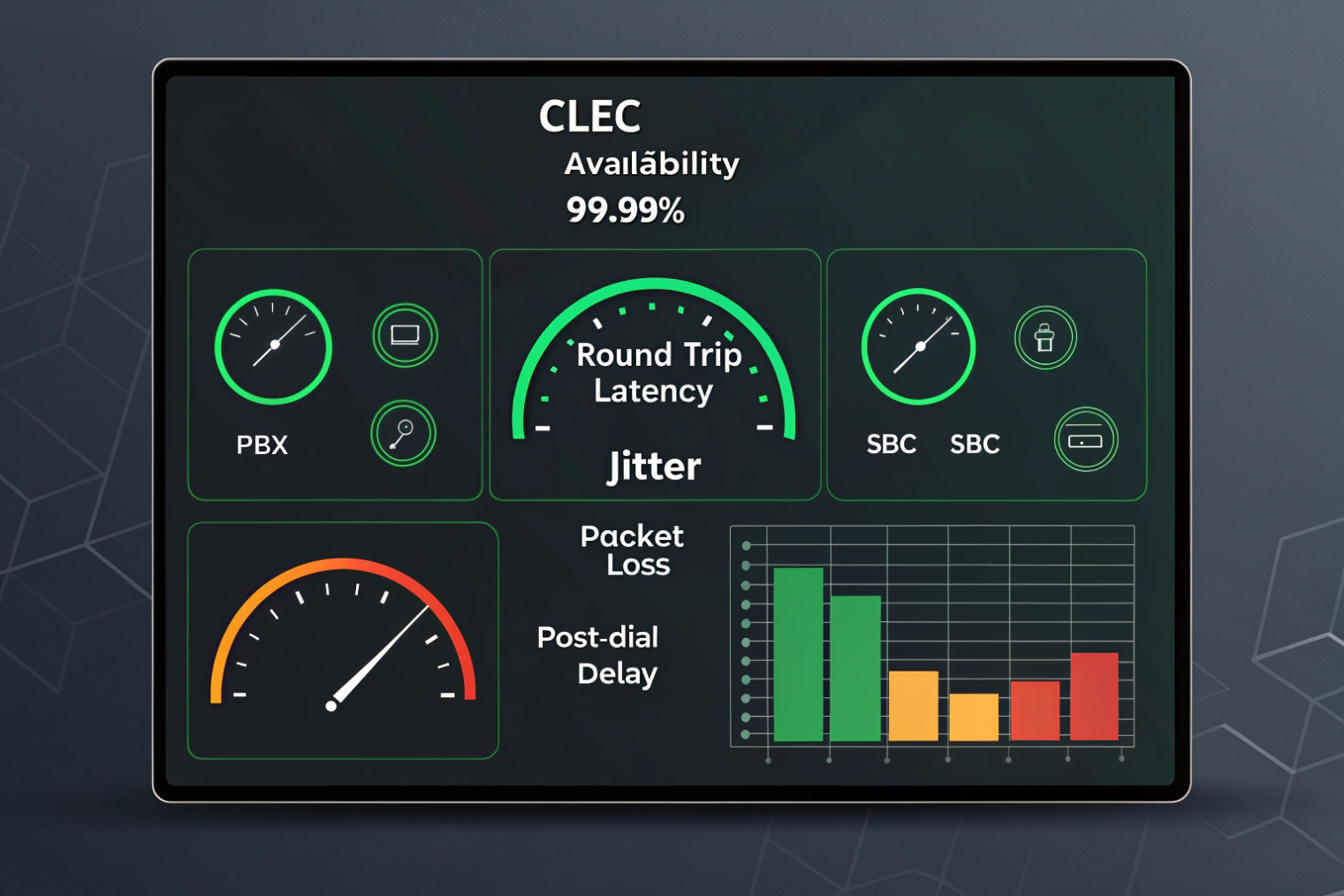
CLEC pricing often includes recurring charges for DIDs and trunk capacity, usage charges for termination, and add-on fees for E911 and database services. Taxes and regulatory fees vary by jurisdiction, so the invoice rarely matches the base rate card.
SLAs: what is realistic to demand
SLAs differ by product type. A SIP trunk delivered over the public internet cannot promise the same performance as a private circuit. Still, a business-grade CLEC or ITSP can commit to:
- trunk/SBC availability
- ticket response times
- clear escalation rules
- maintenance notifications
- call completion targets in broad terms
For emergency calling, the SLA is often more about process and compliance than “speed.” The key is record accuracy, correct routing, and documented testing methods.
Pricing: common line items
Many CLEC invoices include:
- DID monthly charge (per number)
- channel or concurrent call capacity (per trunk group)
- usage per minute (domestic and international)
- origination charges in some cases
- E911 address binding 7 monthly fee per DID or per endpoint record
- toll-free fees and RespOrg items (if used)
- porting fees (one-time or per number)
- CNAM storage or query related charges in some models
The simplest pricing models exist, but “simple” is not universal. Some providers bundle domestic calling. Others meter everything. A clean requirement list helps compare offers.
Taxes and regulatory fees
Telecom billing can include:
- federal and state taxes (varies by country)
- universal service contributions in some markets
- 911 fees and local surcharges
- local telecom taxes and municipal fees
- regulatory recovery fees (provider-specific)
These fees change by location and by service classification. The safest budgeting method is to ask for a sample invoice using your expected DID counts and call volume.
| Category | Typical billing model | What to clarify in writing |
|---|---|---|
| DIDs | monthly per number | rate center coverage and moves |
| Trunk capacity | monthly per channel or per trunk | burst limits, CPS limits |
| Usage | per minute or bundled | destination list and exclusions |
| E911 | monthly per DID or per location | how addresses are managed |
| Porting | per order or per TN | rejection fees and timelines |
| Taxes/fees | pass-through + provider fees | estimate method and audit trail |
A strong CLEC relationship feels boring. Orders complete on time. Ports hit the FOC. Caller ID looks consistent. E911 records are correct. When those basics are stable, the VoIP system looks “easy,” and support load drops.
Conclusion
A CLEC is the local carrier layer behind many VoIP services. It drives DIDs, porting, E911, and identity data, so clear roles, clean records, and realistic SLAs keep your deployment stable.
Footnotes
-
SIP (RFC 3261) defines the signaling used by many trunks; useful for understanding standards behind SIP trunking. ↩ ↩
-
LNPA/NPAC overview showing how ported-number and LRN data is managed and distributed across carriers. ↩ ↩
-
Explains LIDB and CNAM databases and why caller name display varies across terminating networks. ↩ ↩
-
FCC PDF explaining CLEC roles and classification, helpful context for who controls local numbering and interconnect. ↩ ↩
-
FCC call authentication hub for STIR/SHAKEN, attestation, and policy updates that affect caller ID trust and blocking. ↩ ↩
-
FCC guide to keeping your phone number when switching providers, including portability rules and common port rejection causes. ↩ ↩
-
FCC guide on VoIP and 911 service explains registered address requirements and limits for emergency calling over VoIP. ↩ ↩








