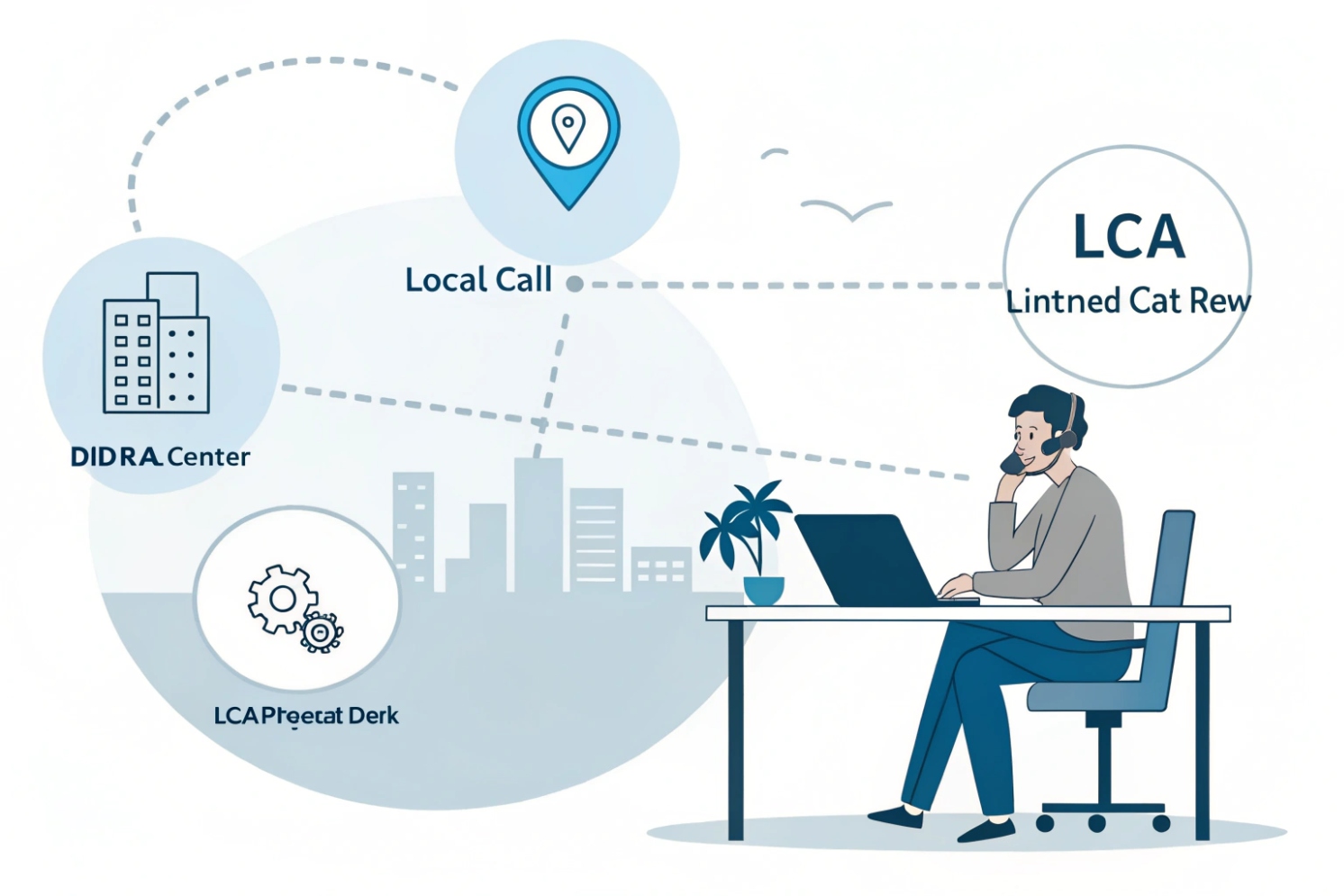
In your VoIP system, a local call refers to a call made to a phone number within the same local calling area or rate center as the caller’s DID (Direct Inward Dialing number) 1. These calls are typically billed at local rates or included in the user’s calling plan, meaning they don’t incur additional long-distance charges.
Local calls are defined not by your physical location or IP address, but by the geographic area of the caller’s DID number. This means that you can place a local call to a number in the same rate center, even if you’re physically located elsewhere, thanks to the flexibility of VoIP.
Key Characteristics of Local Calls:
- Billing: Local calls usually have lower or no additional charges, especially compared to long-distance or international calls.
- Routing: They typically stay within a carrier’s network, avoiding PSTN (Public Switched Telephone Network) hops, which can reduce cost and latency.
- Call Quality: Local VoIP calls often maintain high-quality audio, as they tend to travel over shorter, optimized network paths.
- Number Portability: When you port a geographic DID, the call remains "local" as long as the number is still tied to that geographic area.
Now, let’s dive into some of the details around how carriers define local calls, the impact of SIP trunks vs. PSTN on local calls, and how various elements like caller ID and emergency calling are impacted.
How do carriers define local calling by rate center and LCA?
Carriers use rate centers and Local Calling Areas (LCA) to define the boundaries for local calls, determining what is considered "local" based on geography rather than the actual phone number’s location.
1. Rate Centers:
A rate center is a geographic area that the carrier uses to define local calling regions. Each area code is divided into smaller rate centers. A call is considered local if it originates and terminates within the same rate center 2, typically within the same area code.
2. Local Calling Area (LCA):
An LCA expands the rate center concept by grouping together multiple rate centers that are within a specific distance from each other. Calls within the LCA are also considered local, even if they originate in one rate center and terminate in another, as long as both are within the same local calling area 3.
Why it matters: This definition of "local" is critical for understanding how your VoIP provider bills calls. Calls within the same rate center or LCA are often treated as local, while calls outside of these boundaries may incur long-distance charges, especially in traditional PSTN systems.
| Term | Description | Example |
|---|---|---|
| Rate Center | Geographic area defined by the carrier for local calling | Two cities within the same area code |
| Local Calling Area (LCA) | Multiple rate centers grouped together for local calling | Several nearby cities grouped into one LCA |
Will local calls bill differently on SIP trunks versus PSTN?
The billing structure for local calls can differ between SIP trunks and traditional PSTN lines. While both can carry local calls, the cost structure is different.
1. SIP Trunks:
- Local calls on SIP trunks are typically included in the service plan, especially if the VoIP provider offers unlimited calling within a certain region or country.
- Billing: Local calls are usually billed at a flat rate or are included in the monthly plan, making SIP trunks a cost-effective solution for businesses that make frequent local calls. Many providers explain this as SIP trunking billing models 4 (channels, metered usage, or bundled minutes).
2. PSTN Lines:
- Local calls on traditional PSTN lines may still be subject to per-minute charges, even for calls within the same area or rate center, depending on your service provider and plan.
- Billing: On PSTN, local calls are billed based on the distance between the caller and recipient (though this is often included in flat-rate plans with unlimited local calls).
| Calling Method | Billing for Local Calls | Cost Model |
|---|---|---|
| SIP Trunk | Typically included in plan or low-cost | Flat-rate or unlimited |
| PSTN | Can be per-minute, even for local calls | Per-minute or flat-rate |
In short, SIP trunks generally offer more predictable and cost-effective billing for local calls compared to PSTN, which can still involve per-minute charges for local calls.
Can I keep local caller ID when forwarding or porting numbers?
Yes, you can keep local caller ID when forwarding or porting numbers, but this depends on several factors, especially related to number portability and caller ID configuration.
1. Porting Local Numbers:
When you port a geographic DID (Direct Inward Dialing number) to a new VoIP provider, the number retains its local status, meaning it will maintain its local calling area for incoming and outgoing calls. This includes keeping the area code and rate center, preserving the local presence for your business even if you move locations or change providers.
2. Forwarding Calls:
When you forward calls from one number to another, the local caller ID is preserved as long as the call remains within the same area code or rate center. However, if you’re forwarding to a number outside the local area, the caller ID could show the area code of the forwarding number, or the caller ID may not reflect the local presence accurately.
Tip: Ensure your VoIP provider supports call forwarding with caller ID preservation if maintaining local presence is important for your business.
| Scenario | Caller ID Preservation | Notes |
|---|---|---|
| Porting Local Number | Maintained | Local status remains post-port |
| Forwarding to Another Local Number | Maintained | Local caller ID stays intact |
| Forwarding to Non-local Number | Potentially lost | Caller ID may reflect forwarding number’s area code |
How do local calling rules affect E911, taxes, and compliance?
Local calling areas are tied to specific geographic regions, and this has implications for E911 (emergency calling), taxation, and compliance.
1. E911 (Emergency Calling):
- E911 routing is critical for local calls. The registered address of the DID (local number) determines the correct Public Safety Answering Point (PSAP) for emergency calls.
- If your business uses a local DID, the VoIP and 911 service rules 5 will route emergency calls based on that local address. If the DID is not registered correctly, emergency calls could be misrouted.
2. Taxes:
- In many regions, taxes for phone services are based on the location of the caller or the DID number. Local calls might incur local taxes that vary based on your DID’s area code or rate center. VoIP providers generally collect these taxes based on the DID’s registration.
3. Compliance:
- Local calling also impacts compliance for businesses. For example, in the U.S., local and long-distance services are subject to different regulations. Maintaining the local status of numbers helps align with requirements around phone number porting 6, numbering practices, and service availability.
| Factor | Local Impact | Compliance Consideration |
|---|---|---|
| E911 Routing | Tied to registered local address | Ensures calls are directed to correct PSAP |
| Taxes | Local taxes based on DID’s area code | VoIP providers collect local taxes accordingly |
| Regulations | Local regulations apply for service delivery | VoIP must adhere to applicable rules for local service |
In short, local calling rules significantly affect E911 routing, taxation, and compliance, so it’s important to ensure your VoIP system and provider handle these elements correctly to meet legal and operational requirements.
Conclusion
A local call in your VoIP system refers to calls made within the same rate center or local calling area, benefiting from reduced costs and simplified routing. By understanding how local calling is defined by carriers, the differences in billing between SIP trunks and PSTN, and how it impacts caller ID, E911, taxes, and compliance, you can optimize your VoIP setup to ensure cost efficiency and regulatory compliance.
Footnotes
-
Explains what a DID is and why the DID’s assignment matters for inbound calling and local presence. ↩ ↩
-
Clarifies what carriers mean by “rate center” and how it determines local vs long-distance boundaries. ↩ ↩
-
Shows why “same area code” isn’t the same as “local,” and how LCAs/rate centers drive local calling. ↩ ↩
-
Breaks down common SIP trunk pricing structures so you can predict “local” costs accurately. ↩ ↩
-
Summarizes VoIP E911 expectations so your registered location and routing stay correct. ↩ ↩
-
Practical guide to porting numbers and what to expect when changing providers without losing the number. ↩ ↩