Many teams ask for an “800 number” in VoIP but are unsure who pays, how it routes, or what limits and surcharges exist.
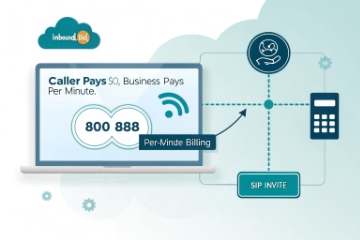
In VoIP, a toll-free number is a special inbound DID where the business, not the caller, pays per minute. The carrier then delivers those calls over SIP trunks to your IP PBX, IVRs, queues, or SIP intercom workflows.
Behind that simple 800 or 888 prefix sits a mix of routing tables, rating plans, and SIP trunk rules. Once what a toll-free number is and how it works 1 is clear, it becomes much easier to design reliable toll-free flows, understand costs, and decide when international toll-free really makes sense.
How does a toll-free number work with SIP trunks?
Sales wants a toll-free hotline on the website, and IT wants everything on SIP trunking 2. If the flow is not clear, everyone worries about reliability and hidden costs.
A toll-free number is hosted by a carrier, pointed at your SIP trunk, then delivered as an inbound call to your IP PBX with the dialed toll-free DNIS and the caller’s ANI.
From toll-free prefix to SIP INVITE
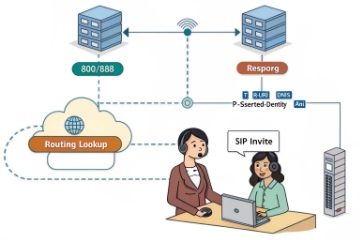
From the outside, callers dial a familiar prefix like 800, 888, 877, 866, 855, 844, or 833 (in North America). On the inside, the routing looks like this:
- Caller dials the toll-free number from a landline, mobile, or VoIP line.
- The originating carrier recognizes it as toll-free and hands the call to the toll-free carrier / Responsible Organization (RespOrg) 3.
- The toll-free carrier looks up your routing: SIP trunk, PSTN trunk, or a failover setup.
- The carrier sends a SIP INVITE request 4 toward your trunk with:
- To / R-URI = your toll-free number (DNIS).
- From / P-Asserted-Identity header 5 = caller’s number (ANI).
- Your IP PBX uses the dialed toll-free DNIS to decide which IVR, queue, or SIP intercom flow should handle the call.
So to your PBX, a toll-free number is effectively just another inbound DID with different billing rules.
Toll-free on multi-trunk and hybrid designs
In many systems we do not send toll-free traffic over the same paths as normal local DIDs:
- One SIP trunk may be dedicated to US/Canada toll-free.
- Another trunk or gateway may handle local geographic DIDs.
- Legacy PSTN (FXO/PRI) may still exist as backup.
A simplified view:
| Layer | PSTN / Toll-free carrier | Your side |
|---|---|---|
| Number ownership | Toll-free number managed by RespOrg | You choose target trunk / IP endpoints |
| Trunk type | TDM or SIP | SIP trunks into IP PBX or SBC |
| Routing decision | At carrier (toll-free routing table) | At PBX (inbound route based on DNIS) |
| Failover options | Alternate trunk or backup number | Backup SIP trunks, PSTN gateway, or voicemail |
The nice part with VoIP is flexibility. You can have the same toll-free number route to an IP PBX in one data center and, on failover, to a second PBX or hosted platform somewhere else.
Can I route toll-free calls to my IP PBX?
Many people still think toll-free calls must land on old analog lines. That is no longer true in most carriers.
Yes. In VoIP, toll-free numbers route cleanly to IP PBXs over SIP trunks, where you can send them to IVRs, queues, ring groups, SIP intercoms, or external forwarding targets.
Mapping toll-free DIDs to PBX objects
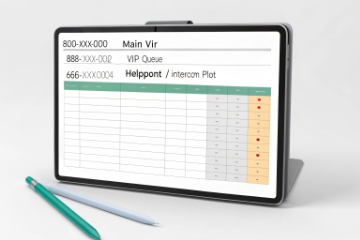
Once your carrier points a toll-free number at your SIP trunk, the PBX sees it as an inbound call with a specific “called number” (DNIS). Then you can map it like any other inbound DID:
- Sales hotline → ring group or contact center queue.
- Technical support → multi-level IVR with skill-based routing.
- Service portal → separate IVR tree or language selection.
- SIP intercom / emergency → special route with higher priority.
Inside the PBX dial plan, you usually create inbound routes that match the toll-free number and choose what happens:
| Toll-free DNIS | PBX destination | Typical use |
|---|---|---|
| 800-XXX-0001 | Main IVR | General customer support |
| 888-XXX-0002 | VIP queue with shorter wait | High-value accounts |
| 877-XXX-0003 | 24/7 on-call ring group | Critical service line |
| 866-XXX-0004 | SIP intercom / help point pilot | Public or campus help phones |
For DJSlink-style deployments, toll-free can also be the front door to SIP intercom systems. For example, remote users or tenants may call a toll-free number to reach a gate intercom menu, which then rings specific SIP endpoints or security desks.
If you need a clean mental model for inbound routing fields, Dialed Number Identification Service (DNIS) and Automatic Number Identification (ANI) 6 are the two key labels to understand.
Failover and disaster routing
Toll-free works well with disaster recovery because the routing decision sits upstream:
- At the carrier side, you can define multiple SIP targets or backup PSTN numbers.
- At the PBX side, you can define failover if an IVR, queue, or trunk is down.
In practice, I often see:
- Primary route → SIP trunk to main IP PBX.
- Secondary route → SIP trunk to backup PBX or hosted UC platform.
- Emergency fallback → simple PSTN number that at least reaches a small help desk.
Because the business pays per-minute, the key is to ensure there is always somewhere for those calls to land, even under partial outages.
What costs or surcharges apply to toll-free calls?
Teams sometimes think toll-free “comes free” with VoIP, then are surprised by line items for mobile surcharges, international origination, and overage.
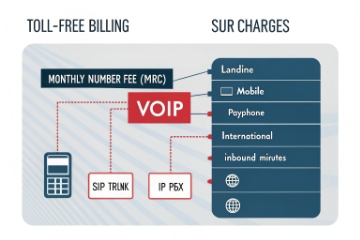
Toll-free numbers usually have a monthly fee plus per-minute inbound charges. Higher rates often apply for mobile, payphone, or international origination, and heavy use can add carrier surcharges.
Basic cost structure
A typical toll-free plan in VoIP looks like this:
- Monthly recurring charge (MRC) for the number itself.
- Included minutes bundle or zero-included, pay-as-you-go.
- Per-minute rate by origin type (landline, mobile, payphone, international).
From the business point of view, the call is “reverse charged”: callers pay nothing extra, you pay the metered usage. This is the core promise of toll-free.
A simple example model:
| Cost element | How it is billed |
|---|---|
| Toll-free number MRC | Flat monthly fee |
| Inbound landline minutes | Low per-minute rate |
| Inbound mobile minutes | Higher per-minute rate |
| Inbound payphone minutes | Highest rate or extra per-call surcharge |
| International origination | Special higher per-minute rate, if allowed |
Less obvious charges and policies
There are some details that often only show up in the fine print:
- Payphone surcharges: Some carriers add per-call fees when calls originate from payphones or certain public devices.
- High-cost destinations: If your toll-free accepts calls from certain territories, those calls may cost far more than domestic landline traffic.
- Spam and abuse impact: Heavy robocall traffic toward your toll-free can raise your bill with no value. That is one reason robust call screening and upstream rate limiting matter.
- SMS / MMS on toll-free: In many regions, enabling SMS requires separate registration and may add a per-message fee plus campaign charges.
From a design angle, I always tie cost planning to call routing:
- Use simple menus so people do not spend minutes lost in IVR loops.
- Keep hold times short with reasonable staffing on toll-free queues.
- Consider using local geographic DIDs or callback workflows for very long or non-urgent interactions.
In short, toll-free is a great front door for customers, but it is not magic free capacity. A clear view of origination types and screening rules keeps your bill under control.
Do international toll-free numbers work across countries?
Marketing often wants “worldwide toll-free support”, but the real behavior of international toll-free numbers is full of edge cases and gaps.
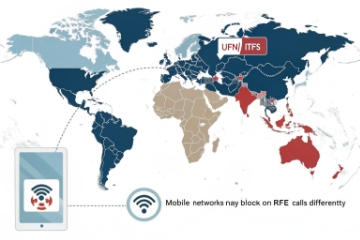
International toll-free numbers (ITFS/UIFN) are country- or region-specific; they do not automatically work worldwide, and coverage, mobile support, and rates vary by origin country and network.
Domestic vs international toll-free
A standard toll-free number is usually valid only inside its home region:
- North American 800/888/877/… numbers are toll-free only from US/Canada and sometimes specific NANPA territories.
- Many callers outside that region cannot reach them at all, or they pay normal international rates.
International toll-free services try to bridge this by providing:
- ITFS (International Toll Free Service): Country-specific numbers (for example, a German 0800 number) that all terminate into your centralized IP PBX via SIP.
- Universal International Freephone Number (UIFN) 7: A unified international-format number with varying reach, still subject to which countries participate.
Coverage is never truly global. Some mobile networks block these numbers, some countries are excluded, and payphones may or may not treat them as free.
Practical design patterns for global support
Because of these limits, I often see mixed strategies:
| Approach | What it looks like | Pros | Cons |
|---|---|---|---|
| Single domestic toll-free only | One US/Canada 800 number | Simple, cheap for core market | Hard to reach from abroad |
| Multiple ITFS numbers | Local toll-free per key country | Best caller experience per market | More numbers to manage, higher cost |
| UIFN where supported | One “global” number for many countries | Cleaner branding | Patchy coverage, setup longer |
| Local geographic DIDs + SIP | Local city numbers forwarded to your IP PBX | Reliable reach, often cheaper | Not “toll-free” for caller in all plans |
| Call-back / web-initiated calling | Customer requests a callback or web call | Good for low-cost global interaction | Needs data or web access |
For SIP intercoms and emergency-oriented endpoints, international toll-free is usually not the right tool. You want local numbers and local emergency paths, or pure SIP between sites, with clear responsibility for each country’s regulations.
Things to verify before you advertise “global toll-free”
Before printing numbers on packaging, portals, or intercom labels, it helps to confirm:
- Which countries and networks can actually call this toll-free number.
- Whether mobile calls are truly toll-free or only landlines.
- How international origination is rated and billed to you.
- What backup path exists if the toll-free route from a given country fails.
With VoIP and SIP trunks, you have many routing options; the real constraint is regulatory and commercial coverage in each origin country. Setting expectations early avoids angry customers who thought a number should work from everywhere but discover that it does not.
Conclusion
In VoIP, toll-free numbers are just inbound DIDs with different billing rules. Once routing, costs, and international limits are clear, they become powerful, predictable entry points into your IP PBX and SIP ecosystem.
Footnotes
-
FCC guide covering toll-free prefixes, basic rules, and who pays for the call. ↩ ↩
-
Plain-language overview of SIP trunking and how voice traffic rides IP connections. ↩ ↩
-
Explains what a RespOrg is and its role in toll-free service provider operations. ↩ ↩
-
The SIP specification describing INVITE signaling used to initiate VoIP calls. ↩ ↩
-
Defines the P-Asserted-Identity header used for verified identity inside trusted SIP networks. ↩ ↩
-
Quick reference explaining DNIS vs ANI so inbound routing and reporting fields stay clear. ↩ ↩
-
ITU overview of UIFN, including the concept and how international freephone numbering is structured. ↩ ↩