
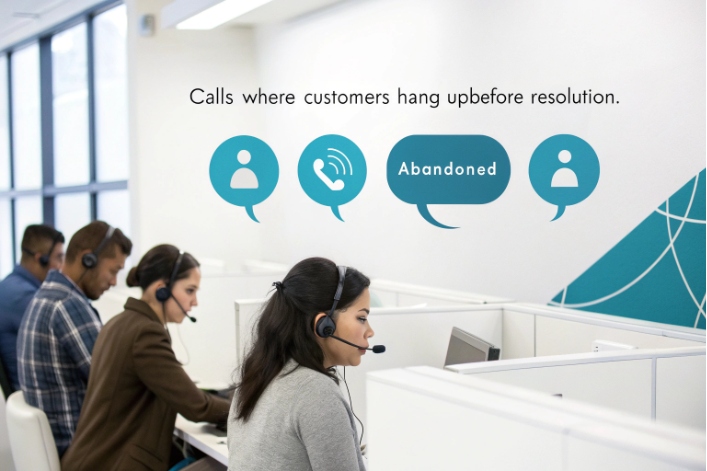
Customers do not always wait for an agent. Many hang up in the queue. If we ignore these calls, our view of real demand and experience becomes wrong.
An abandoned call is a call where the caller disconnects before reaching a live agent or finishing self-service, so the contact stays unresolved and the demand may be hidden in reports.
In every contact center, abandoned calls sit between demand and capacity. They tell us how patient customers are, how well our IVR works, and how healthy our staffing plan is. When we define them clearly and track them well, they become a powerful early warning signal. When we define them loosely, they pollute our dashboards, and we fool ourselves about real volume and service quality.
What counts as an abandoned call 1?
Many teams throw every hang-up into “abandonment” and move on. That makes reports busy but not useful. The real question is which disconnects actually reflect customer impatience or friction.
An abandoned call usually means the caller reached the system, entered the IVR or queue, and then hung up before speaking with an agent or completing the intended self-service task.
Where abandonment actually happens in a call flow
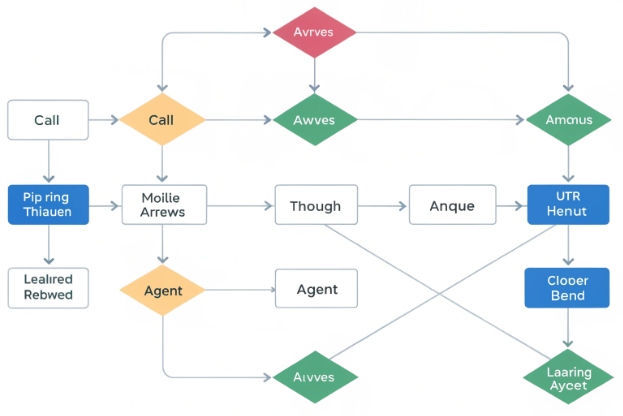
We can think about abandonment as a series of possible “exit points” in the call journey:
- The caller reaches our IVR, hears options, and hangs up.
- The caller chooses a menu option, joins a queue, and then hangs up during hold.
- The caller starts self-service, maybe authenticates, but leaves before finishing.
All of these are abandoned calls if the customer’s intent stays unresolved. The system saw the call as “offered,” but no successful outcome followed. These events affect customer experience. They also affect revenue, especially on sales or collections lines.
We should separate abandonment from missed calls in call centers 2. A missed call is when the system rang an agent but that agent did not answer. The caller did not choose to leave; we failed to pick up. Both events matter, but they describe different problems.
Short abandons need special handling. Many operations exclude hang-ups in the first few seconds. These may be misdials, test calls, or immediate regrets. If we count them, our abandonment rate jumps for reasons that do not reflect our service.
A simple way to structure this is:
| Call outcome | Counts as abandoned? |
|---|---|
| Caller hangs up in IVR after 15 seconds | Yes |
| Caller hangs up in queue after 3 minutes | Yes |
| Caller hangs up after 1 second (misdial) | Often excluded as short abandon |
| System fails before IVR plays | No, usually counted as system fail |
| Agent phone rings but agent does not answer | No, this is a missed / not answered call |
The key is to write down these choices. Then we apply them the same way across all queues and all time periods, so trends stay real and not arbitrary.
How do I calculate abandonment rate?
Abandonment can look scary on a dashboard. But the math behind it is simple. What often creates confusion is which calls we place in the numerator and which calls we exclude from the denominator.
Abandonment rate is usually the number of abandoned calls divided by total offered calls, after we exclude system failures and any short abandons that we decide to ignore.

Core formula, exclusions, and an example
In most operations, the abandonment rate in contact centers 3 is the number of abandoned calls divided by total offered calls.
Abandonment Rate = Abandoned Calls ÷ Offered Calls
Where “offered” means all valid calls that entered our system and could have been answered by an agent or finished in self-service. We normally remove:
- System-failed calls (carrier drops, IVR crash).
- Duplicate attempts that happen within a very short window.
- Short abandons under a chosen threshold, like 3–5 seconds.
Short abandons are important. Many platforms let you configure short abandons as a separate metric 4. If we leave them in, a spam spike or one bad campaign can make it look like customers are much less patient than they really are. Most centers exclude those early hang-ups from both the numerator and the denominator. The important part is to be consistent.
Let us look at a simple example for one hour on a support line:
| Item | Count |
|---|---|
| Total calls that hit the platform | 520 |
| System failures | 10 |
| Valid offered calls | 510 |
| Short abandons (< 5 sec) | 40 |
| Long abandons (≥ 5 sec) | 35 |
| Completed calls (agent or self-service) | 435 |
If we ignore all context, we might say 75 abandons out of 510, so 14.7%. But if we treat short abandons as noise and remove them, the numbers change:
- Offered (after removing short abandons) = 470
- Abandoned (after removing short abandons) = 35
So the abandonment rate becomes 35 ÷ 470 ≈ 7.4%.
Many centers aim for less than about 5%, but targets vary by industry and intent. A line that handles emergencies or time-critical sales needs a lower value. A low-intent inquiry line might accept a bit higher.
The real value comes when we slice abandonment rate by queue, hour, and campaign. Then we see where our plan breaks and where customers lose patience fastest.
What causes high call abandonment?
When abandonment rate climbs, we often blame “impatient customers.” In reality, customers are usually quite rational. They give up because the system does not respect their time or make their choices clear.
High call abandonment is usually driven by long waits, weak workforce planning, confusing IVR flows, and technical issues such as one-way audio, drops, or bad announcements.

Wait time, experience design, and technical friction
High call abandonment is usually driven by long waits and other common causes of call abandonment 5. The first and biggest driver is long perceived wait time. This is not only the absolute time in seconds. It is also how that time feels. If music loops badly or messages are vague, even a moderate wait can feel endless. When we under-staff, queues grow, and more callers leave before we answer. This is why strong workforce management is so important. Good forecasting and scheduling keep wait times and abandonment within the planned range.
IVR design is the second main factor. When menus are deep, unclear, or change often, customers feel trapped. They press zero, they press random keys, or they hang up. If the IVR does not give self-service that really solves problems, it only adds friction. Each extra prompt is a chance for abandonment.
Technical issues are the third common cause. One-way audio, choppy sound, and drops hurt trust. Customers may think we hung up on them. They may call again, which doubles volume and hides the real first attempt in our stats.
We can group these causes like this:
| Cause category | Examples | Typical impact on abandonment |
|---|---|---|
| Capacity / staffing | Understaffed peaks, no overflow or backup | Long waits, visible spikes by hour |
| IVR design | Too many options, poor wording, dead ends | Hang-ups in menus and authentication |
| Technical | Carrier issues, one-way audio, IVR crashes | Sudden jumps, many quick re-dials |
| Policy / process | Forced transfers, strict handle time pressure | Agents rush, more repeat contacts |
High abandonment hurts more than one metric. On sales lines, it means lost orders. On collections lines, it means lost chance to recover cash. On emergency or safety lines, it can put people at risk. It also distorts demand visibility. If we do not treat duplicates and short abandons carefully, we may undercount or overcount real customer need and design the wrong capacity plan.
Time-to-abandon analysis helps us see patterns. We look at how long customers stay in the queue before they hang up, for each queue and each hour. A sharp cliff at, say, 90 seconds tells us where patience ends. Then we can adjust staffing, messaging, or routing around that point.
Can callbacks and IVR reduce abandonment?
Many customers do not mind waiting a bit. They do mind holding the phone to their ear while they wait. If we only offer live hold, they must choose between frustration and giving up.
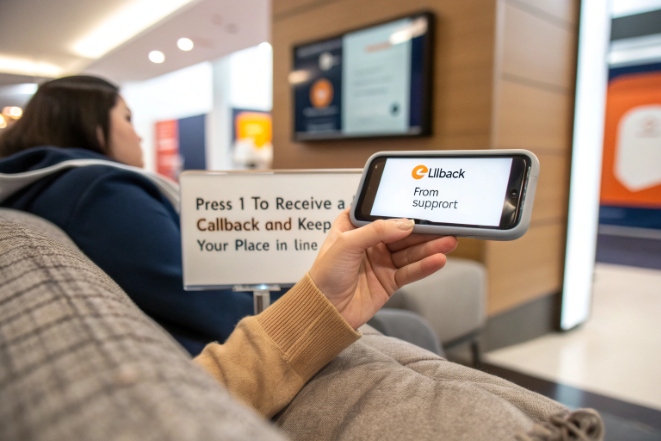
Well-designed queue callbacks, honest wait-time messages, and focused IVR self-service can reduce abandonment by giving customers control and removing dead time from the experience.
Virtual hold, better promises, and smarter self-service
Queue callbacks, sometimes called virtual hold technology 6, change the deal. The customer keeps their place in line but does not stay on the phone. Our system calls them when an agent is almost free. For many lines, this step alone cuts abandonment and repeat calls. It also smooths peaks, because we can pace outbound callbacks within our agent capacity.
Estimated wait time (EWT) messages also help. When we tell customers “Your expected wait is about five minutes,” they can decide calmly. If they decide to stay, they are less likely to abandon halfway through. The key is honesty. If the real wait is 15 minutes and we promise five, we damage trust and still see high abandonment.
IVR can support this in two ways. First, it can offer useful self-service that actually solves tasks: payments, simple order changes, PIN resets. When the self-service path works, the caller does not abandon, because the problem is solved. Second, it can route callers to the right queue faster. Each wrong transfer is extra hold time and a new chance to give up.
Workforce management sits behind all of this. Call center workforce management 7 ensures your staffing plan actually matches demand. Callbacks and IVR cannot fix a chronic shortage of agents. We still need a plan that forecasts arrivals, models patience, and sets a service level that keeps abandonment near our target level, often under 5%.
We can think about main levers like this:
| Lever | How it reduces abandonment |
|---|---|
| Queue callbacks | Remove live hold, keep place in line |
| Accurate EWT messages | Set real expectations, reduce “rage hang-ups” |
| Strong self-service | Resolve simple intents without a human agent |
| Smarter routing | Cut transfers and wasted queue time |
| Better staffing | Lower average wait during known peaks |
When we combine these tools and measure time-to-abandon by queue, hour, and IVR path, we see where each lever works best. Then abandonment falls, and customer satisfaction and revenue follow.
Conclusion
Abandoned calls show where patience, design, and capacity do not match; with clear definitions, honest math, and smart callbacks and IVR, we can control them instead of fearing them.
Footnotes
-
Definition of abandoned calls in contact centers and why customers hang up before reaching an agent. Back to content ↩
-
Explains differences between abandoned, missed, and lost calls with practical reporting guidance. Back to content ↩
-
KPI guide describing how to calculate call abandonment rate and what “good” performance looks like. Back to content ↩
-
Glossary definition of short abandons and how platforms configure thresholds and exclude them from metrics. Back to content ↩
-
Comprehensive guide to common causes of high call abandonment and strategies to reduce it. Back to content ↩
-
Explains virtual hold and queue callback technology that lets callers keep their place without waiting on hold. Back to content ↩
-
Overview of call center workforce management, forecasting, and scheduling to align staffing with demand. Back to content ↩








