
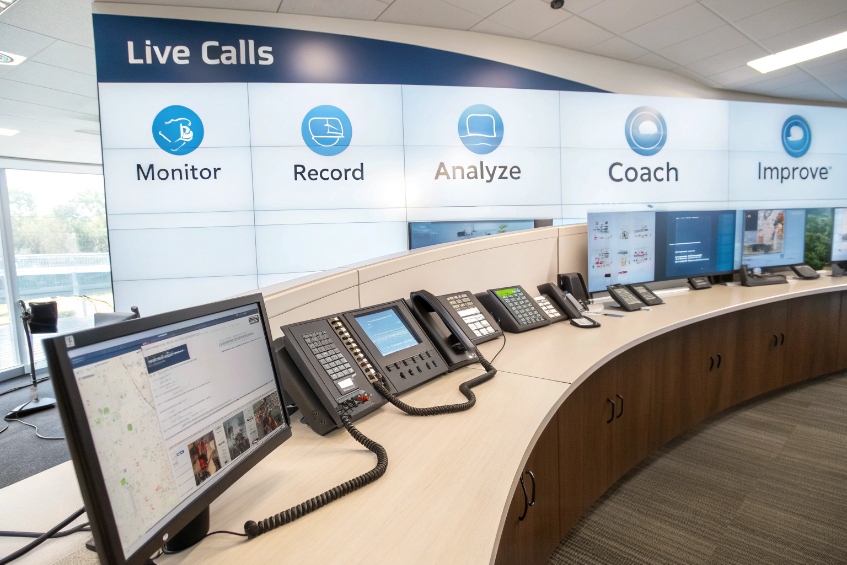
Better calls do not happen by accident. Call monitoring 1 turns raw conversations into guidance that agents can act on today.
Call monitoring means listening to live or recorded calls, scoring what matters, and using those insights to coach, comply, and improve customer outcomes.
The basics are simple: hear, measure, improve. The craft is picking the right mode (monitor, whisper, barge) 2, choosing which calls to review first, building a fair QA scorecard, and keeping everything compliant without slowing the floor. Here is the playbook.
How do monitor, whisper, and barge differ for me?
Each mode has a job. Use the gentlest tool that gets the result. Escalate only when the call needs it.
Monitor is listen-only. Whisper lets a supervisor coach the agent privately. Barge joins the call so both parties hear the supervisor.
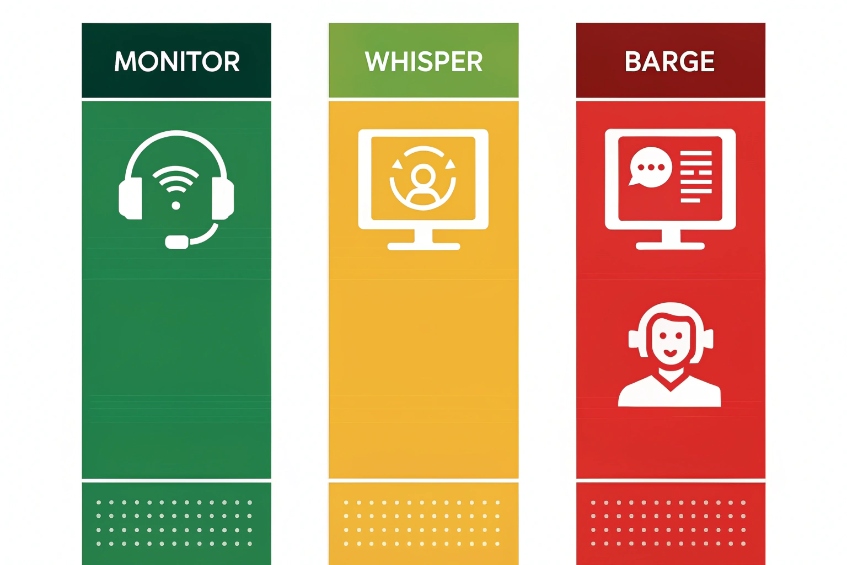
The three modes at a glance
Think of these as steps on a ladder. Monitor is silent and safe. It checks quality, tone, and process in real time. Whisper adds live coaching to help the agent adjust. Only the agent hears it. Barge turns the call into a three-way conference. The supervisor speaks to the customer as well. It is great for rescues and required disclosures, but it must be used with care.
| Mode | Who hears the supervisor | Typical use | Risk profile | Notes |
|---|---|---|---|---|
| Monitor | No one | QA spot checks, new-hire shadowing | Low | No intervention; best default |
| Whisper | Agent only | Live coaching, de-escalation tips, policy reminders | Medium | Keep prompts short and clear |
| Barge | Agent + Customer | Save escalations, complex cases, legal disclosures, VIP | Higher | Announce role, then help quickly |
When to use which
Start with monitor for most new queues, promotions, and process changes. Move to whisper if the agent needs a nudge: slow pace, confirm identity, set expectations, or follow the save script. Use barge when the situation exceeds the agent’s authority or skill, when the call risks loss or harm, or when the law requires the supervisor to speak (some industries do). When barging, announce your role in one sentence, fix the issue, then hand back or close.
Practical guidelines
Keep whisper messages short—under seven words if possible: “Pause. Empathy first.” “Offer option B now.” “Ask for email consent.” For barge, avoid stepping on the agent. Say the role, offer one action, and let the conversation breathe. Log every intervention with a reason code so later coaching and audits have context.
Which calls should supervisors monitor first?
Time is scarce. Review the calls that change outcomes or carry outsized risk. The rest can wait.
Prioritize risk, impact, and teachable moments 3: escalations, cancellations, complaints, payment calls, new hires, and policy-change spikes rise to the top.
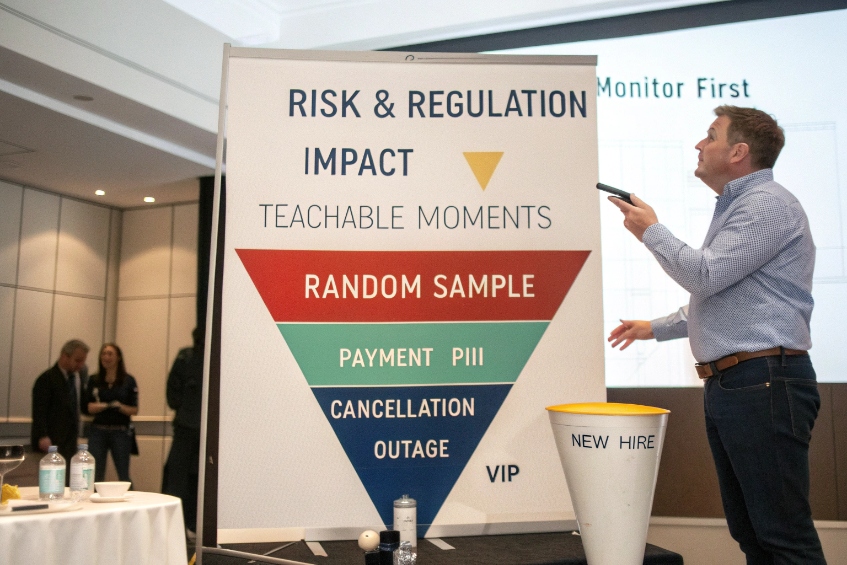
A simple prioritization funnel
Begin with risk and regulation. Payment, identity, and disclosure-heavy calls carry legal exposure. Next, chase impact. Cancellations, high-value accounts, outage escalations, and high-churn segments deserve fast attention. Then look for teachable moments—new agents in week one, agents shifting to a new product, or teams touched by a policy change. Finally, sample randomly to keep a fair baseline.
Smart sampling rules that scale
- Stratified by intent: Take a fixed share from each top driver (billing, tech, orders, cancellations).
- By tenure band: Heavier sampling for <60 days tenure, lighter for veterans.
- By outlier metrics: Pull calls with very long silence, high overlap, or extreme handle times.
- By outcome: Review save wins and losses, low CSAT, and repeat contacts within seven days.
- By change window: When a new script or system ships, double sampling for two weeks.
A tactical pull list (start-of-day)
| Bucket | Why it matters | Daily pull target |
|---|---|---|
| Payment or PII captured | Compliance risk | 10–20 per site |
| Cancellations/retentions | Revenue risk | 15 per team |
| New-hire calls (Week 1–2) | Coaching leverage | 3 per new agent |
| Low CSAT / complaint tags | Experience risk | All from prior day |
| Policy-change intents | Process reliability | 20 per affected queue |
| VIP / high-value | Brand risk | All escalations |
Close the loop
Do not just listen; act. Tag a single coaching theme per call. Send one clear ask to the agent. Track acceptance and next-call improvement. Share two great examples in the next huddle so skills spread.
How do I record and score for QA coaching?
Recording without a plan creates noise. A small, fair scorecard and tight workflow turns reviews into growth.
Record 100% where lawful, score a focused rubric, calibrate weekly, and coach with one behavior at a time. Tie scores to outcomes, not just boxes.
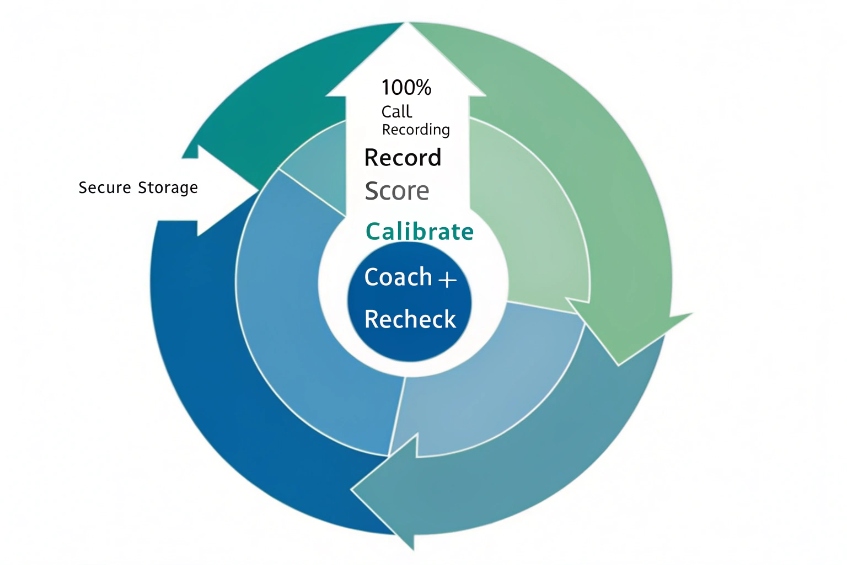
Build a scorecard agents can learn from 4
Keep the rubric short and weighted. Ten to twelve items is enough for most queues. Mix compliance checks with behaviors that move outcomes. Make each item observable and binary when possible, with a notes field for nuance.
| Category | Item | Weight | What good looks like |
|---|---|---|---|
| Opening & Identity | Recording notice given | 10% | Clear notice in first 15s |
| Security | ID&V completed before account actions | 15% | Two factors matched per policy |
| Diagnostics | Clarifies reason, sets expectation | 10% | Simple restate + path |
| Solution | Accurate steps, correct tools | 20% | Verified resolution or next best action |
| Communication | Empathy phrases, no overtalk | 10% | Acknowledges emotion, lets customer finish |
| Compliance | Payment redaction or pause/resume | 15% | No PAN/CVV stored |
| Closure | Confirms resolution and next step | 10% | Summarizes, invites more help |
| Documentation | Clear notes/disposition | 10% | Future agent can pick up fast |
Calibrate so “fair” means the same thing
Run a 30-minute calibration weekly. Everyone scores the same three calls, then you compare, discuss, and lock examples. Keep a golden library of scored calls with comments and timestamps. Use it to onboard new QA staff and align supervisors.
Make coaching easy to accept
Focus on one behavior, not five. Show the clip, state the impact, and script the better line. Example: “Pause before the invoice amount. Then say, ‘I can fix that for you.’” Schedule a recheck within a week. Celebrate the change on the next team call.
Connect QA to business results
Pair QA scores with FCR, repeat rate, AHT, and CSAT. If QA rises but outcomes do not, the rubric is off. If outcomes rise while QA holds, raise the bar. Share a monthly heatmap by item so the whole floor sees where to improve.
Recording hygiene
Record 100% where allowed. Keep retention short for general calls; keep longer only where law or contracts require. Redact or pause for cards, SSNs, and passwords. Encrypt in transit and at rest. Limit who can play full audio and transcripts.
What policies keep monitoring compliant?
Monitoring helps only if it is lawful and respectful. Clear policies protect customers, agents, and the brand.
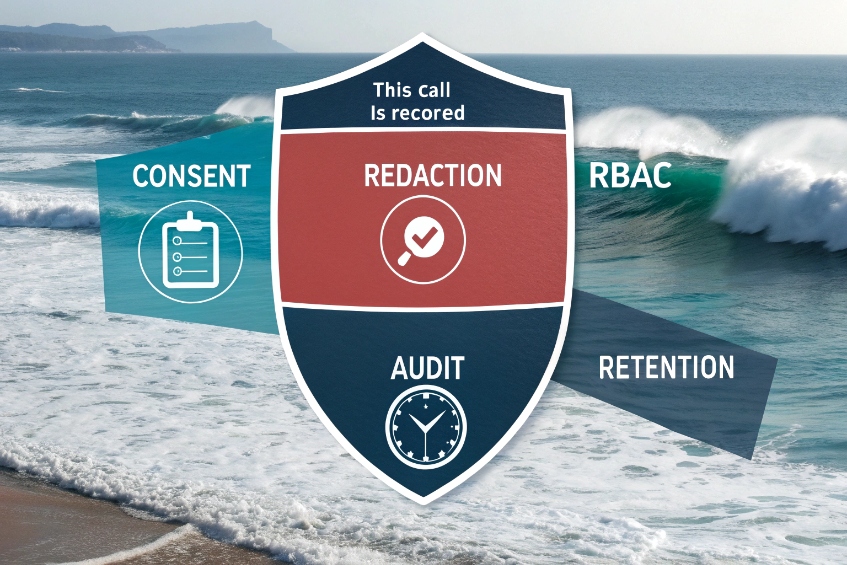
Post a recording notice, honor consent rules, protect payment and PII data, limit access with roles, and keep detailed audit logs and deletion paths.
Consent and notice
Follow local one-party vs all-party consent rules 5. When in doubt, announce recording at the start and provide a path to opt out or use an alternative channel. Ensure the same notice appears in prompts and scripts. For monitoring modes, your policy must state that authorized supervisors may monitor, whisper, or barge for quality and safety, and you should display an indicator to agents when monitoring is active (where platform supports it).
Payment and PII handling
For card data, align to PCI DSS call recording requirements 6. Use pause/resume or DTMF masking so recordings never store sensitive numbers. For PII like SSN or DOB, minimize collection and mask transcripts by default. Run scheduled scans to catch any stray tokens and remediate fast.
Access control and purpose limits
Use role-based access control. Agents can review only their calls. Supervisors see team calls. QA sees assigned samples. Compliance can access evidence, not entire libraries. For all users, enforce SSO/MFA and session timeouts. Document purpose limits—QA, coaching, training, safety—not surveillance for unrelated aims.
Retention and deletion
Set retention windows by call type using call recording retention best practices 7. Example: 90–180 days for general service, longer only when required by law or contract. Automate deletion and export flows for subject requests. Keep an immutable log of who accessed which call, when, and why.
Vendor and data location
List all subprocessors, confirm where audio and transcripts are stored, and set breach SLAs. If cross-border flows apply, document the lawful basis and apply data localization where needed. Test fallbacks: if analytics is down, can you still route and record safely?
Worker respect and transparency
Share the monitoring policy with agents. Explain why you monitor and how results are used. Ban secret recordings unless legally required. Include appeals for disputed QA scores and run regular calibrations so scoring is even.
Quick compliance checklist
- Recording notice played and logged
- Pause/resume on payment fields verified
- RBAC enforced; least privilege checked monthly
- Retention timers set by call type
- Access and playback fully audited
- Clear supervisor playbook for monitor/whisper/barge
- Annual training and quarterly tabletop tests
Compliant monitoring protects people and keeps the program trusted and durable.
Conclusion
Use monitor for awareness, whisper for guidance, and barge for saves. Prioritize high-risk and high-impact calls, score a simple rubric, coach one behavior at a time, and lock compliance with clear consent, redaction, RBAC, and audit.
Footnotes
-
Overview of call monitoring in contact centers, benefits, and quality assurance best practices. ↩︎ ↩
-
Explains monitor, whisper, and barge call monitoring features and when supervisors should use each mode. ↩︎ ↩
-
Risk-based call monitoring tactics and frameworks for prioritizing the most important customer interactions to review. ↩︎ ↩
-
How to design a call center QA scorecard with examples, templates, and coaching-focused best practices. ↩︎ ↩
-
Summary of U.S. one-party versus all-party call recording consent laws for businesses. ↩︎ ↩
-
Details PCI DSS rules for recording calls that handle cardholder data and keeping PAN and CVV secure. ↩︎ ↩
-
Guidance on choosing call recording retention periods and deletion policies across industries. ↩︎ ↩








