
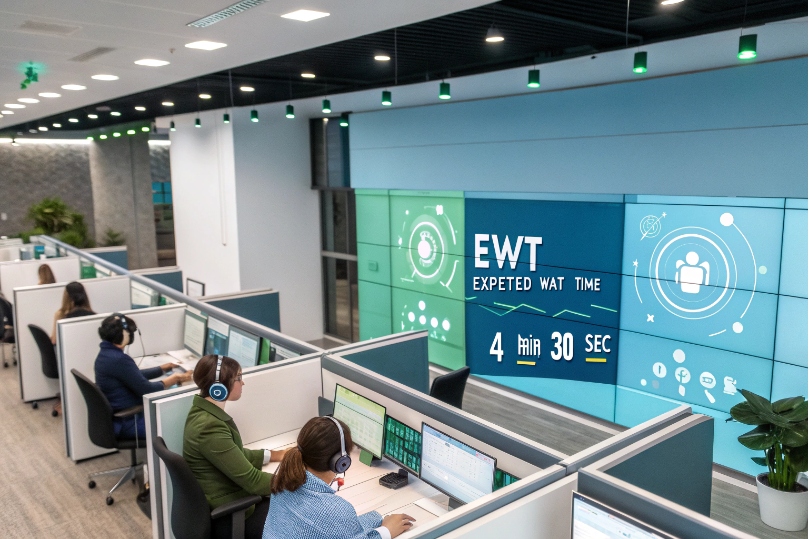
Long queues feel like silence. Callers hang up. Agents get blamed. Reports get messy. When nobody can explain the wait, the whole center looks out of control.
EWT (Expected or Estimated Wait Time) is the system’s best prediction of how long a caller will wait in a queue before reaching an agent, based on live staffing, queue load, and recent handle-time data.
EWT is a forecast built from throughput
EWT is not a stopwatch. It is a forecast. The queue engine looks at how quickly the queue is “draining” and compares that to how fast new calls are “filling” the queue. The fastest mental model is simple:
- Demand: how many callers are waiting and how many are arriving.
- Supply: how many agents can take calls and how quickly they finish calls.
Most platforms use one of these approaches (or a mix):
- a moving average of recent waits and completions
- a queueing model (often inspired by the Erlang C formula 1)
- a hybrid with smoothing so it does not jump every second
That is why EWT can be “wrong” for a single caller but still useful across many callers.
EWT vs position-in-queue and ASA
EWT and position are related but not equal. Two callers can both be “3rd in line” and still have different waits if the queue is multi-skill, has priorities, or has callbacks.
| Metric | What it answers | Best use |
|---|---|---|
| EWT | “How long will I probably wait?” | Caller messaging, callback triggers |
| Position | “How many are ahead of me?” | Simple transparency in small queues |
| Average Speed of Answer (ASA) 2 | “How fast are answered calls picked up?” | KPI reporting and SLA tracking |
Why EWT accuracy is a data quality issue
In real operations, EWT gets noisy when:
- AHT changes fast (new product issue, outages, complex tickets)
- agents go offline without logging out
- wrap-up time increases but is not counted correctly
- concurrency rules exist (voice + chat) and the model does not reflect them
So EWT is both a customer-facing metric and a system-health signal. If it swings hard with no obvious reason, something about staffing, state, or measurement is usually drifting.
If EWT is understood as a forecast, it becomes a tool. The next step is knowing how the system calculates it, because that explains why EWT sometimes looks “too high” or “too low.”
How is expected wait time calculated in my queues?
When EWT is wrong, agents assume the platform is broken. Most of the time, the platform is doing math on inputs that do not match reality.
EWT is usually calculated from queue depth, real-time eligible agents, and recent AHT/throughput, often with smoothing so one spike does not whiplash the estimate.
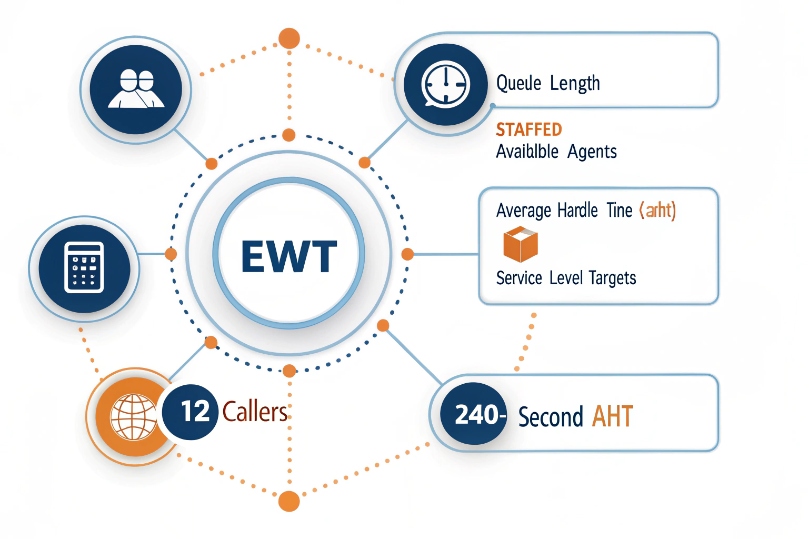
The core inputs most VoIP ACDs use
Even if vendors hide the exact formula, the inputs are consistent:
- Calls waiting (and their priority/skill requirements)
- Eligible agents (logged in, not DND, not at concurrency limit)
- Service rate (how many calls per minute the queue can complete)
- AHT components (talk + hold + after-call work (ACW) 3)
A very practical way to explain it to supervisors is:
- If 10 calls are waiting and the queue completes 2 calls per minute, EWT will trend toward ~5 minutes.
- If agents go unavailable and completion drops to 1 call per minute, EWT trends toward ~10 minutes.
This is why EWT can jump when one experienced agent logs off during peak time.
Models: moving averages vs queueing math
Some systems lean on recent history:
- “Calls in the last 10 minutes waited X on average.”
Others use queueing math:
- “Given arrivals, staffing, and service time, expected wait is Y.”
Both can be valid. The danger is when the system uses stale baselines for Average Handle Time (AHT) 4 or counts wrap-up differently than the real workflow.
Common calculation pitfalls that inflate or deflate EWT
| Pitfall | What happens to EWT | What to fix |
|---|---|---|
| AHT baseline too low | EWT underestimates, callers get upset | Include ACW and peak-hour AHT |
| Agents stay “available” while not taking calls | EWT underestimates | Enforce accurate states and adherence |
| Multi-skill routing not reflected | EWT looks random per caller | Segment EWT by skill/priority |
| Callbacks counted incorrectly | EWT oscillates | Track virtual queue rules clearly |
The best practice is not chasing a perfect formula. It is making sure the inputs match the real center: who is truly eligible, and how long work truly takes. In most systems, that’s ultimately governed by the Automatic Call Distribution (ACD) 5 logic and agent-state rules.
Once calculation inputs are clear, the next question is about timing: whether EWT changes during the wait and how fast it reacts.
Does EWT update in real time as agents take calls?
Callers and supervisors often ask the same thing: “Is that wait time live or just a guess from earlier?” The answer affects trust.
Yes, EWT usually updates in near real time because it recalculates as calls enter/leave the queue and as agent availability changes, though many systems smooth updates to avoid constant jumps.
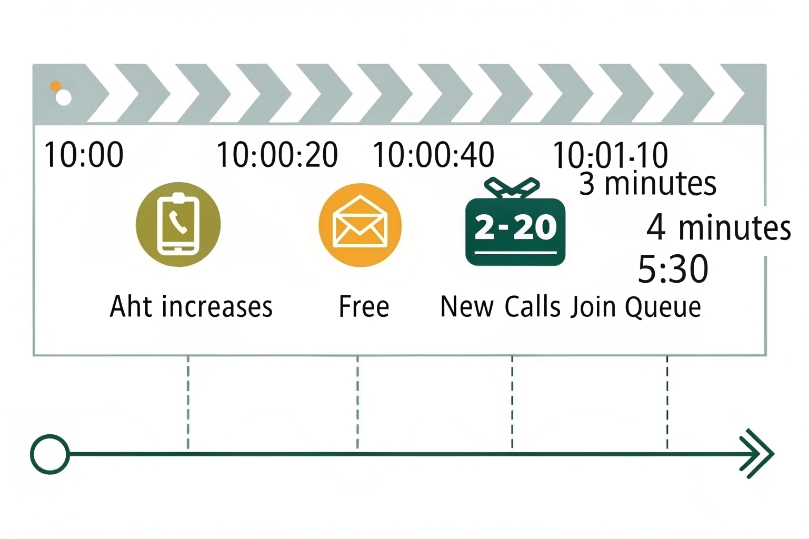
What triggers EWT to change
In a typical SIP-based ACD, EWT shifts when:
- an agent becomes available
- a queued call is answered or abandons
- a new call arrives (especially a priority call)
- AHT rises due to longer conversations
- the routing engine expands or narrows the eligible agent pool
That means EWT can spike fast during a short staffing gap, then recover when two agents finish calls at the same time.
Why EWT can feel “laggy”
Most platforms add smoothing for stability:
- They cap how fast EWT can rise or fall.
- They round announcements (“about 5 minutes”) instead of speaking exact seconds.
- They update on a cadence (every 10–30 seconds) rather than every packet.
This is usually good. A caller does not need a jittery estimate that changes every few seconds. The goal is calm guidance, not precision theater.
Multi-skill and priority makes “one EWT” hard
If the queue supports skills-based routing 6, two callers may see different effective waits even in the same queue:
- Caller A needs bilingual agents.
- Caller B can be served by anyone.
If only one bilingual agent is active, Caller A’s EWT should be higher. Some systems expose this as segmented EWT per skill, while others show one blended number.
| Scenario | What EWT should do | What often goes wrong |
|---|---|---|
| Agents finish calls quickly | EWT falls smoothly | Overreaction and oscillation |
| Sudden AHT increase | EWT rises | Model uses stale AHT |
| Agents go DND/offline | EWT rises fast | Eligibility rules not synced |
| Priority callers arrive | Non-priority EWT rises | Queue policy not communicated |
For stable EWT, the real requirement is clean real-time agent state and accurate AHT inputs. When those are right, EWT becomes reliable enough to drive actions like callbacks and overflow.
That leads to the practical question every manager asks: how to reduce EWT without hurting quality.
How can I reduce EWT with IVR, callbacks, or staffing?
High EWT is not only a staffing problem. It is usually a flow problem. Small routing changes can cut waits without adding headcount.
You can reduce EWT by deflecting simple calls in IVR, offering callbacks when EWT crosses a threshold, balancing skills, and tightening after-call work so agent throughput rises without rushing calls.
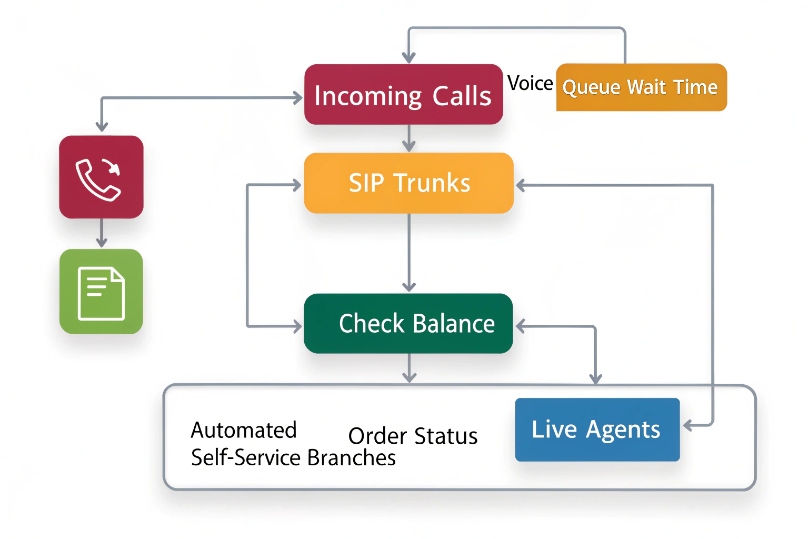
IVR: remove avoidable agent minutes
IVR is not about making callers suffer through menus. It is about taking the 10–30% of contacts that do not need an agent:
- order status
- password resets
- hours and location
- simple account lookups
- ticket status updates
Even a small deflection rate reduces queue pressure and drops EWT because the queue drains faster.
Callbacks: convert waiting time into off-queue time
Callbacks help when EWT is high and abandonment risk rises. Two common models:
- Callback when next in line: caller keeps position, phone rings later.
- Scheduled callback: caller selects a time window.
Callbacks reduce perceived wait and can lower abandonment, but they must be sized correctly. If callbacks flood the same queue later, EWT simply moves to a different hour—so treat virtual queue callbacks 7 as a capacity tool, not just a feature.
Staffing and process tuning: raise effective capacity
Staffing is not only “add agents.” It can also be:
- shifting break schedules away from peak minutes
- adding cross-skilled agents during spikes
- reducing ACW steps with CRM automation
- improving knowledge base search so calls end faster
| Lever | What it changes | Typical EWT impact |
|---|---|---|
| IVR deflection | Demand decreases | Strong, steady improvement |
| Callback offers | Abandonment decreases | Strong on CX, medium on EWT |
| Better adherence | Supply becomes real | Strong during peak hours |
| Shorter ACW | Higher throughput | Medium to strong |
| Skill balancing | More eligible agents | Strong for niche queues |
The best reductions usually come from two moves at once: reduce low-value demand with IVR, and increase throughput by cleaning up ACW. That keeps quality stable while EWT drops.
Once EWT is lower, the final decision is whether to tell callers the EWT. That choice affects abandonment and brand trust.
Should I display EWT to callers to lower abandonment?
Some teams fear that announcing “10 minutes” will scare callers away. Others believe transparency builds trust. Both can be true, depending on how it is done.
Displaying EWT can reduce abandonment when the estimate is credible and paired with choices like callbacks, but it can increase abandonment if estimates are wrong, jumpy, or announced too early without context.
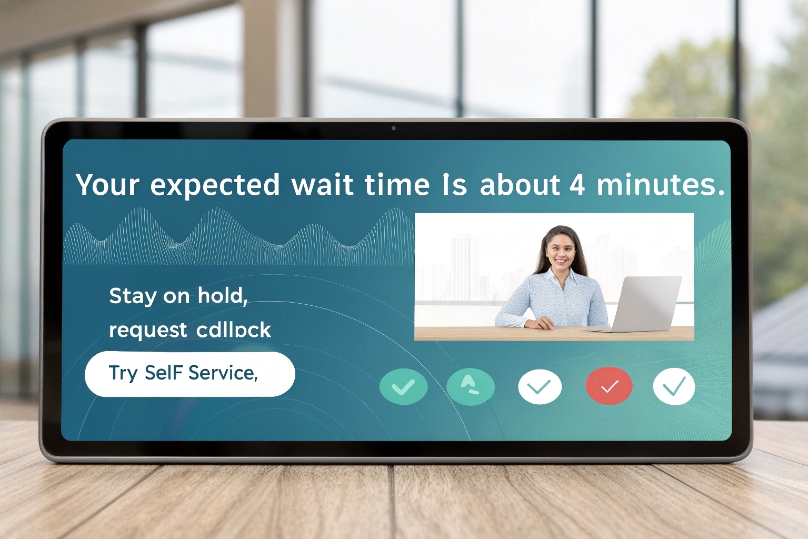
When announcing EWT helps
Announcing EWT often helps when:
- EWT is reasonably accurate
- the message is rounded and calm (“about 5 minutes”)
- the IVR offers a callback when EWT is high
- callers have already chosen the right department (post-IVR routing)
Transparency reduces uncertainty. Uncertainty is what makes callers hang up quickly.
When announcing EWT hurts
Announcing EWT can hurt when:
- the estimate is wrong by a wide margin
- EWT changes too often and callers feel misled
- the announcement happens before proper queue selection
- there is no option besides “keep waiting”
If EWT is unstable, it is better to announce bands:
- “less than 5 minutes”
- “between 5 and 10 minutes”
- “more than 10 minutes”
Pair EWT with an action, not just information
The best caller experience is:
- tell the wait
- give one simple option (callback or voicemail)
- confirm the choice
- keep the message short
| Approach | Caller reaction | Best use |
|---|---|---|
| Exact seconds | Distrust when it changes | Rarely worth it |
| Rounded minutes | Feels honest | Most queues |
| Capped bands | Feels stable | Noisy peak-hour queues |
| EWT + callback | High trust, lower abandonment | High-volume centers |
In practice, EWT announcements work best as part of a larger promise: “Here is the wait, and here is your best option.” That reduces abandonment without pushing callers away.
Conclusion
EWT is a live forecast of queue wait built from staffing, eligibility, and handle-time data. With smart IVR, callbacks, and clean agent states, EWT drops and abandonment falls.
Footnotes
-
Erlang C basics for estimating waits from call volume, staffing, and handle time. ↩ ↩
-
Definition and measurement notes for ASA in contact center reporting. ↩ ↩
-
Why ACW matters and how wrap-up time impacts capacity and wait predictions. ↩ ↩
-
Breakdown of AHT and what’s typically included in handle-time calculations. ↩ ↩
-
Explains how ACD engines distribute contacts and why agent state affects forecasts. ↩ ↩
-
Clarifies skills-based routing and how skill eligibility changes who can answer. ↩ ↩
-
Overview of callback/virtual-queue behavior and common configuration considerations. ↩ ↩








