
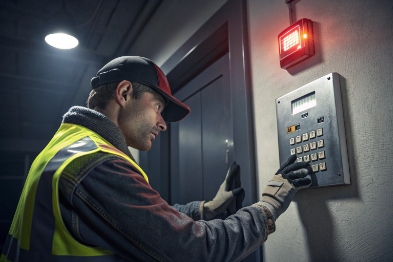
A keypad that fails in a hazardous area does not fail politely. The phone still powers on, but the call cannot be placed when seconds matter.
A realistic keypad lifespan depends on the key technology and the test plan. Metal-dome keypads often target 1–5 million presses, while piezo stainless keys often target 50 million. Real proof comes from combined life cycling and IEC 60068 environmental tests, plus IP66/IP67 verification.
Keypad life is a system spec, not a single number
A keypad life number sounds simple, but it is not one simple number in real industrial sites. …A keypad is a mix of parts. The “key” is the actuator. The “switch” is the contact system. The “seal” is the barrier that keeps oil, dust, and salt out. The “electronics” is the scanning circuit that reads presses. If one part fails, the keypad fails.
Most buyers ask for a cycle figure first. That is normal. Still, cycle figures alone do not match hazardous-area reality. A keypad can reach a high cycle count in a clean lab and still fail early on site due to corrosion, vibration, cable strain, or thermal stress. That is why the best requirement is a combined requirement: cycle life plus environment plus sealing.
Environmental tests usually come from the IEC 60068 1 family. …IEC 60068 is a set of methods for environmental testing of electronic and electromechanical products. It covers vibration, temperature change, and corrosion-style stresses. …:contentReference[oaicite:0]{index=0} A separate standard, IEC 60529, defines IP ratings 2 for dust and water ingress. :contentReference[oaicite:1]{index=1} These two families work together in a good keypad plan.
ATEX [^3] and IECEx 3 also matter, but in a different way. …Those certifications focus on safe use in explosive atmospheres. They do not exist to certify “keypad cycles.” That is why keypad life should be written as a reliability requirement and verified by test evidence, while Ex certification covers ignition risk. :contentReference[oaicite:2]{index=2}
| What the buyer asks for | What it really means on site | What to request from the vendor |
|---|---|---|
| “How many cycles?” | Wear-out of the key and switch | Cycle test method and pass criteria |
| “Will it survive salt and oil?” | Corrosion and seal stability | IEC 60068 evidence + material details |
| “Is it IP66/IP67?” | Seal performance after aging | IEC 60529 report and setup |
| “Is it ATEX/IECEx?” | Safe operation in hazardous zones | Ex certificate + marking + drawings |
The next sections break this down into clear numbers, test standards, and a planning method for warranty and spares.
If cycle figures are the first question, the second question is always the same: which cycle number is realistic for the key technology used.
How many actuation cycles are realistic for an explosion-proof telephone keypad?
A keypad can look rugged and still be a wear part. If the deployment is large, that wear becomes a budget line.
For harsh-site telephones, 1–5 million presses is a common target for mechanical dome-style keypads, while 50 million presses is a common target for piezo stainless-steel keys because they use a solid-state sensing structure and have no traditional moving contacts. :contentReference[oaicite:3]{index=3}

What “1M, 5M, 50M” usually means in procurement
Cycle life is normally measured as full presses under a defined force and speed, at a defined temperature and humidity. Many vendors state the number but do not state the method in the datasheet. That is why a purchase spec should ask for the method, not only the headline.
For metal-dome keypads 4, multiple industry sources describe typical ratings around one million to five million cycles, with some dome series exceeding five million. :contentReference[oaicite:4]{index=4} For piezo switches 5 and piezo keypads, several manufacturers and technical notes describe life expectancy around 50 million cycles. :contentReference[oaicite:5]{index=5}
Convert cycles into years with your own usage model
A life number becomes useful only after it is linked to expected usage. Many emergency phones do not see heavy daily use, but some do. A gatehouse or a dispatch point can see constant presses. A plant-wide paging or maintenance workflow can also increase usage.
| Daily presses per phone | 1,000,000 cycles | 5,000,000 cycles | 50,000,000 cycles |
|---|---|---|---|
| 20 presses/day | ~137 years | ~685 years | ~6,850 years |
| 200 presses/day | ~13.7 years | ~68.5 years | ~685 years |
| 2,000 presses/day | ~1.37 years | ~6.85 years | ~68.5 years |
These numbers look extreme because many phones are pressed less than expected. Still, harsh environments reduce life because corrosion, grit, and oil raise friction and attack contact surfaces. In those sites, the “environment factor” matters more than the “press count.”
In DJSlink projects, the safest approach is to treat mechanical keypads as serviceable items when the site is oily, dusty, or salty, and treat piezo as the long-life option when cleaning, corrosion, and vandal resistance are high priorities.
Cycle numbers answer only one part of the question. The next part is proof. A serious industrial buyer wants to know which standards and tests can validate those claims.
Which standards and tests actually validate keypad life in vibration, salt, and thermal cycling?
A keypad that survives 5 million presses in a calm lab can still fail during a pump start or a winter-to-summer cycle. The test plan must match the stress.
Keypad life is usually validated by combining actuation cycling with IEC 60068 environmental tests and then re-checking sealing to IEC 60529 (IP66/IP67). ATEX/IECEx certification proves explosion safety, not press life, so it should sit next to the durability evidence, not replace it. :contentReference[oaicite:6]{index=6}
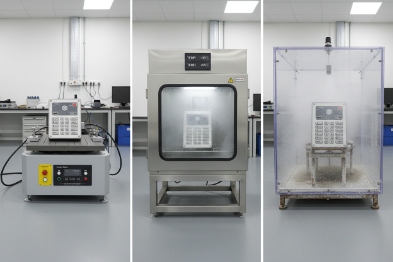
IEC 60068: the toolbox for harsh-environment validation
IEC 60068 is a collection of environmental test methods used to assess performance under real stresses. :contentReference[oaicite:7]{index=7} For explosion-proof telephones 6, the most common keypad-relevant parts are:
- Vibration (sinusoidal): IEC 60068-2-6, used to find mechanical weakness during vibration exposure. :contentReference[oaicite:8]{index=8}
- Vibration (random): IEC 60068-2-64, used for broadband random vibration and accumulated stress effects. :contentReference[oaicite:9]{index=9}
- Salt mist (cyclic): IEC 60068-2-52, used for salt-laden atmospheres and corrosion acceleration. :contentReference[oaicite:10]{index=10}
- Change of temperature (thermal cycling): IEC 60068-2-14, used to assess ability to withstand rapid or repeated temperature changes. :contentReference[oaicite:11]{index=11}
A strong keypad validation plan runs actuation cycling, then applies one or more of these environmental test methods 7, then repeats actuation checks. Some projects also run stress first, then cycle. Both sequences are useful because corrosion and seal aging can change key feel and electrical response.
IEC 60529: confirm IP66/IP67 after aging, not only on day one
IEC 60529 8 defines the IP code system for dust and water ingress resistance. :contentReference[oaicite:12]{index=12} In procurement language, “IP66/IP67 keypad” often means:
- …IP66: resistant to powerful water jets and dust ingress limits
- IP67: dust tight plus temporary immersion conditions that many labs describe as up to 1 meter for 30 minutes, depending on the test plan :contentReference[oaicite:13]{index=13}
The key point is simple. A keypad seal can pass IP tests when new, then fail after thermal cycling or after chemical cleaning. That is why post-aging IP tests are valuable.
| What the standard proves | Typical test family | What the buyer should ask to see |
|---|---|---|
| Mechanical robustness in vibration | IEC 60068-2-6 / -2-64 | Test levels, axis, duration, pass criteria |
| Corrosion resistance | IEC 60068-2-52 | Method number, cycles, and inspection results |
| Thermal stress resistance | IEC 60068-2-14 | Temperature range, dwell, ramp, cycles |
| Dust/water sealing | IEC 60529 | IP level, setup photos, pass/fail notes |
| Explosion safety | ATEX / IECEx | Certificate, marking, manufacturing control |
When a vendor says “ATEX/IECEx approved keypad,” it is worth pushing for clarity. …ATEX/IECEx proves hazardous-area safety. IEC 60068 and IEC 60529 help prove durability and sealing. :contentReference[oaicite:14]{index=14}
The next question is the one that decides the design choice: does piezo really outlast mechanical domes in oil, dust, and corrosive environments?
Do piezo stainless-steel keys outlast mechanical dome keys in oil, dust, and corrosive environments?
A harsh site punishes moving parts. Oil carries grit. Dust grinds. Salt attacks metal surfaces. A keypad that is “fine” in an office becomes sticky and unstable in months.
In many industrial deployments, piezo stainless-steel keys tend to outlast mechanical dome keys because piezo designs use a sealed, solid actuation surface and no traditional moving contacts. Mechanical dome designs can still be reliable, but their contact and membrane systems are more sensitive to contamination, wear, and seal aging. :contentReference[oaicite:15]{index=15}
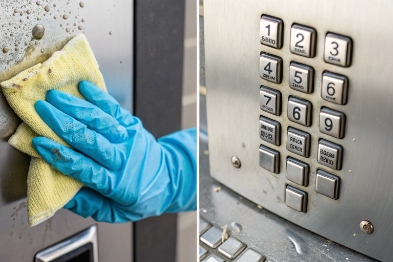
What piezo does well in oil, dust, and chemical cleaning
Many piezo switch references highlight very long life around 50 million cycles and strong sealing levels when mounted correctly. :contentReference[oaicite:16]{index=16} The construction often uses a one-piece metal surface, which is easier to clean and harder to damage. That sealed surface reduces paths for oil and dust to reach a contact area.
This matches field logic. If a key does not rely on a moving contact dome, there is less wear at the point of switching. That reduces failure modes like contact bounce, oxide buildup, and stuck domes after repeated exposure.
Where mechanical domes still win
Mechanical dome keys are cost-effective and have a clear tactile feel. Many dome keypads are rated from one million to five million cycles, and some dome series exceed five million. :contentReference[oaicite:17]{index=17} For many emergency call points with low daily use, this can be more than enough.
Mechanical domes can also be designed well for harsh sites when the sealing system is strong and materials are chosen carefully. Still, the design has more interfaces that can age: overlay, adhesive, venting approach, and the contact surfaces.
The decision rule used in industrial phone selection
A simple rule works well in tenders:
-
Choose piezo keys when corrosion resistance, washdown cleaning, and vandal resistance matter most, and when a long-cycle spec is required.
-
Choose mechanical domes when cost, strong tactile feedback, and service replacement are the main priorities, and when the environment is not extreme.
| Environment stress | Piezo stainless keys | Mechanical dome keys |
|---|---|---|
| Oil + grit | High resistance due to sealed surface :contentReference[oaicite:18]{index=18} | Depends heavily on membrane and sealing |
| Salt air | Good with correct materials and coatings | Dome and contacts need corrosion control |
| Washdown cleaning | Often strong due to sealed face :contentReference[oaicite:19]{index=19} | Risk if overlays and edges age |
| Long-life cycle targets | Often stated near 50M :contentReference[oaicite:20]{index=20} | Often stated near 1–5M :contentReference[oaicite:21]{index=21} |
After the technology choice, the last part is operational planning. A plant does not want a keypad surprise. Warranty terms, MTBF language, and spare modules should be planned early.
How should warranty, MTBF, and spare keypad modules be planned for large industrial deployments?
A deployment of 500 phones turns a small failure rate into weekly tickets. A deployment of 5,000 phones turns it into a staffing plan.
A practical plan separates “wear parts” from “electronics.” MTBF is useful for electronic boards, while keypad cycle life and seal aging drive the wearable risk. A spare module plan and a clear warranty scope keep uptime predictable in large sites.
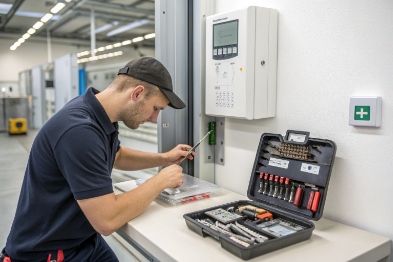
Use MTBF carefully, because keypads do not fail like ICs
MTBF is a statistical measure often used for electronic assemblies. It does not describe wear-out very well. Keypads have wear and contamination modes, so a separate wear plan is needed. The most useful approach is to ask the vendor for:
- MTBF 9 (for main electronics) and what method was used
- Expected keypad cycle life and the test method
- Service parts list and replacement time estimate
A good deployment spec also defines “acceptable behavior” during keypad life:
- No stuck keys
- …No missed presses within defined force range
- No double-press events beyond a small threshold
- No loss of sealing after aging tests
Warranty scope should match the reality of hazardous sites
A warranty clause should state what is covered when the phone is installed correctly:
- Keypad module and scanning electronics coverage
- Seal and membrane coverage under specified cleaning chemicals
- Ex marking and enclosure integrity coverage under correct gland practice
In DJSlink support work, the highest value warranty detail is not the number of months. The highest value detail is the process: how fast replacement ships, what logs the buyer must provide, and whether the keypad is a field-replaceable module.
Spare keypad planning: simple rules that scale
A spare plan should be based on environment and usage class. A simple method is to classify sites:
- Light use: emergency-only presses, clean or indoor
- Medium use: daily operations, mixed environment
- Heavy use: gatehouse, dispatch, outdoor coastal, washdown, or oily zones
Then plan spares based on module replaceability and response time. A field-replaceable keypad module lowers downtime a lot, especially in hazardous areas where work permits are slow.
| Deployment type | What to stock | Practical target |
|---|---|---|
| 100–300 phones, mixed use | Keypad modules + one full phone | Keep 1–2% spares if module is easy |
| 300–1,000 phones, industrial | Keypad modules + PCB set + seals | Keep 2–3% modules for fast swap |
| 1,000+ phones, harsh zones | Modules + staged spares by area | Keep area-based spares and swap kits |
This is not a standard requirement. It is an operations habit. The goal is simple. A keypad should never be the reason an emergency call fails. A spare module on the shelf and a clear service method turns keypad wear into a planned task.
Conclusion
Keypad lifespan is proven by cycle targets plus IEC 60068 stress tests and IEC 60529 IP checks. Piezo usually wins in harsh sites. Large deployments need spares and a clear warranty plan.
Footnotes
-
IEC 60068 International standard defining environmental testing procedures for electronic equipment durability. ↩
-
IP ratings Classification system rating the degree of protection against dust and water intrusion.[^3]: ATEX EU directives describing safety requirements for equipment in explosive atmospheres. ↩
-
IECEx International certification system for equipment used in explosive atmospheres. ↩
-
metal-dome keypads Keypad technology using stainless steel domes for tactile feedback and reliability. ↩
-
piezo switches Solid-state switches generating signals via pressure, offering high durability and sealing. ↩
-
explosion-proof telephones Communication devices designed to prevent ignition of hazardous substances in explosive areas. ↩
-
environmental test methods Procedures to assess product performance under stress like vibration, heat, and corrosion. ↩
-
IEC 60529 Standard defining the IP code system for enclosure protection classifications. ↩
-
MTBF Statistical measure of the expected reliability and operating time between failures. ↩








