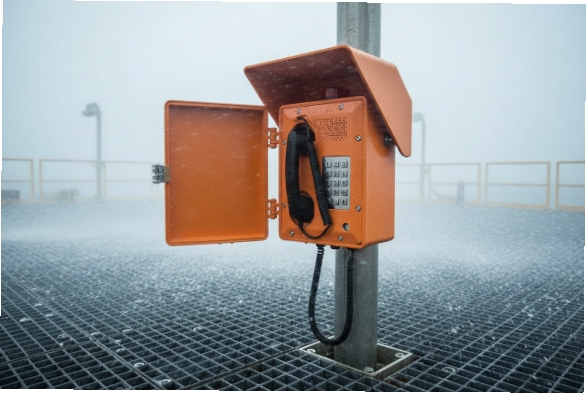
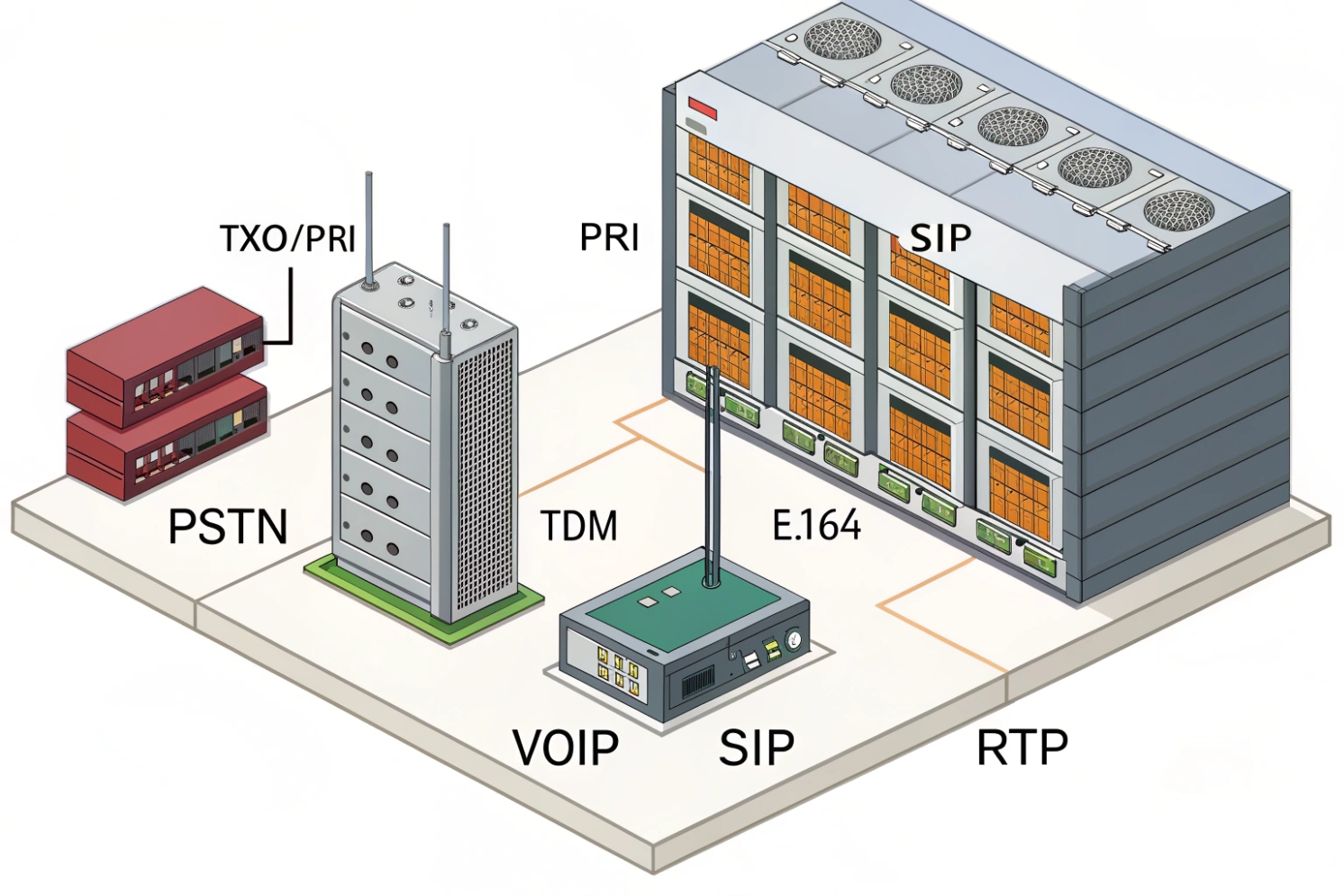
VoIP gets the attention, but the PSTN is still the backbone behind most phone numbers. When a SIP call reaches a “real” phone line, it is the PSTN doing the last mile and the global routing.
The PSTN is the traditional public telephone network that connects calls using carrier switching and standardized phone numbers (E.164). It sets up a dedicated voice path (historically TDM circuits) through exchanges, then tears it down when the call ends, with strong reliability and emergency calling behavior built in.
PSTN 101: the global circuit-switched phone system
The PSTN is “phone service” as a utility
The PSTN (Public Switched Telephone Network) is the global network of carrier exchanges, trunks, and numbering systems that makes traditional calling work. It includes local loops (the line to the customer), switching centers, and inter-carrier links. Even when the core is digital, the logic is still “reserve a path for the call.”
A classic PSTN call behaves like this:
- The caller dials an E.164 international phone number format 1 (the familiar +country code format).
- The network uses signaling to decide where that number currently lives.
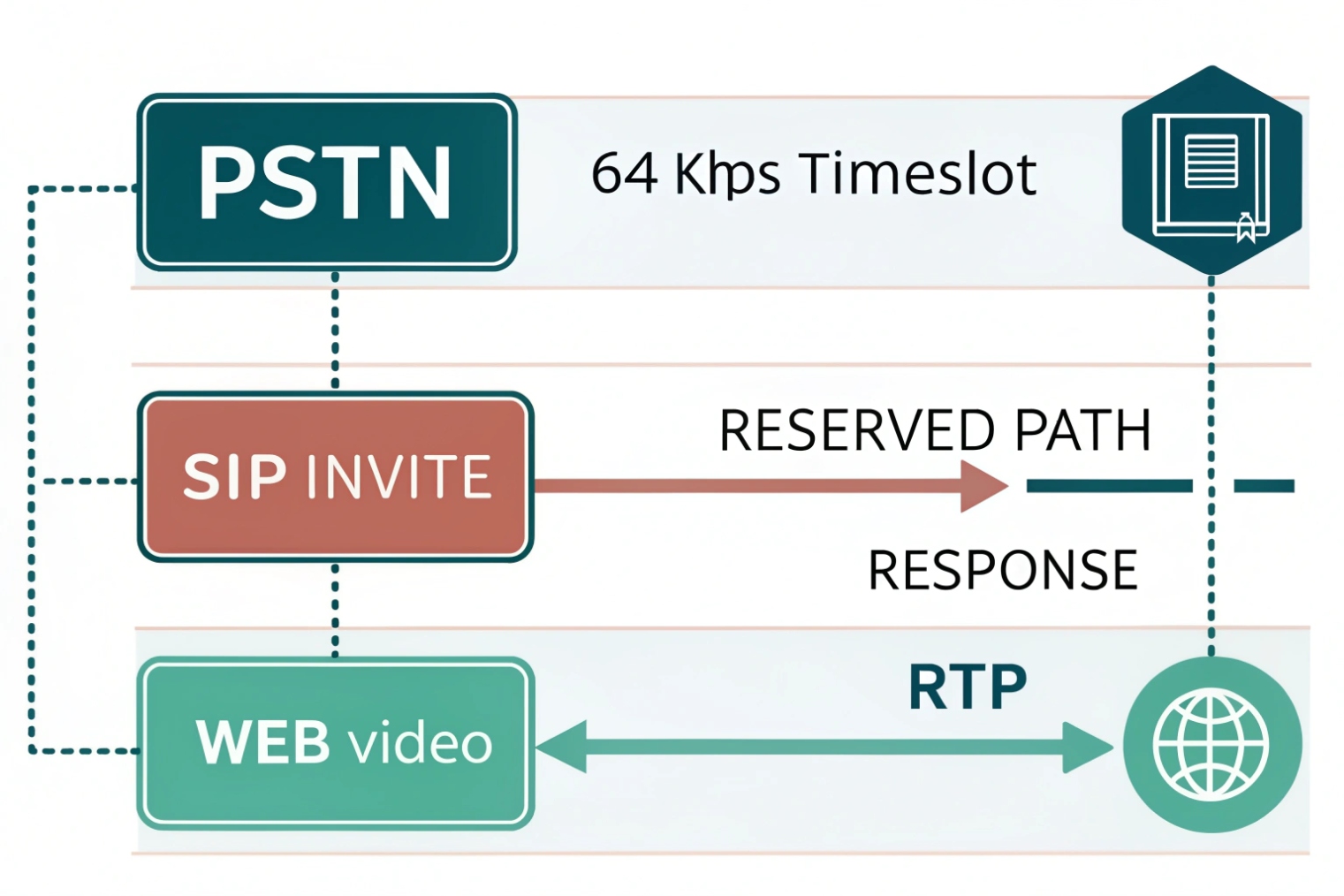
- The network reserves capacity end-to-end for the call duration.
- Audio is carried in a stable channel, traditionally a 64 kbps PCM timeslot (G.711) 2.
- When the call ends, the reserved resources are released.
That “reserved resources” model is what most people mean by circuit switching. It is also why PSTN voice feels consistent even when networks are busy.
What’s happening at the customer edge
Traditional analog landlines (POTS) use a copper pair that is powered from the central office, often around -48 V DC. That powering model is why plain analog phones can keep working in a local power outage. Inside the carrier network, voice is generally digitized and transported in time slots. Even if the carrier backhaul is now IP in many regions, the service behavior still looks like a circuit call to the user.
Signaling vs voice path in the PSTN
PSTN uses a signaling system to set up and route calls. Historically, the SS7 signaling network (ITU-T Q.700 series) 3 is the famous signaling fabric for inter-exchange call setup and number translation. The user experience is simple: dial, ring, connect. Under the hood, signaling checks number portability and routes through carriers, then connects the audio path.
| PSTN element | What it does | What users notice |
|---|---|---|
| E.164 numbers | Global addressing | Phone numbers “just work” |
| Exchanges/switches | Connect calls | Fast call setup and stable audio |
| Trunks | Carry voice between exchanges | Long-distance calling reliability |
| Central office power | Powers the line | Calls still possible during outages |
| Emergency routing | Prioritized handling | 911/112 behavior and location |
That is the PSTN worldview. Next is the practical comparison everyone asks about: PSTN vs VoIP and SIP trunks.
How does PSTN differ from VoIP and SIP trunks?
Many projects get stuck because people compare “PSTN vs SIP” as if they are the same category. PSTN is a service network. SIP is a signaling protocol in IP networks.
PSTN is a carrier-operated circuit-style telephony service; VoIP carries voice as IP packets; SIP trunks are an IP-based replacement for traditional carrier trunks that connect your PBX to the PSTN through a provider.
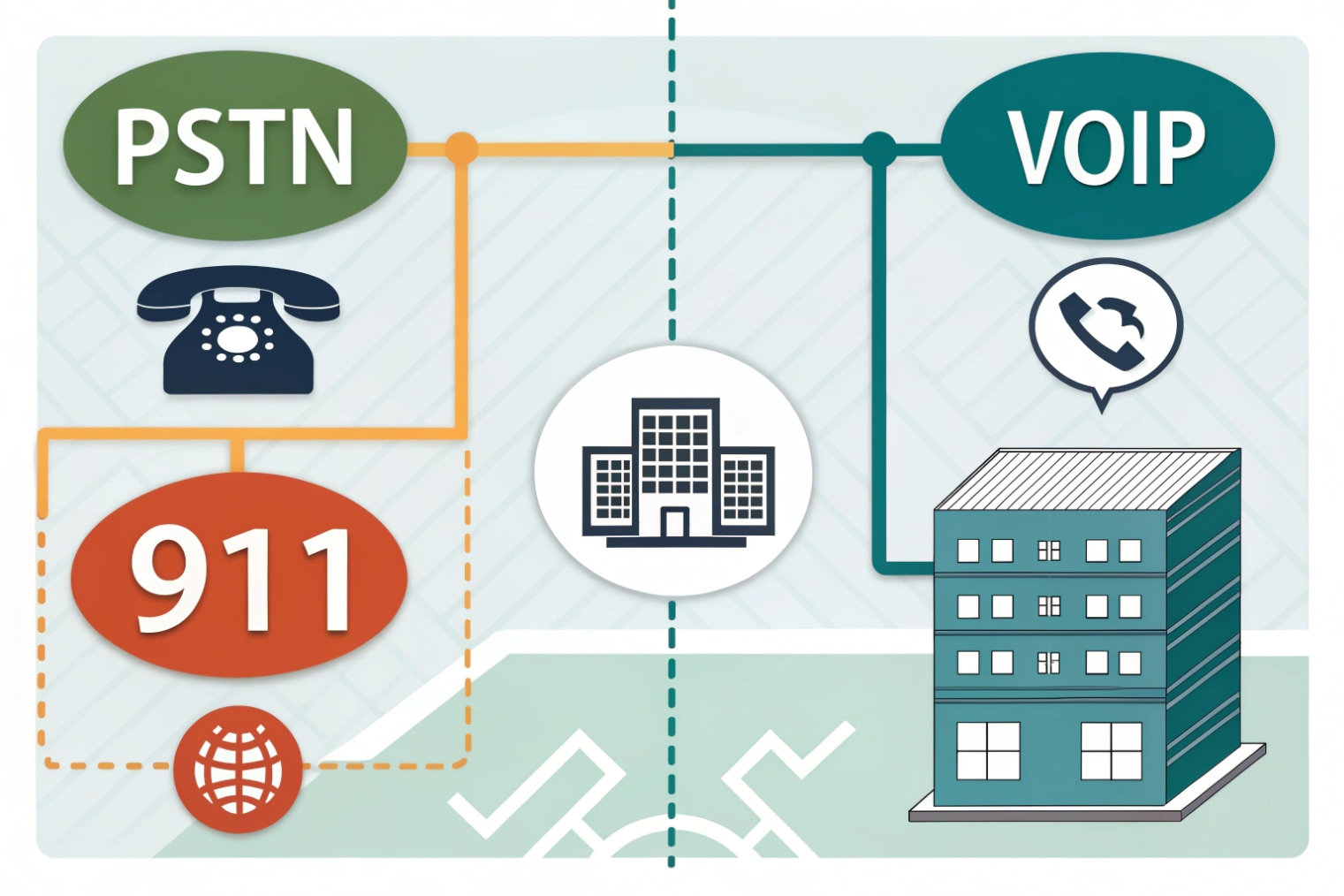
The biggest architectural difference: circuit vs packet
- PSTN (circuit model): reserves capacity for the call. Delay is stable and predictable.
- VoIP (packet model): sends voice in packets over shared networks. Quality depends on latency, jitter, and loss.
VoIP does not automatically mean “bad quality.” It means the network must be engineered. QoS, bufferbloat control, and stable WAN links decide success.
SIP trunks are “PSTN access delivered over IP”
A SIP trunk is typically how a modern IP PBX reaches the outside world. Instead of plugging into PRI lines or analog FXO lines, the PBX connects to a SIP provider over an IP link. The provider then bridges the call into the PSTN as needed.
So the call path often looks like:
IP PBX → SIP trunk provider (IP) → PSTN termination
In many countries, carriers are retiring legacy PSTN switching and delivering “PSTN service” as IP at the edge while keeping the same phone numbers. In practice, that means you still call PSTN numbers, but the access method becomes IP.
What changes for operations and troubleshooting
PSTN troubleshooting focuses on line quality and carrier service tickets. VoIP troubleshooting focuses on network metrics and firewall/NAT behavior. SIP trunk troubleshooting also includes SIP (Session Initiation Protocol) call signaling 4, codec negotiation, and RTP reachability.
| Topic | PSTN line | VoIP/SIP trunk |
|---|---|---|
| Transport | Dedicated circuit path | Shared IP packet path |
| Main risk | Physical line faults | Jitter/loss/NAT/firewalls |
| Power | CO powers analog line | CPE + router + ISP power needed |
| Scaling | Add physical circuits | Add channels by license/bandwidth |
| Features | Limited by carrier | Rich PBX features and integrations |
Once the difference is clear, the real business question appears: keep PSTN lines or migrate to SIP?
Should I keep PSTN lines or migrate to SIP?
This decision is rarely about “technology preference.” It is about reliability, emergency calling, cost, and operational control. Many teams end up using a hybrid approach.
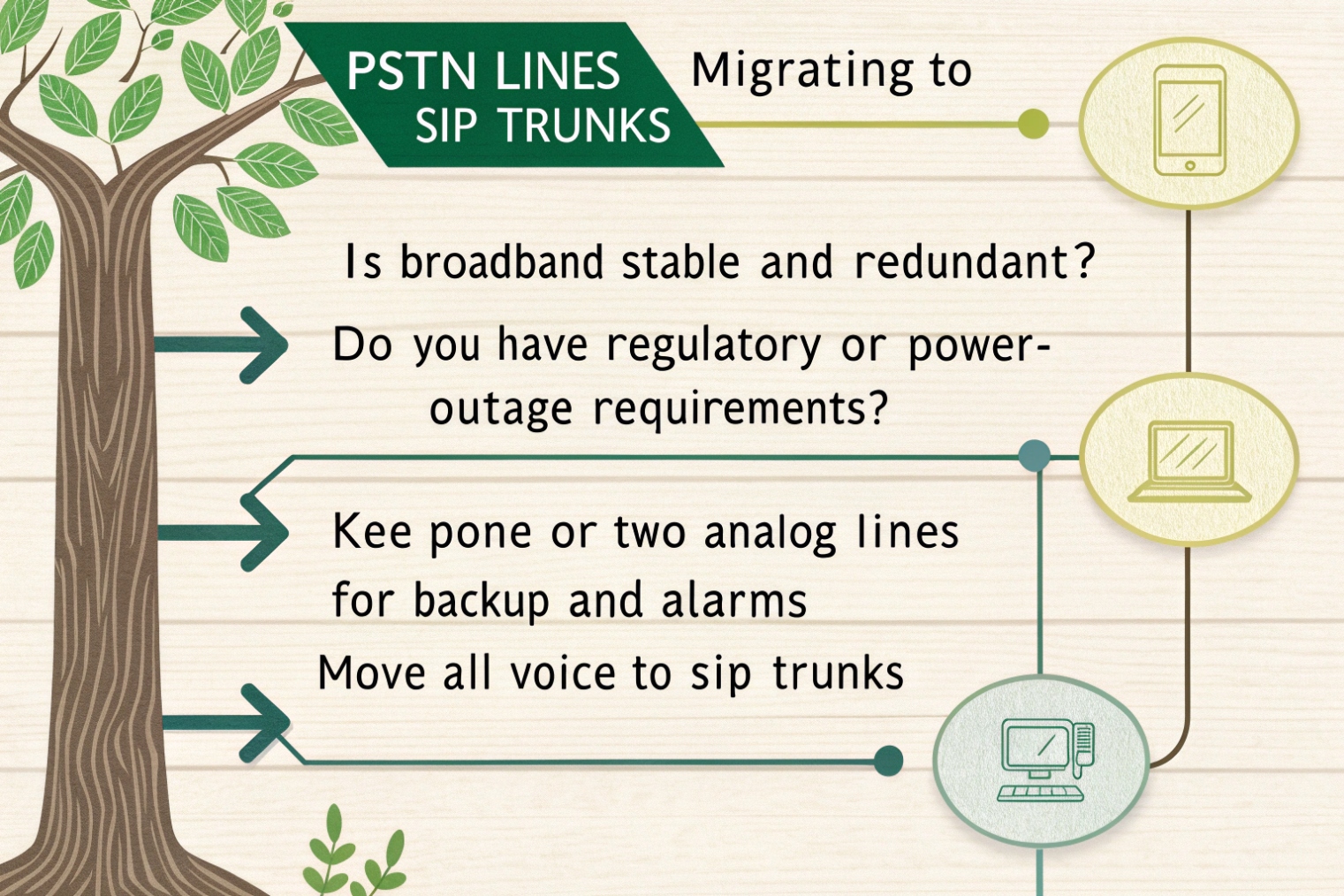
Keeping PSTN lines can make sense for resilience and emergency calling fallback, while migrating to SIP trunks often reduces cost and increases flexibility. A hybrid design—SIP trunks as primary with a small PSTN fallback—often gives the best risk balance.
When keeping some PSTN still makes sense
- Sites that must make emergency calls during local power outages
- Locations with unreliable broadband or frequent ISP outages
- Facilities where an analog line is needed for elevators, alarm panels, or legacy fax
- High-stakes environments that want a physically diverse path
A single analog line can still be a useful “last resort” in some buildings. It is simple and independent of your LAN.
When SIP trunks are the better operational choice
- Multi-site organizations that want centralized routing
- Rapid scaling (seasonal call volume, contact centers)
- Feature needs like number portability, failover, and flexible DID mapping
- Lower cost compared to maintaining many physical circuits
SIP trunking also integrates cleanly with SIP intercom systems and IP PBXs. It allows one dial plan across phones, door stations, and paging endpoints.
A practical migration stance for integrators
For most modern deployments, I prefer:
- SIP trunk as the primary carrier connection
- An SBC or properly secured edge
- A small PSTN or cellular voice fallback for emergency and resilience
| Requirement | Better fit | Why |
|---|---|---|
| Lowest operational cost | SIP trunk | Shared capacity and easier scaling |
| Highest independence from LAN/ISP | PSTN analog | CO-powered and separate path |
| Multi-site unified dialing | SIP trunk | Centralized routing and policy |
| Regulatory/E911 confidence | Hybrid | Redundant paths and clearer fallback |
The next step is the hardware bridge question: how do you connect legacy PSTN circuits to an IP PBX when you still need them?
How do gateways connect PSTN (FXO/PRI) to IP PBX?
A lot of “PSTN vs VoIP” deployments are actually “PSTN + VoIP together.” Gateways are the translators that make that possible.
Gateways connect PSTN circuits to an IP PBX by converting PSTN signaling and audio into SIP signaling and RTP media. FXO ports terminate analog lines, FXS ports drive analog phones, and PRI/E1/T1 interfaces terminate digital trunks, while the gateway presents SIP trunks to the PBX.
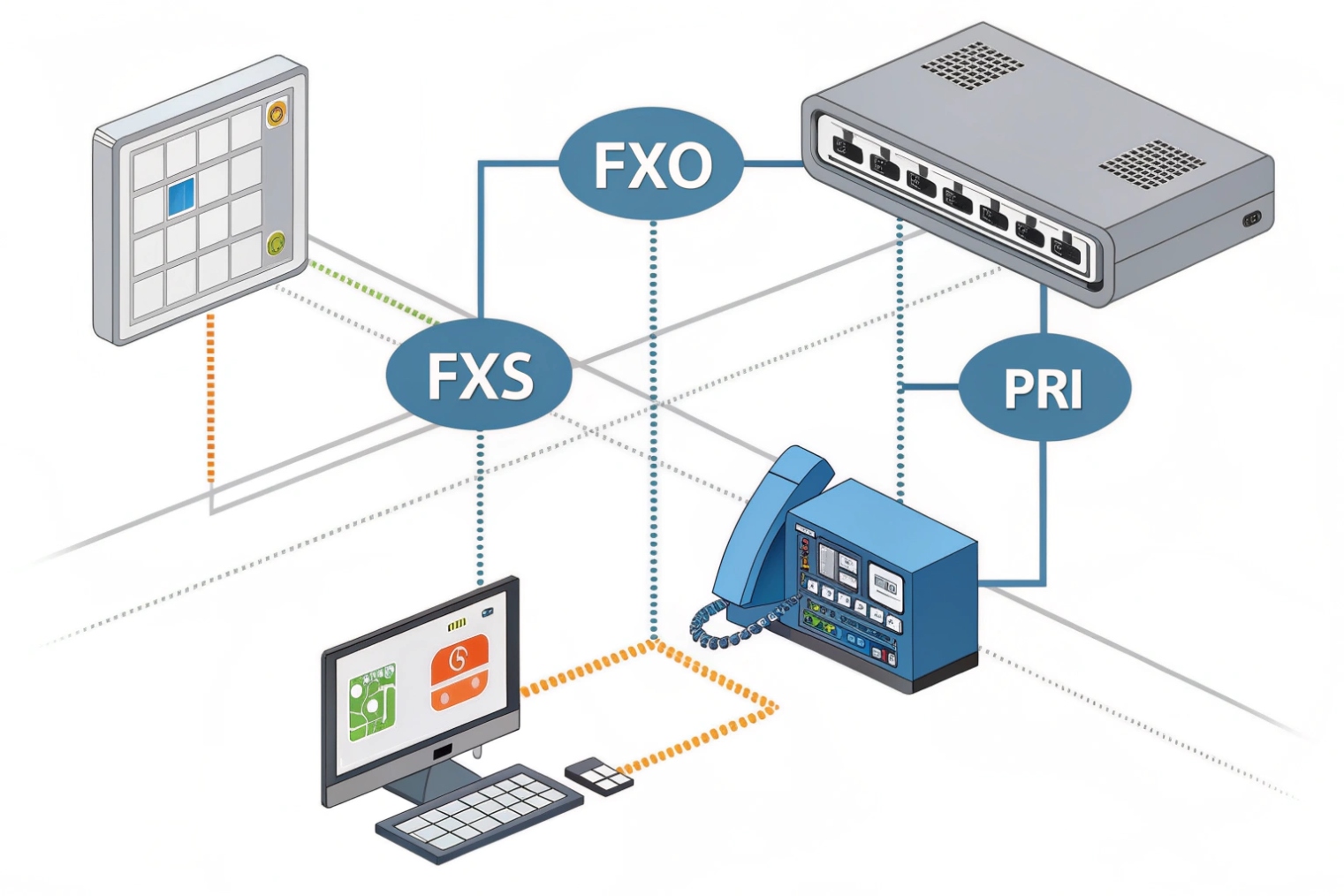
FXO vs FXS: the fastest way to avoid wiring mistakes
- FXO is used to connect to the telephone company line (or a PSTN line). Think “O = Office line input to the gateway.”
- FXS provides dial tone to an analog device like a phone, fax, or paging adapter. Think “S = Station device output.”
In a hybrid VoIP building:
- A gateway with FXO ports can bring analog PSTN lines into the PBX as SIP.
- A gateway with FXS ports can let the PBX drive legacy analog phones or elevator phones.
PRI (T1/E1): digital PSTN trunking into VoIP
PRI is a digital circuit with multiple channels. A PRI gateway terminates that circuit and maps it to SIP trunks. This is common in older enterprise sites where PRI was the main carrier interface. If you need the formal interface definition, start with the ISDN Primary Rate Interface (PRI) user-network interface standard (ITU-T I.431) 5.
Media and signaling translation
The gateway has two jobs:
- Convert signaling (dialing, ringing, hangup, caller ID) into SIP messages.
- Convert audio (TDM/analog) into RTP streams, usually using G.711 for faithful PSTN mapping.
If audio fails in a gateway scenario, the same principles apply: check RTP port ranges, NAT, codec negotiation, and DTMF method mapping.
| Interface | Connects to | Typical use | Notes |
|---|---|---|---|
| FXO | PSTN analog line | Legacy trunk fallback | Needs line voltage and correct impedance |
| FXS | Analog phone/fax | Legacy endpoints | Provides dial tone and ring voltage |
| PRI (T1/E1) | Digital PSTN trunk | Multi-channel trunking | Clocking and framing must match |
| SIP side | IP PBX/SBC | Main VoIP interface | Control RTP ranges and codecs |
Now the most important part of the PSTN vs VoIP debate: emergency calling, reliability, and power.
How do E911, reliability, and power differ on PSTN vs VoIP?
Most call-quality conversations ignore the worst-case scenario. Emergency calling and power outages are where the design is tested.
PSTN analog lines are often powered from the carrier central office and can keep working during local outages. VoIP depends on local power for the modem/router/switch/PBX and on broadband availability. E911 on VoIP requires accurate location provisioning and correct routing, while PSTN lines have location tied more directly to the service address.
Power: the simplest difference with the biggest impact
- PSTN analog: the line itself often provides power for basic phones.
- VoIP: your phone and network gear need power, plus the ISP link must stay up.
The practical fix is also simple: UPS protection for modem/router/switch and the PBX or SBC. Many teams protect servers but forget the ISP modem. For SIP intercom systems, PoE switches also need UPS if you want door stations alive during outages.
Reliability: PSTN’s historical advantage vs engineered VoIP
PSTN is built as a utility with strong redundancy inside carrier networks. VoIP can match that reliability when:
- ISP links are redundant (dual WAN or fiber + LTE)
- SIP trunks have failover routes
- SBCs and PBXs are high-availability
- QoS prevents congestion from hurting voice
The difference is who owns the reliability work. PSTN hides it inside the carrier. VoIP puts more responsibility on the customer network design.
E911: location truth and call routing
PSTN service addresses are traditionally tied to a physical line. VoIP endpoints can move. That mobility is useful, but it means location must be managed. E911 for VoIP typically relies on correct provider and enterprise configuration aligned to VoIP and 911 service requirements 6.
For multi-site companies and campus deployments, this is not optional. A clean design maps extensions to locations and ensures the provider receives correct emergency location information.
| Topic | PSTN analog line | VoIP/SIP trunk |
|---|---|---|
| Power during outage | Often continues | Depends on UPS and ISP uptime |
| Location association | Tied to line address | Must be provisioned and maintained |
| Failure modes | Line cut, carrier outage | ISP outage, LAN outage, misconfig |
| Hardening | Mostly carrier responsibility | Customer + provider shared responsibility |
| Best practice | Keep one lifeline if needed | UPS + dual WAN + SBC + E911 policy |
In most modern buildings, the best answer is not ideological. It is a design that matches risk. SIP trunks bring flexibility and cost benefits. PSTN fallback (or cellular fallback) can cover power and ISP edge cases.
Conclusion
The PSTN is the traditional circuit-based phone network, while VoIP and SIP trunks carry calling over IP. SIP migration brings flexibility, but reliability and E911 need UPS, redundancy, and location policy to match PSTN behavior.
Footnotes
-
Official E.164 numbering reference for global phone number structure and country codes. ↩ ↩
-
Explains G.711 PCM encoding used for classic 64 kbps digital voice channels. ↩ ↩
-
Overview entry point for SS7 signaling standards used for PSTN call setup and routing. ↩ ↩
-
SIP standard defining how VoIP signaling sets up, manages, and ends sessions. ↩ ↩
-
Defines the PRI physical interface details commonly referenced for legacy T1/E1 ISDN trunking. ↩ ↩
-
FCC guidance on VoIP-to-911 obligations, limitations, and location requirements. ↩ ↩