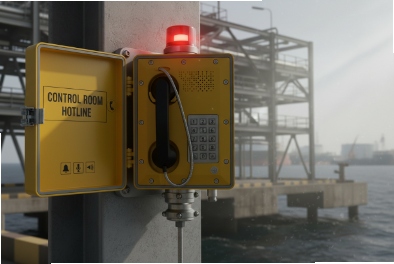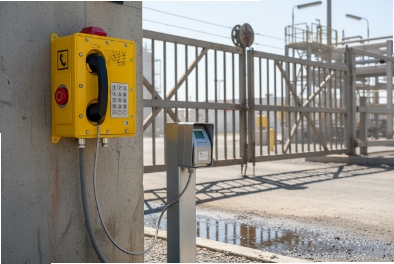
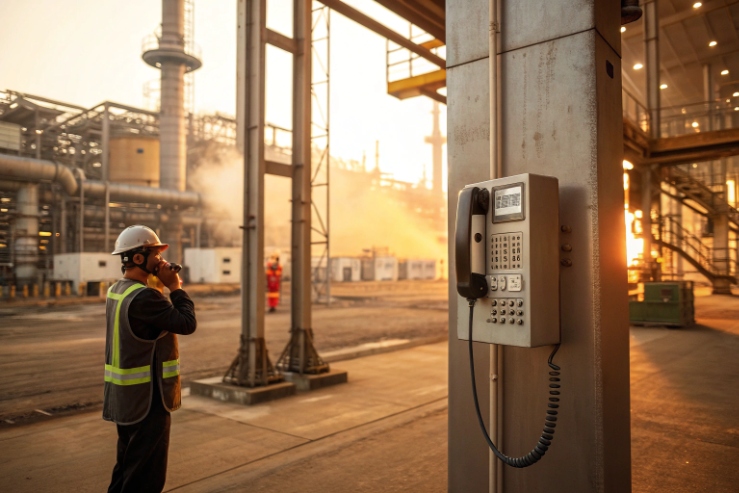
If the ringer is too quiet, operators miss calls and delays grow. If it is too loud, it adds risk in already noisy and stressful areas.
Most explosion-proof telephones deliver about 80–95 dB(A) at 1 m with the internal ringer, while systems with external Ex horns can reach roughly 110–117 dB(A) at 1 m. The usable result depends on measurement method, ambient noise, hearing protection, and how the site handles paging and alarms.
Why “ringer volume” is not one number
Internal ringer SPL is only the start
A datasheet number like “95 dB(A) at 1 m” is useful, but it is not the full story. The moment the phone is installed, the real Sound Pressure Level 1 at the operator changes. Walls reflect sound. Wind and rain mask it. Operators wear hearing protection. Machines add broadband noise that covers the same frequency range as a standard ring.
In many projects, the internal ringer is enough for control rooms, pump stations, and fenced outdoor zones. In loud process areas, it is often a “notification only” signal, and the real alerting is done with an external horn, strobe, or PAGA.
Distance and mounting change perceived loudness fast
Ringer SPL drops with distance. A ring that is clear at 1 m can be weak at 4 m. Also, mounting on a rigid wall can increase perceived loudness because of reflection and resonance. Mounting on a soft structure can reduce it. This is why a site acceptance test matters more than a lab number.
The right target is audibility above ambient, not maximum SPL
For safety-style alerting, the target is not “as loud as possible.” The target is “clearly recognizable above ambient noise, without harming hearing.” A plant can define a site SNR target 2 like:
-
ring or alert is 10–15 dB above local ambient at the listening point, or
-
ring is distinct in frequency and cadence so it cuts through masking noise
A simple decision table for tenders
| Site area | Typical ambient noise | Internal ringer likely enough? | Recommended add-on |
|---|---|---|---|
| Control room / office | 45–70 dB(A) | Yes | None or strobe for visibility |
| Outdoor utility yard | 70–85 dB(A) | Often | Strobe or louder ring profile |
| Process unit near pumps | 85–100 dB(A) | Sometimes not | External Ex beacon/horn or PAGA tie-in |
| Near compressors / crushers | 95–110 dB(A) | Rarely | External Ex horn + strobe + workflow logic |
A purchase spec works best when it includes both the internal ring SPL target and the required method for “high noise zones.”
The next section explains how SPL at 1 m is measured and how to compare vendors in a fair way.
How many dB(A) at 1 m does the ringer deliver, and how is it measured?
If measurement is unclear, two quotes cannot be compared. One vendor may measure in a reflective room, another in a free field, and the numbers will look “better” or “worse” by accident.
Typical internal ringer output for industrial Ex telephones is around 80–95 dB(A) at 1 m. Measurement should be A-weighted, at 1 m distance, with a defined mounting condition and ring signal setting, using a calibrated sound level meter and documented test setup.

What numbers are realistic
Across common industrial and Ex telephone datasheets, internal ringer values often land in this band:
-
\~80 dB(A) at 1 m for some basic or analog models
-
\~90 dB(A) at 1 m for many industrial builds
-
up to \~95 dB(A) at 1 m for louder designs
These are not universal guarantees. They are typical ranges that show up repeatedly in published specifications.
How to measure it so results are comparable
For a fair comparison, define the test like this:
-
Use a calibrated A-weighted sound level meter 3 (dB(A))
-
Set the microphone 1 m from the phone, on axis to the sound opening
-
Define the environment as essentially free field over a reflecting plane, or state the room type and correction method
-
Define the phone state: maximum ringer volume, chosen ring tone, and normal supply voltage
-
Record the result as LAeq over a defined ring burst or LAFmax during a ring burst
What to ask for in a test report
| Item | What to request | Why it matters |
|---|---|---|
| Sound metric | LAeq and/or LAFmax | prevents “peak-only” marketing |
| Distance | 1 m and microphone position | makes results comparable |
| Mounting | wall mount vs free-hanging | changes reflections and output |
| Ring setting | volume step, tone selection | ensures repeatability |
| Calibration | meter model and calibration date | avoids unreliable readings |
Is the ring level adjustable in steps, with max SPL for refineries and mines?
A fixed ringer is rarely ideal. Some areas are quiet and need low ring volume. Some areas are loud and need maximum output plus visual alerts. In many projects, the internal ringer is enough for control rooms, pump stations, and IP66/67 ratings 4 enclosures.
Many explosion-proof telephones offer ringer volume steps (often a small range of levels) and multiple ring melodies. For refineries and mines, the practical approach is to set the internal ringer to max, then add external Ex sounders or beacons where ambient noise exceeds the ring audibility target.

What “adjustable” usually looks like
In industrial devices, ringer adjustment is commonly discrete steps (example: 5–7 steps), a “mute” or “night” mode, and a choice of ring melodies to improve recognition.
Max SPL is not the only need in mines and refineries
High-noise sites need a ringer that avoids the frequency band already masked by machinery. It is also common to add a visual strobe for line-of-sight awareness.
Do ring tones meet alarm audibility standards—ISO 7731, OSHA/NIOSH guidance, and site SNR targets?
A ring tone is not always a safety alarm. Still, many customers treat emergency call points as safety-related, so audibility targets become part of acceptance.
A standard phone ring does not automatically “meet alarm standards.” ISO 7731 is often used as a reference: the signal should be clearly audible above ambient noise and not create unsafe exposure. OSHA and NIOSH guidance also pushes noise control and hearing protection limits, so high SPL must be used carefully.

What ISO 7731 is used for in practice
ISO 7731 focuses on auditory danger signals 5 in noisy environments. In procurement language, it is often translated into a simple target: the alert must cut through masking noise, but it should not push exposure into unsafe ranges.
OSHA/NIOSH: focus on exposure and hearing risk
OSHA and NIOSH material is often used to justify that workplaces above certain noise levels require hearing protection programs 6 to ensure worker safety. Paired with clear limits on maximum SPL at the listening point, this reduces long-term liability.
| Target method | What you measure | When it works best |
|---|---|---|
| dB above ambient | LAeq ambient and ring LAeq | steady plant noise |
| Frequency separation | octave-band noise profile | machinery-dominated noise |
| Visual redundancy | strobe visibility distance | high PPE and high noise areas |
Can external Ex horn speakers or beacons be driven for higher SPL and distinct ring patterns?
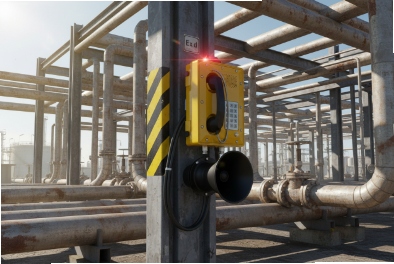
In many plants, the internal ringer is not the main alert. The main alert is a horn, a strobe, or a paging speaker that everyone can notice.
Yes. Explosion-proof telephones can be integrated with external Ex horns and beacons to reach higher SPL and clearer patterns. This can be done by relay outputs, ring-voltage sensing accessories, or SIP-based triggering to Ex-rated sounders and PAGA systems, depending on the architecture.

Driving external alerts via SIP
A SIP loud ringer or paging speaker is registered as a SIP endpoint. The PBX or platform calls it or triggers multicast paging. This is flexible and scales well for large zones when using PAGA systems 7, depending on the architecture.
Wiring and certification rules that must be respected
External sounders and beacons in hazardous areas must match the zone and gas/dust group, temperature class, and ingress protection needs.
Conclusion
Most Ex phones ring around 80–95 dB(A) at 1 m internally, and external Ex horns can push above 110–117 dB(A). Use site noise targets and a system approach for acceptance.
Footnotes
-
Learn how sound pressure level measures the physical intensity of sound relative to a reference level. ↩ ↩
-
A metric used to ensure signals are distinguishable from background noise in industrial environments. ↩ ↩
-
Learn how A-weighting adjusts sound measurements to match human ear sensitivity across different frequencies. ↩ ↩
-
Standardized ratings defining the level of protection against dust and liquid ingress for electrical enclosures. ↩ ↩
-
International standards for audio signals intended to warn workers of danger in high-noise areas. ↩ ↩
-
Essential safety guidelines for preventing permanent noise-induced hearing loss in hazardous industrial workplaces. ↩ ↩
-
Overview of Public Address and General Alarm systems used for plant-wide emergency notifications. ↩ ↩