
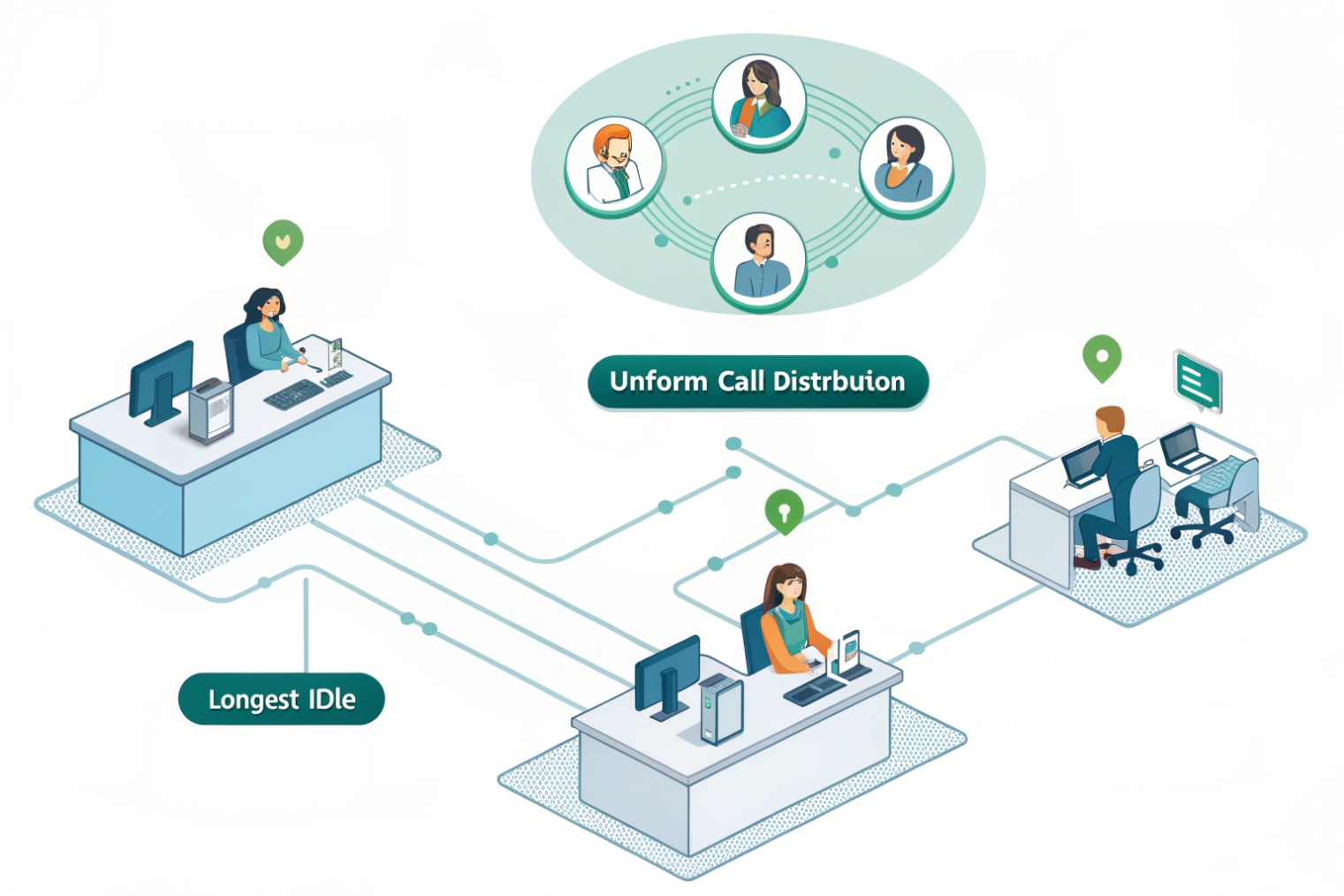
When inbound calls pile up, the same few agents often get hit first. That creates fatigue, uneven performance, and messy reports that do not match reality.
Uniform Call Distribution (UCD) is an inbound routing method that spreads calls evenly across eligible agents, often by sending the next call to the longest-idle agent so workload stays balanced.
Uniform Call Distribution (UCD) 1 is usually a simple Automatic Call Distribution (ACD) 2 feature inside an IP PBX or contact center module. The key idea is fairness among agents who are actually ready to take calls. The PBX tracks agent state and recent activity, then selects who should receive the next call.
Most UCD implementations use longest-idle agent selection 3 logic:
- Calls are offered to the agent who has been idle the longest.
- If the agent does not answer within a ring/offer timeout, the call moves to the next longest-idle agent.
- The system keeps the “fairness” order over time, so one agent does not get back-to-back calls unless everyone else is busy.
Some systems also support “uniform” based on a rolling window:
- Equalize by call count (each agent gets a similar number of calls)
- Equalize by talk time (each agent gets a similar number of minutes)
UCD works best when agent states are reliable. If agents forget to go into break, wrap-up, or auxiliary modes, the algorithm becomes unfair because the PBX believes they are available when they are not.
| What UCD tries to balance | Common metric | Why it helps | What breaks it |
|---|---|---|---|
| Fair workload | Longest idle time | Prevents repeated hits on same agent | Bad agent state discipline |
| Fair call count | Calls answered in window | Keeps “calls per agent” close | Different call types / AHT mismatch |
| Fair talk time | Talk minutes in window | Reduces burnout on heavy talkers | Skills and escalations skew time |
| SLA stability | Responsive offer intervals | Reduces queue wait | Long ring timeouts |
UCD is not magic. It is a fair allocator. When the queue is overloaded, UCD cannot create capacity. It can only share the pain more evenly.
Next comes the practical comparison: UCD vs round-robin vs linear hunting, and how to configure it without hurting answer speed.
How does uniform distribution differ from round-robin and linear hunting?
Many PBXs label these differently, but the behavior is what matters. The biggest difference is whether the algorithm knows who is busy and whether it remembers fairness.
Round-robin rotates through a list in order, linear hunting starts at the top and walks down, while UCD routes based on agent readiness and an idle/workload metric to keep distribution fair among available agents.
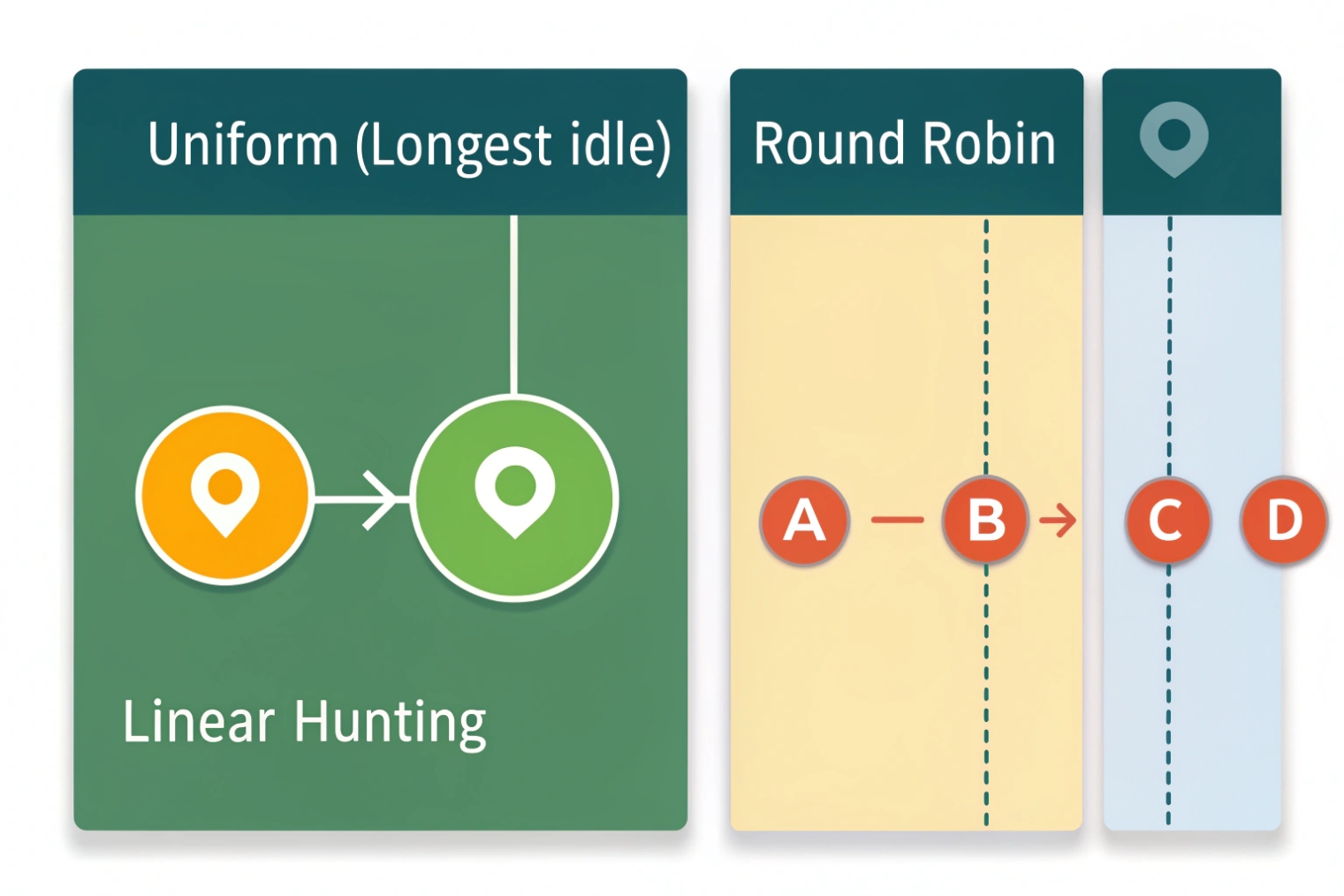
Linear hunting (top-down)
Linear hunting 4 always starts with the first agent in the list. That sounds simple, but it creates predictable overload:
- The first agents receive the most offers
- The bottom agents become “backup” and get fewer calls
- Reports look uneven and morale suffers
Linear can be useful for escalation patterns, but it is rarely fair.
Round-robin (rotation)
Round-robin routing 5 moves a pointer through the list. It is more balanced than linear, but it is still blind in many systems:
- It can rotate to someone who just returned from a call and is still wrapping up
- It may skip someone for reasons that feel random to users
- If timeouts are long, the rotation can stall
Round-robin is fine for small groups, but it often needs tight timeouts to feel responsive.
Uniform distribution (idle-aware fairness)
UCD is “rotation with memory and eligibility.” It changes the target based on:
- Who is ready
- Who has been idle longest
- Who has handled fewer calls or less talk time recently (variant-dependent)
- Tie-breakers (priority, last answer time, etc.)
That is why UCD usually feels fairer in practice, especially when agents step in and out of Ready/Wrap-up/Break states.
| Method | Selection rule | Who gets overloaded | When it works well |
|---|---|---|---|
| Linear hunting | Always start at top | First few agents | Small team with intentional escalation order |
| Round-robin | Next in fixed rotation | Depends on timeouts and list position | Small groups with consistent availability |
| UCD | Longest idle / lowest workload among eligible | Less overload by design | Queues where agents do similar work |
If the goal is fairness, UCD is usually the first choice. If the goal is “always ring the primary desk first,” then linear hunting is the right tool.
How do I configure uniform call distribution on my IP PBX?
Different PBXs use different menu names, but the configuration pattern is consistent: define a group, define eligibility states, define the offer strategy, then define overflow.
To configure UCD, create a queue or hunt group, choose a “uniform/longest-idle” distribution strategy, set offer timeouts, define agent states (Ready, ACW, Break), and add overflow rules for when no one answers.
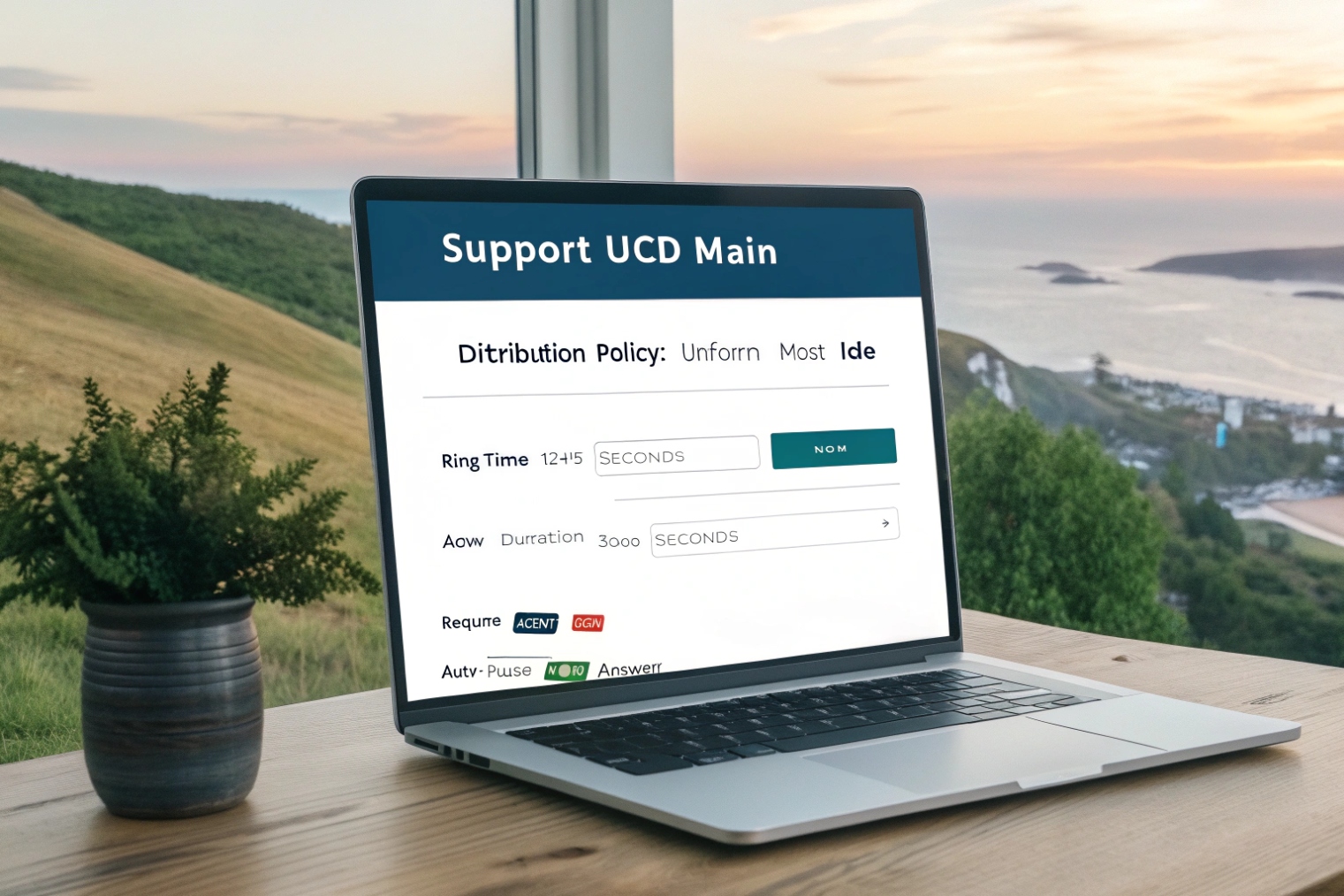
The core knobs that matter
1) Agent eligibility states
Define which states count as eligible:
- Ready / Available: eligible
- In call: not eligible
- Wrap-up (After-Call Work (ACW) 6): not eligible
- Break / AUX: not eligible
- Offline: not eligible
The system must trust presence and state. If agents never change state, UCD becomes guesswork.
2) Offer model: ring-all vs sequential offers
Many PBXs implement UCD as sequential offers:
- Offer to best agent
- Wait X seconds
- Offer to next best agent
- Continue until answered or overflow
This model needs short offer intervals (often 10–15 seconds). Long timeouts slow the whole queue.
3) Tie-breakers and priorities
When two agents look equally idle, PBXs break ties using:
- Last answered time
- Lower recent call count
- Agent priority (weights)
Priorities are useful, but too much priority defeats fairness.
4) Overflow and fail-safes
Define what happens when nobody answers:
- Overflow to backup queue
- Ring a supervisor group
- Send to voicemail
- Trigger callback option
- Announce expected wait time
Overflow is what protects SLAs when volume exceeds staffing.
A practical starter configuration that works well
- Distribution: Longest idle (UCD)
- Offer timeout: 12 seconds
- Max attempts before overflow: N agents once, then overflow
- Wrap-up: 10–30 seconds for after-call work
- Break and AUX: required usage for fairness
- Reporting: track “offered vs answered” per agent weekly
| Setting | Recommended starting point | Why it works | What to watch |
|---|---|---|---|
| Offer timeout | 10–15s | Keeps queue moving | Too short can annoy agents |
| Wrap-up (ACW) | 10–30s | Prevents instant re-hit | Too long inflates ASA |
| Overflow threshold | 30–60s queued | Protects caller experience | Needs staffing reality |
| Priority weights | Minimal | Keeps fairness true | Heavy weighting defeats UCD |
The goal is not “perfect math.” The goal is predictable behavior that agents understand and managers can defend with reports.
Will uniform routing improve fairness, ASA, and agent occupancy for me?
UCD is strong for fairness. Its impact on ASA and occupancy depends on load and configuration. It can help, but only within the limits of staffing and process.
UCD usually improves fairness and stabilizes occupancy across agents. ASA can improve if UCD reduces missed calls and shortens stalled ringing cycles, but ASA will still rise if the queue is under-staffed or ring timeouts are too long.
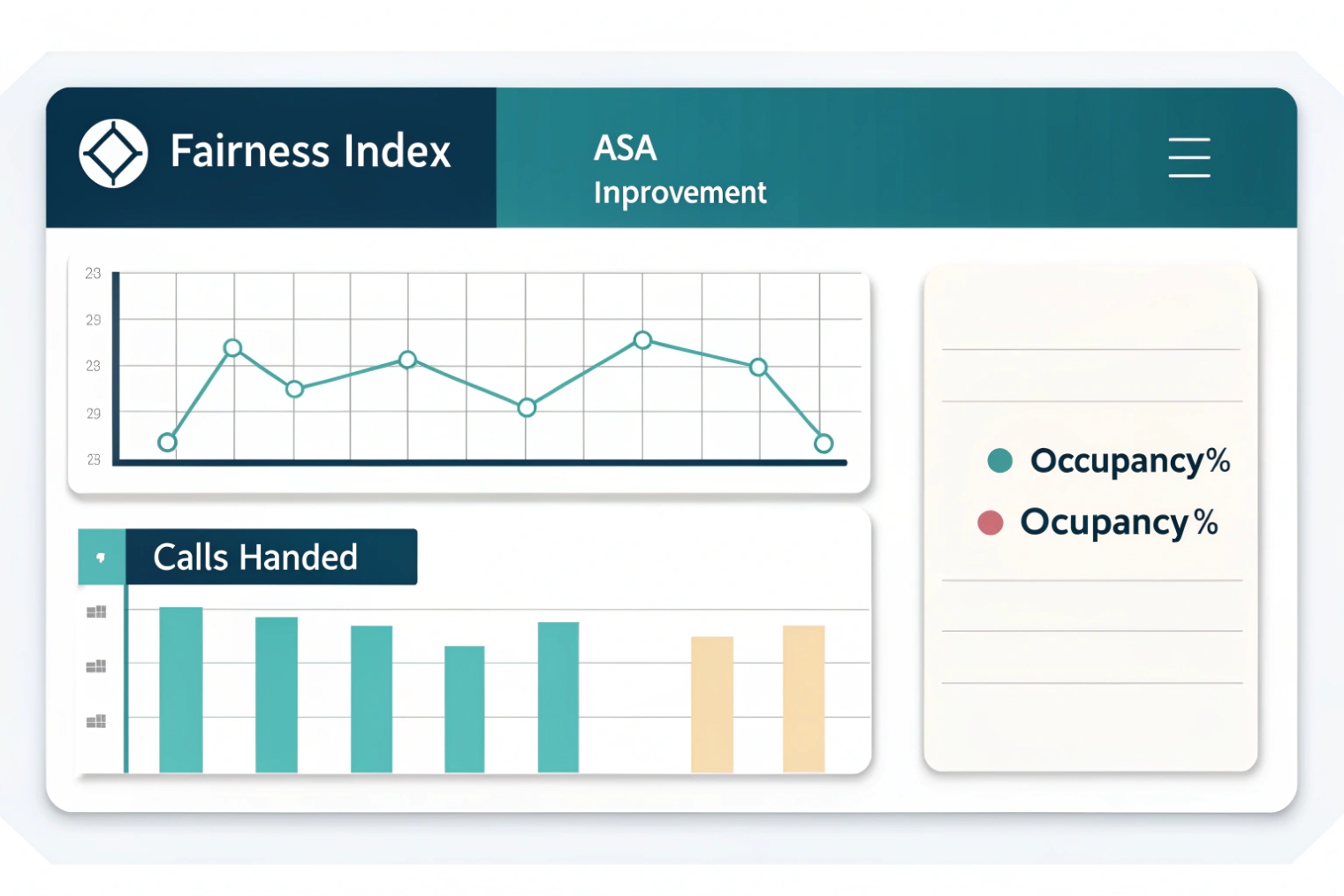
Fairness: almost always improves
UCD is built for fairness among ready agents. If agents are similarly skilled and handle similar calls, the result is easy to see:
- Offered calls per agent converge over time
- No “top of list” agent burnout
- Fewer complaints about being singled out
ASA: depends on timeouts and the miss rate
ASA (Average Speed of Answer) is mostly driven by demand vs staffing, but UCD can indirectly help when:
- Agents miss fewer calls because offers go to truly available agents
- Offers move quickly to the next agent
- Wrap-up is used correctly, keeping eligibility accurate
ASA can get worse if:
- Offer timeouts are long and sequential
- Agents stay “Ready” while away (phantom availability)
- Too many priorities or skills filters shrink the eligible pool
Occupancy: becomes more even, not necessarily lower
Agent occupancy 7 is about how much time agents spend handling calls vs waiting. UCD tends to:
- Make occupancy more balanced across the team
- Reduce extremes (one agent at 85%, another at 30%)
It does not guarantee “better” occupancy in a business sense. If calls are heavy, everyone will still be busy. UCD just spreads the load.
| KPI | Typical UCD impact | When it improves most | When it disappoints |
|---|---|---|---|
| Fairness | Strong positive | Similar agent roles and call types | Skills and escalations dominate |
| ASA | Mixed | Short offer intervals + clean states | Long timeouts + bad state discipline |
| Occupancy balance | Positive | Agents adhere to ACW/break states | Agents game states or stay “Ready” |
If reports still show imbalance under UCD, it usually points to state misuse, priority weights, or one agent getting special call types.
Can UCD respect agent availability, skills, breaks, and dynamic priorities?
Yes, but this depends on whether the PBX is “UCD only” or a fuller ACD with skills. UCD alone is typically skill-agnostic, so skills must be layered in.
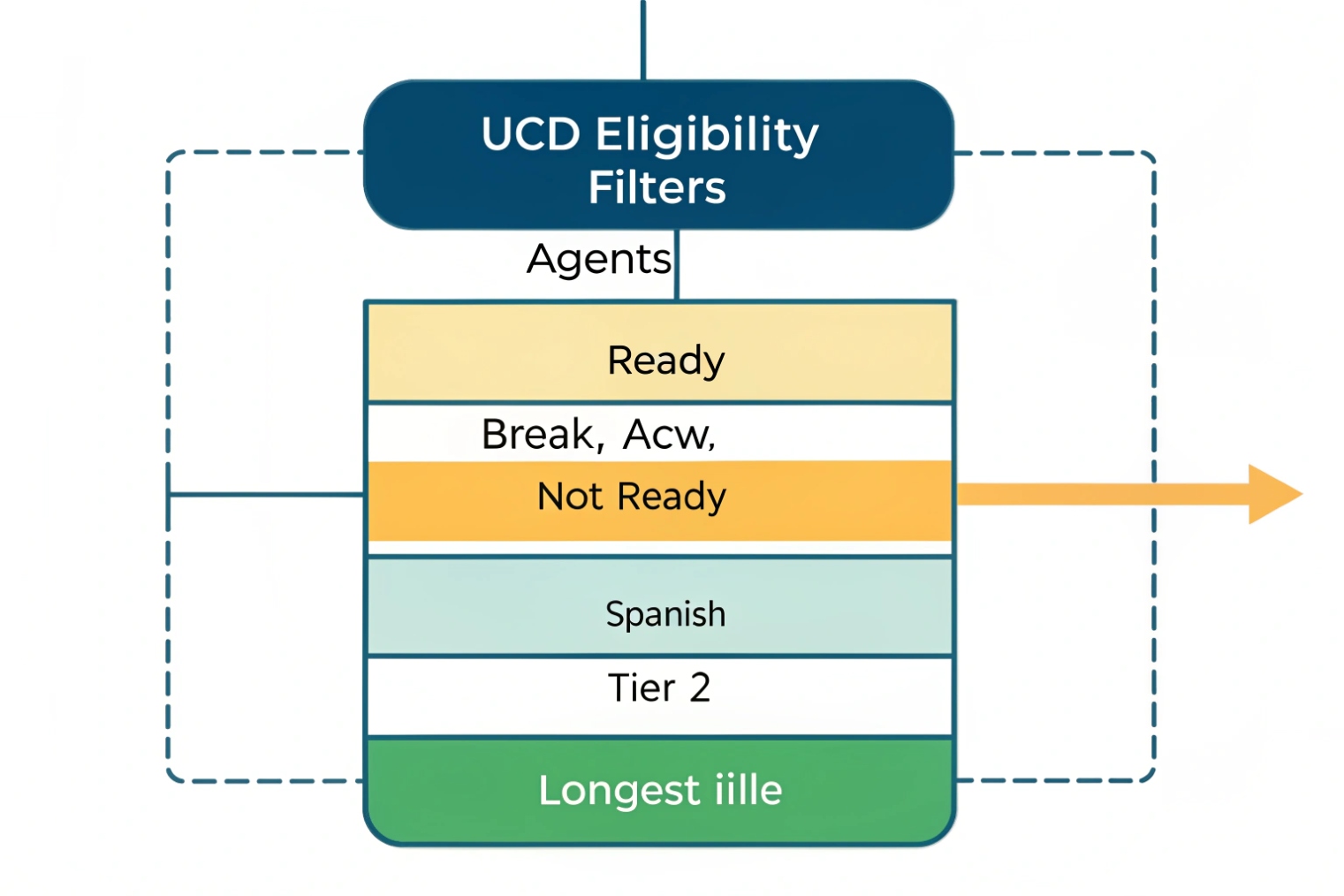
UCD can respect availability states and breaks by excluding non-ready agents. Skills and dynamic priorities can be supported when the PBX applies skill filters first, then runs UCD fairness inside the qualified pool.
Availability and breaks: the easy part
Most PBXs support eligibility gates:
- Ready → eligible
- ACW/Wrap-up → temporarily ineligible
- Break/AUX → ineligible
- Offline → ineligible
This is why training and supervisor enforcement matter. UCD is only fair when states are honest.
Skills: fairness inside the qualified set
UCD by itself does not understand “language” or “product tier.” A better pattern is:
1) Filter agents by skill requirement (must-have)
2) Rank remaining agents by UCD rule (longest idle / lowest workload)
3) Apply tie-breakers and priorities
This keeps fairness meaningful. It is unfair to compare a Level-3 support engineer against a Level-1 agent if only one can solve the call.
Dynamic priorities: useful, but keep them simple
Dynamic priority can be based on:
- VIP caller ID
- SLA age in queue
- Campaign or DID
- Time of day (after-hours rules)
- Staffing level
A clean approach is to change queue priority, not to micromanage agent priority. Too much per-agent weighting defeats the value of UCD.
What good UCD design looks like in real operations
- Agents have clear states and use them
- Skills decide eligibility, not favoritism
- Offer timeouts are short and consistent
- Overflow protects callers
- Reports are reviewed weekly to catch drift
| Feature | Can UCD handle it? | How it is usually done | Risk |
|---|---|---|---|
| Availability | Yes | Ready/Not Ready gates | Agents forget state changes |
| Breaks / AUX | Yes | Exclude from eligible pool | “Phantom ready” breaks fairness |
| Wrap-up (ACW) | Yes | Temporary ineligible after call | Too long ACW inflates ASA |
| Skills | Sometimes | Skill filter, then UCD ranking | Too few qualified agents increases wait |
| Dynamic priority | Sometimes | Queue priority rules + overflow | Over-complex rules confuse teams |
Uniform routing is a strong “default” when the team handles similar work. When skills matter, the best results come from skill gating first, then uniform fairness inside each skill group.
Conclusion
UCD routes calls to eligible agents in a fair way, often by longest idle. It beats linear and many round-robin setups when states, timeouts, and overflow rules are configured well.
Footnotes
-
Definition of UCD and how “uniform/longest-idle” routing typically works. ↩︎ ↩
-
Overview of ACD systems and common distribution strategies used in inbound contact centers. ↩︎ ↩
-
Vendor example of longest-idle routing behavior and why it balances workload under steady volume. ↩︎ ↩
-
Clear explanation of line hunting behavior and why top-of-list agents get overloaded. ↩︎ ↩
-
Practical definition of round-robin routing and how sequential rotation differs from idle-aware selection. ↩︎ ↩
-
What ACW is and why wrap-up time changes who counts as “eligible” for the next call. ↩︎ ↩
-
How occupancy is measured and why balancing it helps prevent burnout and uneven performance. ↩︎ ↩








