
Unlimited calling looks simple. But the fine print can turn “flat-rate” into surprise charges, blocked calls, or policy warnings when real traffic hits the system.
Unlimited VoIP calling in business plans usually means a flat monthly rate for in-region calling, while channel limits, fair-use rules, and exclusions (international, toll-free surcharges, premium numbers, and automation) still apply.
What “unlimited” usually covers
Most business VoIP plans use “unlimited” as a billing promise, not as a technical promise. The provider is saying: “Domestic calls inside a defined region will not create per-minute charges for normal business use.” That is it. It does not mean every destination is covered, and it does not mean a PBX can push traffic without limits.
Unlimited calling is usually tied to a calling region. For a North America plan, this is often the U.S. and Canada, and sometimes extra territories. Many providers map that “in-region” idea to the North American Numbering Plan (NANP) 1. For an EU plan, it may be a list of specific countries, not the whole continent. Calls inside that region are treated as included minutes. Calls outside that region are treated as billable minutes.
“Unlimited” also assumes human conversation. Providers expect normal talk patterns: short inbound calls, medium outbound calls, and regular business hours. If one seat acts like a dialer, a contact center, or a wholesale trunk, the provider may treat it as a policy issue, even if the plan says “unlimited.”
What is commonly excluded
The most common exclusions are the ones that create shock on invoices:
- International calling outside the plan region
- Premium, satellite, and special-rate numbers
- Some toll-free costs (especially inbound toll-free, and sometimes surcharges)
- Off-net call forwarding to PSTN or mobile numbers
- Some call recording storage fees (often billed per GB or per user tier)
- Regulatory taxes and fees that must appear as separate line items
So the best way to explain “unlimited” to a buyer is this: it covers a large, predictable bucket, and it pushes everything unusual into separate buckets.
| Item | Usually included in “unlimited” | Usually excluded or billed separately | Why it matters for system design |
|---|---|---|---|
| Domestic outbound in-region | Yes | No | Good for daily calling and cost control |
| International outbound | No | Yes, per-minute | Needs clear routing and alerts |
| Inbound toll-free | No | Yes, per-minute + surcharges | Needs a forecast and reporting |
| Premium/special-rate numbers | No | Often blocked or high cost | Must block by policy unless required |
| Off-net forwarding to PSTN/mobile | Often no | Often per-minute | Can leak minutes even when users do not “call” |
| Call recording storage | Sometimes included | Often tiered or per-GB | Storage can become a hidden bill driver |
| Taxes/fees | No | Always separate lines | Not a provider “trick,” but still a surprise |
Why “unlimited” still affects PBX and SIP intercom projects
Even if the plan includes domestic minutes, the PBX still needs clean routing, trunk sizing, and control rules. Unlimited minutes do not remove busy-hour limits. Unlimited minutes do not protect against toll-free usage spikes. Unlimited minutes do not solve compliance rules. So “unlimited” should be treated like a cost model input, not a network shortcut.
Keep reading because the next step is the part that confuses most teams: how “unlimited” shows up when SIP trunks still have channel limits and metered destinations.
How does unlimited VoIP apply to SIP trunks?
Unlimited calling can be written in big letters, but the portal still shows trunk channels and sometimes per-minute rates. That mismatch makes teams second-guess the plan.
Unlimited VoIP on SIP trunks usually means domestic minutes are covered by a flat fee per seat or per trunk bundle, while concurrent call limits and excluded destinations are still enforced and billed.
Minutes and channels live in different worlds
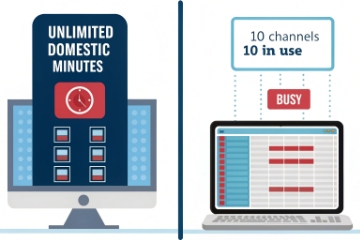
A SIP trunk has two separate limits:
- Minutes: what the provider includes in the monthly price
- Channels (concurrent calls): how many calls can run at the same time
Unlimited almost always targets minutes, not channels. So a plan can be “unlimited” and still block calls when concurrency is too low. This is why a busy hour test—based on busy-hour traffic in erlangs 2—is often more important than a monthly minutes report.
Most providers also publish hard platform constraints somewhere (or enforce them quietly) in documentation like SIP trunking scale and limits 3.
Per-user vs per-trunk unlimited packaging
Providers sell unlimited in a few packaging styles, and each style pushes system design in a different direction.
- Per-user unlimited: each licensed seat gets unlimited in-region minutes. The provider may scale trunk capacity in the background, or sell concurrency separately.
- Per-trunk unlimited: a trunk bundle (like 10 or 20 channels) comes with unlimited domestic minutes across that bundle.
- Hybrid: some users are unlimited, and some are metered, and they share multiple trunk groups based on policy.
| Model | What you pay for | What still limits you | Best fit |
|---|---|---|---|
| Per-user unlimited | Seats | Concurrency caps, AUP | Office users and mixed roles |
| Per-trunk unlimited | Channel bundle | Channel count, AUP | Shared calling pools and heavy traffic sites |
| Hybrid | Mixed seats + trunks | Policy mistakes, reporting gaps | PBX + intercom + multi-site mixes |
What this changes in PBX routing
Unlimited does not remove routing work. It shifts the goal. The goal becomes: keep normal domestic traffic on the included route, and keep unusual traffic on routes that are visible, controlled, and easy to bill.
A practical dial-plan pattern looks like this:
- Domestic in-region → “Unlimited” trunk group
- International → Metered trunk group with rate visibility
- Toll-free numbers → Routed by rule, monitored as a separate cost bucket
- Off-net forwarding → Restricted, or routed through a specific trunk group
- Emergency calls → Always available, with correct location handling and backup paths
SIP intercom and emergency endpoints add another layer. Their call volume is usually low, but their calls are high priority. So the best design often reserves concurrency for critical endpoints and avoids letting low-importance devices consume the same outbound pool.
A simple sanity check before go-live
Before a deployment goes live, it helps to validate these two questions:
1) What happens at the busy hour when all channels are in use?
2) Which call types will still generate per-minute charges even on an “unlimited” plan?
Answer those questions early, and the plan stops being confusing.
Does unlimited include international and toll-free minutes?
“Unlimited” usually feels global in a sales pitch. In billing language it is regional, and toll-free follows different rules than local calling.
Unlimited business VoIP almost always covers only domestic or in-region calling, while international and most toll-free usage (especially inbound toll-free and surcharges) is billed separately.
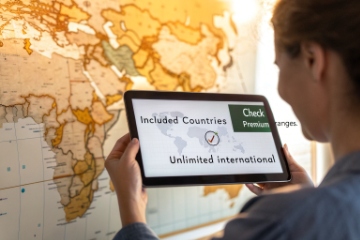
International calling: always check the destination list
International is normally billed per minute, and it is billed by destination type:
- Landline vs mobile can be priced differently
- Some countries have special-rate ranges that cost far more
- Some plans include “selected countries” in higher tiers, but only that list is covered
Call routing and numbering still follow the ITU-T E.164 numbering plan 4, so “unlimited international” should be read as “unlimited to these destinations only,” and it still may exclude mobile numbers or premium ranges.
Toll-free: outbound and inbound are not the same
Toll-free is tricky because the cost often sits with the toll-free owner, not with the caller. The FCC’s guide on what a toll-free number is and how it works 5 is a useful baseline for explaining why the toll-free subscriber pays.
Inbound toll-free minutes to your business are commonly billed per minute, and there can be surcharges based on origination types.
Outbound calls to someone else’s toll-free number may be treated as normal outbound calling by some providers, but other providers apply separate rules or exclude specific toll-free patterns. The safe approach is simple: treat toll-free as a separate billing category until the provider terms prove otherwise.
| Traffic type | Usually included in “unlimited”? | Typical billing behavior | PBX control idea |
|---|---|---|---|
| Domestic in-region | Yes | Flat-rate minutes | Default route |
| International | No | Per-minute by destination | Separate trunk + alerts |
| Inbound toll-free to your numbers | No | Per-minute + possible surcharges | Track and budget as its own line |
| Outbound to toll-free numbers | Sometimes | Often included, sometimes special rules | Put rules and reporting around it |
Transfers, forwarding, and “off-net” surprises
A big invoice surprise can come from features that look like “not calling,” but still create PSTN minutes:
- Call forwarding to an external mobile number
- Off-net transfers that push the call back to the PSTN
- Ring groups that include external numbers
These can create chargeable minutes even if the user believes the plan is “unlimited.” So the PBX should treat off-net routing as a controlled feature, not as a default convenience.
What fair use policies or soft caps should I expect?
Unlimited is not infinite. Providers protect their networks and their pricing models with fair-use rules and acceptable-use policies.
Unlimited VoIP plans usually include fair-use thresholds and AUP rules, and providers can throttle, surcharge, move you to a different tier, or terminate service for high-volume or automated patterns.
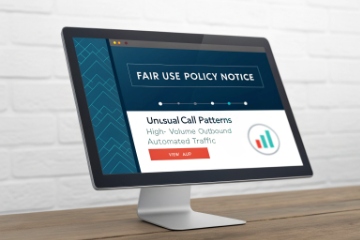
Soft caps exist, even when the plan does not show a number
Some providers publish thresholds. Many do not. But most enforce a “typical business use” standard. The trigger is not only total minutes. The trigger is also traffic shape:
- One seat running nonstop outbound traffic
- Very short calls at high frequency
- High failure rates and repeated retries
- Patterns that look like reselling or trunking
This is why “thousands of minutes per user per month” is a common mental model, even when the provider does not print the number. Normal office behavior rarely gets close. Automation can hit it fast.
AUP: the behaviors that usually break “unlimited”
Acceptable-use rules often restrict:
- Autodialers and predictive dialers
- High-volume broadcast campaigns and robocalls (in the U.S., these map closely to the FCC’s telemarketing and robocalls rules under the TCPA 6)
- Using a user license as a trunk for third-party traffic
- Some forms of call center usage unless the plan tier is designed for it
This matters because a business can pay for “unlimited” and still violate AUP on day one if the use case is a broadcast-style application. In those cases, the right solution is usually a contact center tier, a campaign-approved service, or a separate wholesale SIP agreement.
| Use case | Usually OK on unlimited business seats | Typical provider view | Better plan path |
|---|---|---|---|
| Normal staff calling | Yes | Normal human use | Standard unlimited seats |
| Support and sales teams | Often yes | Still normal if human-driven | Unlimited + proper concurrency sizing |
| Autodial campaigns | Usually no | AUP risk | Contact center or approved campaign service |
| Reselling / third-party calling | Usually no | Prohibited | Wholesale SIP trunking agreement |
Monitoring that keeps teams safe
A simple monthly routine avoids most trouble:
- Review CDRs by extension and by route
- Alert on spikes in outbound minutes and call attempts
- Watch for unusual short-call patterns
- Tag and separate intercom, emergency, and automation endpoints
- Keep a clear record of what each trunk group is for
When fair-use is treated as a design input, the plan stays stable and the provider relationship stays clean.
Can IP PBX users mix unlimited and metered extensions?
Not every endpoint deserves a flat rate. Some phones talk all day. Some devices call once a week. A single plan type often wastes money or creates risk.
Most IP PBX deployments can mix unlimited and metered users or trunks, so heavy callers stay on flat-rate plans while low-usage devices and special routes remain metered and controlled.

Why mixing plans matches real buildings
A real project includes different endpoint behaviors:
- Sales and support seats generate steady domestic minutes
- Reception generates many short calls and transfers
- Lobby phones and warehouse phones have low outbound use
- SIP intercom panels create short, urgent calls
- Emergency phones must have priority and redundancy
So a mixed model can reduce cost and reduce risk:
- Unlimited seats for predictable, high-volume domestic users
- Metered or internal-only profiles for low-volume devices
- Separate trunks for international, toll-free, and forwarding
A common mixed layout that stays easy to manage
A simple layout works well in many sites:
- Unlimited seats for office users
- Metered extensions for intercoms and courtesy phones
- Trunk Group A: domestic included route
- Trunk Group B: international and special-rate route
- Trunk Group C: toll-free and forwarding route (if needed)
| Extension type | Plan choice | Reason | Suggested PBX restriction |
|---|---|---|---|
| Sales/support | Unlimited | High domestic minutes | International via approved trunk only |
| Reception/management | Unlimited | Many calls and transfers | Monitoring and reporting enabled |
| SIP intercom panels | Metered or internal-only | Low volume, short calls | Block premium/international by default |
| Lobby/courtesy phones | Metered | Rare outbound | Limit to local + emergency |
| Test/lab devices | Metered or blocked | No need for unlimited | Restrict outbound fully |
The gotchas to watch in mixed environments
Mixing works best when a few details are handled on purpose:
- Concurrency planning: unlimited minutes do not add channels. Busy-hour still needs enough concurrent call paths.
- Shared caller ID: shared IDs can hide which device created costs, so reporting must tag by extension.
- Off-net forwarding: forwarding can create billable minutes, so it should be limited or routed through a controlled trunk group.
- Call recording storage: if recording is enabled, storage can grow fast, so retention policy matters.
- E911 and location: emergency calling must be correct for each site and each endpoint, and taxes/fees will still appear as separate invoice lines.
If you operate in the U.S., the FCC guide on VoIP and 911 service 7 is a good baseline for planning location, routing, and compliance expectations.
A mixed plan is not complicated when the dial plan is clean. It is often the most cost-stable way to run an IP PBX that includes both people and devices.
Conclusion
Unlimited VoIP is flat-rate in-region calling, not infinite calling. With clear trunk sizing, routing rules, and fair-use awareness, costs stay stable and service stays reliable.
Footnotes
-
Erlang basics help size trunks using busy-hour traffic and blocking. ↩ ↩
-
Twilio lists SIP trunking limits, including call concurrency and rate constraints. ↩ ↩
-
ITU-T E.164 defines global phone-number structure and country codes. ↩ ↩
-
FCC summarizes TCPA-based telemarketing and robocall restrictions for automated calling. ↩ ↩
-
FCC explains VoIP 911/E911 obligations and location requirements. ↩ ↩