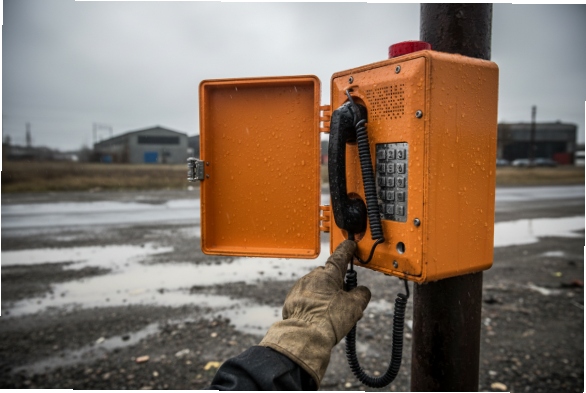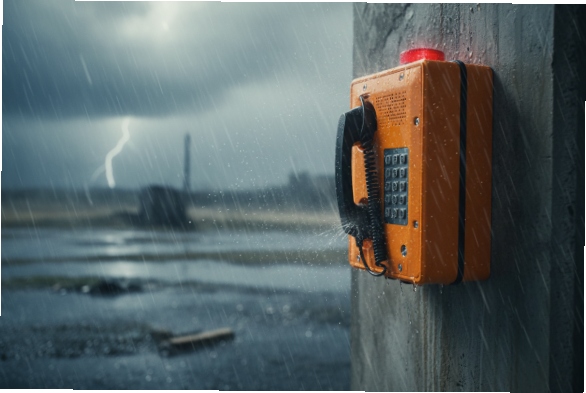
A phone can pass every site test, then fail during the one call that matters. Power is often the weak link, not the handset.
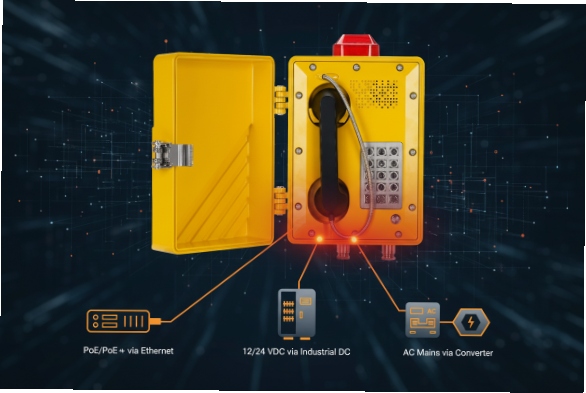
Explosion-proof telephones can run on PoE/PoE+, 12/24 VDC, or AC mains via an external or Ex-certified power supply. Certification depends on the exact phone variant and its stated input limits, not on the idea of “same platform.” Solar-battery kits can work for remote sites if sizing, temperature, and hazardous-area placement are handled. Redundancy comes from dual feeds, UPS/battery backup, and network-side PoE resilience.
A practical map of power options for Ex telephones?
The four power architectures seen on real sites
Explosion-proof telephones usually land in one of these patterns:
1) PoE / PoE+ (and sometimes PoE++)
One Ethernet cable carries data and power. This is clean for indoor stations, tank farms, and corridors where structured cabling already exists. Heat inside the enclosure matters because PoE power becomes internal dissipation.
2) 12/24 VDC direct input
This fits industrial plants that already distribute 24 VDC for control and instrumentation. It also fits battery-backed systems because batteries are native DC.
3) AC mains to a local AC/DC converter
This can be done two ways: put the AC/DC supply in a safe area and bring DC to the phone, or put the AC/DC supply in the hazardous area inside an appropriate Ex solution.
4) Hybrid off-grid DC (solar + battery + regulator)
This is common on remote pipelines, perimeter roads, and offshore edges where trenching power is slow and expensive.
Why the Ex protection concept changes the power discussion
“Explosion-proof” is often used loosely. On datasheets, the actual marking matters: flameproof Ex d, increased safety Ex e, intrinsic safety 1 Ex i, and more. A flameproof telephone can accept higher power because the safety concept is enclosure containment. An intrinsically safe handset must limit electrical energy, so power budgeting and barriers become part of the design.
A quick selection matrix
| Power option | Typical fit | Hidden constraint | Best when |
|---|---|---|---|
| PoE / PoE+ | Modern SIP deployments | Cable heat, PoE budget, switch uptime | Network is strong and managed |
| 12/24 VDC | Industrial control sites | Voltage drop 2 on long runs | DC bus already exists |
| AC mains (via PSU) | Utility buildings, kiosks | Ex rules for PSU placement | Local AC is reliable |
| Solar + battery | Remote, no grid | Winter sun + battery temp | Trenching is not possible |
The next sections answer the exact questions that procurement teams ask during hazard reviews and FAT.
A power choice is never only “voltage.” It is also installation method, certificate scope, and what still works when part of the system fails.
A common mistake is assuming “same housing” means “same certificate.” Auditors do not accept that shortcut.
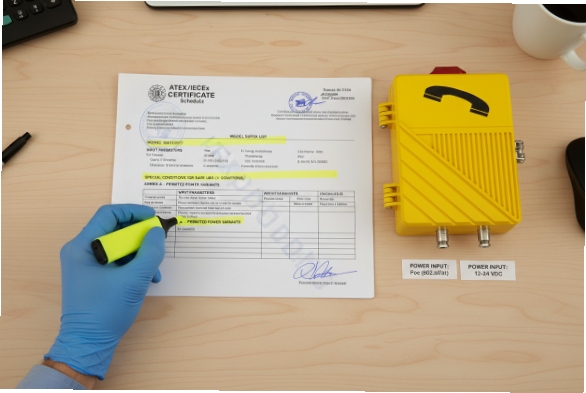
PoE and 12/24 VDC models can share an ATEX/IECEx certificate only if that exact input design is included in the certificate schedule and its conditions of safe use. Many product families keep one certificate number with multiple model suffixes, but it is not automatic. Always match the power option to the certificate annex.
What usually changes between PoE and DC variants
PoE brings an Ethernet magnetics front end, PD controller, and inrush/negotiation behavior. DC input brings a different protection and conversion path. That means:
-
Different heat map inside the enclosure (temperature class and max ambient can shift).
-
Different fault modes (PoE negotiation vs. DC short-circuit stress).
-
Different wiring entry expectations (Ethernet cable vs. power pair, and sometimes different glands).
So a lab may treat PoE and DC as two evaluated variants, even if the mechanical parts are identical.
How to check quickly (without arguing with QA)
When reviewing an ATEX/IECEx 3 package, verify:
-
The model list includes both PoE and DC variants (often shown as suffixes).
-
The input parameters list the allowed ranges (for example “10–30 VDC” for a DC model).
-
Any “X” conditions are satisfied (special conditions for safe use can include installation limits, enclosure IP, or overvoltage category).
Shared certification becomes more likely when:
-
The phone uses one internal DC bus and both PoE and 24 VDC feed the same converter stage.
-
The manufacturer submits both variants in the same technical file from day one.
-
The marking and thermal limits remain the same across variants.
A practical procurement table
| Item to compare | PoE/PoE+ model | 12/24 VDC model | Why it matters |
|---|---|---|---|
| Input spec on datasheet | 44–57 VDC via Ethernet | 12 or 24 VDC terminals | Drives test scope |
| Certificate annex | Must list PoE variant | Must list DC variant | Prevents site rejection |
| Installation notes | PoE switch budget + cabling | Voltage drop + fuse | Avoids brownouts |
| Heat inside enclosure | Depends on PoE class | Depends on converter | Impacts T-rating |
From an OEM/ODM perspective, the safest workflow is simple: treat each power input type as a separate compliance item until the certificate proves otherwise. That approach avoids late-stage surprises during project acceptance.
Are AC mains supplies Ex-certified or externally located?
AC power looks convenient, but it often creates the most compliance work in a hazardous area.
Most explosion-proof telephone deployments keep AC/DC power supplies in a safe area (or unclassified cabinet) and bring low-voltage DC to the phone. Ex-certified AC/DC supplies do exist, but they must be installed with the correct Ex method (often in Ex d or Ex e solutions) and with proper glands and wiring rules.
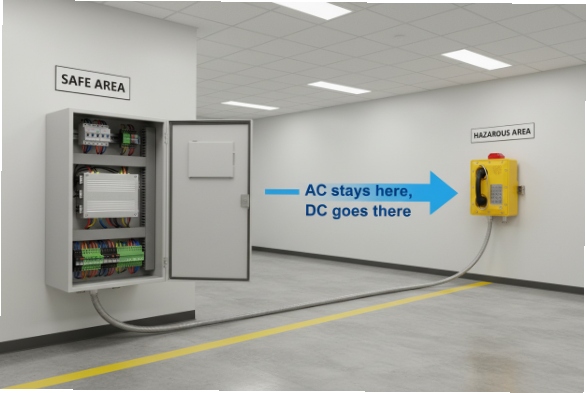
The common real-world pattern: AC outside, DC inside
Many sites already have reliable 110/230 VAC in a control room. The clean method is:
-
Place the AC/DC PSU in the control room or a non-hazardous panel.
-
Feed the hazardous-area telephone with 24 VDC (or the phone’s rated DC input).
-
Use appropriate cable routing, protection, and labeling per the site standard.
This reduces what must be certified inside the hazardous zone. It also makes maintenance easier because the PSU is accessible without a hot-work mindset.
When AC inside the hazardous area makes sense
Some locations have no practical DC distribution. In that case, teams use:
-
An Ex-certified AC/DC power supply, or
-
A standard PSU mounted inside an Ex enclosure that is certified for the application (the enclosure and the assembly approach matter).
This approach can work, but it moves the compliance boundary. Heat dissipation, gland selection, and enclosure rating become part of the safety case.
Intrinsic safety is different
If the telephone or its interface is intrinsically safe, associated apparatus such as Zener barriers 4 or isolators are commonly placed in a safe area. That is why many intrinsically safe circuits are fed from safe-area cabinets rather than local hazardous-area conversion.
Decision table for AC use
| Approach | Where the AC/DC conversion sits | Typical benefit | Typical pain point |
|---|---|---|---|
| AC in safe area, DC to phone | Control room / unclassified | Simple maintenance | DC voltage drop if long |
| Ex-certified AC/DC PSU in zone | Hazardous area | Short cable runs | Higher cost + more rules |
| AC into Ex enclosure + PSU inside | Hazardous area | Flexible | Thermal + enclosure approvals |
If an end user asks for “AC-powered explosion-proof telephone,” the first step is to ask where they expect the conversion to sit. That single detail decides most of the engineering work.
Can solar-battery kits support remote deployments?
Remote phones fail most often because the power system was sized for a sunny week, not for the worst month.
Solar-battery kits can power remote SIP or VoIP telephones if the energy budget covers worst-case sunlight and temperature. The kit needs a battery sized for autonomy, a charge controller, and DC regulation. For hazardous locations, the placement and certification of panels, batteries, and enclosures must match the zone rules.
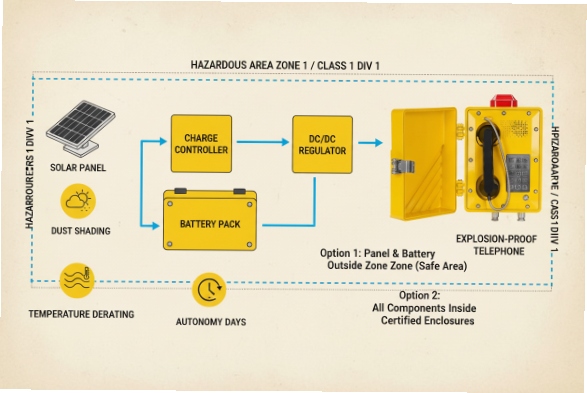
Start with the energy math that teams skip
A remote phone load is not only “standby watts.” It is also:
-
SIP registration and keepalive traffic
-
Amplifier or horn load if present
-
Heater load if cold climates are involved
-
Network gear load (radio bridge, switch, media converter)
A sizing workflow that works:
1) Calculate average watts over 24 hours.
2) Multiply by days of autonomy (often 3–7 days).
3) Apply temperature derating for batteries.
4) Size PV for the worst solar month, not the annual average.
Battery chemistry and temperature
Many industrial deployments still use sealed lead-acid because it is simple and tolerant. Lithium batteries 5 can reduce size, but cold charging rules and certification details matter. In cold regions, battery boxes often need insulation or controlled heating, which raises the power budget again.
Hazardous-area placement choices
There are three practical patterns:
-
Put solar panels and battery cabinet outside the classified zone and run DC into the zone.
-
Use certified hazardous-area enclosures for storage and control gear when the cabinet must sit inside.
-
Use a hybrid design where only the phone is in-zone, while the power kit sits in a nearby safe area boundary.
Table for remote kit architecture
| Subsystem | Purpose | Typical failure mode | Simple mitigation |
|---|---|---|---|
| PV panel | Harvest energy | Shading, dust | Panel angle + cleaning plan |
| Charge controller | Protect battery | Wrong settings | Lock profile + labeling |
| Battery pack | Store energy | Cold capacity loss | Oversize + insulation |
| DC/DC converter | Stable voltage | Brownout resets | Wide-input converter |
| Surge protection | Lightning risk | Port damage | Surge protection device 6 + grounding scheme |
Solar works well when it is treated like a small power plant, not like an accessory. Remote deployments reward simple loads and conservative autonomy targets.
What power redundancy improves emergency availability?
A phone is an emergency device. It should be designed like one, not like a desk VoIP phone.
The best redundancy combines dual power paths (PoE + 24 VDC or dual DC feeds), upstream UPS/battery backup, and resilient network power sourcing (redundant PoE switches or injectors). Add surge protection and monitoring so failures show up before an incident.
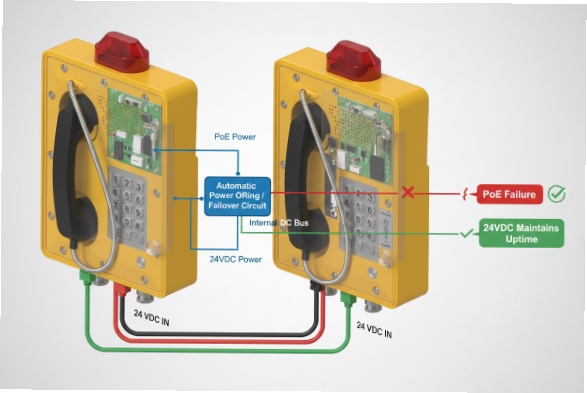
Redundancy on the device side
The strongest design feature for availability is a phone with:
-
Dual power input (PoE and DC), with automatic switchover, or
-
Dual DC input (A/B feeds) if the product supports it.
Even when only one input is used day-to-day, the second input helps during maintenance or when a cable is damaged.
Redundancy on the network side
Power over Ethernet 7 is only as reliable as the switch and its upstream power.
-
Use a PoE switch with redundant DC inputs, or two independent PoE injectors in a controlled design.
-
Feed the switch from a UPS sized for the required runtime.
-
Consider two network paths where the site design allows it (ring or dual-homing).
Redundancy for remote sites
For remote deployments, redundancy often looks like:
-
A battery bank sized for long autonomy
-
A solar array sized for worst month
-
Optional backup generator input or a secondary energy source
| Redundancy method | What it protects against | Cost level | Notes |
|---|---|---|---|
| Phone supports PoE + DC | Single feed failure | Medium | Best if auto-failover |
| UPS for PoE switch | Utility outage | Medium | Also protects other endpoints |
| Redundant PoE switch PSU | PSU failure | Medium | Depends on switch model |
| Dual PoE switches | Switch failure | High | Needs network design support |
| Battery + PV autonomy | No-grid outage | Medium/High | Needs conservative sizing |
| Monitoring (SNMP/alarm) | Silent degradation | Low | Saves truck rolls |
Emergency availability improves most when the power plan matches the site risk level. A refinery control room and a remote pipeline valve station do not need the same redundancy, but both need a deliberate one.
Conclusion
Power for explosion-proof telephones is a system choice. Match the power option to the certificate, place conversion wisely, size solar for worst case, and add redundancy where failure is unacceptable.
Footnotes
-
Protection technique limiting electrical and thermal energy to prevent ignition. ↩
-
Loss of voltage in a circuit due to resistance in wires over distance. ↩
-
Global certification scheme for equipment used in explosive atmospheres. ↩
-
Safety device that limits voltage and current to intrinsically safe levels. ↩
-
Advanced battery chemistry offering high energy density but requiring careful management. ↩
-
Component designed to protect electrical devices from voltage spikes. ↩
-
Technology that passes electric power along with data on twisted pair Ethernet cabling. ↩