
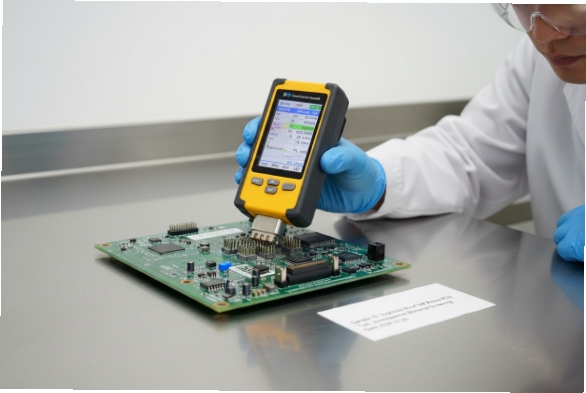
Environmental compliance is no longer optional for industrial electronics. In the past, "safety-critical" equipment often got a pass on environmental regulations, but those days are gone.
RoHS (Restriction of Hazardous Substances) fully applies to explosion-proof SIP telephones sold in the EU, typically falling under Category 3 (IT and Telecommunications Equipment) or Category 9 (Monitoring and Control). There is no blanket exemption for ATEX equipment; manufacturers must ensure all homogeneous materials meet strict substance limits.
The Green Transition in Hazardous Areas
As the representative of DJSlink, I’ve seen the industry struggle with the transition to "Lead-Free" soldering. For a long time, engineers argued that lead-free solder (SAC305) was brittle and prone to "tin whiskers," which could cause short circuits—a terrifying prospect in an explosive atmosphere.
However, Directive 2011/65/EU 1 (RoHS 2) and the subsequent "Open Scope" of 2019 removed most ambiguity. Unless your phone is specifically designed for a "Large-Scale Fixed Installation" (LSFI)—which a wall-mounted phone rarely is—it must be compliant.
This means every resistor, screw, and coating on our explosion-proof phones must be accounted for. It’s not just about saving the planet; it’s a market access requirement. If a custom officer tests your device and finds lead levels above 0.1%, your entire shipment can be seized and destroyed.
Does RoHS apply to explosion-proof SIP phones sold into the EU?
Many integrators assume that because a device is "safety-critical," it is exempt. This is a dangerous misconception.
RoHS 2 (Directive 2011/65/EU) applies to virtually all Electrical and Electronic Equipment (EEE). Explosion-proof telephones typically fall under Category 3 (IT/Telecom). While some specific industrial monitoring sensors might claim temporary exemptions, standard communication endpoints must be fully compliant to be placed on the EU market.
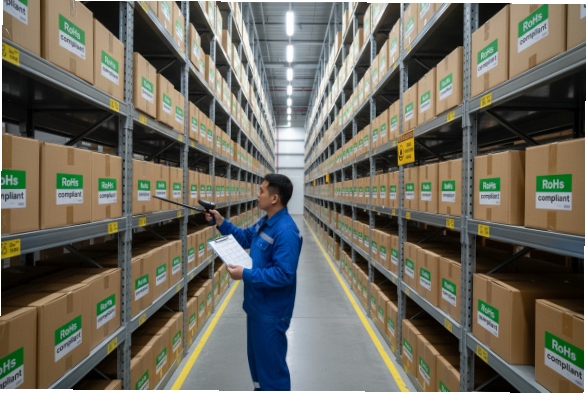
Categories and Exclusions
The "Large-Scale Fixed Installation" (LSFI) exclusion is the most cited loophole, but it rarely works for telephones. An LSFI refers to something like an oil refinery’s main distillation column integration—not the 500 individual phones attached to it. Since the phone is a finished functional unit that can be replaced individually, it is EEE 2 (Electrical and Electronic Equipment).
-
Category 3 (IT and Telecommunications): This is where most SIP phones live. Compliance has been mandatory since 2006.
-
Category 9 (Industrial Monitoring and Control): Some specialized emergency signaling devices might fit here. Compliance became mandatory for industrial use in July 2017.
Key Takeaway: Do not rely on exclusions. If you are buying a DJSlink phone for a project in Germany, it is RoHS compliant by design. We do not use the LSFI excuse.
Which 10 restricted substances and maximum limits must be controlled?
It is not just about Lead anymore. The list has grown to include plasticizers that are common in rugged cables and keypads.
The "RoHS 10" includes Lead (Pb), Mercury (Hg), Hexavalent Chromium (Cr6+), PBB, and PBDE (flame retardants), plus four phthalates (DEHP, BBP, DBP, DIBP). The limit is 0.1% (1000 ppm) by weight for all substances, except for Cadmium (Cd), which is strictly limited to 0.01% (100 ppm).
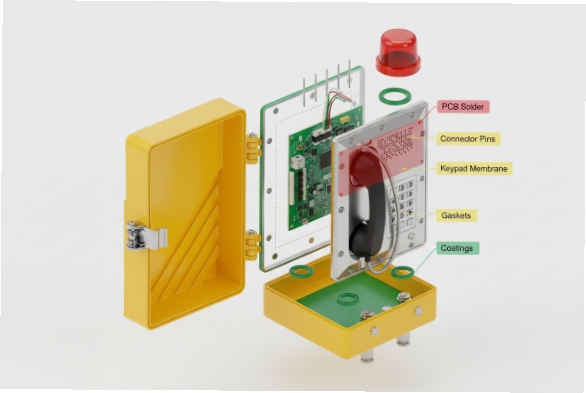
Homogeneous Materials: The Atomic Level
The rule applies to "homogeneous materials" 3. This is the tricky part. You cannot just grind up the whole phone and test the average. You have to test:
-
The plastic usage in the handset cable jacket.
-
The paint on the aluminum housing.
-
The solder on the PCB.
-
The plating on the screws.
If any of these individual materials exceeds the limit, the whole device fails.
| Substance | Symbol | Limit | Common Risk Areas in Ex Phones |
|---|---|---|---|
| Lead | Pb | 0.1% | Solders, machining brass (pins/connectors), glass in CRTs/displays. |
| Cadmium | Cd | 0.01% | Electrical contacts, switches, yellow/red pigments in plastics. |
| Mercury | Hg | 0.1% | Backlights in older displays, relays (rare now). |
| Hexavalent Chromium | Cr6+ | 0.1% | Anti-corrosion coatings on metal screws/chassis. |
| PBB / PBDE | – | 0.1% | Flame retardants in plastic housings. |
| Phthalates (4 types) | DEHP, etc. | 0.1% | Soft rubber keypads, curly cords, gaskets. |
What RoHS compliance evidence should be requested from a manufacturer?
A sticker saying "RoHS OK" is not evidence. In the event of an audit, you need a technical trail.
The primary evidence is the EU Declaration of Conformity (DoC), which must explicitly list Directive 2011/65/EU. Behind this, the manufacturer must hold a Technical File compliant with EN IEC 63000, containing Supplier Declarations of Conformity (SDoC) and analytical test reports (XRF/ICP) for high-risk components.

The Paper Trail (EN IEC 63000)
When I prepare a "Compliance Pack" for a major European distributor, I don’t just send a certificate. I provide assurance based on the EN IEC 63000 4 standard (formerly EN 50581). This standard defines how we gather data.
-
Tier 1: Supplier Declarations: We get a signed letter from the chip maker (e.g., Texas Instruments) stating their chip is RoHS compliant.
-
Tier 2: Analytical Testing: For high-risk items like custom plastic molds or cheap cables from third-party vendors, we don’t trust; we verify. We send samples to a lab for XRF 5 (X-ray Fluorescence) screening.
-
The DoC: The final Declaration of Conformity is a legal document. By signing it, I am personally liable if the product is non-compliant.
Red Flag: If a manufacturer cannot produce a DoC that specifically mentions "RoHS Directive 2011/65/EU" alongside the ATEX Directive, walk away.
How should RoHS be managed during OEM/ODM customization and lifecycle revisions?
Changing a material to meet RoHS can inadvertently kill your ATEX certification if not managed correctly.
Material substitutions (e.g., changing to lead-free solder or phthalate-free gaskets) must be verified against the ATEX Schedule Drawings. Lead-free solders have higher melting points ($217^{\circ}\text{C}$ vs $183^{\circ}\text{C}$), which can affect the "Temperature Class" (T-rating) or thermal rise of components, potentially requiring a Variation to the Ex certificate.
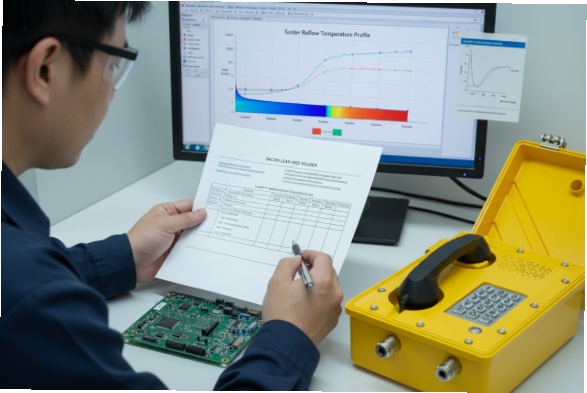
The Collision of Safety and Ecology
This is the most critical intersection for us as a manufacturer.
-
Problem: We need to remove DEHP (plasticizer) from the rubber gasket to pass RoHS.
-
Solution: We find a new bio-based rubber.
-
Risk: Does this new rubber degrade when exposed to the chemicals found in a refinery? Does it hold the IP66 6 seal as well as the old one? If the seal fails, gas gets in, and the phone explodes.
Furthermore, switching to Lead-Free Solder (SAC305) requires higher reflow oven temperatures. This puts more thermal stress on components. In an Intrinsic Safety (Ex i 7) design, we have to ensure that components don’t run hotter than the certified T-Class (e.g., T6 8 surface temperature < $85^{\circ}\text{C}$).
Management Strategy:
-
Change Control Board: Every RoHS substitution is reviewed by an Ex Authorized Person.
-
Verification: We often re-run thermal rise tests in the lab.
-
Certification Update: If the material characteristics change significantly, we file a variation with our Notified Body.
Conclusion
RoHS compliance for explosion-proof telephones is a legal mandate, not a suggestion. It requires rigorous control of the "RoHS 10" substances, particularly in the soft plastics and soldering processes used in rugged devices. For buyers, the lesson is simple: Ensure your supplier’s EU Declaration of Conformity cites Directive 2011/65/EU and that their move to "green" manufacturing hasn’t compromised the "red" safety line of their ATEX certification.
Footnotes
-
The EU legislation restricting the use of hazardous substances in electrical and electronic equipment. ↩
-
Equipment depending on electric currents or electromagnetic fields to work properly. ↩
-
Material of uniform composition throughout or a material consisting of a combination of materials that cannot be disjointed. ↩
-
International standard for the technical documentation required for assessing materials, components, and products. ↩
-
Non-destructive analytical technique used to determine the elemental composition of materials. ↩
-
Rating indicating the level of protection against dust and high-pressure water jets. ↩
-
Protection technique for safe operation of electrical equipment in hazardous areas by limiting energy. ↩
-
Classification system defining the maximum surface temperature an equipment can reach. ↩








