Navigating the IEC 60079 series 1 can feel like learning a new language. For industrial telecommunications, it’s not just one standard; it’s a complex ecosystem of rules that dictate everything from how thick the aluminum casting must be to how tight the terminal screws are.
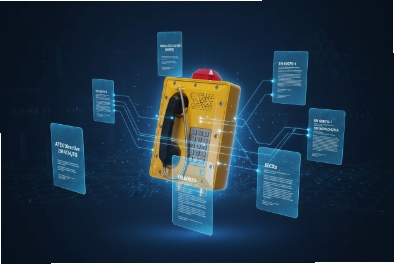
The primary standards for explosion-proof telephones are EN 60079-0 (General Requirements), EN 60079-1 (Ex d Flameproof), EN 60079-7 (Ex e Increased Safety), EN 60079-11 (Ex i Intrinsic Safety), and EN 60079-31 (Ex t Dust). Installation and maintenance are governed by EN 60079-14 and EN 60079-17 respectively.
The Library of Safety
As the technical lead at DJSlink, I often see tender documents that simply say "Must comply with EN 60079." That is like saying "Must comply with the law." Which law? Traffic? Criminal? Tax?
The EN 60079 series is broken down into "Parts." Part 0 is the foundation—it applies to everyone. It defines general rules like impact resistance, plastic aging, and surface temperature limits. Then, we have the specific "Protection Concepts" (Parts 1, 7, 11, etc.) which are the distinct engineering methods we use to prevent explosions. Finally, we have the "User Standards" (Parts 14, 17, 19) which tell you, the customer, how to install and look after the gear.
For a modern explosion-proof SIP phone, we rarely rely on just one concept. We build "Hybrid" devices. We might use a Flameproof box to hide the high-power CPU, an Increased Safety terminal chamber to make your wiring easier, and Intrinsically Safe circuits for the handset so you don’t get a spark near your face.
Here is the map of the standards we live by:
| Standard | Title | Application for Ex Phones |
|---|---|---|
| EN 60079-0 | General Requirements | The baseline. Impact tests, material specs, T-Class 2 definitions. |
| EN 60079-1 | Flameproof Enclosures ‘d’ | The heavy cast-aluminum body containing the main PCB. |
| EN 60079-7 | Increased Safety ‘e’ | The terminal box/connectors (preventing sparks/heat). |
| EN 60079-11 | Intrinsic Safety ‘i’ | The handset, microphone, and keypad (energy limitation). |
| EN 60079-31 | Dust Ignition Protection ‘t’ | Seals and gaskets to keep out combustible dust. |
Which EN 60079 parts cover general requirements and equipment construction?
Before we even talk about sparks, we have to talk about survival. If the phone casing cracks when a wrench hits it, the explosion protection is gone.
EN 60079-0 is the parent standard governing general construction, including mechanical strength (impact tests), non-metallic material aging (UV/Thermal endurance), and electrostatic discharge limits. Specific construction rules for the protection type (like the flame path gap for Ex d) are then found in EN 60079-1.

The Foundation: Part 0
EN 60079-0 3 is the unsung hero. It sets the rigorous "Type Tests" that our DJSlink phones must pass before they ever see gas.
-
Impact Test: A 1kg mass is dropped from a height (usually 0.7m for high risk) onto the glass display and the lens. If it cracks? Fail.
-
Thermal Shock: We heat the phone to $80^{\circ}\text{C}$ and then immediately douse it in water.
-
Electrostatics: It defines how much surface area can be non-conductive plastic to prevent static build-up.
Once Part 0 is satisfied, we move to the specific construction rules.
EN 60079-1 (Ex d) dictates the "Flame Path" 4. This is the precise gap between the lid and the body. It allows an internal explosion to vent pressure without letting the flame escape. The tolerances here are measured in microns.
EN 60079-31 (Ex t) focuses on "Ingress Protection" 5 (IP). For dust explosion protection, the enclosure must be tight enough (IP6X) to prevent dust from entering and contacting hot components.
Which protection concepts under EN 60079 are most common for Ex telephones?
Designing an Ex phone is a balancing act. You want the robustness of a tank but the audio clarity of a studio.
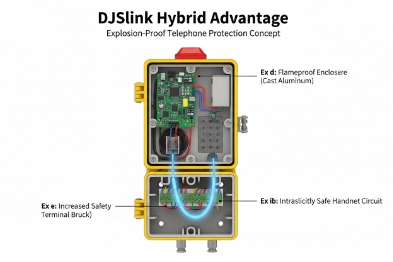
The most common design for Ex telephones is a hybrid ‘Ex de ib’ structure. This uses Ex d (Flameproof) for the main electronics to contain potential ignition, Ex e (Increased Safety) for the wiring chamber to simplify connection, and Ex ib (Intrinsic Safety) for the handset and keypad to ensure user safety.
The Hybrid Advantage
Why do we mix them? Why not just make the whole thing Ex d?
-
Ex d 6 (Flameproof): Great for high-power electronics (like the SIP CPU and PoE conversion). Downside: It requires heavy, threaded entries and potting. If you had to unscrew 20 bolts just to plug in a CAT6 cable, you would hate us.
-
Ex e 7 (Increased Safety): This is where we put the terminal block. It allows for "standard" wiring practices (using certified glands) without the need for potting compounds. It makes the installer’s life easier.
-
Ex ib 8 (Intrinsic Safety): This is vital for the Handset. The handset cord gets twisted, pulled, and eventually cut. If that cord carried full power, a cut could spark. By using an Ex i barrier inside the main body, we ensure that even if you cut the cord with a knife in a gas cloud, the energy is too low to ignite anything.
| Concept | Symbol | Principle | Usage in DJSlink Phones |
|---|---|---|---|
| Flameproof | Ex db | Contain the bang. | Main Housing (PCB, Power Supply). |
| Increased Safety | Ex eb | No arcs, no sparks. | Terminal/Wiring Chamber. |
| Intrinsic Safety | Ex ib | Low energy. | Handset, Keypad, Headset Port. |
| Encapsulation | Ex mb | Seal it in resin. | LED Indicator / Beacon lights. |
What Ex marking elements required by EN 60079 should appear on the nameplate?
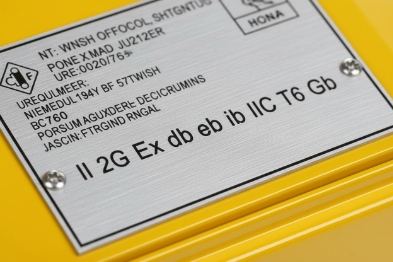
The nameplate is the device’s passport. If the marking is wrong or illegible, the site inspector will red-tag the phone and block commissioning.
The nameplate must display the CE/UKCA mark, the Ex hexagon, the equipment group (II) and category (2G/2D), the specific protection string (e.g., Ex db eb ib IIC T6 Gb), the ambient temperature range ($T_{amb}$), and the certificate number. It essentially tells the inspector exactly where and how the device can be safely used.
Decoding the String
At DJSlink, we laser-etch our stainless steel plates to ensure they survive for 20 years. Here is how to read a typical string:
II 2G Ex db eb ib IIC T6 Gb
-
II: Equipment Group (Surface Industry, not Mining).
-
2G: Category 2 (High Protection) for Gas (Zone 1).
-
Ex: Explosion Proof Standard.
-
db: Flameproof (Main body) – Equipment Protection Level ‘b’.
-
eb: Increased Safety (Terminals).
-
ib: Intrinsic Safety (Handset).
-
IIC: Gas Group (Hydrogen/Acetylene – the most dangerous group).
-
T6: Temperature Class (Surface never exceeds $85^{\circ}\text{C}$).
-
Gb: Gas Protection Level (High).
Critical Note: Pay attention to $T_{amb}$ (Ambient Temperature). Standard is $-20^{\circ}\text{C}$ to $+40^{\circ}\text{C}$. Our phones are often rated $-40^{\circ}\text{C}$ to $+70^{\circ}\text{C}$. If you install a $-20^{\circ}\text{C}$ phone in a Siberian oil field, you are non-compliant.
Which EN 60079 installation and inspection rules impact Ex telephone wiring?
Buying the right phone is only half the battle. If you install it incorrectly, you have just bought a very expensive paperweight.
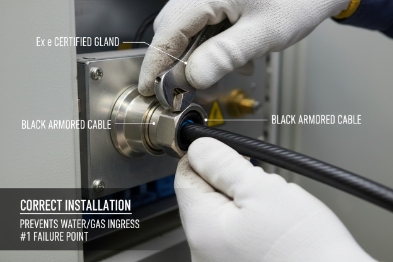
Installation is governed by EN 60079-14, which mandates the use of correct barrier glands for Ex d entries and proper equipotential bonding. Inspection falls under EN 60079-17, requiring ‘Initial Detailed Inspection’ upon installation and periodic ‘Close’ or ‘Visual’ checks to ensure seals are intact and bolts are tight.
The Rules of the Road (Part 14 & 17)
EN 60079-14 9 (Installation) is the installer’s bible.
-
Cable Glands: This is the #1 failure point. If you enter an Ex d chamber, you usually need a "Barrier Gland" (filled with compound) unless the cable is filled and short. If you enter an Ex e chamber, a standard certified compression gland is fine. Since DJSlink phones usually have an Ex e terminal chamber, you save money on glands!
-
Earthing: You must connect the external earth stud to the plant’s equipotential bonding 10 system using a minimum $4mm^2$ wire.
EN 60079-17 (Inspection) keeps the plant safe.
-
Initial Inspection: Before you turn it on, every single screw and seal must be checked (Detailed Grade).
-
Periodic Inspection: Usually every 3 years. Inspectors look for corrosion on the flame path, loose bolts, or cracked glass.
-
Documentation: You must keep an "Ex Register" of all equipment. If you replace a phone, you must update the register.
| Action | Standard | Key Requirement |
|---|---|---|
| Gland Selection | EN 60079-14 | Match gland type to enclosure type (d or e). |
| Cabling | EN 60079-14 | Sheath must be robust; unused cores must be grounded or isolated. |
| Earthing | EN 60079-14 | Internal & External earth points must be used. |
| Maintenance | EN 60079-17 | Do not open Ex d enclosure while energized (unless certified otherwise). |
| Repair | EN 60079-19 | Only by certified workshops or the manufacturer (us). |
Conclusion
The EN 60079 series is a comprehensive ecosystem designed to leave nothing to chance. From the Part 0 impact tests ensuring durability, to the Part 1/7/11 hybrid design concepts giving us flexible and safe phones, to the strict Part 14/17 rules for installation and care. Understanding these standards ensures that when you choose a DJSlink telephone, you aren’t just buying a device; you are buying a certified assurance of safety.
Footnotes
-
Series of international standards covering equipment for explosive atmospheres. ↩
-
Classification defining the maximum surface temperature an equipment can reach. ↩
-
Standard specifying general requirements for construction, testing, and marking of Ex equipment. ↩
-
Designated interface gap to cool escaping hot gases and prevent ignition. ↩
-
Rating indicating the level of protection against dust and water ingress. ↩
-
Protection method capable of withstanding internal explosions without igniting the external atmosphere. ↩
-
Protection method providing increased security against excessive temperatures and sparks. ↩
-
Protection technique limiting electrical and thermal energy to safe levels. ↩
-
Standard detailing electrical installations design, selection, and erection in explosive atmospheres. ↩
-
Practice of connecting metal parts to ground to prevent dangerous potential differences. ↩