
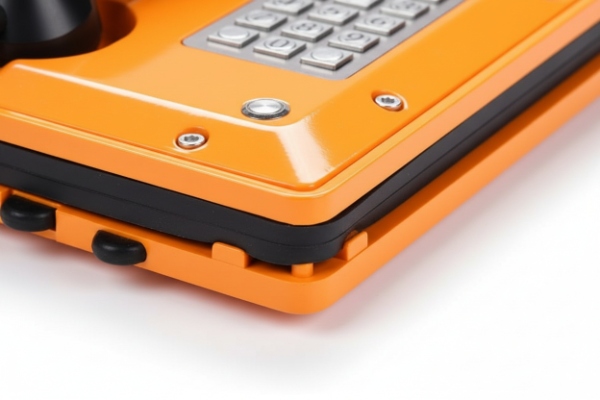
Outdoor phones often “look sealed,” then fail after one season. Dust slips in, salt eats the joint, and the door seal 1 takes a set. The result is downtime and ugly warranty talks.
Choose gasket materials based on your real exposure: EPDM for weather and steam, silicone for UV and wide temperature, and fluororubber (FKM) for oil and chemicals. Then match Shore hardness to your door gap and latch force.
Pick the gasket like a system, not a part
A gasket does not work alone. It works with the enclosure flatness, door stiffness, screw torque, latch force, and cable entry method. In many outdoor failures, the gasket compound was fine. The problem was the squeeze. It was uneven, too low, or too high.
Start from the three questions that decide everything
1) What hits the seal? UV, salt fog, oil mist, cleaning chemicals, hot water, dust.
2) How is the door closed? Screws, cam latch, hinge, snap fit, magnets.
3) What is the gap and squeeze? Real measured gap under load, not the CAD gap.
A weatherproof telephone enclosure 2 often has a front door or a faceplate. That seal line sees local bending near corners and near screw holes. So the best compound can still leak if the door bows. In my field work, a common pattern shows up: the middle seals well, and the corners leak. That is not “bad rubber.” That is door stiffness and compression control.
What matters more than the material name
-
Compression set: how much the gasket stays squashed after long load and heat. Low compression set 3 keeps IP protection for years.
-
Ozone/UV resistance: outdoor aging 4 is brutal, even in mild climates.
-
Chemical compatibility: oil mist and cleaning agents attack many rubbers fast.
-
Surface finish and friction: a sticky gasket can twist during closing and create gaps.
-
Tolerances: Shore hardness drift and cross-section drift create real sealing drift.
A practical selection table for weatherproof telephone doors
| Requirement | What to prioritize | Why it matters |
|---|---|---|
| Long outdoor life | UV/ozone resistance + low compression set | Keeps seal tight after years |
| Harsh wash and cleaners | Chemical resistance + stable hardness | Stops swelling and softening |
| Oil exposure | Oil resistance | Avoids gasket growth and leaks |
| Low latch force | Softer gasket or sponge + controlled squeeze | Ensures contact with low force |
| High IP target | Solid gasket + controlled compression | Reduces wicking and micro-gaps |
A simple design target that often works: aim for a gasket design that achieves steady, even compression around the whole perimeter, then pick the compound that survives the environment.
Next, material choice. Silicone, EPDM, and fluororubber (FKM) are the common shortlist for outdoor telecom enclosures.
Keep reading, because “best rubber” depends on what your site does to it.
Should I choose silicone, EPDM, or fluororubber for my gaskets?
Picking a gasket by popularity is risky. A compound that works on a sunny campus can fail fast near a refinery gate or a food plant wash bay.
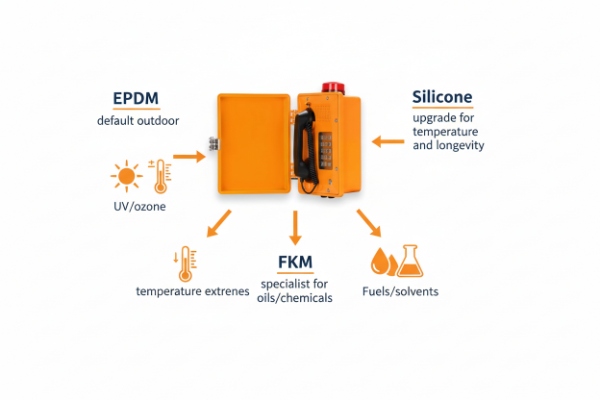
Use EPDM for outdoor weather, ozone, and hot water; use silicone for extreme temperature and UV; use fluororubber (FKM) when oils, fuels, and solvents are present.
How each material behaves in real outdoor phone use
EPDM is a strong default for weatherproof telephones. It handles ozone and outdoor aging well. It also does well with hot water and steam compared with many other elastomers. That makes it a good fit for outdoor units that see rain, humidity, and mild cleaning. The weakness is petroleum oils and fuels. EPDM 5 can swell and soften in oil mist environments.
Silicone shines when the phone faces harsh sun, big temperature swings, or cold climates where many rubbers stiffen. Silicone 6 also keeps flexibility at low temperature. It can be a great option for exposed outdoor stations and for cold regions. The trade-off is tear strength and abrasion. Some silicone compounds can nick or tear easier during service if the door edge is sharp. Silicone can also be less happy with certain oils, depending on the exact compound.
FKM (fluororubber, often called Viton®) is the choice for oil and many chemical exposures. If your phone sits near pumps, diesel traffic, or oily industrial air, FKM 7 often stays stable where EPDM fails. The trade-offs are cost, and sometimes low-temperature flexibility. Some FKM compounds can get stiff in cold environments, so the door may need more closing force.
The quick “best fit” table for outdoor telecom enclosures
| Environment reality | Best first choice | Why | Watch-outs |
|---|---|---|---|
| General outdoor weather | EPDM | Great ozone/UV resistance and sealing life | Avoid oil mist |
| Strong sun + cold winters | Silicone | Wide temperature range, strong UV stability | Protect from cuts, check tear strength |
| Oil mist / fuels nearby | FKM | Strong oil and solvent resistance | Cost, cold stiffness |
| Hot water rinse | EPDM or silicone | Better hot water stability than many rubbers | Verify cleaner chemistry |
| Mixed unknown exposures | EPDM with clear limits | Balanced and cost-effective | Add chemical list and test plan |
A small field story that explains the choice
A gate phone near truck fueling looked fine for months. Then the gasket grew and turned soft. The door started to “float,” and jets pushed water inside. The root cause was EPDM in an oil-mist zone. The fix was simple: switch to FKM, and the problem stopped.
So the best material is the one that matches your exposure list. That list should include UV, salt fog, and oil, because those three are common in outdoor projects.
Now let’s break down how UV, salt fog, and oil change the decision.
How do UV, salt fog, and oil affect my gasket choice?
Outdoor damage is not only water. UV hardens surfaces. Salt fog drives corrosion at the seam. Oil makes many rubbers swell until the door cannot seal.
UV pushes you toward EPDM or silicone, salt fog pushes you toward corrosion-resistant design plus stable elastomers, and oil pushes you toward FKM and away from EPDM.
UV and ozone: the slow seal killer
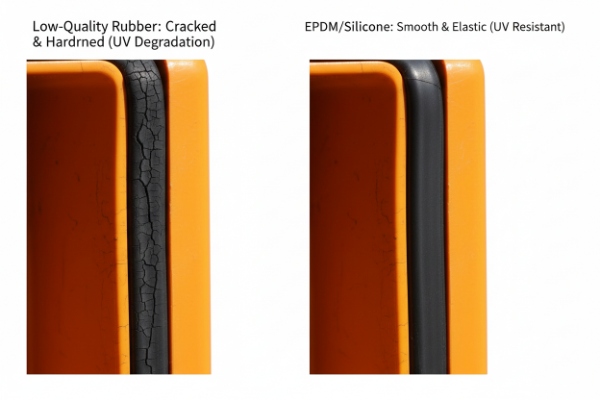
UV and ozone attack many elastomers by cracking the surface and raising hardness over time. That reduces compression recovery. For weatherproof telephones mounted in direct sun, the gasket must keep flexibility for years.
-
EPDM is known for strong ozone and outdoor weather resistance.
-
Silicone also holds up well in UV exposure and stays flexible.
-
FKM can be fine outdoors, but it is usually chosen for chemical reasons first.
If your phone sits on a pole with full sun, it is smart to also specify UV-stable enclosure plastics, coatings, and label materials, because the seal is only one part of the aging path.
Salt fog: not only a gasket topic
Salt fog 8 often causes leakage by corroding screws, door frames, and mating surfaces. Even a perfect gasket fails if the metal flange pits and lifts. So salt fog sites need:
-
corrosion-resistant fasteners (often stainless),
-
protected mating surfaces,
-
and a gasket that does not lose strength in salty moisture.
In coastal projects, EPDM or silicone can both work, but the real success factor is the enclosure material and surface protection. The gasket should also resist water absorption and keep stable compression set.
Oil and fuel: the fast failure mode
Oil mist, diesel fumes, and lubricants can swell and soften many rubbers. When a gasket swells, it can:
-
lose its shape,
-
extrude out of the groove,
-
and create local gaps when the door is closed.
This is where FKM earns its place. It often stays dimensionally stable in oil exposure. If oil is even possible, it is better to state the oil types in the spec, then select the compound from compatibility data.
A table you can paste into your internal spec notes
| Exposure | What it does | Preferred gasket direction | Extra spec to add |
|---|---|---|---|
| UV + ozone | Hardening, cracking, loss of recovery | EPDM or silicone | UV aging test or outdoor durability note |
| Salt fog | Corrosion at seam, surface pitting | EPDM or silicone + corrosion design | Salt spray test for metal parts |
| Oil mist / fuel | Swelling, softening, extrusion | FKM | List oils/fuels and temperature range |
| Cleaning chemicals | Swelling or embrittlement | Depends on chemistry | Provide chemical list and concentration |
If the environment is clear, the next big decision is Shore hardness, because hardness decides how easy it is to seal your door and how tolerant you are to manufacturing variation.
Let’s get practical about Shore A hardness for door seals.
What Shore hardness works best for my door seals?
Many specs say “60A gasket” because it sounds standard. That can be fine, but it is not always correct. Hardness must match the gap, the groove design, and the closing force.
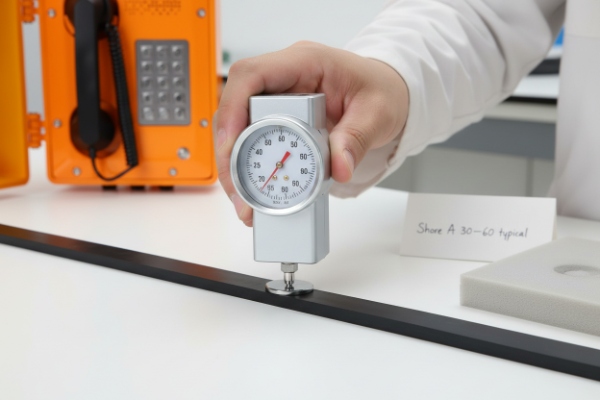
For most weatherproof telephone door seals, Shore A 50–60 is a strong default, 40–50 helps when latch force is low, and 60–70 fits when the groove and compression control are very stable.
Why hardness matters for IP performance
A softer gasket conforms to small surface roughness and door warp. That helps sealing at low force. But soft materials can also:
-
take compression set faster in heat,
-
extrude from a groove,
-
and tear during service if edges are sharp.
A harder gasket resists extrusion and can last longer under high clamping force. But it needs more force to seal and can leak if the door is slightly warped.
So the goal is balance: soft enough to conform, and firm enough to keep shape.
Typical working ranges that fit common enclosure designs
-
40–50 Shore A: good for low closing force designs, large tolerances, and some foam-like behaviors in solid rubber.
-
50–60 Shore A: common sweet spot for gasket-in-groove door seals with screws or cam latches.
-
60–70 Shore A: good when the door and flange are very stiff and you have controlled compression, often with stronger latching.
A useful design target for solid gaskets is often 20–30% compression on the cross-section. Too little compression leaks. Too much compression raises set and makes opening hard.
Control hardness like a procurement item, not a hope
When ordering, it helps to specify:
-
Shore A target, and allowed tolerance (often ±5A),
-
compression set limit at stated temperature and time,
-
and the gasket cross-section tolerance.
Let’s get practical about Shore A hardness 9 for door seals.
A selection table that ties hardness to door mechanics
| Door closure style | Typical clamp force | Better hardness range | Why |
|---|---|---|---|
| Many perimeter screws | Medium to high | 55–65A | Even compression around the frame |
| Single cam latch | Medium | 50–60A | Needs conformity at corners |
| Low-force latch / quick open | Low | 40–55A | Seals with less force |
| Heavy industrial latch | High | 60–70A | Resists extrusion and wear |
A simple way to explain hardness to clients
Hardness is the “spring” of the seal. Softer seals fill gaps easier. Harder seals hold shape better. The right point depends on how tight and stiff the door system is.
Now, food plants bring a different set of requirements. The gasket has to survive washdown and also meet material compliance.
So the last topic is FDA-grade sourcing.
Can I source FDA-grade materials for my food-plant projects?
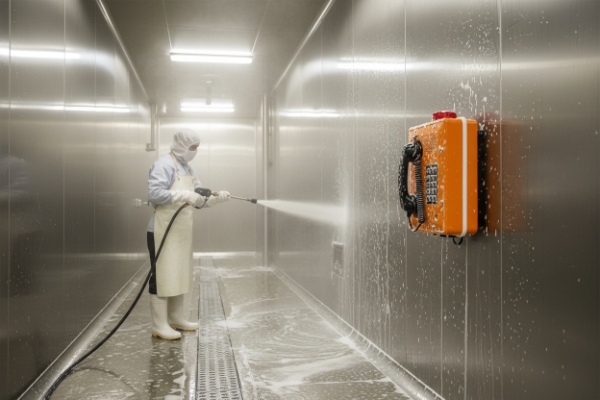
Food plants are strict. The phone can face hot washdown, strong cleaners, and audits. If materials are not documented, approvals stall.
Yes. FDA-grade gasket materials are commonly available, especially platinum-cured silicone and selected EPDM compounds that meet FDA 21 CFR 177.2600 for rubber articles intended for repeated use.
What “FDA-grade” should mean in your documents
“FDA-grade” is often used loosely. For tenders, it is better to ask for:
-
a statement of compliance to FDA 21 CFR 177.2600 10 (for rubber articles intended for repeated use),
-
compound traceability (batch and date),
-
and migration or extraction data if required by the site.
Many food projects also ask for NSF listings or other local compliance marks. The right set depends on the country, the plant policy, and the audit rules.
Best material choices for food washdown zones
-
Platinum-cured silicone is common because it handles wide temperature and is available in compliant grades. It also has low odor and good stability.
-
EPDM can also be used in food environments, especially where hot water and steam are present, and where oil exposure is low.
-
FKM can be used when oils or fats and certain chemicals demand it, but you should confirm the exact compliance grade and cleaning chemistry.
Food plants also care about cleanability. Smooth gasket surfaces and tight joints help. A sponge gasket with open cells can trap dirt. For hygienic sites, a solid gasket and clean groove design is often safer.
What to add to your tender for food plants
| Spec item | What to write | Why it helps |
|---|---|---|
| Compliance | “Gasket compound compliant with FDA 21 CFR 177.2600” | Audit-friendly requirement |
| Material type | “Platinum-cured silicone or FDA-grade EPDM” | Keeps choices practical |
| Cleaner resistance | “Resistant to CIP chemicals listed by buyer” | Prevents swelling in real cleaning |
| Washdown rating | “IP66 minimum, add IPX9/IPX9K if pressure washdown is used” | Matches actual cleaning |
| Documentation | “Provide CoC, batch traceability, and material declaration” | Speeds acceptance |
How to avoid common mistakes in food projects
-
Do not assume any “white gasket” is food compliant. Ask for paperwork.
-
Do not ignore cleaning chemicals. Caustic and sanitizers can change rubber fast.
-
Do not test by blasting installed units with a pressure washer. Use the rated method and sample testing.
With the right material and the right documents, food-plant weatherproof telephones can be reliable and easy to approve.
Conclusion
EPDM fits most outdoor weather. Silicone fits UV and wide temperature. FKM fits oil and chemicals. Then match hardness to door force, and use documented FDA-grade compounds for food sites.
Footnotes
-
Flexible strip used to prevent ingress of dust, water, and contaminants into the housing. [↩] ↩
-
Protective housing designed to shield communication equipment from environmental hazards. [↩] ↩
-
Permanent deformation of rubber after prolonged stress, affecting sealing capability. [↩] ↩
-
Degradation of materials caused by exposure to sunlight, temperature, and moisture. [↩] ↩
-
Synthetic rubber known for excellent resistance to heat, ozone, and weather. [↩] ↩
-
Elastomer valued for thermal stability and flexibility in extreme temperatures. [↩] ↩
-
Fluoroelastomer designed for high resistance to oils, fuels, and chemicals. [↩] ↩
-
Corrosive atmosphere testing used to evaluate material resistance to saline environments. [↩] ↩
-
Measure of rubber material resistance to indentation, determining seal compressibility. [↩] ↩
-
Regulation specifying safety standards for rubber articles intended for repeated use. [↩] ↩








