
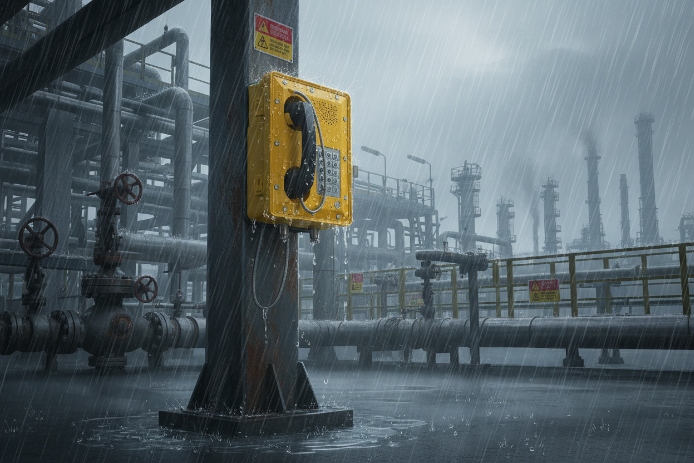
Outdoor phones fail in boring ways. A small gap at the cable entry becomes water ingress. A cheap keypad cracks in the sun. Then the “emergency phone” becomes a dead box.
For most outdoor weatherproof telephones, IP65 or IP66 is the normal baseline, IP67 fits flood-prone mounting, and IP69/IP69K only makes sense for high-pressure hot washdown.
A simple rating map that matches real site risk
Weatherproof telephone specs often get over-written “just to be safe.” That drives cost, adds long lead items, and still does not guarantee reliability. The clean way is to map ratings to the real threat: dust, rain, washdown, immersion, corrosion, and abuse.
What each rating family actually covers
IP tells you dust and water ingress performance for an enclosure. The first digit is solids. The second digit is water. Most outdoor phones aim for “6” on solids, because dust is everywhere at roadsides, ports, and yards. Water is the differentiator.
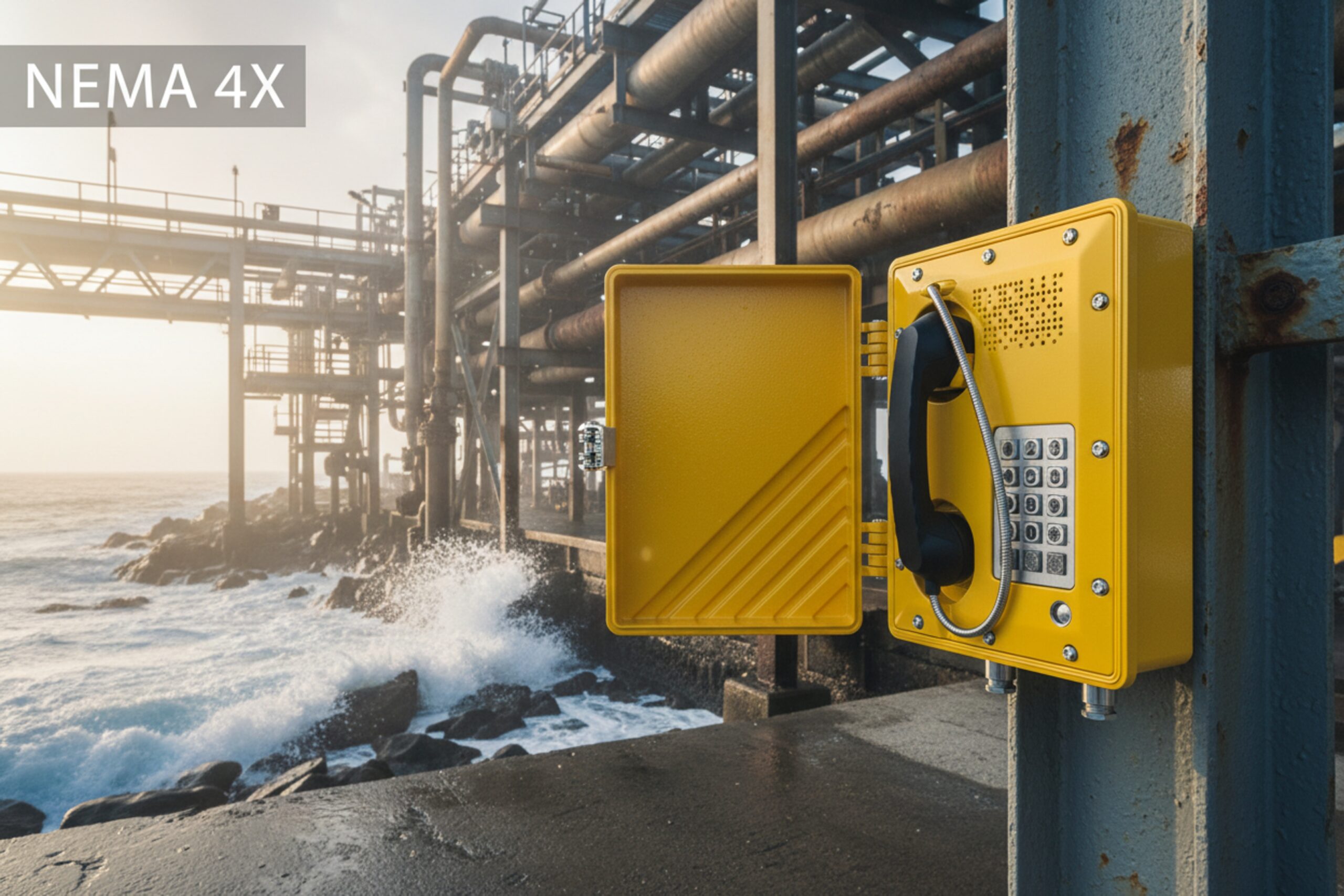
NEMA 4X 1 is not just “an IP number.” It adds ideas that IP alone does not clearly cover in day-to-day purchasing: corrosion resistance and outdoor durability details like ice formation on the enclosure. For North America tenders, NEMA 4X is a common “plain language” requirement for outdoor enclosures, especially near coastal air, de-icing chemicals, or aggressive cleaning.
IK is a separate impact rating. It matters when the phone is exposed to people, carts, tools, or vandalism. Many “weatherproof” failures in public spaces are not water failures. They are impact failures: a cracked faceplate, a bent button, or a damaged handset cradle.
The fast decision table used in many projects
| Site condition | Main threat | Typical requirement | When to upgrade |
|---|---|---|---|
| Outdoor wall under canopy | Windblown dust + rain | IP65 | Upgrade to IP66 if cleaning jets exist |
| Outdoor pole, open sky | Strong rain + dust | IP66 | Add IK10 in public areas |
| Low mounting near drainage | Splash + temporary flood | IP66 + IP67 | Consider raised mounting before higher IP |
| Food plant / vehicle wash bay | Hot high-pressure washdown | IP69/IP69K | Only if washdown is routine and close-range |
| Coastal / chemical mist | Corrosion | NEMA 4X or corrosion requirement | Specify material grade + salt spray test 2 |
A practical warning from the field
In many outdoor installs, the weak point is not the front cover. It is the cable gland, the RJ45 path, or an open drain hole. So the tender should treat “complete assembly” as the rated product, including glands, connectors, and mounting method. That one line prevents a lot of disputes later.
If the rating choice is clear, the next step is picking between IP65, IP66, IP67, and IP69 without overbuying.
A good spec reads like a site description, not like a wish list.
Do I need IP65, IP66, IP67, or IP69 for my project?
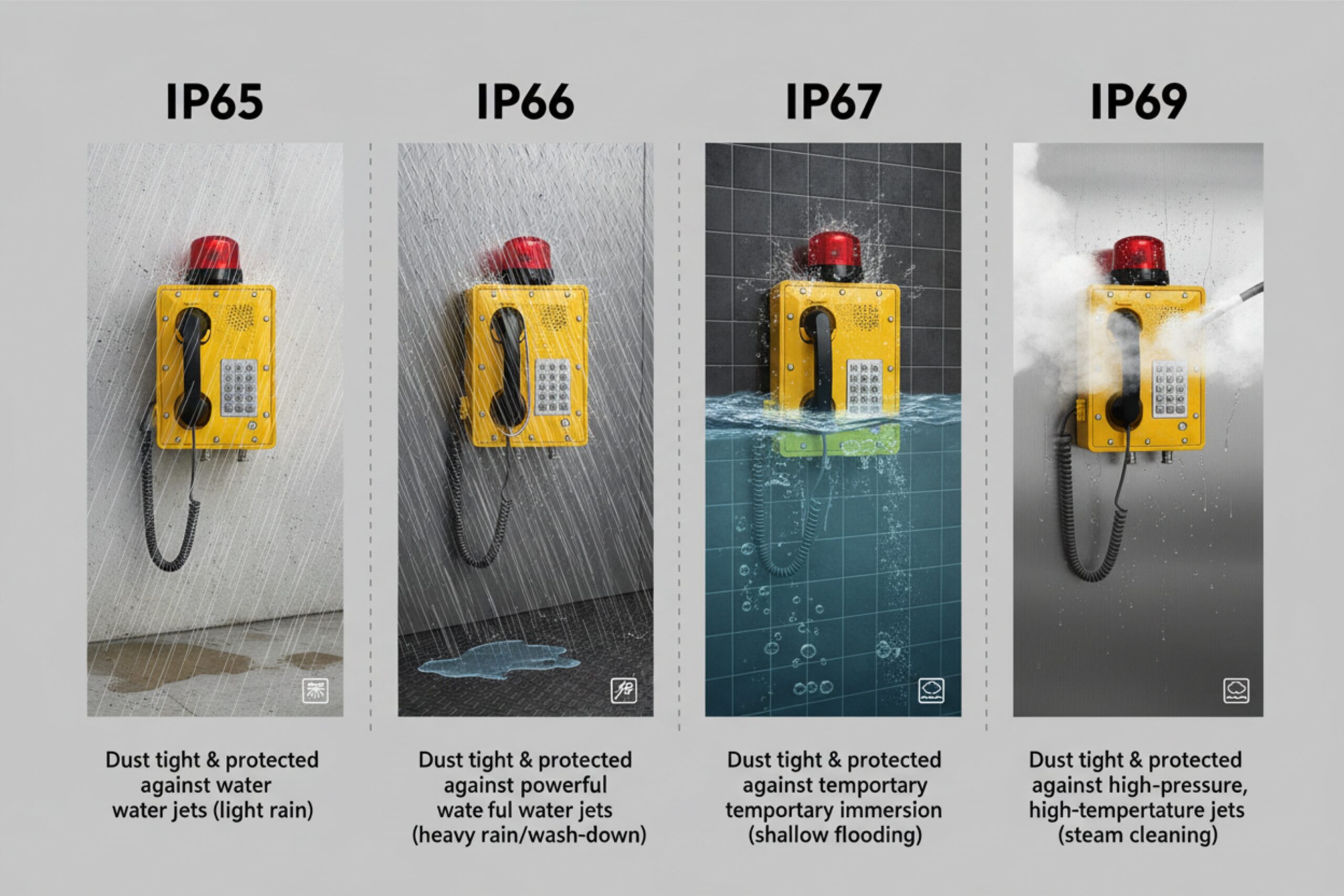
A rating is only “right” if it matches how water hits the phone. Rain, hose jets, immersion, and washdown are different problems.
IP65/IP66 covers most outdoor sites, IP67 is for real immersion risk, and IP69/IP69K is only for hot high-pressure washdown like food processing or vehicle wash bays.
IP65 vs IP66: the normal outdoor fork
-
IP65 fits rain and general outdoor exposure. It is a common baseline for outdoor SIP endpoints.
-
IP66 is the safer choice when water can hit the unit with stronger force, like wind-driven storms, hose cleaning, or heavy splash near traffic lanes and loading docks.
If the phone is installed on a pole in an open parking lot, IP66 usually avoids argument later. It is still realistic in cost and design.
IP67: choose it when water can cover the device
IP67 is about temporary immersion. It is not “better IP66.” It is “a different water event.” IP67 helps when the phone is mounted low, near drains, or near places where water can pool after storms. In these cases, raising the mounting height is often cheaper and more effective than upgrading the enclosure, but IP67 is still a good safety net when location cannot change.
IP69 / IP69K: only for washdown, not for “extra outdoor”
IP69 is used when equipment must survive high-pressure, high-temperature jet cleaning. IP69K 3 is a stricter washdown method that is widely referenced in industrial cleaning specs. This is common in food and beverage plants, certain chemical areas, and vehicle wash facilities. For a campus blue-light phone or a port gate phone, IP69 is usually waste. It increases complexity, raises seal sensitivity, and can reduce serviceability if technicians open the unit often.
A short “don’t overbuy” checklist
| Question | If “yes” | If “no” |
|---|---|---|
| Will staff spray it with hoses often? | Consider IP66 | IP65 may be enough |
| Can water rise above the bottom of the unit? | Add IP67 or raise mounting | Stay with IP65/IP66 |
| Is there hot high-pressure washdown? | Consider IP69/IP69K | Avoid IP69 |
| Is dust heavy (yards, mines, roads)? | Keep solids digit at 6 | Lower solids digit may pass but may age badly |
When the water and dust choice is set, the next spec debate is usually “Should the tender ask for NEMA 4X and IK too?”
Should I consider NEMA 4X or IK ratings for my specs?
Many projects fail because they only specify IP. IP covers dust and water, but it does not fully capture corrosion or abuse.
NEMA 4X is useful for North American outdoor specs and corrosive sites, while IK ratings protect you in public or industrial areas where impact and vandal risk is real.
When NEMA 4X belongs in the tender
NEMA 4X is a strong fit when:
-
The project is in the US/Canada and contractors are used to NEMA language
-
The site is coastal, marine, or near de-icing chemicals
-
You need a clear corrosion requirement, not only “IP66”
-
The enclosure must survive outdoor conditions such as hose-directed water and ice on the enclosure
It also helps when the phone is part of a cabinet or pedestal package, because many enclosure vendors already quote NEMA types.
When IK is non-negotiable
IK ratings 4 tell you impact resistance in joules. For emergency phones in public areas, impact is common. In many campus or parking deployments, IK10 is the usual target because it supports strong resistance to strikes and abuse. For industrial yards, IK09 or IK10 can be the difference between “works for years” and “needs monthly repairs.”
How IP, NEMA, and IK work together
| Spec item | What it protects against | Typical use case |
|---|---|---|
| IP66 | Dust-tight + powerful water jets | Outdoor pole phones, ports, yards |
| NEMA 4X | Outdoor water exposure + corrosion expectation | Coastal sites, North America tenders |
| IK10 | High impact/vandal resistance | Campus, parking, transit, public spaces |
A simple rule used in many bid documents
-
If the phone is public-facing, add an IK requirement.
-
If the phone is coastal or chemical-mist, add NEMA 4X or explicit corrosion requirements.
-
If the phone is industrial cleaning zone, keep IP and add washdown language.
Once the ratings are defined, buyers ask the next practical question: who can test or “certify” these ratings, and what proof is acceptable?
Which labs certify my weatherproof telephone ratings?
Confusion here causes procurement delays. Some teams ask for “CE certification for IP66,” which is not how IP normally works.
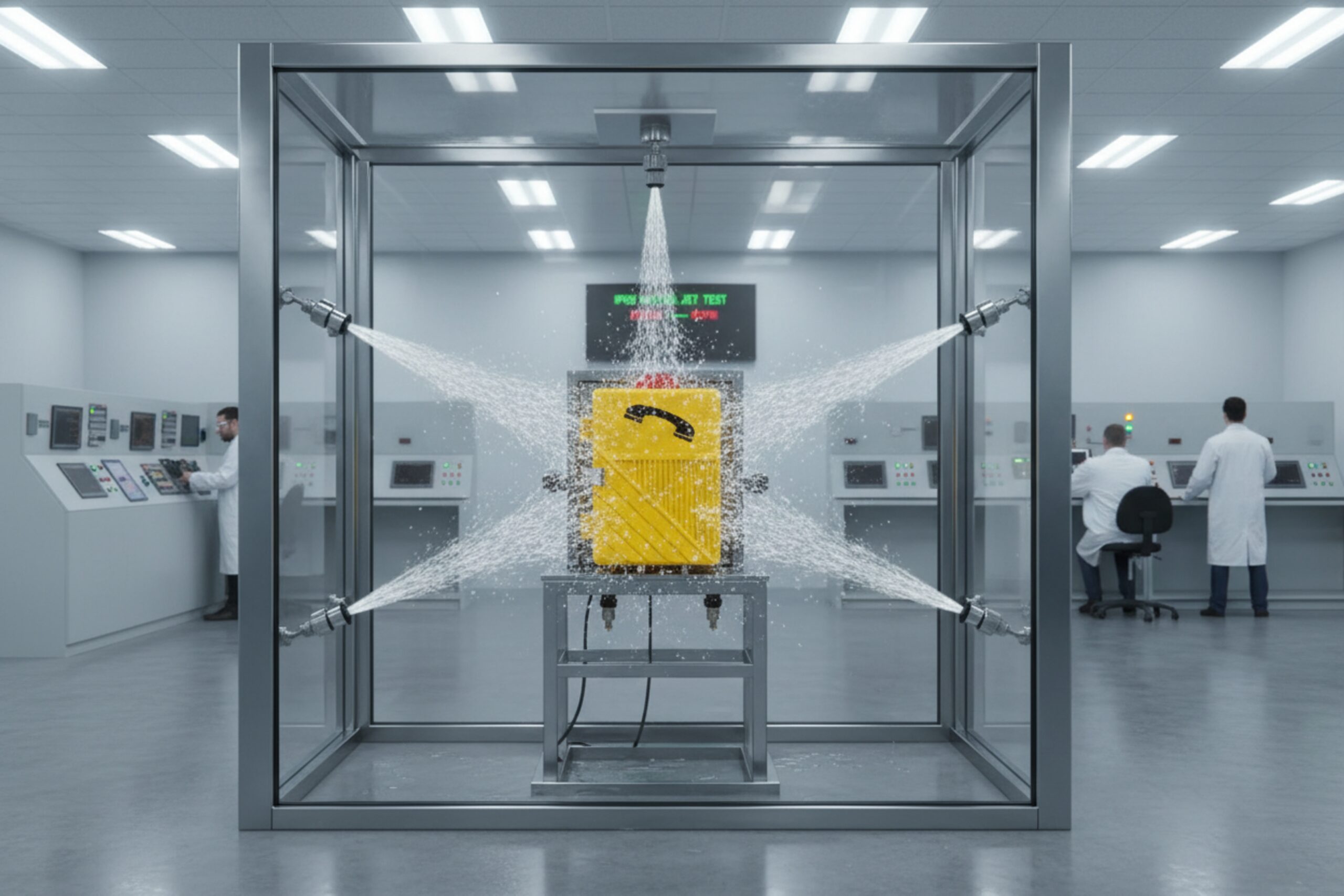
IP and IK are usually proven by third-party test reports from ISO/IEC 17025 accredited labs, while NEMA 4X can be supported by testing and, when needed, listing programs tied to enclosure standards.
Think “testing + report,” not always “a certificate”
For most weatherproof telephone projects, the strongest proof is a formal test report that states:
-
the exact model tested and sample condition
-
pass/fail and test setup
-
photos and measurements
Many manufacturers also mark the rating on the label, but the report is what wins arguments.
What “ISO/IEC 17025 accredited” means in practice
ISO/IEC 17025 7 is the quality and competence framework for testing labs. When a lab is accredited for IP/IK work, it means the lab has proven capability for specific methods within an accredited scope. That gives more trust in the report, especially for government or large industrial tenders.
Examples of lab types commonly used
A project does not need a single “one lab.” It needs a credible lab with the right scope:
-
Global TIC groups that offer ingress testing (examples include Intertek and TÜV organizations)
-
Specialist enclosure testing labs that focus on IP/IK and enclosure standards
-
Regional labs that are ISO/IEC 17025 accredited and recognized through accreditation agreements
What to request from the lab or supplier
| Item to request | Why it matters |
|---|---|
| ISO/IEC 17025 scope snippet showing IP/IK tests | Confirms competence for that exact method |
| Full test report with photos | Proves the exact configuration passed |
| Test sample configuration list | Prevents “tested different gland” problems |
| Marking/label photo | Helps site acceptance and audits |
After lab proof is clear, the final step is documentation. A strong tender and datasheet can prevent most disputes before they happen.
How do I document ratings in my tenders and datasheets?
Many tenders fail because they say “IP67 weatherproof” and stop there. That leaves too many loopholes. The goal is to specify test standards, scope, and evidence.
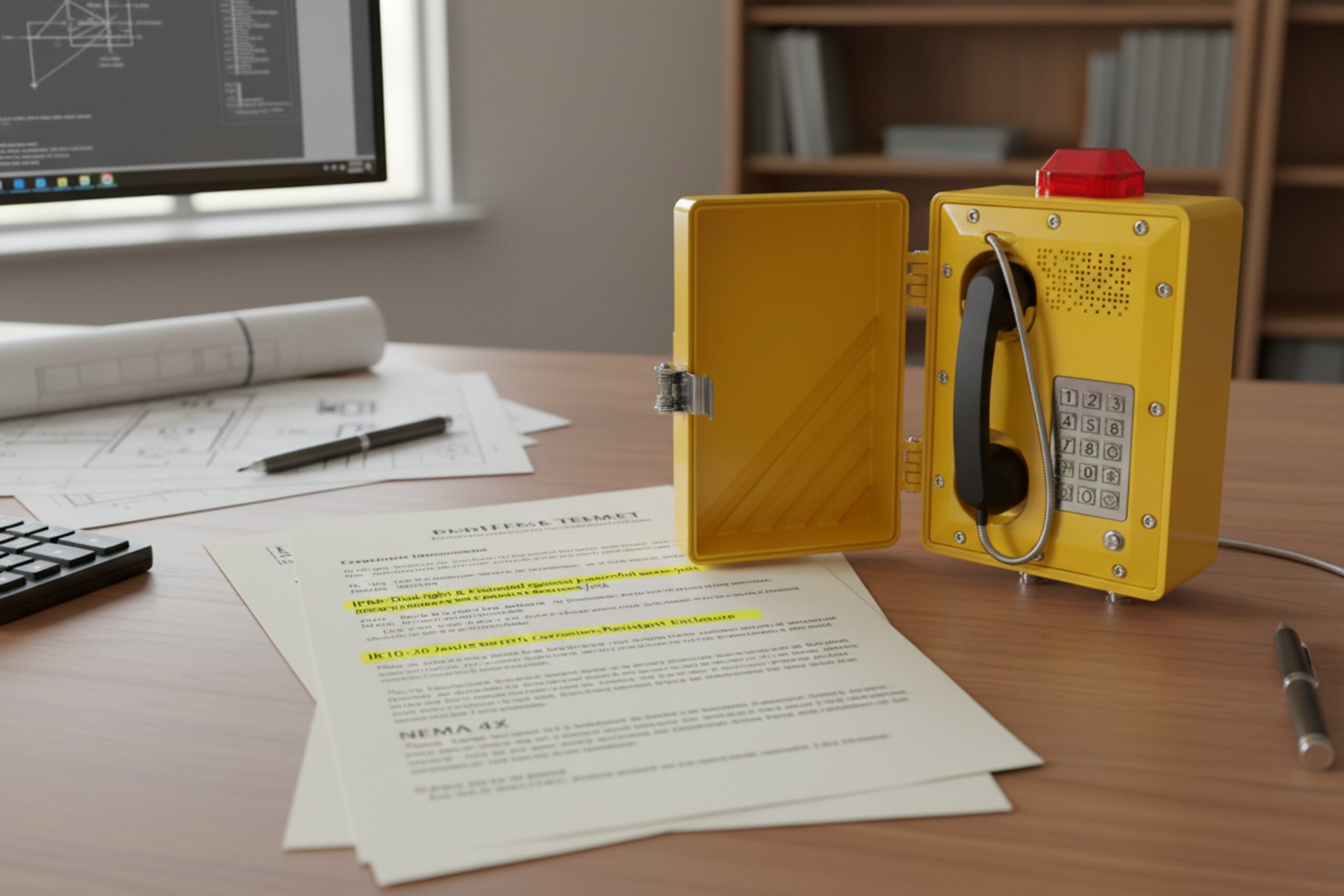
A good tender states the standard, the exact rating, the tested configuration (including glands/connectors), and the evidence required: an ISO/IEC 17025 lab report or equivalent third-party report.
Tender wording that reduces risk
Use a structure that procurement, contractors, and QA can all read:
1) Ratings and standards
-
Ingress Protection: minimum IP66 tested to IEC/EN 60529
-
Impact Protection: minimum IK10 tested to IEC/EN 62262 (if public-facing)
-
North America option: NEMA 4X enclosure performance (if required by project region)
-
If washdown is required: IP69/IP69K tested to ISO 20653 or stated washdown standard
2) What must be included in the rated assembly
-
Rating must apply to the complete telephone assembly including:
-
cable entries and glands supplied with the product
-
any external antennas or connectors used in the final install
-
mounting orientation as installed (wall/pole/pedestal)
-
handset cord exit (if handset model)
-
3) Evidence required
-
Third-party test report(s) showing:
-
standard and edition/date
-
tested model number and revision
-
sample quantity and condition (new/aged if required)
-
test results and photos
-
-
Lab accreditation proof (preferred): ISO/IEC 17025 scope covering the test method
Datasheet format that buyers can verify fast
| Datasheet field | Example entry | Notes |
|---|---|---|
| Ingress rating | IP66 (IEC/EN 60529) | State the standard, not only the number |
| Impact rating | IK10 (IEC/EN 62262) | If vandal risk exists |
| Enclosure type | NEMA 4X (where required) | Avoid “equivalent to” unless proven |
| Material | 316L stainless / aluminum alloy | Link to corrosion needs |
| Cable entry | Sealed gland supplied | Prevent install-time downgrades |
| Mounting | Wall / pole | Mounting can change water paths |
| Test evidence | Third-party report available | Provide report ID on request |
Acceptance criteria for site delivery
Add a simple acceptance plan so the contractor cannot substitute a weaker build:
-
Nameplate must show IP/IK (and NEMA if relevant)
-
Supplier must provide matching report IDs
-
Visual check: gasket condition, correct glands, sealed unused holes
-
If the install uses a different cable method than the tested setup, require a written variance approval
When this documentation is clean, vendor comparison becomes easy, and post-install arguments become rare.
Conclusion
Choose ratings from the real site threats, not from fear. IP handles water and dust, IK handles abuse, and NEMA 4X helps with corrosion and North American clarity.
Footnotes
-
A standard for electrical enclosures that protects against corrosion, windblown dust, and rain, often used outdoors. [↩] ↩
-
A standardized corrosion test method used to evaluate the corrosion resistance of coated metals and materials. [↩] ↩
-
A rating for equipment that can withstand high-pressure, high-temperature washdown, common in food processing. [↩] ↩
-
An international classification for the degree of protection provided by electrical equipment enclosures against external mechanical impacts. [↩] ↩
-
The international standard defining degrees of protection provided by enclosures (IP Code) against solids and water. [↩] ↩
-
The international standard defining degrees of protection provided by enclosures for electrical equipment against external mechanical impacts (IK code). [↩] ↩
-
The primary international standard for the general requirements for the competence of testing and calibration laboratories. [↩] ↩








