

An Ex telephone can look rugged and still fail a site audit. One missing marking or one wrong certificate can delay commissioning and block payment.
Explosion-proof telephone compliance is a stack: hazardous-area certification (ATEX/IECEx or NEC/CEC), correct Ex nameplate marking (protection type, gas/dust group, T-rating, EPL, Ta), plus product standards like IP/IK, EMC, and safety (62368-1) backed by traceable documents.

Compliance is a layered checklist, not a single certificate
Hazardous-area approval comes first
A true explosion-proof telephone must prove it will not ignite gas or dust under normal operation and defined faults. This is the hazardous-area certificate layer. It is the most important layer because it defines where the phone can be installed: Zone 1/2, Division 1/2, and dust zones.
Product safety and performance come next
After hazardous-area approval, the phone still needs to survive the environment and not interfere with other systems. This is where IP66/IP67, IK10, NEMA 4X, EMC limits, and the product safety standard (EN/UL/IEC 62368-1) matter.
Documentation is the real “passport”
Many projects fail on paperwork, not hardware. Buyers need certificates, reports, and a clear quality system audit trail. The right documentation reduces project risk and makes cross-border delivery easier.
A quick “compliance stack” view
| Layer | What it proves | Typical evidence | Who checks it |
|---|---|---|---|
| Hazardous-area Ex | No ignition risk in classified area | ATEX certificate / IECEx CoC / Class-Div listing | HSE + inspector |
| Marking correctness | Correct installation match | Nameplate + manual | Site engineer |
| Ingress and impact | Survives washdown and abuse | IP/IK/NEMA reports | Maintenance + QA |
| EMC/EMI | No interference, good immunity | EN 55032/55035 or FCC reports | IT/OT + QA |
| Product safety | Electrical safety and hazards | EN/UL/IEC 62368-1 report | Compliance team |
| Manufacturing control | Build consistency | ISO 9001, Ex QMS audit | Procurement + auditor |
In my projects, the fastest approvals happen when the tender includes this stack from day one. The phone becomes easy to approve, and the network team can focus on routing and paging instead of chasing missing papers.
Now the rest of the article breaks the stack into four practical parts: certification schemes, nameplate reading, extra standards, and the document pack buyers should demand.
Which hazardous-area certifications apply—ATEX/IECEx Zone 1/2, NEC/CEC Class I Div 1/2, and Ex tb for dust?
Hazardous-area buyers often compare two phones and assume both are “Ex” because both look heavy. That mistake shows up at inspection, not at quotation time.
For global projects, ATEX and IECEx cover Zone 1/2 requirements, while NEC/CEC covers Class I Division 1/2 in North America. For dust, many Ex telephones use Ex tb protection for combustible dust atmospheres, and the marking must match dust group and temperature limits.
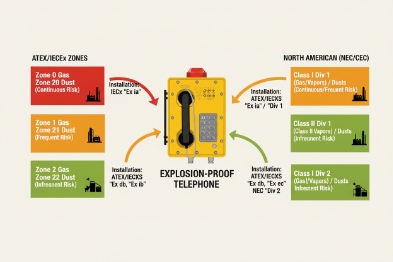
ATEX: EU legal route for explosive atmospheres
ATEX 1 is the route used in the EU and many neighboring markets. For telephones, the equipment is usually Group II (surface industries), and the category and protection concept must match the zone:
-
Zone 1 usually needs Category 2G equipment (often marked “II 2G”)
-
Zone 2 usually needs Category 3G equipment (often marked “II 3G”)
ATEX also links strongly to the manufacturer’s audited Ex quality system. If the factory does not hold the right quality assurance, certificates do not help.
IECEx: global certificate format many owners trust
IECEx 2 is not a law in most countries, but it is widely accepted by oil and gas owners, EPCs, and inspectors. IECEx certificates are easy to share across borders, and the system includes the product certificate plus the quality audit for the manufacturer.
A practical buying rule is simple:
-
Use IECEx when you have multi-country deployment or strict owner approval lists.
-
Use ATEX when the project is in the EU or must show CE/ATEX legal compliance.
NEC/CEC Class-Div: common in the US and Canada
In North America, hazardous locations are often specified as Class I Div 1 or Div 2 for gas and vapor. For an Ex telephone project, this matters because:
-
A Zone-rated product is not automatically accepted for every Class-Div requirement without the right listing and marking.
-
Many owners require a UL/CSA listing or an accepted certification path.
Dust: Ex tb and dust groups matter
Dust hazards are not the same as gas hazards. For combustible dust 3, telephones often use “Ex tb” protection (protection by enclosure). The dust group and the maximum surface temperature must match:
-
IIIA for fibers and flyings
-
IIIB for non-conductive dust
-
IIIC for conductive dust
A phone that is fine in gas Zone 2 may still be wrong for conductive dust if seals, entries, and temperature are not correct.
| Region / spec style | Typical site wording | What you should request |
|---|---|---|
| EU / Zone | ATEX Zone 1 or Zone 2 | ATEX certificate + correct Ex marking |
| Global owner specs | IECEx Zone 1/2 | IECEx CoC + QAR + ExTR summary |
| US | Class I Div 1/2 | UL/CSA Class-Div listing or accepted equivalent |
| Canada | CEC Class I Div 1/2 | CSA route or accepted listing |
| Dust areas | Zone 21/22 or dust hazard | Ex tb + IIIA/IIIB/IIIC marking + IP proof |
A clear certification choice at tender stage prevents redesign later. It also prevents a common trap: a phone certified for Zone 2 getting pushed into a Zone 1 location because the mounting point moved during construction.
How should nameplate markings be read—Ex d/Ex e, IIA/IIB/IIC, IIIC, T-rating, EPL Ga/Gb/Db, and ambient range?
Many buyers ask for “Zone 1 IIC.” That is not enough. The nameplate is the real contract. It tells you exactly what the device is allowed to do.
An Ex telephone nameplate should be read as a full sentence: protection type (Ex d/Ex e/Ex i/Ex tb), gas or dust group (IIA/IIB/IIC, IIIA/IIIB/IIIC), temperature class or max surface temp, EPL (Ga/Gb/Gc or Da/Db/Dc), and the ambient range (Ta). Every part must match the hazardous area study and the site temperature.
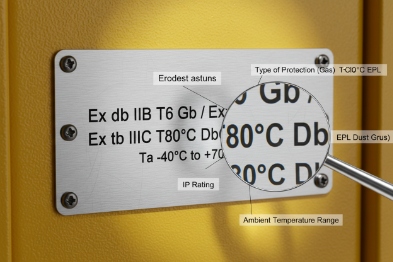
Protection concept: what Ex d, Ex e, and Ex tb actually mean
-
Ex d means flameproof enclosure. It can contain an internal explosion and prevent ignition outside, when correctly installed with certified entries.
-
Ex e means increased safety 4. It avoids arcs and high temperatures by design. It is often used for terminal compartments or low-risk circuits.
-
Ex tb means protection by enclosure for dust. It relies on sealing and temperature control to prevent dust ignition.
Many telephone designs combine concepts, like Ex db eb, where the main enclosure is Ex d and the terminal area is Ex e. This can reduce maintenance time and wiring risk when done correctly.
Gas groups and dust groups: match the worst credible hazard
For gases:
-
IIA is the least severe group in Group II.
-
IIB is more severe.
-
IIC is the most severe and includes gases like hydrogen and acetylene.
A phone certified for IIC can generally be used in IIB and IIA gas groups, but the full marking and temperature limits still matter.
For dust:
- IIIC (conductive dust) is the most demanding.
A phone with IIIC dust approval gives strong coverage across dust hazards, but again the temperature marking must match the dust ignition risk.
Temperature class and ambient range: the most common mismatch
Temperature marking is where many field failures happen. Two parts must match:
-
T-rating (T1 to T6) for gas, or a maximum surface temperature for dust
-
Ta ambient range, like -40°C to +70°C
If the phone is installed in a hot sun cabinet or near a hot process line, the ambient can rise. A phone with a narrow Ta range can become non-compliant even if the Zone and group are correct.
EPL: the quick risk indicator
EPL tells you how much protection level 5 is built in:
-
Gb is typical for Zone 1 equipment
-
Gc is typical for Zone 2 equipment
-
Db is typical for Zone 21 dust equipment
-
Dc is typical for Zone 22 dust equipment
Example: how to read a marking like a buyer
A marking like “Ex db eb IIC T6 Gb” tells a simple story:
-
flameproof + increased safety design
-
suitable up to IIC gas group
-
surface temperature limited to T6 conditions
-
EPL Gb means Zone 1 intent (when installed per instructions)
| Marking element | What it answers | Common buyer mistake |
|---|---|---|
| Ex d / Ex e / Ex tb | How ignition risk is controlled | assuming all “Ex” is the same |
| IIA/IIB/IIC | Which gas group is allowed | ordering IIB for IIC sites |
| IIIA/IIIB/IIIC | Which dust type is allowed | ignoring conductive dust risk |
| T-rating / Tmax | Max surface temperature | ignoring local ambient and sun load |
| EPL | Zone suitability shorthand | mixing Zone 2 equipment into Zone 1 |
| Ta range | Allowed ambient temperature | ignoring -40°C start-up needs |
A disciplined way to buy is to treat the nameplate like a checklist and match it line by line to the hazardous area classification drawing.
What additional product standards are needed—IP66/67, IK10, NEMA 4X, EMC/EMI (CISPR 32/FCC Part 15), and safety EN/UL 62368-1?
Hazardous-area approval is necessary, but it does not guarantee the phone survives washdown, corrosion, and network noise. That is why projects add more standards.
Beyond Ex certification, explosion-proof telephones often need ingress protection (IP66/IP67), impact resistance (IK10), corrosion enclosure expectations (NEMA 4X), EMC compliance (CISPR 32/EN 55032 and FCC Part 15 for emissions, plus industrial immunity like IEC 61000-6-2), and product safety under EN/UL/IEC 62368-1.
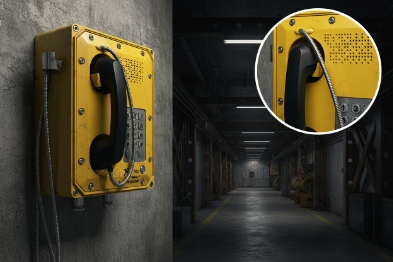
IP rating: match the real water exposure
-
IP66 fits heavy rain and strong water jets.
-
IP67 adds short-term immersion.
Some sites also ask for IP68, but that is only needed for prolonged submersion and must be defined with depth and time.
The key detail is the assembled condition. Glands, blanking plugs, and covers must match the tested configuration.
IK rating: protect the user interface in harsh areas
IK10 is common when phones face:
-
impacts from tools
-
vandal risk
-
heavy gloves and harsh handling
The goal is not only “no cracks.” The goal is “still works after impact.” Keypad, hookswitch, and handset cord strain relief should survive.
NEMA 4X: corrosion and washdown expectation
NEMA 4X is often required in marine and coastal sites. It signals:
-
water protection similar to strong washdown expectations
-
corrosion resistance 6 expectations for enclosure and hardware
NEMA and IP are not identical systems, so many tenders list both.
EMC/EMI: do not let the phone become a noise source
For SIP endpoints, EMC includes:
-
emissions limits (so it does not disturb other equipment)
-
immunity performance (so it keeps working near motors and switching)
Industrial sites often prefer Class A emissions for industrial use and strong immunity levels because RF and surge noise is real.
Safety standard 62368-1: product safety baseline
Even though the phone is Ex-rated, buyers still want the electrical safety standard 7 used for AV/ICT equipment. EN/UL/IEC 62368-1 helps prove:
-
electrical shock protection
-
fire and energy hazard control
-
safety design discipline
| Standard area | Typical requirement | What you should verify |
|---|---|---|
| Ingress | IP66 / IP67 | test report and gland conditions |
| Impact | IK10 | functional test after impact |
| Outdoor corrosion | NEMA 4X | material and hardware quality |
| EMC emissions | EN 55032 / CISPR 32, FCC Part 15 | class level and report scope |
| EMC immunity | IEC 61000-6-2 style levels | ESD, EFT, surge, RF immunity |
| Product safety | EN/UL/IEC 62368-1 | CB report or NRTL listing path |
A phone that passes these standards is easier to own. It fails less. It also survives the real issues in terminals: salt fog, washdown, and electrical noise.
What compliance documents and audits are required—EU DoC, IECEx CoC/ExTR/QAR, ISO 9001, and CE/UKCA/EAC/PESO registrations?
A device can be compliant and still be rejected if the supplier cannot provide the right document set. In B2B projects, paperwork is part of the product.
A complete compliance pack usually includes: EU Declaration of Conformity for CE/ATEX, IECEx CoC plus ExTR and a quality audit report (QAR), manufacturing quality audits like ISO 9001 and Ex-specific quality control, and market access marks such as CE, UKCA, EAC, and PESO where required.

EU documents: DoC and technical file discipline
For EU supply, the supplier should provide:
-
EU Declaration of Conformity 8 that lists the directives and standards used
-
ATEX certificate and correct CE/Ex marking alignment
-
supporting test reports for EMC and safety standards when required
A strong DoC is specific. It lists the exact model and the exact standards.
IECEx documents: certificate plus test report plus quality audit
IECEx is valuable because it separates:
-
CoC (the certificate)
-
ExTR (test report that supports the certificate)
-
QAR (quality audit report for the factory)
Owners and EPCs often ask for all three because it shows the product is tested and the factory is controlled.
ISO 9001 and Ex manufacturing control
ISO 9001 supports general manufacturing discipline. For Ex products, buyers often also expect:
-
traceability 9 by batch or serial
-
controlled changes to critical parts
-
calibration records for test equipment
-
incoming inspection rules for seals, glands, and metal parts
This is what reduces “same model, different build” problems across shipments.
Regional market access marks
Global projects often need local registrations or marks:
-
UKCA for the UK market where required
-
EAC for certain Eurasian markets
-
PESO for India in some hazardous-area procurement paths
These are not always needed for every project, but the tender should state the target countries early. That avoids late-stage compliance surprises.
| Document or audit | What it proves | What to ask from the vendor |
|---|---|---|
| EU DoC | legal compliance basis | DoC listing model + standards |
| ATEX certificate | Ex conformity for EU route | certificate + marking photo |
| IECEx CoC | global Ex certificate | CoC link or PDF |
| ExTR | how it was tested | ExTR summary pages (key parts) |
| QAR | factory Ex quality audit | current QAR status and scope |
| ISO 9001 | basic QMS | valid certificate and scope |
| EMC report | emissions and immunity | lab report 10 with configs |
| 62368-1 report | product safety | CB report or NRTL evidence |
| Country marks | market entry | proof of registration where needed |
A simple buyer habit reduces risk: request the document pack before placing a bulk order, not after production. This avoids schedule pressure and helps the inspector approve the device without debate.
In our DJSlink-style OEM/ODM projects, the smoothest deliveries are the ones where the compliance list is locked early, and every shipment includes the same structured document set. This keeps distributors and integrators confident, and it keeps project timelines stable.
Conclusion
Explosion-proof telephone compliance needs the right Ex scheme, correct nameplate marking, extra IP/EMC/safety standards, and a complete document pack with audited quality control.
Footnotes
-
[European Union directive mandated for equipment used in potentially explosive atmospheres.] ↩
-
[International certification system ensuring equipment meets global standards for explosive environments.] ↩
-
[Fine particles that pose a fire or explosion hazard when suspended in air under certain conditions.] ↩
-
[Concept in hazardous area protection designed to prevent ignition sources like sparks and high temperatures.] ↩
-
[Equipment Protection Levels indicating the likelihood of an ignition source becoming active.] ↩
-
[Standard specifying requirements for electrical enclosures to protect against corrosion and environmental hazards.] ↩
-
[Safety standard for audio/video, information, and communication technology equipment.] ↩
-
[Official document stating that a product meets all relevant EU safety and performance requirements.] ↩
-
[Ability to track the history, application, or location of an item through recorded identification.] ↩
-
[Formal document detailing the resul ↩








