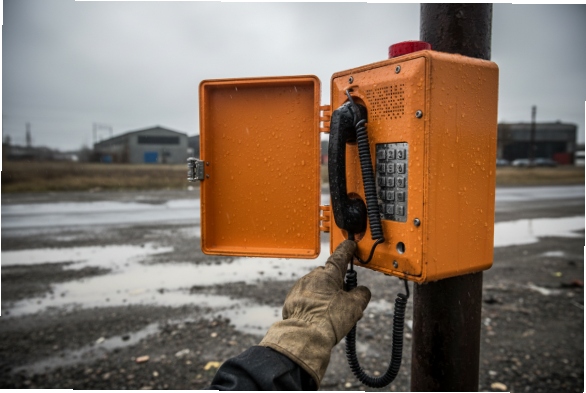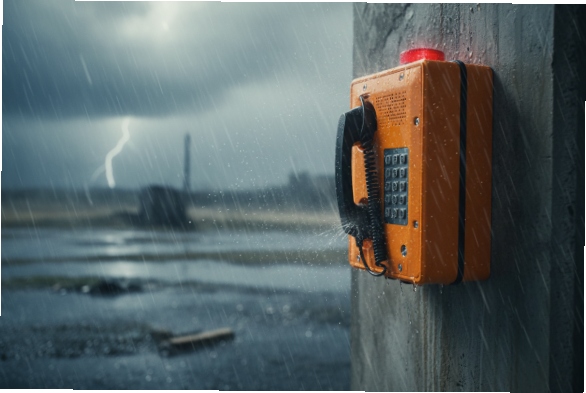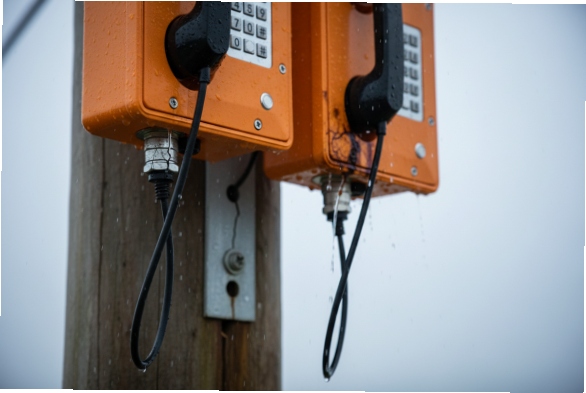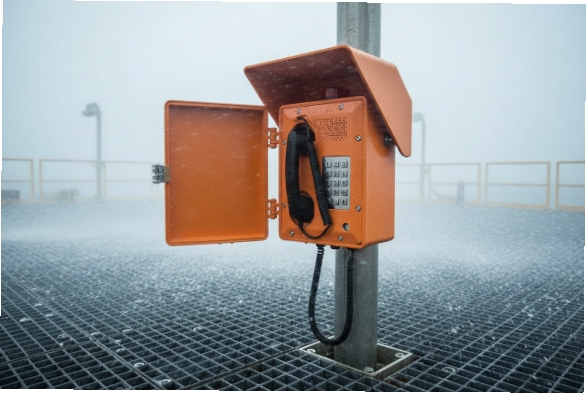
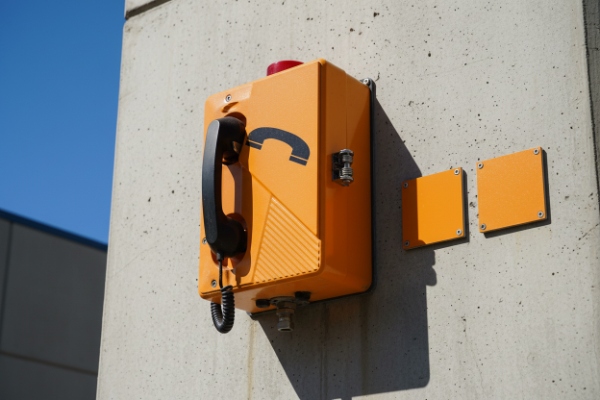
Weatherproof telephones spend years in direct sun, heat, rain, and (often) salt air. UV resistance is not just about “color staying nice”—UV can also embrittle plastics, chalk coatings, and reduce sealing reliability over time.
In practice, UV “classification” for a weatherproof telephone is proven by test methods and material ratings—not a single universal UV class. Commonly referenced standards include ISO 4892 and ASTM G154/G155 (accelerated weathering), UL 746C (polymeric outdoor suitability such as f1), and IEC 60068-2-5 (solar radiation) for equipment-level environmental validation.
Does validation follow ISO 4892 or ASTM G154/G155 accelerated weathering?
Yes—these are among the most common accelerated weathering methods used to screen plastics and finishes for outdoor use.
ISO 4892 and ASTM G154/G155 are test methods that simulate UV + moisture cycling to measure color change, gloss loss, chalking, cracking, and mechanical degradation.
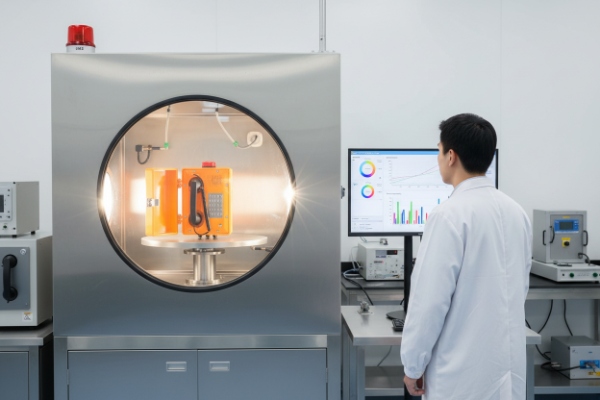
ISO 4892 (commonly used for plastics)
-
ISO 4892-2 (xenon-arc): full-spectrum sunlight simulation (often preferred when you want closer spectral match to real sun). (See ISO 4892-2 details 1)
-
ISO 4892-3 (fluorescent UV): strong UV emphasis for faster surface degradation screening.
ASTM G154 / G155 (widely used across plastics + coatings)
-
ASTM G154 (fluorescent UV): QUV-style 2 UVA/UVB exposure with condensation cycles.
-
ASTM G155 (xenon-arc): xenon exposure with optional water spray/humidity to simulate outdoor conditions.
Procurement tip: ask suppliers to quote the exact cycle (irradiance, wavelength, black panel temp, condensation/spray timing) and not just the standard name.
What exposure method is used—QUV UV-A/UV-B or xenon-arc with spray?
Both are common, and they answer slightly different questions.
QUV (fluorescent UV) is excellent for fast screening of surface degradation; xenon-arc is often chosen when closer sunlight spectrum match matters (appearance + real-world correlation).
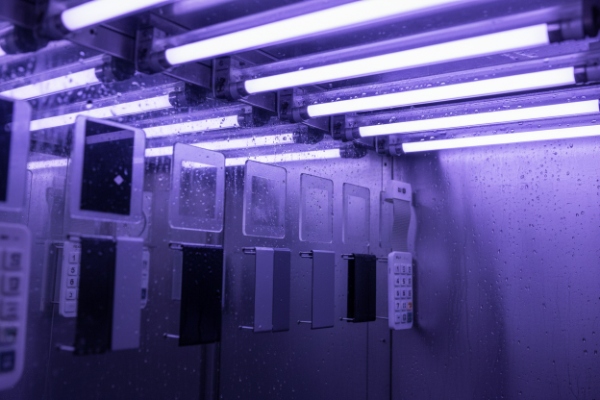
QUV UV-A / UV-B (fluorescent UV)
-
UV-A is often used as a more realistic long-term sunlight UV component. (Read about UV-A vs UV-B 3)
-
UV-B is harsher and can accelerate failure—useful for margin testing, but sometimes less representative.
Xenon-arc (often with moisture/spray)
-
Better spectral match to sunlight including visible light (important for color drift).
-
Spray/humidity cycles help expose coating edge weaknesses and microcracking.
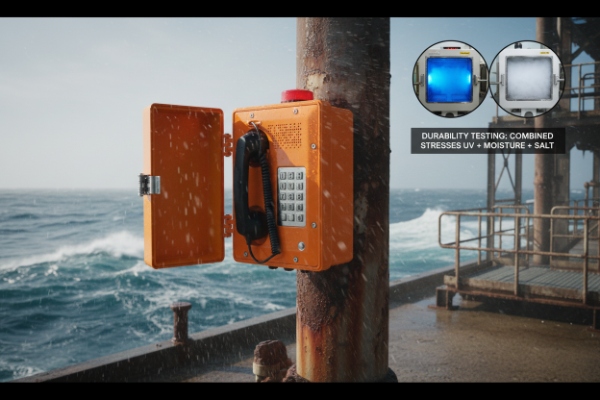
Best practice for outdoor phones: don’t test UV alone—pair UV with moisture cycling, and add salt-fog 4 only when the hardware/coating system needs coastal proof.
What color/gloss retention and cracking criteria define pass or fail?
UV testing is only useful when “pass/fail” is measurable and written down.
Most programs define acceptance by ΔE color change, gloss retention, and “no functional damage” (no cracking, chalking that transfers, or embrittlement that risks sealing or impact performance).
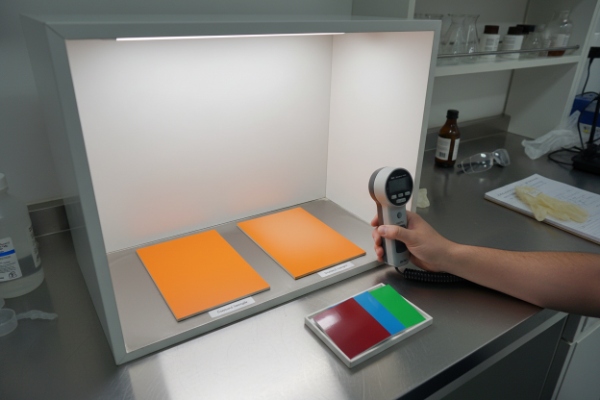
Typical acceptance metrics (examples you can put in a spec)
-
Color change: ΔE ≤ 3 (strict cosmetic) or ΔE ≤ 5 (industrial practical) after defined exposure hours. (Understanding Delta E 5)
-
Gloss retention: ≥ 50–80% (depends on gloss level and product positioning). (See gloss measurement 6)
-
Defects: no visible cracking, blistering, delamination; no chalking that wipes off heavily; no brittleness that reduces IK performance or damages gasket lands.
-
Functional checks (recommended): door still seals, gasket compression line intact, keypad/window still secure, fasteners serviceable.
Important detail: measure color on real molded/coated parts with real texture and thickness, not only flat plaques—texture and thin features often age faster.
Does UL 746C apply, and what does “f1” mean in outdoor claims?
UL 746C is often referenced when buyers want a recognizable “outdoor suitability” marker for polymeric materials used in electrical equipment.
UL 746C can strengthen an outdoor claim—especially when the exact resin grade, color system, and thickness are tied to a UL listing such as “f1.” But it is not a promise of “no color change”; it is evidence that the material passed defined exposure and moisture conditions within that program.
What to request from suppliers:
-
Exact resin manufacturer + grade
-
UL file reference / listing scope (Explanation of UL 746C f1 7)
-
Rated thickness versus the thinnest real part thickness
-
Color/masterbatch control statement (UV packages can vary with pigment systems)
How are UV results mapped to durability classes such as ISO 12944?
This is a common confusion: ISO 12944 is primarily a corrosion-protection coating standard (environment categories like C3/C4/C5 and durability ranges such as L/M/H/VH). It is not a direct “UV class” standard.
In practice, teams “map” UV performance to ISO 12944 projects by pairing ISO 12944 (corrosion category + coating system design) with separate weathering test methods (ISO 4892 / ASTM G154/G155 or coating-focused methods) to prove the topcoat’s UV resistance.
How to write it cleanly in a project spec:
-
Use ISO 12944 to define the corrosion environment and coating system requirements (e.g., coastal/marine expectations). (See ISO 12944 overview 8)
-
Use ISO 4892 / ASTM G154/G155 (or coating-specific weathering standards like ISO 11507 9) to define UV/appearance durability.
-
Require evidence: hours, cycle, ΔE/gloss, defect limits, plus photos and measurement records.
Conclusion
UV resistance for weatherproof telephones is proven by documented test methods and controlled acceptance criteria, not by a vague “UV resistant” label. The most common references are ISO 4892 and ASTM G154/G155 for accelerated weathering, plus UL 746C (e.g., f1) for polymer outdoor suitability support, and IEC 60068-2-5 (see standard scope 10) when solar radiation is included in equipment-level environmental validation. Define ΔE/gloss/cracking limits, test the real assembled parts, and lock resin/coating batches so UV performance stays consistent year after year.
Footnotes
-
Describes ISO 4892-2 standard for xenon-arc lamp exposure of plastics. ↩
-
Overview of QUV weathering testers and their application in ASTM G154 testing. ↩
-
Technical article comparing UV-A and UV-B lamps for accelerated weathering tests. ↩
-
Details on ASTM B117 salt spray testing for corrosion resistance. ↩
-
Explains Delta E as a metric for quantifying color differences. ↩
-
Guide to understanding gloss measurement and retention in coatings. ↩
-
Explains the significance of the UL 746C f1 rating for outdoor plastic enclosures. ↩
-
Introduction to ISO 12944 standards for corrosion protection of steel structures. ↩
-
ISO 11507 standard for exposure of coatings to fluorescent UV lamps and water. ↩
-
Scope of IEC 60068-2-5 standard for environmental testing with simulated solar radiation. ↩