

Customers hate friction. Leaders hate wasted spend. Echoed goals clash with rising compliance risk. You need a clean model that fits your outcomes without breaking KPIs or culture.
Inbound centers handle customer-initiated calls for support and service, while outbound centers place calls for sales, collections, surveys, and proactive outreach. Goals, skills, tooling, metrics, and compliance focus differ in practical ways.
Both models can work well. The best choice starts with who initiates contact, what outcomes you target, and what laws and brand standards you must honor. Then you design staffing, metrics, and stack for scale.
What is the difference between inbound and outbound call centers?
Problems mount when teams chase two different missions with one playbook. Missed service levels, burned leads, and compliance flags follow fast. Clear separation makes performance measurable.
Inbound is reactive support led by IVR/ACD and CSAT/FCR goals; outbound is proactive outreach powered by dialers and conversion goals. Each needs distinct skills and workflows.

The core split, in plain terms
Inbound work in a typical inbound call center model 1 begins when customers call you. The mission is to resolve needs, calm emotions, and protect loyalty. Agents listen first, diagnose, and fix. Technology routes calls to the best-skilled person 2, exposes CRM history, and tracks response and handle times. Outbound work begins when you call customers or prospects. The mission is to create or accelerate demand, recover revenue, or collect feedback. Agents open the conversation, create relevance fast, handle objections, and move to a clear next step. Technology dials at scale, manages lists and consent, enforces scripts, and measures connects and conversions.
Side-by-side view
| Dimension | Inbound | Outbound |
|---|---|---|
| Who initiates | Customer | Business |
| Primary outcomes | CSAT, FCR, retention | Revenue, pipeline, survey completion, collections |
| Approach | Reactive service | Proactive outreach |
| Core skills | Listening, empathy, product expertise | Persuasion, objection handling, rapport |
| Key tools | IVR, ACD, CRM routing, knowledge base | Auto-dialer (predictive/progressive/power), list/lead management, scripting |
| Typical KPIs | Service level, ASA, AHT, FCR, CSAT | Connect rate, contact rate, talk time, conversion, CPA |
Which model fits my goals and compliance risk?
Ambition without fit invites fines or churn. Map goals to model first, then check laws. A good fit lowers cost and raises trust.
Choose inbound if your North Star is loyalty and fast resolution. Choose outbound if your North Star is net-new revenue or recovery—provided your consent, disclosures, and DNC processes are airtight.
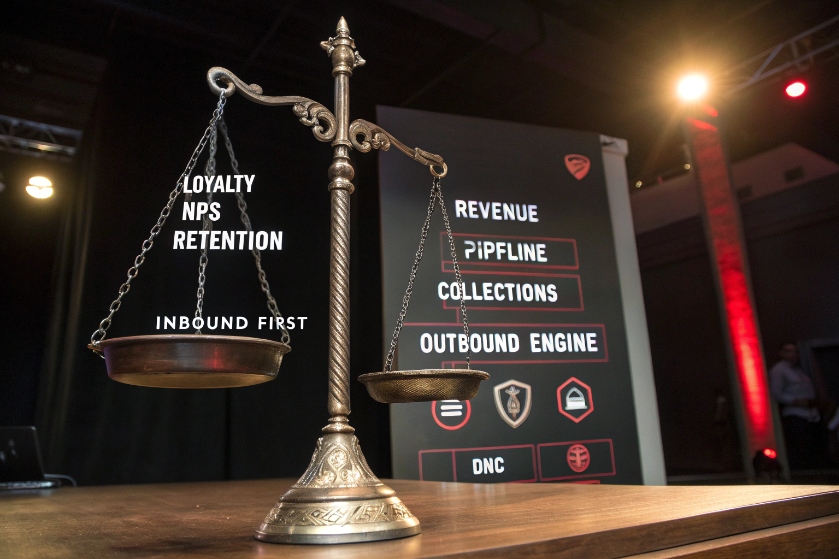
Goal-to-model map with risk lens
Start from outcomes. If the plan is to reduce churn, lift NPS, or stabilize renewals through better care, inbound is the spine. If the plan is pipeline creation, upsell, collections, or mass-feedback, outbound is the right engine. Now layer compliance. Outbound faces stricter obligations in many regions: consent requirements, honoring national and internal Do Not Call lists 3, call-time windows, caller ID transparency, call recording disclosures, and opt-out controls. Inbound still has data privacy and recording rules, but the risk profile is lighter because the customer starts the contact.
Decision guide
| Goal / Constraint | Better Model | Why | Risk Controls |
|---|---|---|---|
| Improve FCR and retention | Inbound | Reactive needs + deep product help | QA on resolution, knowledge governance |
| Drive net-new sales | Outbound | Scalable outreach and sequencing | Consent capture, DNC scrubs, script compliance |
| Increase survey response | Outbound | Time-boxed campaigns | Clear purpose, opt-out, sampling ethics |
| Reduce billing contacts | Inbound | Root-cause service + self-serve | Secure auth, IVR containment design |
| Recover failed payments | Outbound | Targeted, event-driven calls | Compliance scripting, sensitive data handling |
| Strict regulatory posture | Inbound-first | Lower outreach risk | Narrow recording scope, data minimization |
Can I run blended operations without harming KPIs?
Leaders want peak utilization and one team culture. Blending can deliver both. Poor guardrails, though, crush service levels and tank conversions.
Yes—blend inbound and outbound with skill-based routing, guardrails on concurrency, and clear priority rules. Protect service targets first, then feed surplus capacity to campaigns.

The operating model that works in practice
Blending is not “everyone does everything all day.” It is controlled exposure. You anchor service levels for inbound queues with protected staffing. You set routing priorities so inbound interrupts outbound only within defined occupancy bands. You separate coaching and scorecards by work type. You schedule campaign blocks that flex around forecasted arrival curves. You use real-time management to release or yank agents from campaigns when thresholds approach. Do not mix cold outbound with complex inbound in the same 15-minute window; cognitive switching costs are real.
Blended guardrails and levers
| Lever | What to set | Why it matters |
|---|---|---|
| Priority rules | Inbound queues > callbacks > outbound | Safeguards service level and abandonment |
| Occupancy caps | e.g., max 88% in blended hours | Prevents burnout and quality drops |
| Skill tiers | Novice inbound only; outbound by certification | Maintains conversion and resolution quality |
| Dialing mode | Progressive for blended blocks | Keeps talk-time quality stable |
| Intraday triggers | Pull from campaigns at SL < target | Real-time protection of KPIs |
| Coaching lanes | Separate rubrics by work type | Focused feedback and fair goals |
How do staffing and metrics differ for each?
One size staffing fails both sides. Inbound faces random arrivals. Outbound is a scheduled machine. Metrics must signal different truths.
Staff inbound with Erlang-style forecasting and service-level targets. Staff outbound by list size, contact probability, and conversion math. Track different KPIs and hold teams to relevant outcomes.
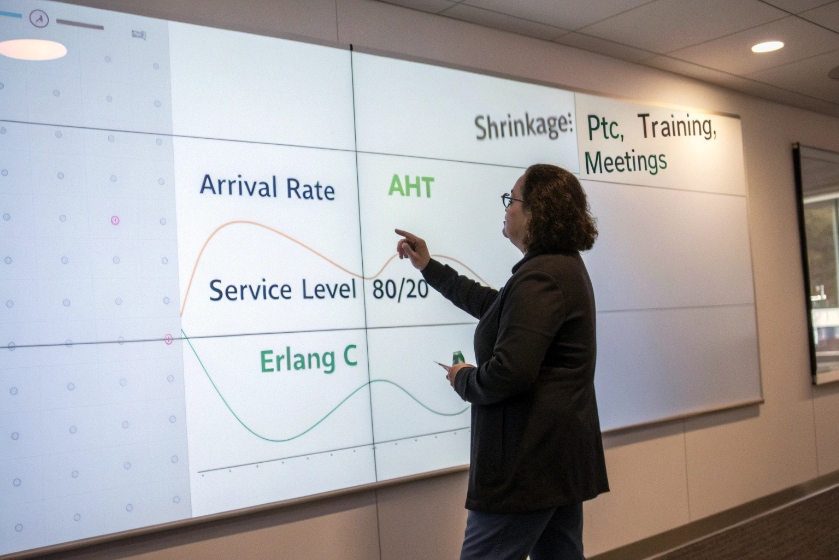
Staffing math, simply put
Inbound staffing starts with arrival forecasts by interval. You estimate Average Handle Time and desired service level (for example, 80/20). You use the Erlang C formula 4 or simulation to convert demand into required agents, then add shrinkage for time off, meetings, and training. Outbound staffing starts with campaign math: how many completions you need, your historical connect rate, right-party contact rate, and conversion rate. You select a dialing mode that fits your quality bar and compliance posture, then back into required talk time and agent hours. Outbound shrinkage often runs lower during tight campaign windows but requires stronger QA and compliance monitoring.
Metric sets that matter
| Domain | Primary KPIs | Secondary KPIs | Common Targets (illustrative) |
|---|---|---|---|
| Inbound | Service Level (SL), ASA, FCR, CSAT 5 | AHT, Transfers, Abandonment | SL 80/20, FCR 70%+, Abandon < 5% |
| Outbound | Connect/Contact Rate, Conversion, CPA | Right-Party %, Talk Time/Hour, DNC Compliance | Conversion 8–20% (context), RPC > 50% |
| Blended | SL protection, Occupancy, Schedule Adherence | Quality Score, After-Call Work | Occupancy 75–88%, Adherence 90%+ |
Practical tips
Use interval-level WFM, not daily averages. Separate QA scorecards: empathy and resolution depth for inbound; discovery, need qualification, and close discipline for outbound. Align incentives to the metrics that matter for that work type to avoid gaming. For blended agents, set dual thresholds and pay on the weaker side to prevent cherry-picking.
What tech stack supports both at scale?
Tools shape behavior. The right stack makes blended simple, compliant, and observable. The wrong stack forces tradeoffs you do not want.
Adopt an omnichannel platform with IVR/ACD for inbound, compliant dialers for outbound, deep CRM integration, WEM/WFM for forecasting, and real-time compliance and quality layers.
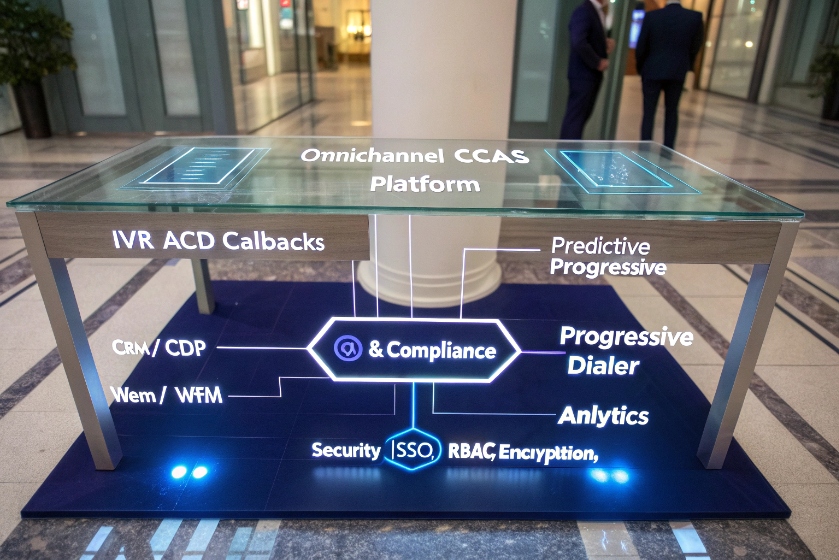
Reference architecture you can copy
At the core, use a contact center platform that handles both queues and campaigns. For inbound, you need IVR with natural language, skills-based ACD, and callback orchestration. For outbound, you need multiple dialing modes (predictive, progressive, power) with pacing controls that respect consent and time windows. Your CRM must be the record of truth for identity, consent, segmentation, and next-best action. Workforce Engagement Management (WEM) 6 covers forecasting, scheduling, adherence, and performance analytics. Quality and compliance add voice recording, screen capture, transcript search, redaction, and policy alerts. Add real-time speech analytics 7 to detect disclosures, mini-Miranda where relevant, and risky phrases. Tie it all together with an event bus so product, billing, and logistics events can trigger smart outreach or proactive service.
Stack checklist
| Layer | Must-haves | Why |
|---|---|---|
| Telephony / CCaaS | IVR, ACD, callbacks, multi-dialer modes | Serve and sell with one brain |
| CRM/CDP | Unified profile, consent flags, case/oppty objects | Personalization + compliance source of truth |
| WEM/WFM | Forecasting, intraday, adherence, coaching | Efficiency at scale |
| QA & Compliance | Recording, transcription, redaction, policy rules | Reduce risk, speed coaching |
| Analytics | Real-time dashboards, cohort reports, speech/NLP | Visibility and action |
| Security | SSO, RBAC, encryption, audit logs | Protect trust and data |
Conclusion
Choose the model by outcomes and risk. Protect inbound service first, then layer smart outbound. Blend with guardrails, staff with the right math, and run on a unified, compliant stack.
Footnotes
-
Twilio overview of inbound and outbound call center roles and use cases. ↩ ↩
-
Zendesk guide to skills-based routing for directing customers to the most qualified agents efficiently. ↩ ↩
-
FCC’s official Do Not Call Registry information and compliance guidance for telemarketing activities. ↩ ↩
-
Free Erlang C calculator and explanation for modeling inbound call center staffing requirements. ↩ ↩
-
Teledirect article explaining key inbound and outbound call center performance metrics and benchmarks. ↩ ↩
-
Genesys overview of Workforce Engagement Management tools for forecasting, scheduling, and agent performance. ↩ ↩
-
Talkdesk guide to using real-time speech analytics to coach agents and improve contact center outcomes. ↩ ↩








