
Voice sounds fine in the lab, then falls apart over busy WAN links. Often the root cause is the wrong codec choice, not the PBX or phones.
G.729 is a narrowband 8 kbps VoIP codec that trades audio fidelity for bandwidth. I enable it mainly on constrained WAN links or when a trunk or carrier explicitly requires it.
If I understand what G.729 does well (and where it hurts quality), I can design my codec order, licensing, and routing rules in a way that avoids surprises. That also lets me answer a key question for every site: do we really need ITU-T Recommendation G.729 1 here, or are G.711, G.722, or Opus enough?
How does G.729 quality compare with G.711 and Opus?
Users rarely ask which codec is in use. They ask why voices sound “robotic” or why music on hold feels thin. That is often G.729 doing its job a bit too well.
G.729 sounds more compressed and “processed” than G.711 and Opus. It stays intelligible at 8 kbps but loses richness, so I reserve it for speech on tight links, not for HD audio.
What G.729 actually does to the audio
G.729 is an 8 kHz narrowband codec. It focuses on the speech band, around 300–3400 Hz. It uses CS-ACELP speech coding 2 at 8 kbps. In simple terms, it throws away detail and keeps just enough information to reconstruct understandable speech.
That has three clear effects:
- Voices stay clear enough for conversation.
- Sibilants, background detail, and room tone are flattened.
- Music, IVR prompts, and rich voices sound more “metallic”.
ITU-T Recommendation G.711 (µ-law/A-law) 3 by contrast is 64 kbps and basically passes what classic PSTN circuits would carry. It still uses 8 kHz sampling, so it is not “HD”, but it keeps more nuance and is more forgiving under light packet loss.
Opus plays in a different league:
- It supports wideband and fullband audio.
- It adapts bitrate from low values up to hundreds of kbps.
- It is more robust to network issues and can include FEC.
So in a clean LAN environment, or for app-to-app calls, Opus (RFC 6716) 4 or G.722 sounds much better and is easier on the ears over long calls.
Simple comparison at a glance
| Codec | Bandwidth (codec) | Typical per-call IP usage* | Audio type | Perceived quality |
|---|---|---|---|---|
| G.711 | 64 kbps | ~80–90 kbps | Narrowband | “PSTN quality”, natural speech |
| G.729 | 8 kbps | ~30–40 kbps | Narrowband | Intelligible but more processed |
| G.722 | 64 kbps | ~80–90 kbps | Wideband (HD) | Much clearer, easier to understand |
| Opus | Variable | Depends on config | Wide/fullband | Best overall, especially on good links |
*Including IP/UDP/RTP overhead at common 20 ms packetization.
So my rule of thumb:
- Inside the LAN or good VPN: prefer G.722 or Opus.
- Toward the PSTN on solid bandwidth: G.711 is fine.
- On constrained WAN links or older SIP trunks: enable G.729 but only when it actually solves a bandwidth or interop problem.
I also avoid G.729 for things like:
- Fax over audio (use G.711 or T.38).
- IVR prompts / music that needs to sound good.
- Conferencing where multiple voices and background sound matter.
Do I need licenses for G.729 on my PBX?
G.711 and Opus often feel “free”: enable them and move on. G.729 is different, especially on older platforms that still treat it as a paid add-on.
Many PBXs and phones historically required paid G.729 encode licenses. Before enabling it, I check whether my PBX, phones, or SBC count G.729 channels and enforce any license limits.
Where licensing tends to show up
G.729 came with patent pools in the past. Even though that landscape has changed over time, many vendors still ship G.729 as a licensed feature:
- Commercial PBXs may require a G.729 add-on per channel.
- Some SBCs and gateways sell G.729 packs for transcoding.
- Certain phone vendors have separate SKUs or firmware builds with G.729 support.
The main points to check:
- Does the PBX list available G.729 channels in its license view?
- Is G.729 only allowed on certain trunks, or globally?
- Do phones need separate keys or special firmware to encode G.729?
If I ignore this and just enable G.729 in a rush, I might see:
- Only a small number of calls able to use G.729 at once.
- Random calls failing when the codec pool is exhausted.
- PBX logs showing “no license” or “codec not available” during negotiation.
Strategy to stay out of license trouble
I treat G.729 like any other scarce resource:
| Step | Reason |
|---|---|
| Count calls that really need G.729 | Avoid paying for channels I do not use |
| Enable only on key trunks | Keep LAN and app calls on better codecs |
| Minimize transcoding usage | Transcoding eats both CPU and licenses |
| Monitor codec usage | See whether G.729 channels actually fill up |
A practical pattern:
- Let phones use G.711 / G.722 / Opus internally.
- Allow G.729 only on the SIP trunk where the carrier requires it, or on the remote-site trunk where bandwidth is tight.
- Let the SBC or PBX transcode at the edge, with enough licensed channels.
If licenses are expensive or complex and bandwidth is not terrible, it is sometimes simpler to upgrade the WAN link and stay with G.711 than to build a whole design around G.729.
Will G.729 save bandwidth on my WAN links?
It is easy to look at 8 kbps vs 64 kbps and think “8x more calls”. In real networks, overhead and design choices change the math, but savings are still real.
G.729 reduces VoIP bandwidth from roughly 80–90 kbps per call to about 30–40 kbps, so it helps on limited or costly WAN links, especially for many simultaneous calls.
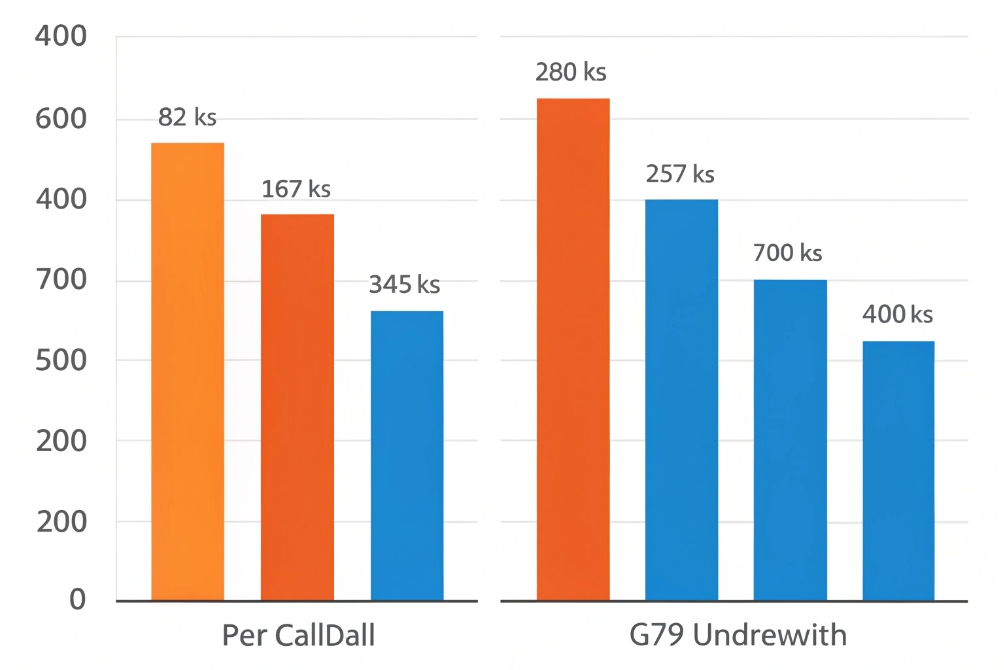
What a G.729 call actually uses on the wire
Codec bitrate is only part of the story. RTP rides on UDP on IP, and there is layer-2 framing as well. At a common 20 ms packetization:
- G.711: 160 bytes payload per packet → about 80–90 kbps per direction.
- G.729: 20 bytes payload per packet → about 30–40 kbps per direction.
So a quick comparison:
| Codec | Payload bitrate | Approx per-call bandwidth (1-way) | 10 calls (1-way) |
|---|---|---|---|
| G.711 | 64 kbps | ~80–90 kbps | ~0.8–0.9 Mbps |
| G.729 | 8 kbps | ~30–40 kbps | ~0.3–0.4 Mbps |
For full-duplex, just double the numbers.
On small WAN links (for example 2–10 Mbps), this difference matters a lot. It can be the difference between:
- “We can carry 10–15 calls safely” (G.711).
- “We can carry 25–30 calls comfortably” (G.729).
When G.729 is worth the trade-off
I consider G.729 for:
- Remote branches on limited MPLS or VPN links.
- Sites using expensive satellite or LTE backhaul.
- Legacy WANs where upgrading bandwidth is hard or costly.
In these cases, G.729 lets more concurrent calls fit inside a QoS-protected voice class. That matters when I need predictable performance during busy hours.
However, G.729 is more sensitive to:
- Packet loss and jitter.
- Wrong jitter buffer or large packetization intervals.
- Bursty congestion on shared links.
So enabling G.729 does not remove the need for:
- Proper QoS (separate voice class, DSCP, shaping).
- Clean routing and no unnecessary hairpinning.
- Good jitter buffer settings on phones and PBX.
If the WAN is already clean and bandwidth is cheap, I often skip G.729 and standardize on G.711 or G.722. It simplifies interop and keeps voices sounding better without worrying about licensing or transcoding in the middle.
Why do G.729 calls fail with codec mismatch?
A lot of “this trunk is broken” tickets come down to one thing: both sides support G.729 in theory, but they never agree on a common codec in practice.
G.729 calls fail with codec mismatch when endpoints or trunks do not offer an overlapping codec set, versions differ, licenses are missing, or transcoding is disabled on the PBX or SBC.

How codec negotiation works and where it breaks
In SIP, the caller sends an offer in SDP listing supported codecs, for example:
- G.711 µ-law
- G.729
- Opus
The far side replies with an answer choosing one (or sometimes more) codecs it also supports. A successful call needs at least one common codec.
G.729 mismatch issues show up as:
- SIP 488 “Not acceptable here”.
- SIP 415 “Unsupported media type”.
- Calls with no audio if SDP and media expectations do not align.
Common root causes:
- One side offers only G.729, the other has it disabled or unlicensed.
- One side uses G.729a while the other has strict G.729 only support (rare today but still appears).
- PBX is out of G.729 licenses, so it silently drops the codec from the offer.
- SBC is set to pass-through only, so it cannot transcode between G.729 and other codecs.
If I need a clean reference for how that selection happens, I follow the SDP offer/answer model (RFC 3264) 5, then confirm what media is actually flowing over the Real-time Transport Protocol (RTP) (RFC 3550) 6.
Practical checklist for fixing G.729 mismatches
When I see codec mismatch errors, I walk through a simple set of checks:
| Check | What I look for |
|---|---|
| Offer/answer in SIP trace | Is G.729 in the offer? Is it in the answer? |
| PBX codec order per trunk | Is G.729 enabled and placed reasonably in the list? |
| Licensing status | Any messages about G.729 channel limits? |
| SBC or gateway settings | Is transcoding on? Any codec restrictions? |
| Carrier requirements | Do they force G.729, G.711, or a specific variant? |
Some small but important tips:
- Put higher-quality codecs first in your preference list, but still include G.729 where needed.
- Make sure both internal phones and external trunks have a common codec. If phones use only G.722/Opus and trunks only G.729, you must enable transcoding somewhere.
- Do not forget that some older endpoints may only support G.711 and G.729, not Opus or G.722.
In many cases, you can keep G.729 as a fallback option:
- LAN / app calls stay on G.722 or Opus.
- Normal PSTN calls use G.711.
- Only specific trunks or routes use G.729 when the far side or bandwidth demands it.
Once codec lists, licenses, and SBC rules line up, G.729 calls stop failing, and the codec becomes just another tool in the VoIP toolbox instead of a constant source of mystery errors. When I’m sizing and marking voice traffic, I also lean on DiffServ voice class guidance (RFC 4594) 7 so the WAN treats voice predictably.
Conclusion
G.729 is still useful, but only in the right places; when I combine it with good QoS, clear licensing, careful codec order, and minimal transcoding, it saves bandwidth without turning every call into a troubleshooting session.
Footnotes
-
Official ITU spec for G.729, including bitrate, sampling rate, and annex options. ↩ ↩
-
Quick overview of CS-ACELP so you understand why G.729 sounds “processed.” ↩ ↩
-
Official ITU spec for G.711, the baseline 64 kbps codec used across PSTN interoperability. ↩ ↩
-
The IETF standard for Opus, detailing wideband/fullband modes, bitrate behavior, and resiliency tools. ↩ ↩
-
Defines how SIP endpoints negotiate codecs via SDP offer/answer, useful for debugging mismatch errors. ↩ ↩
-
RTP standard reference for packet timing, payload carriage, and the media path basics. ↩ ↩
-
Practical QoS class recommendations for voice and signaling, helping you map DSCP and shaping policies. ↩ ↩








