
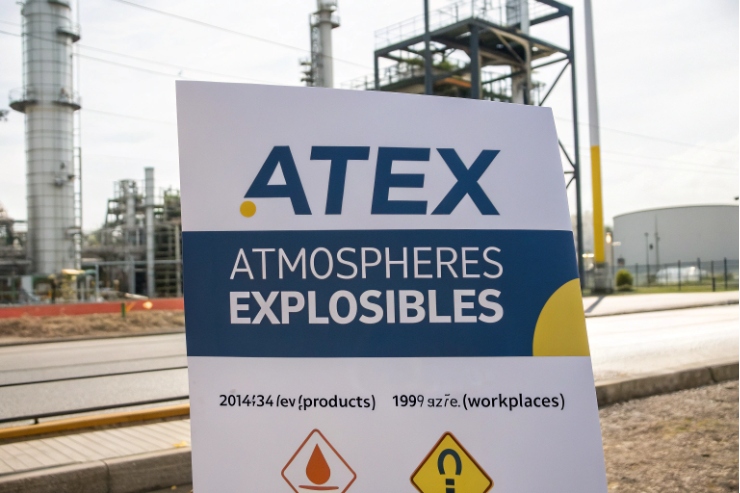
Navigating the regulatory landscape of hazardous environments can feel like walking through a minefield without a map. If you get the certification wrong, you are not just risking a fine; you are risking lives and the integrity of your entire facility.
ATEX stands for "ATmosphères EXplosibles" (Explosive Atmospheres) and refers to two European Union directives—2014/34/EU for equipment manufacturers and 1999/92/EC for workplace safety—that mandate stringent safety standards for equipment used in environments with explosive gases, vapors, or dust.
Dive Deeper: The Two Pillars of ATEX
When I talk to my clients in Europe, I often realize they confuse the responsibilities of the manufacturer with those of the site operator. ATEX is not a single rule; it is a framework divided into two distinct parts.
1. The Equipment Directive (2014/34/EU)
This is my Bible as a manufacturer. It dictates how we design, test, and certify our DJSlink telephones. It covers everything from the materials we use (like anti-static GRP or stainless steel) to the documentation we must provide. If a product does not bear the CE mark and the distinctive Ex hexagon, it cannot be legally sold for use in hazardous areas within the EU.
2. The Workplace Directive (1999/92/EC)
This is your responsibility as the employer. It requires you to perform a risk assessment 1 of your facility, classify your areas into "Zones" (like Zone 1 or Zone 21), and ensure that your workers are safe. You cannot simply buy an ATEX phone and assume you are compliant; you must install it in the correct zone and maintain it properly.
The synergy between these two is critical. I have seen project managers specify a Zone 1 phone for a Zone 2 area "just to be safe." While this is acceptable (higher safety covers lower risk), doing the reverse—putting Zone 2 gear in Zone 1—is a criminal offense in many jurisdictions.
Understanding ATEX is the first step in compliance. It is the legal language of safety in Europe, ensuring that both the gear we build and the places you work meet a harmonized standard of protection.
Now that we have established what ATEX is, let’s look at how modern technology fits into this strict framework.
Can explosion-proof telephones be ATEX-certified while supporting SIP/VoIP, PoE, and relay I/O?
Many engineers assume that "safety" means "old technology." They think an explosion-proof phone has to be a dumb, analog brick. This is a massive misconception that limits operational efficiency.
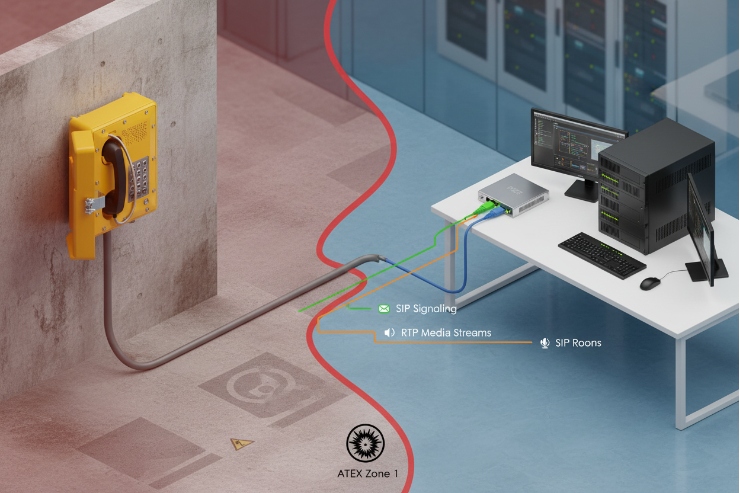
Yes, modern explosion-proof telephones can be fully ATEX-certified while supporting advanced features like SIP/VoIP, Power over Ethernet (PoE), and programmable relay I/O, provided their internal energy is managed via flameproof (Ex d) or encapsulated (Ex m) designs.
Dive Deeper: Bridging Safety and Modern Tech
In my experience at DJSlink, the biggest challenge in designing these phones is power management. Features like a bright LCD screen, a high-volume amplifier, and Power over Ethernet Plus 2 (PoE+) require energy. In the world of ATEX, energy is the enemy because energy creates heat and sparks.
The Engineering Solution: Ex d Enclosures
We typically use the Ex d (Flameproof) protection concept to solve this. Instead of limiting the power to a trickle (which would make modern features impossible), we build a robust enclosure that can contain any internal explosion.
-
SIP/VoIP: We embed a high-performance SIP mainboard inside the heavy-duty aluminum or stainless steel body. This allows the phone to register with your 3CX 3, Avaya, or Cisco Call Manager just like a desk phone.
-
PoE (802.3af/at): This is crucial for reducing installation costs. We use specialized isolation transformers to ensure that the Ethernet current does not leak or create ground loops that could be dangerous.
-
Relay I/O: This is a feature my industrial clients love. We include dry contact relays inside the explosion-proof housing. You can program the phone to trigger an external ATEX-rated beacon or siren when a call comes in. Since the relay is inside the "Ex d" chamber, the switching spark is contained.
Why this matters for you:
You do not have to compromise. You can have a unified communication system where your control room can page a worker in a Zone 1 refinery, and that worker can answer on a crystal-clear VoIP line. I have deployed systems where the phone’s relay automatically shuts down a piece of machinery when an emergency number is dialed. That is the power of integrating smart tech with ATEX safety.
Moving on, let’s clarify how the zones in your facility map to the equipment you need to buy.
How do ATEX Zones 0/1/2 and 20/21/22 relate to equipment Categories 1/2/3?
This is where the confusion usually starts. You see "Zone 1" on your site plan, but the catalog lists "Category 2" equipment. Are they compatible?
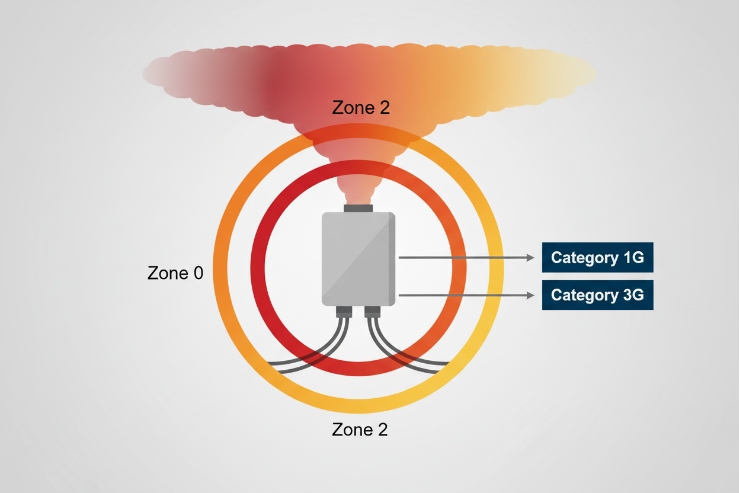
ATEX Zones define the likelihood of an explosive atmosphere being present, while Categories describe the equipment’s level of protection; Zone 0/20 requires Category 1, Zone 1/21 requires Category 2, and Zone 2/22 requires Category 3.
Dive Deeper: The Mapping Matrix
To select the right equipment, you must understand the relationship between the Environment (Zone) and the Hardware (Category). I use this simple mapping rule with my customers:
Gas Environments (G):
-
Zone 0: Explosive gas is present continuously or for long periods (e.g., inside a fuel tank).
- Requires: Category 1G equipment (Very High Protection). This is rare for phones; usually, only sensors go here.
-
Zone 1: Explosive gas is likely to occur in normal operation (e.g., near a fill valve).
- Requires: Category 2G 4 equipment (High Protection). This is the standard for most "explosion-proof" phones.
-
Zone 2: Explosive gas is not likely to occur, and if it does, it will be for a short time (e.g., a storage warehouse).
- Requires: Category 3G equipment (Normal Protection).
Dust Environments (D):
The logic is identical but uses different numbers.
-
Zone 20 (Continuous dust cloud): Requires Category 1D.
-
Zone 21 (Occasional dust cloud): Requires Category 2D.
-
Zone 22 (Rare dust cloud): Requires Category 3D.
My Recommendation:
Always aim for Category 2 (Zone 1/21) equipment for industrial sites. Why? Because site classifications can change. A "safe" Zone 2 area might be reclassified as Zone 1 after a risk assessment update. If you installed Category 3 phones, you have to rip them all out. If you installed Category 2 phones, you are already compliant. It is a small upfront cost for long-term peace of mind.
Once you know the Category, you need to decipher the cryptic string of letters and numbers stamped on the device.
How to read an ATEX marking—Ex d/e/ib, gas group, temperature class, and ambient rating?
When you look at the ID plate of an explosion-proof phone, it looks like a secret code. Understanding this code is the only way to verify if the device is safe for your specific gases.
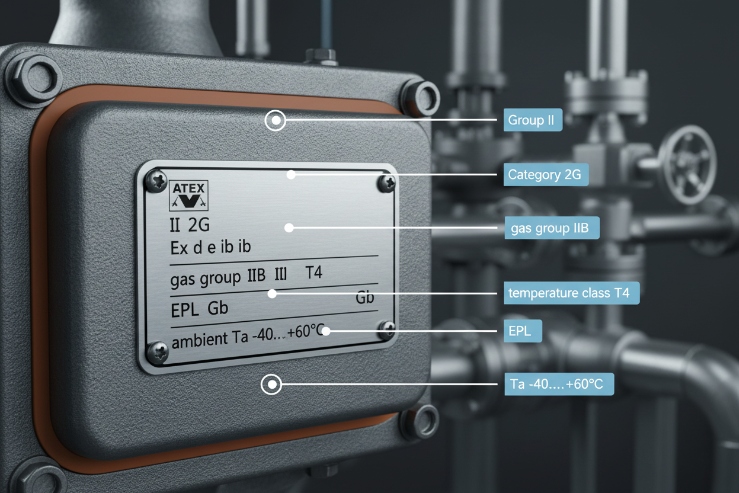
An ATEX marking is a standardized string that details the protection method (e.g., Ex d for flameproof), the gas group (e.g., IIC for hydrogen), the temperature class (e.g., T6 for <85°C), and the ambient temperature range it can withstand.
Dive Deeper: Decoding the String
Let’s break down a typical marking you might see on one of our DJSlink phones: II 2G Ex d IIC T6 Gb.
-
II: Equipment Group. "II" means surface industry (factories, oil rigs). "I" would be for mining.
-
2G: Category. "2" means High Protection (Zone 1), and "G" means Gas.
-
Ex d: Protection Type. "d" stands for Flameproof Enclosure. This tells you the housing contains explosions. You might also see "Ex e" (Increased Safety) or "Ex ib" (Intrinsic Safety).
-
IIC: Gas Group. This is critical.
-
T6: Temperature Class. This indicates the maximum surface temperature the device will reach.
-
T6: < 85°C (Safest).
-
T4: < 135°C.
-
If your gas ignites at 100°C, you cannot use a T4 phone; you need T5 or T6.
-
-
Gb: Equipment Protection Level (EPL). "Gb" corresponds to Category 2G (High protection for Gas).
Ambient Rating (Ta):
Do not ignore the "Ta" or "Tamb" marking. It might say -40°C to +60°C. If you are installing this phone in the Russian Arctic or a Middle Eastern desert, this range is just as important as the gas group. If the temperature exceeds these limits, the rubber seals might fail, or the housing might crack, rendering the ATEX certification void.
Finally, we need to address the global elephant in the room: strict regional standards versus international acceptance.
What is the difference between ATEX and IECEx, and when is each accepted in tenders?
I often get asked if an ATEX phone can be used in Australia, or if an IECEx phone is legal in France. The answer lies in understanding the legal vs. technical nature of these standards.
ATEX is a mandatory legal directive for the European Union, whereas IECEx is a voluntary international certification scheme intended to facilitate global trade; tenders in the EU require ATEX, while most other regions prefer or accept IECEx.
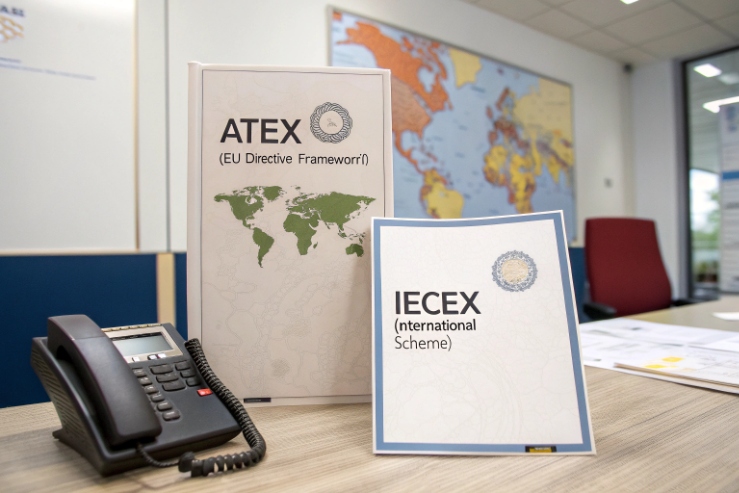
Dive Deeper: Law vs. Standard
Think of it this way: ATEX is the law, IECEx is the quality seal.
1. The Geographic Split
-
EU (European Union): You must have ATEX. It is non-negotiable. Even if a product is IECEx certified, it needs the ATEX documentation and CE marking to clear customs and be installed legally.
-
International (Australia, NZ, UAE, Asia): IECEx 6 is the gold standard. These regions generally accept IECEx certificates directly because the IECEx scheme involves rigorous third-party testing that is visible online.
-
North America: They are the outlier, often requiring UL or FM standards, though acceptance of IECEx (Zone method) is growing.
2. The Credibility Gap
There is a subtle but important difference in how they are issued.
-
ATEX Category 3 (Zone 2): Manufacturers can actually self-declare compliance. They don’t necessarily need a notified body 7 to test the unit. This creates a loop for lower-quality goods.
-
IECEx: Does not allow self-declaration. Every product, even for Zone 2, must be tested by an accredited ExTL (Ex Testing Laboratory) and certified by an ExCB (Ex Certification Body).
My Advice for Tenders:
If you are writing a tender for a global project, specify "ATEX and IECEx certified."
If you are a contractor bidding on a project:
-
In Europe: submit ATEX.
-
In Middle East / APAC: submit IECEx.
-
In Africa/South America: IECEx is usually preferred, but ATEX is often accepted because it is widely recognized.
At DJSlink, we ensure our flagship models carry both. It eliminates the headache of stocking two different versions of the same phone.
Conclusion
Understanding ATEX is about more than just reading a label; it is about guaranteeing that your communication backbone will not become an ignition source. Whether you are deciphering markings, mapping zones, or choosing between ATEX and IECEx, the goal is always the same: operational continuity and absolute safety.
Footnotes
-
Guidelines for identifying and managing workplace hazards effectively. ↩ ↩
-
Technology allowing network cables to carry electrical power. ↩ ↩
-
A software-based private branch exchange based on the SIP standard. ↩ ↩
-
Classification for equipment used in areas where explosive atmospheres are likely. ↩ ↩
-
Properties and safety data for this highly flammable industrial gas. ↩ ↩
-
International system for certification to standards relating to equipment for use in explosive atmospheres. ↩ ↩
-
An organization designated by an EU country to assess the conformity of certain products. ↩ ↩








