
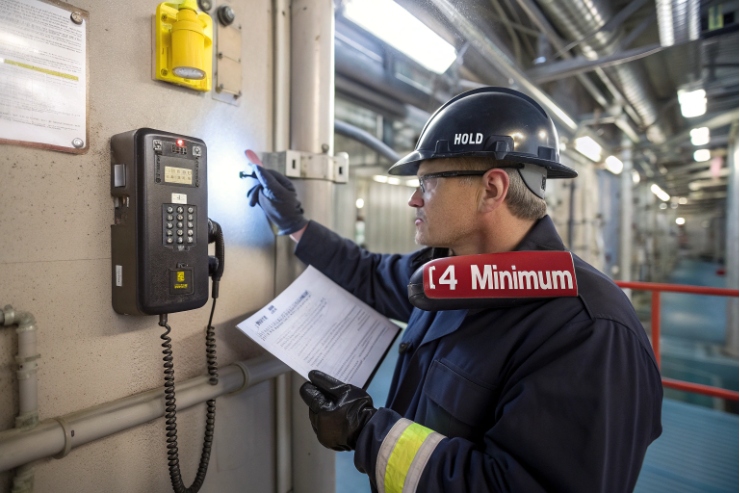
In the world of hazardous area certification 1, the "T-code" (Temperature Class) is often the most misunderstood specification. I frequently see engineers obsessing over the Gas Group (IIC) while ignoring the Temperature Class, only to realize later that their "high-spec" phone is a thermal time bomb for their specific chemical environment.
For maximum safety and universal compatibility, T6 (85°C) is the ideal temperature class for an explosion-proof telephone, as it ensures the device’s surface temperature never exceeds 85°C, making it safe for over 99% of all industrial gases and vapors.
Dive Deeper: The T6 "Universal Donor"
While T4 (135°C) is the industry "workhorse" and covers standard propane and diesel 2, T6 is the gold standard.
Why do we at DJSlink aim for T6? Because in a complex refinery, you might not know exactly what vapors will drift toward the explosion-proof telephone 3 in 10 years. A T6 rating means the phone runs so cool that it is virtually impossible for its surface to ignite anything (except extremely rare unstable chemicals). It provides "future-proof" safety.
How do T-codes T1–T6 relate to gas auto-ignition temperatures in hazardous areas?
This is the core physics rule: The phone must stay cooler than the gas’s flashpoint.
T-codes represent the maximum surface temperature of the equipment, while the Gas Auto-Ignition Temperature (AIT) is the heat level at which a gas spontaneously burns; the T-code must always be lower than the AIT.
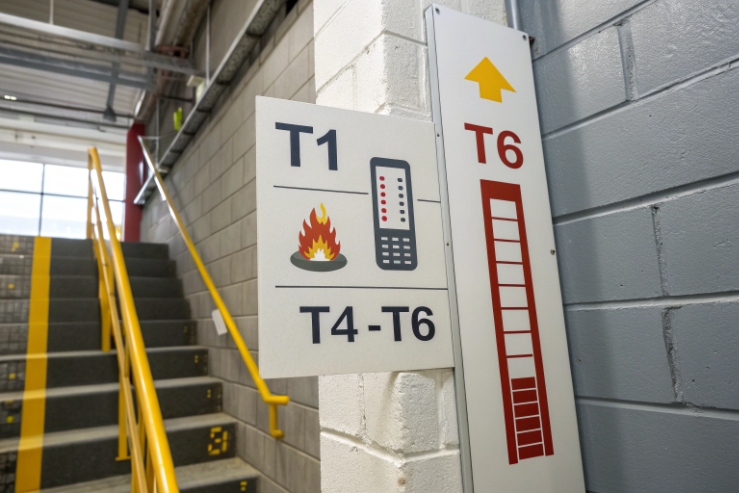
Dive Deeper: The Inverse Scale
The confusion often comes from the numbering: Higher number = Lower Temperature (Safer).
-
T1 (450°C): The device can get very hot (like a stove). Safe only for gases that are hard to ignite (like Hydrogen, ironically).
-
T6 (85°C): The device stays very cool. Required for sensitive gases that ignite easily with heat.
Here is the hierarchy I use to teach my clients about Gas Auto-Ignition Temperature (AIT) 4:
| T-Code | Max Surface Temp | Safe for Gas AIT | Examples of Safe Gases |
|---|---|---|---|
| T1 | 450°C | > 450°C | Hydrogen, Methane, Propane |
| T2 | 300°C | > 300°C | Acetylene, Ethylene |
| T3 | 200°C | > 200°C | Diesel Fuel, Kerosene |
| T4 | 135°C | > 135°C | Diethyl Ether, Acetaldehyde |
| T5 | 100°C | > 100°C | Carbon Disulfide (Borderline) |
| T6 | 85°C | > 85°C | Carbon Disulfide, Ethyl Nitrate |
The Safety Margin:
You cannot use a T3 device (200°C limit) in an area with Diethyl Ether (AIT 160°C). The phone could become a hot plate that ignites the air without ever sparking.
What ambient range and enclosure design keep surface temperature below the required T-class?
A T6 rating on paper is useless if the phone melts in the desert sun. The T-class is dynamic, not static.
To maintain a strict T6 rating, enclosures utilize heat-dissipating aluminum alloys and low-power components, but this rating is strictly tied to the "Ambient Temperature" (Ta); a T6 phone at 40°C might degrade to T5 if installed in a 60°C environment.
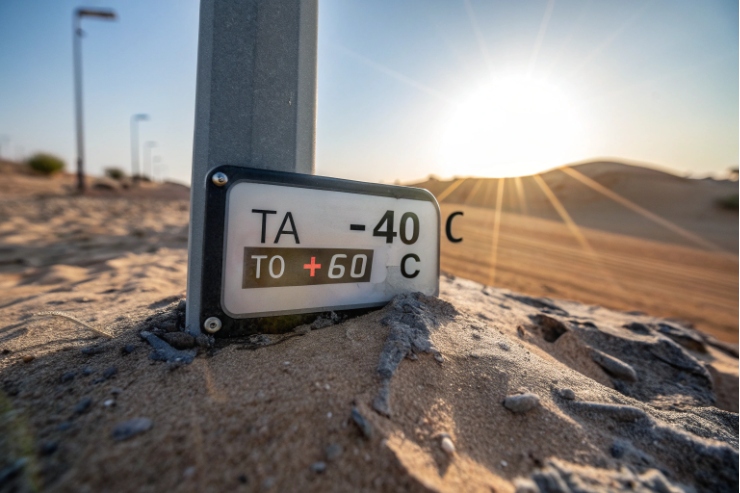
Dive Deeper: The "Ta" Factor
When you read a certificate, look for "Ta" (Ambient Temperature).
-
Standard: -20°C to +40°C.
-
Industrial: -40°C to +60°C or +70°C.
The Engineering Challenge:
If the sun heats the metal housing to 70°C, and the electronics inside generate another 20°C of heat rise, the surface hits 90°C.
-
Result: You have exceeded the T6 limit (85°C). The phone is no longer T6 compliant.
-
Our Solution: For high-heat regions (Middle East, Australia), we often have to "de-rate" the equipment. We might label a phone T5 instead of T6 for that specific market to remain legally compliant. Or, we design the case with massive cooling fins (like a radiator) to shed heat faster.
Do ATEX/IECEx markings map to North American T-codes and gas groups correctly?
Globalization has mostly aligned these ATEX/IECEx markings 5, but the US still likes to be specific.
Yes, T1 through T6 are identical across ATEX, IECEx, and North American (NEC/CEC) standards, although North America occasionally uses sub-codes (T2A, T2B, T3C) for precise intermediate temperatures which are generally encompassed by the main IEC T-classes.
Dive Deeper: The Mapping Reality
-
The Good News: T6 is T6 everywhere. If you buy a T6 phone in Germany, it meets the T6 temperature requirement in Texas.
-
The Nuance: The US NEC 500 system sometimes breaks T3 (200°C) into:
-
T3: 200°C
-
T3A: 180°C
-
T3B: 165°C
-
T3C: 160°C
-
-
The Practicality: For telephones, we rarely use these sub-codes. Modern electronics are either hot (T4) or cool (T6). We skip the messy middle ground. If a phone is certified T4 in Europe, it is safely T4 in the US.
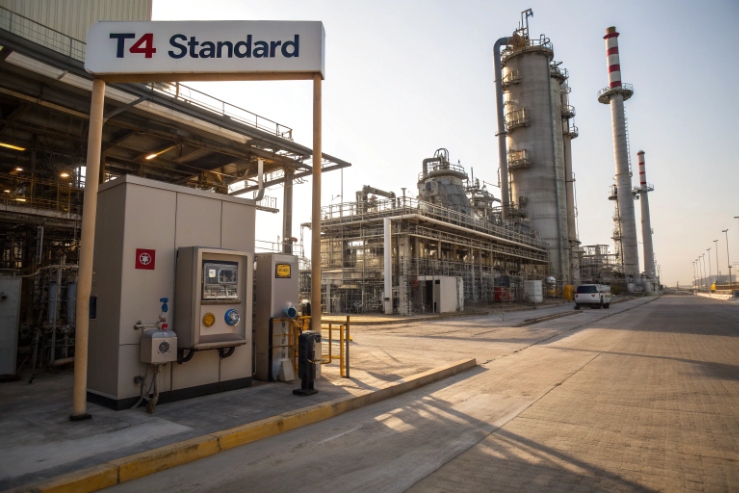
Which applications require T4, T5, or T6—hydrogen, solvents, or low AIT gases?
This is where the "Hydrogen Paradox" confuses people.
T6 is strictly required for chemicals with extremely low Auto-Ignition Temperatures like Carbon Disulfide and Nitrates, while T4 is sufficient for most common solvents and hydrocarbons; surprisingly, Hydrogen (Group IIC) only requires T1 because it has a very high ignition temperature despite being explosive.
Dive Deeper: Matching the Phone to the Chemical
1. The Hydrogen Trap (Group IIC vs. T1)
Hydrogen is terrifying because it explodes easily (needs Group IIC enclosure). However, it requires a very hot surface to ignite (560°C).
-
Verdict: You can theoretically use a T1 phone in a Hydrogen plant.
-
Reality: Nobody does. We use T4 or T6 just to be safe and cover other gases present.
2. The Carbon Disulfide Killer (T6 Mandatory)
Carbon Disulfide 6 (CS2) is used in cellophane and rayon manufacturing.
-
AIT: \~90°C.
-
Danger: A T5 phone (100°C) could ignite it. You MUST use T6 (85°C).
-
My Insight: If you are supplying a textile plant or chemical processing unit, do not guess. Ask for the Material Safety Data Sheet 7 (MSDS) of the chemicals. If CS2 is present, T4 equipment is a death sentence.
3. Common Solvents (T3/T4)
-
Turpentine (AIT 253°C) -> T3 is fine.
-
Methanol (AIT 464°C) -> T1 is fine (but we use T4).
-
Verdict: For 90% of general manufacturing (paint shops, cleaning stations), T4 is perfectly adequate and more cost-effective.
Conclusion
The T-code is your thermal safety limit. While T6 offers the ultimate peace of mind, understanding the specific Auto-Ignition Temperature of your facility’s gases allows you to make smart, compliant choices without over-engineering your system.
Footnotes
-
Global system for certifying equipment used in explosive atmospheres to ensure safety and international performance standards. ↩ ↩
-
Common hydrocarbons used as fuel that require specific temperature classifications for safe handling in industrial environments. ↩ ↩
-
Specialized communication devices engineered to prevent internal heat from igniting surrounding flammable gases in hazardous locations. ↩ ↩
-
The lowest temperature at which a chemical substance will spontaneously ignite without an external spark or flame. ↩ ↩
-
Standardized safety labels and codes identifying equipment suitability for specific hazardous atmospheres across global markets. ↩ ↩
-
A highly volatile chemical with an extremely low ignition threshold, mandating the use of T6 rated safety equipment. ↩ ↩
-
Essential documents providing detailed safety data on chemical properties, flammability limits, and required protective measures. ↩ ↩








