
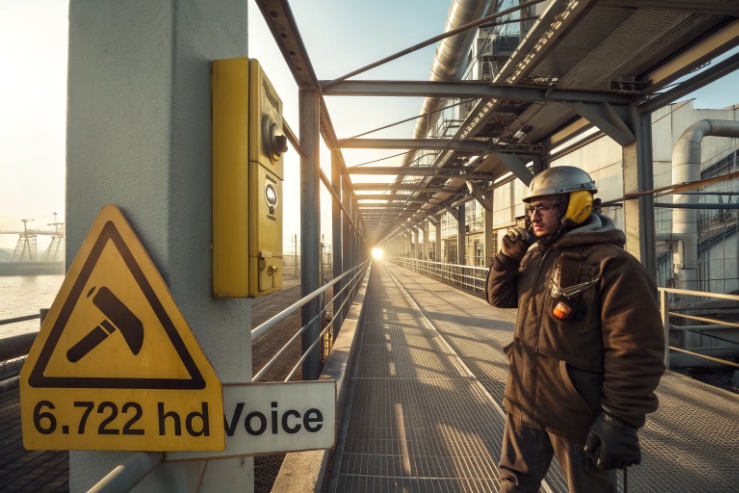
Noisy plants make every syllable hard. Calls still “connect,” but the message gets lost. G.722 codec 1 can lift clarity without changing your wiring plan.
Yes, many explosion-proof SIP telephones support G.722. It is a wideband codec that keeps 64 kbps payload like G.711, but carries more voice detail. Your PBX, codec order, and QoS decide if it works end-to-end.
How does G.722 fit into an explosion-proof SIP phone deployment?
What G.722 changes
G.722 is often called “HD Voice” in SIP systems. It captures more of the wideband audio 2 spectrum, so consonants sound cleaner. In a plant, that can help with call signs, numbers, and short commands. The nice part is that G.722 usually does not ask for more raw codec bit rate than G.711. Both are commonly treated as 64 kbps payload choices. So PoE planning stays simple.
One detail matters in troubleshooting. Even though G.722 audio is wideband, its RTP clock 3 is still commonly shown as 8000. This is a historical rule in RTP signaling. So packet traces can confuse teams who expect “16000.” That is normal. It is not a fault.
What G.722 does not fix
G.722 cannot fix a bad microphone, a weak handset receiver, or heavy acoustic feedback. In very loud zones, the bigger wins often come from: high SPL speaker paths, good sidetone control, strong echo control, and a stable mount that does not vibrate.
A simple spec line that avoids disputes
Ask for “G.722 supported and enabled for internal calls, with fallback allowed to G.711, and with a documented codec priority list per PBX profile.” That one sentence prevents most field arguments.
| Codec | Payload bit rate | Best use in plants | Common risk |
|---|---|---|---|
| G.711 (PCMA/PCMU) | 64 kbps | universal compatibility | sounds “thin” in noise |
| G.722 | 64 kbps | clearer speech for internal calls | trunks may not support it |
| Opus | variable | best quality when supported | PBX/trunk support varies |
If the goal is clearer speech, the next step is always PBX alignment. Most “G.722 problems” are not phone problems. They are negotiation and policy problems.
Now let’s walk through the real questions clients ask on site.
Which PBXs and SIP platforms interoperate with G.722—Asterisk/FreePBX, 3CX, Cisco CUCM, Avaya, and hosted VoIP?
Codec support looks simple until the first trunk call drops back to G.711. Then the client thinks G.722 “does not work.” It usually does, but only inside the right call path.
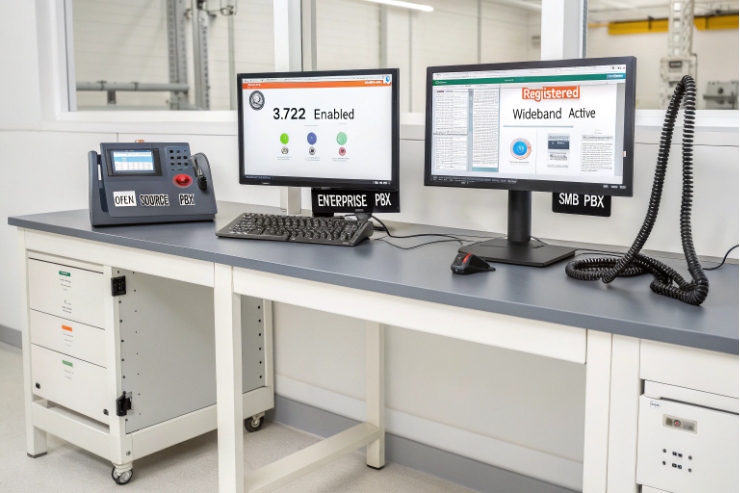
G.722 commonly works with Asterisk/FreePBX, 3CX, Cisco CUCM, and Avaya in LAN calls. Hosted VoIP and SIP trunks often limit you to G.711, so keep G.722 for internal calls unless the provider proves wideband support.
What “interop” really means
Interop has three layers:
1) the phone offers G.722 in SDP
2) the PBX advertises and accepts it
3) the call path stays wideband end-to-end (no forced transcoding)
Asterisk and FreePBX 4 setups can prefer G.722 by putting it high in the allowed list. This is common in PJSIP profiles. When the far end only supports G.711, Asterisk may transcode, which adds CPU load and can reduce quality if the server is busy.
3CX supports G.722 and also supports Opus in many setups, but trunks still decide the final codec. In most projects, G.722 is perfect for extension-to-extension calls, and G.711 is used for PSTN-bound calls.
Cisco CUCM 5 can advertise G.722 based on its settings and call constraints. Avaya platforms also support G.722 for wideband audio, including SIP trunk use in supported designs.
Hosted VoIP is the tricky one. Many providers still stick to G.711. Some allow G.722, but it is not safe to assume. So the clean design is: keep G.722 inside your network, and let the PBX fall back to G.711 for external calls.
| Platform | G.722 is usually fine for | What to verify before rollout |
|---|---|---|
| Asterisk / FreePBX | internal calls, intercom | codec allow list, transcoding load |
| 3CX | internal calls, supported phones | trunk codec list, codec priority |
| Cisco CUCM | enterprise LAN voice | G.722 advertise settings, region/policy |
| Avaya | LAN and some trunk paths | wideband enabled, endpoint support |
| Hosted VoIP | only if provider supports it | written codec list, test call captures |
On an Ex project, the fastest proof is still one call capture and one PBX trace. That is better than any marketing sheet.
Does G.722 improve intelligibility in noisy plants compared with G.711 or AMR-WB?
Noise makes people talk louder and faster. That cuts clarity first, not volume. Wideband codecs can help, but only when the acoustic chain is good.
G.722 can improve perceived clarity because it carries a wider speech band than G.711. In heavy industrial noise, the biggest gains still come from mic design, handset sealing, and correct volume limits. AMR-WB can also sound great, but it is not a drop-in SIP trunk default.

Where G.722 helps the most
G.722 often makes consonants easier to catch. That matters for:
- badge numbers
- equipment IDs
- short commands (“stop,” “north,” “pump two”)
In acceptance tests, a simple trick shows the value. Use a set of short words and numbers, then replay them with a constant noise bed. Wideband speech coding is often rated better in many noisy cases, but results depend on the noise type and the endpoint design.
Where G.722 helps the least
If the microphone clips, if the handset is leaking air, or if the speaker is too weak, G.722 cannot fix it. For harsh zones, it is better to treat G.722 as the last 10–20% improvement, not the first 80%.
AMR-WB in simple terms
AMR-WB (also called G.722.2) is common in mobile networks. It can be very strong for voice quality at lower bit rates. But SIP PBXs and trunks do not always support it. If the project requires wideband to mobile networks, that usually becomes an SBC and transcoding design, not a pure endpoint choice.
| Site condition | Best first move | Codec plan that works |
|---|---|---|
| High steady noise | better mic + volume + echo control | prefer G.722 internally, fall back to G.711 |
| Intercom at gates | clean sidetone + stable mount | G.722 if both sides support it |
| External PSTN calls | trunk decides | keep G.711 available |
| Calls to mobiles | carrier decides | avoid assuming G.722 end-to-end |
For client communication, it helps to say this: “G.722 improves clarity when the call stays inside our VoIP system. Outside the system, the network often forces G.711.”
What network conditions—QoS/DSCP, jitter buffer, and packet loss—are required for stable G.722 audio?
Plants do not fail voice on “bandwidth.” They fail it on congestion bursts, jitter, and bad priority rules. G.722 will not forgive a noisy network.
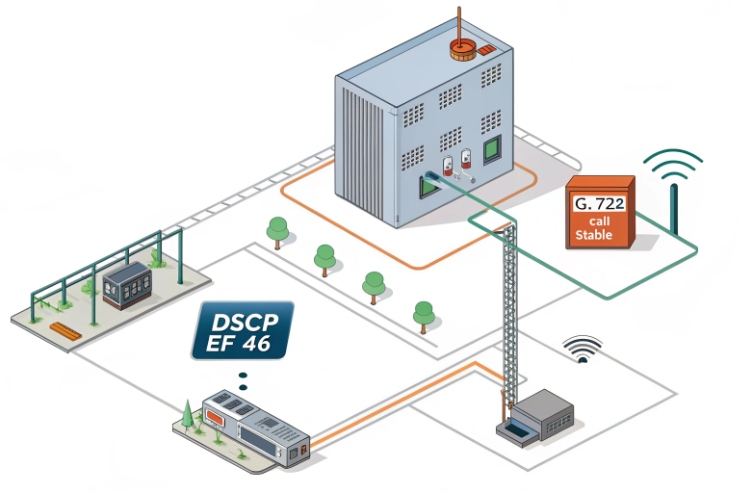
G.722 stability needs the same network basics as G.711: low loss, low jitter, and correct QoS. Mark RTP as EF (DSCP 46) where your policy allows, keep jitter low, and avoid transcoding on overloaded PBXs.
Practical targets that work in industrial LANs
For stable voice, these targets are commonly used in field checks:
- packet loss under about 1%
- jitter under about 30 ms
- one-way latency under about 150 ms
The exact limits depend on jitter buffer behavior, but those numbers are a solid commissioning baseline.
QoS that keeps voice clean
A simple design is:
- tag RTP as EF (46)
- tag SIP signaling as a lower control class
- map EF into a priority queue on access and uplink ports
- do not let video paging or NVR traffic share the voice queue
In multi-vendor plants, DSCP can be remarked at borders. So it is worth checking markings on both sides of your WAN edge or router.
Bandwidth and packet time notes
G.722 and G.711 are both often treated as 64 kbps payload codecs. The overhead adds extra. With common packet times, the real per-call bandwidth is higher than 64 kbps. So planning should include QoS basics 6 like RTP/UDP/IP and L2 overhead, not only codec bit rate.
| Parameter | Target | How to verify fast |
|---|---|---|
| RTP DSCP | EF (46) | packet capture on switch mirror |
| Jitter | < 30 ms typical | RTCP stats + PBX reports |
| Packet loss | < 1% typical | switch counters + RTCP |
| Queue policy | EF in priority queue | queue drops and queue depth |
| Transcoding | avoid when possible | PBX CPU and DSP metrics |
In my projects, the simplest rule is also the strongest: do not “fix” voice with bandwidth alone. Fix it with priority and clean paths.
Can G.722 be prioritized with fallback to G.711/Opus and negotiated via SDP for paging and intercom calls?
If codec rules are vague, the system will pick something you did not expect. That is when paging sounds odd and intercom calls feel delayed.
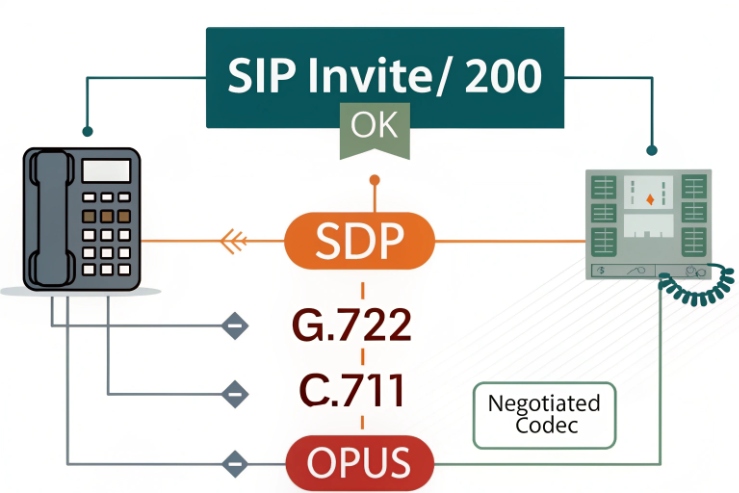
Yes. Codec priority and fallback are handled through SDP offer/answer. Put G.722 first for internal calls, keep G.711 as the universal fallback, and add Opus only when both endpoints and the PBX support it. For paging, keep one stable codec profile per VLAN or zone.
How negotiation works in the real world
The phone offers a codec list in SDP. The PBX answers with one choice. So order matters. Many teams set:
- internal calls: prefer G.722, then G.711
- trunk calls: prefer G.711 first (to avoid server transcoding)
- special services: keep one fixed profile (paging, alarms, dispatch)
If Opus is added, it should be tested on every path. Opus can sound great, but some enterprise PBXs or trunks do not support it end-to-end. If the PBX transcodes Opus to G.711, you lose the value and you add CPU load.
Paging and intercom design tips
Paging is often multicast. Multicast plus QoS needs good IGMP and queue policy. For paging zones, it can be smart to keep a narrow codec set so troubleshooting stays simple. If the site needs “one button paging that always works,” stability beats perfection.
DTMF and “telephone-event” detail
If paging uses keypad triggers or relay actions, keep DTMF consistent. Use RTP events (telephone-event) and keep the configuration stable across codecs. This avoids strange cases where audio is G.722 but the SDP offer/answer 7 payload rules differ.
| Call type | Preferred codec order | Why it works |
|---|---|---|
| Extension-to-extension | G.722 → G.711 | best clarity with safe fallback |
| PBX to PSTN trunk | G.711 → G.722 | reduces transcoding risk |
| Paging multicast | G.711 or G.722 (pick one) | simple policy and stable QoS |
| Gate intercom video | Opus or G.722 → G.711 | quality first, fallback ready |
For client explanation, one sentence helps: “G.722 is a preference, not a promise. The final codec is what both sides accept in SDP.”
Conclusion
Yes, many explosion-proof SIP phones support G.722. Success depends on PBX support, codec order, and QoS, with a clean fallback plan to G.711 for trunks and mixed networks.
Footnotes
-
Learn how the G.722 codec provides high-quality voice communications by doubling the sampling rate of traditional telephony. ↩ ↩
-
Wideband audio, or HD voice, significantly improves speech clarity and intelligibility compared to standard narrowband calls. ↩ ↩
-
Understanding how the Real-time Transport Protocol manages audio and video delivery across IP networks for communication services. ↩ ↩
-
Asterisk and FreePBX are popular open-source platforms used to build flexible and scalable VoIP communication systems. ↩ ↩
-
Cisco Unified Communications Manager provides enterprise-class call control and session management for large-scale IP phone deployments. ↩ ↩
-
Quality of Service (QoS) marking ensures that critical voice traffic is prioritized over less sensitive data on network links. ↩ ↩
-
The Session Description Protocol (SDP) offer/answer model is used to negotiate media types and codecs during call setup. ↩ ↩








