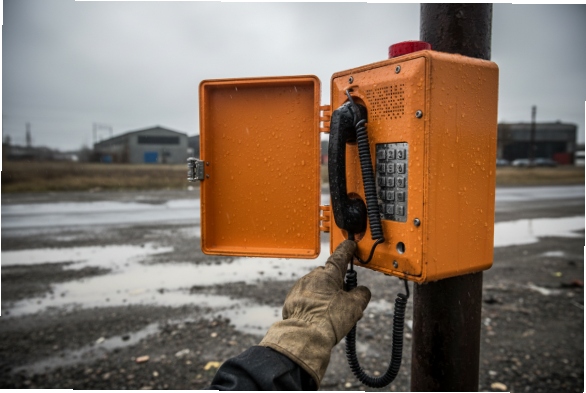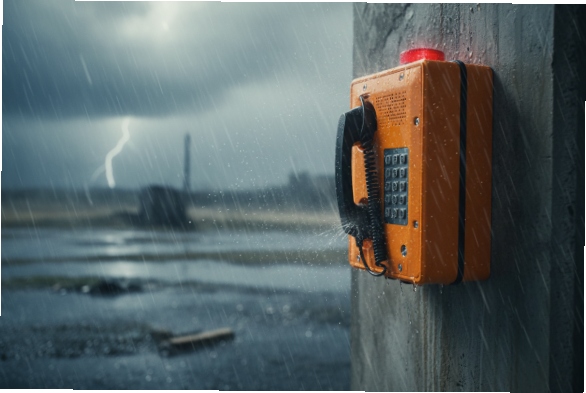

Plant echo turns hands-free calls into a mess. Operators repeat themselves, then they stop using the phone when it matters most.
Echo cancellation can be very effective on explosion-proof telephones when AEC is specified with clear targets (ERLE, tail length, double-talk) and verified in your real acoustic space, not only in a lab.
Echo cancellation effectiveness is measured by stability, not by one big dB number
“Effective AEC” has three visible outcomes
A hands-free Ex phone feels “effective” when three things happen at the same time:
1) The far end does not hear their own voice coming back as echo.
2) Both sides can speak at the same time without the phone “chopping” one side.
3) The device stays stable at max volume in a noisy bay without howling.
These outcomes are easier to manage when the tender asks for the right AEC specifications and proof. Many teams only request “AEC supported,” then they discover later that the unit behaves like partial duplex. ITU-T hands-free terminal guidance even classifies duplex behavior and treats full duplex 1 as a distinct capability. A hands-free Ex phone feels “effective” when echo cancellation 2 technology ensures a full duplex device does not noticeably attenuate the other party during duplex operation.
AEC is not alone in the signal path
AEC needs support blocks. A limiter prevents clipping, and a non-linear processor or comfort noise 3 block can hide residual echo when conditions get hard. Echo cancellers also depend on double-talk detection and control logic, because adaptation can break when both sides talk.
Make “effectiveness” testable for procurement
A practical spec uses:
- objective AEC metrics (ERLE, tail length, double-talk)
- acoustic stability checks (no howling at defined gain)
- speech quality checks (PESQ/POLQA and MOS targets)
- paging intelligibility checks (Speech Transmission Index 4) when paging is part of the scope
| What you want in the field | Spec item to request | How you prove it |
|---|---|---|
| No audible echo | ERLE and residual echo behavior | talkback test + packet capture + audio recording |
| Full duplex talk | Double-talk performance | scripted double-talk conversation |
| No howling | acoustic stability at max volume | on-site max-gain test in worst zone |
| Clear paging | STI target | STI measurement at user points |
A simple rule keeps projects clean: a strong AEC spec includes both “echo removal” and “talk behavior,” then the FAT includes at least one reflective-room test.
Which AEC specs should be required—ERLE (dB), tail length (ms), double-talk, and non-linear processing?
AEC claims sound similar across suppliers, but the meaning changes fast when the spec is vague. One vendor measures under easy conditions, and another measures under real duplex load.
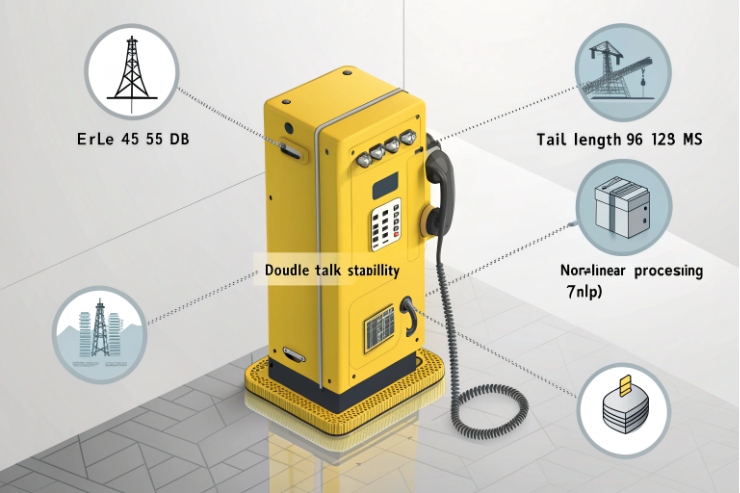
The safest AEC spec asks for ERLE under defined conditions, a tail length that covers your acoustic path, verified double-talk behavior, and a stated non-linear processing strategy that does not destroy speech.
ERLE: ask for the test setup, not only the number
ERLE is Echo Return Loss Enhancement 5. It describes how much the canceller attenuates the echo signal through the cancellation path, and it is defined separately from any extra non-linear processing loss. That separation matters because an aggressive non-linear processor can hide echo but also damage near-end speech.
A strong ERLE request includes:
- ERLE over time (convergence curve), not only a steady-state value
- test signal type (speech-like and tone)
- loudspeaker volume setting used in the test
- whether NLP is enabled during the ERLE number
Tail length: cover the real echo path
Tail length is the time span the adaptive filter can model. In a hands-free wall phone, the acoustic echo path includes:
- direct speaker-to-mic path
- reflection off the front panel and wall
- reflections from nearby steel and concrete
A practical tender does not guess one number. It sets a minimum and asks the supplier to state the configured value and how it was chosen. Many implementations treat 8–128 ms as a common programmable range for echo cancellers, but reflective bays may need more depending on geometry.
Double-talk and non-linear behavior: define what is acceptable
Double-talk is when both near-end speech and far-end speech happen at the same time. The AEC should avoid “divergence” and should not mute one party in a way that feels like a gate.
Non-linear processing is usually there to suppress residual echo when the linear model is not enough. It should be controlled, and it should avoid harsh distortion. A clean spec asks for:
- double-talk detection speed and stability
- NLP thresholds and comfort noise behavior
- a clear statement on how NLP is disabled when near-end speech is present
Does hands-free mode keep full-duplex without howling in high-noise industrial areas?
A phone can cancel echo on a bench and still howl on a wall. High SPL, reflections, and microphone port effects change the loop gain.
A well-designed Ex hands-free phone can keep full-duplex in many industrial areas, but “no howling” depends on acoustic loop gain control, correct limiter settings, and mounting geometry in the worst noise zone.
Full duplex is a behavior, not a marketing term
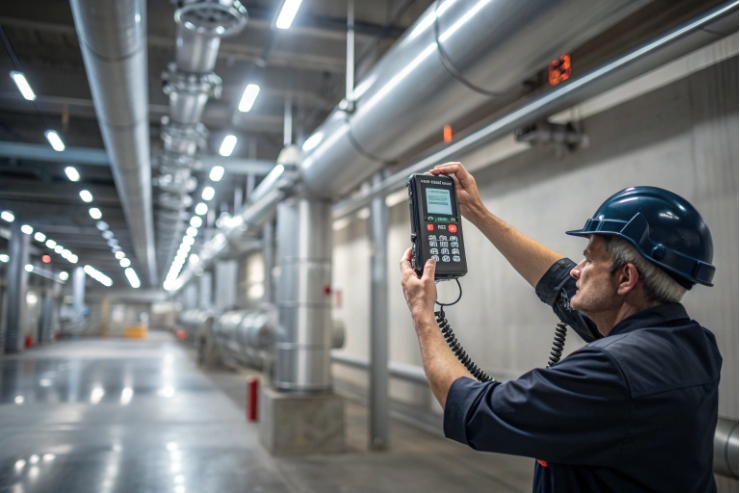
Hands-free terminal guidance describes duplex capability classes, and full duplex means attenuation of the other party does not occur or is unnoticeable during duplex operation. That is the user experience you want for safety talkback.
A phone can appear full duplex in quiet rooms and become partial duplex in loud rooms if:
- AGC lifts the mic too high
- the limiter clips and creates non-linear echo paths
- the AEC tail is too short for the reflection pattern
- the NLP engages too aggressively and masks speech
Howling control is about loop gain margin
Howling is acoustic feedback. It happens when:
- speaker output couples back to the microphone
- the total loop gain at some frequency exceeds 1
- phase conditions allow reinforcement
AEC reduces the “echo component,” but howling can still appear if the physical coupling is too strong. That is why the best Ex hands-free designs also include:
- limiter and volume cap at max user level
- careful EQ to reduce resonance peaks
- mic port design that avoids whistle effects
- mechanical damping that reduces enclosure vibration
How do enclosure acoustics, mic/speaker placement, and gasket design affect echo performance?
Explosion-proof construction changes acoustics. Metal housings reflect sound, and sealing parts can shift the response. These details often decide whether AEC feels “natural.”
Enclosure shape, port placement, and gasket sealing directly affect the echo path that AEC must model. Better mechanical design reduces echo complexity and improves convergence, while poor gasket and port design can create resonances that cause pumping or squeal.
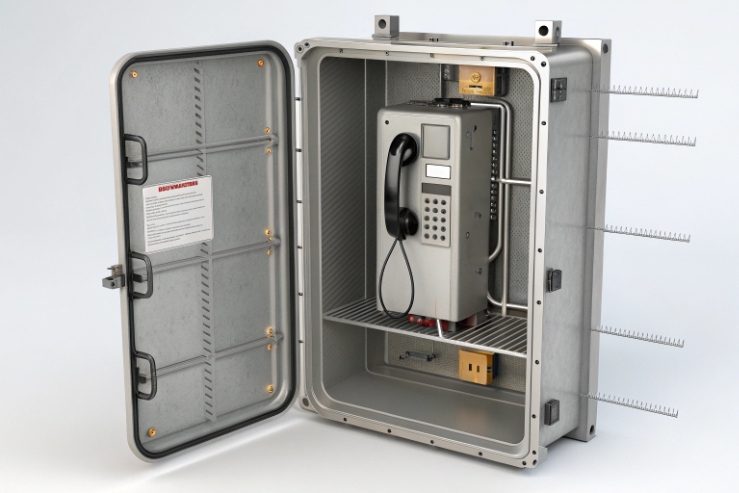
The enclosure creates a predictable echo path or a chaotic one
AEC adapts to the impulse response between loudspeaker output and microphone input. In an Ex phone, the path can include:
- reflections off a thick front plate
- cavity resonances in the speaker chamber
- diffraction around protective grilles
- wall reflections behind the unit
A smooth, well-damped acoustic design gives AEC a stable, mostly linear path. A rattling grille, loose screws, or a vibrating front panel makes the path time-varying. That forces the AEC to chase a moving target.
Mic and speaker geometry matters more than DSP settings
Small changes in mic placement can change coupling by several dB. That changes how much ERLE you need to avoid audible echo. A good layout:
- keeps the mic off the direct speaker axis
- uses a baffle that reduces direct coupling
- avoids placing the mic port in a corner cavity that rings
Can AEC be tuned via UI/API and verified with STI, PESQ, or MOS tests on site?
Field tuning is common in industrial projects. One profile rarely fits both a quiet control room and a steel-lined pump bay. Still, tuning must be controlled, or the fleet drifts.
Many industrial SIP endpoints allow some audio tuning in UI and provisioning. Verification should use a mix of objective metrics (PESQ or POLQA), intelligibility (STI for paging zones), and a simple MOS-style listening script to match real use.

Tuning controls that are worth requesting
Useful AEC-related controls include:
- hands-free mic gain and speaker gain (separate from handset)
- AEC enable/disable per mode
- tail length selection or “room size” presets
- NLP aggressiveness or suppression threshold
- comfort noise enable
- a limiter cap to prevent overdrive
Verification: pick the metric that matches the use case
STI is best when the phone is used for paging or talkback into a noisy area, because it targets intelligibility in acoustic spaces. Objective metrics (Perceptual Evaluation of Speech Quality 6) and the newer objective listening quality model (Perceptual Objective Listening Quality Analysis 7) are used widely for modern VoIP and HD voice. MOS is the human perception score that clients understand, but it needs a controlled script and consistent playback.
A practical on-site verification package includes:
- a short talkback script with double-talk segments
- one noise condition test (fan noise or recorded refinery noise)
- one reflective condition test (near a wall or steel bay)
- one paging intelligibility walk test if paging is in scope
Conclusion
AEC can be very effective in Ex telephones when specs cover ERLE, tail, and double-talk, and when mechanical acoustics and on-site verification protect full-duplex talkback.
⸻
Footnotes
-
An explanation of full duplex communication, which allows simultaneous two-way voice transmission without signal cutting. ↩ ↩
-
Learn how echo cancellation technology removes reflected signals to improve voice clarity in hands-free industrial intercom systems. ↩ ↩
-
Synthetic background noise used in telecommunications to fill silence and reassure users that the connection is active. ↩ ↩
-
A measure of speech intelligibility that accounts for background noise and reverberation in complex industrial environments. ↩ ↩
-
A key performance metric for echo cancellers that quantifies the amount of echo signal attenuation provided. ↩ ↩
-
An industry-standard objective method for end-to-end speech quality assessment in narrow-band telecommunications networks. ↩ ↩
-
The latest global standard for objective speech quality testing, supporting wide-band and super-wide-band VoIP technologies. ↩ ↩