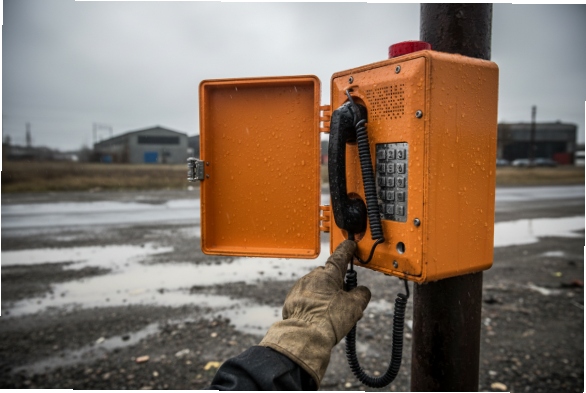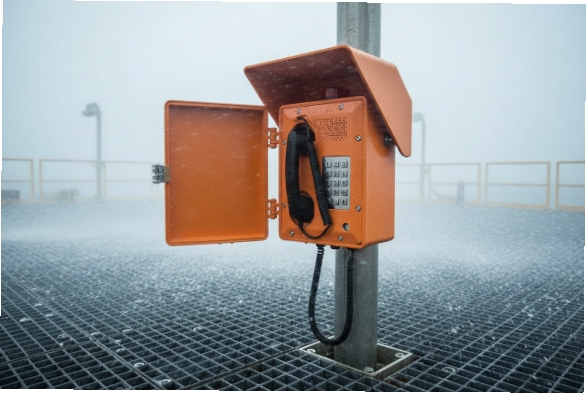

When a plant wants alarms, beacons, and SCADA ties, a basic Ex phone can feel too limited. The wrong I/O approach can also break sealing or trigger re-certification.
Yes, many explosion-proof telephones can support extra I/O, either as internal DI/DO boards or via external I/O gateways. The safest design keeps Ex compliance, IP66/67 sealing, and enough gland space for correct cable entry.

A practical architecture for adding I/O to Ex telephones
Two proven paths: internal I/O vs external I/O
In most industrial deployments, extra I/O lands in one of these paths:
-
Internal I/O option (inside the phone enclosure)
This is clean for wiring. It also keeps the logic close to the endpoint. It is great for simple tasks like one emergency input and one relay output for a beacon. The tradeoff is that it touches certified construction, internal space, heat rise, and cable entry count 1. -
External I/O gateway (nearby, often in a safe area or certified junction)
This is best when you need more points, analog signals, RS-485/Modbus, or flexible isolation. It also limits changes inside the Ex phone. The tradeoff is extra field hardware and extra networking or wiring.
In my projects, the decision is usually made by three questions:
1) How many signals are needed today, and how many will be added later?
2) How harsh is the cable route and how many glands can be safely managed?
3) Does the site inspector accept the same Ex certificate with a documented variant, or will the customer demand a certificate up-issue?
What “I/O” means for emergency workflows
For an Ex telephone, I/O is almost always about actions and events:
-
A digital input detects a door contact, panic button, or gas detector relay
-
A relay output triggers a strobe, siren, gate release request, or a PLC input
-
An 4–20 mA 2 link reports a measured value or reads a sensor loop (less common inside phones)
-
Modbus 3 exchanges status with a local controller (often better as external gateway)
A simple way to write the requirement in a tender
A tender spec should describe function first, then electrical detail, then compliance boundaries.
| Requirement block | What to state clearly | Why it avoids field failure |
|---|---|---|
| Function | “DI1 triggers auto-dial + event log”, “DO1 drives beacon for 30 s” | Stops wrong feature assumptions |
| Electrical | Input voltage range, relay rating, isolation requirement | Prevents burned I/O and nuisance trips |
| Integration | SIP event 4, HTTP API, MQTT topic, or Modbus register mapping | Keeps IT/OT teams aligned |
| Compliance | Must keep ATEX/IECEx status and IP66/67 | Avoids rework and inspection rejection |
| Installation | Number and size of cable glands, armor/shield termination plan | Prevents sealing and earthing problems |
A clean I/O design should not force operators to think. It should work the same way every time, even with gloves, noise, and stress.
Now the next sections go point by point so you can turn this into a purchase-ready requirement.
What extra interfaces are available—digital inputs, relay outputs, analog 4–20 mA, or RS-485/Modbus?
The most common add-ons are dry-contact digital inputs and relay outputs. Analog 4–20 mA and RS-485/Modbus are possible, but they usually work best through external gateways or carefully designed isolation inside the enclosure.
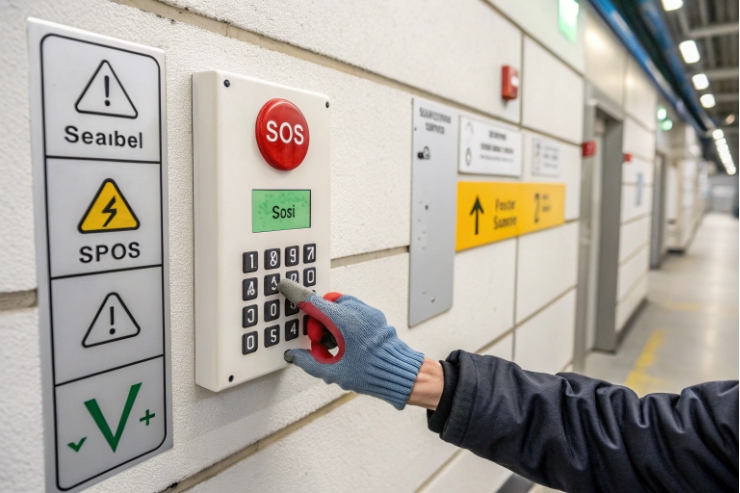
Digital inputs (DI): dry contact or wet input
For emergency workflows, DI is the workhorse. Typical DI use cases:
-
external SOS button in a safer location
-
door open contact for a call box cabinet
-
“alarm active” relay from a gas detection panel
-
maintenance mode switch for testing
A practical digital input 5 design supports either dry contact or wet input that accepts 12/24 VDC from site systems.
Relay outputs (DO): “drive a coil” or “signal a PLC”
Relay outputs are widely used for strobe light activation, door release requests, or PLC status signals. For Ex systems, a key rule helps: use the relay to signal, not to power heavy loads. It keeps wiring safer and reduces contact wear.
How many DI/DO points are supported and what are the voltage/current ratings and isolation levels?
Point counts vary by design. A common range is 1–4 DI and 1–2 DO for internal modules, while external gateways can scale much higher. Always confirm input voltage range, relay contact rating, and galvanic isolation across I/O and Ethernet/PoE.

Typical internal I/O point counts
For internal options, the sweet spot is small: 1–2 DI for emergency triggers and 1 relay output for beacon or PLC signals. This keeps wiring manageable and the enclosure layout clean.
Isolation: the part that prevents mystery faults
Isolation protects against ground potential differences across long cable runs and surge coupling from inductive loads. In emergency endpoints, “intermittent” is unacceptable.
A practical example requirement set includes opto-isolation 6 or galvanic isolation between I/O and logic ground. Isolation should be treated as a required feature, not a nice-to-have.
Can I/O be mapped to SIP events, HTTP/MQTT APIs, or SCADA alarms for emergency workflows?
Yes. I/O can be mapped to SIP actions (auto-dial, paging, call control), to HTTP APIs for automation, to MQTT for event publishing, and to SCADA through gateways like Modbus or OPC layers. The best design uses clear event logic and strong security controls.
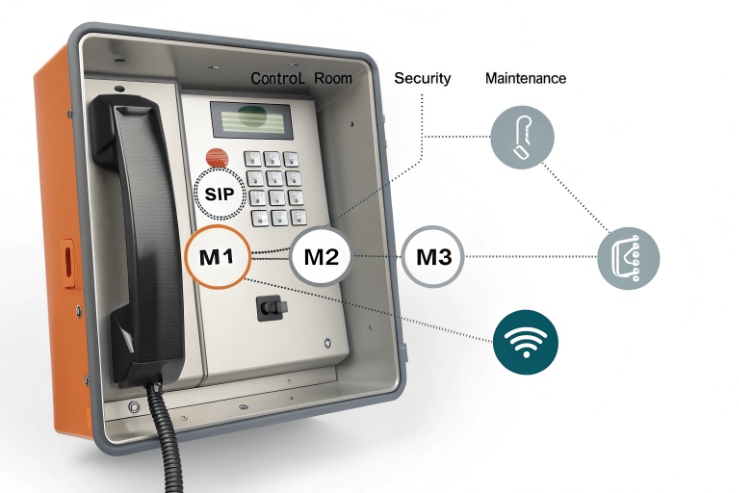
Mapping DI to SIP actions
The most common emergency workflows are simple: DI1 active triggers auto-dial to an emergency group or sends multicast paging to a specific zone.
SCADA alarms: keep OT wiring simple
SCADA teams often want Modbus data. In many cases, the clean approach involves the phone publishing events via IP (HTTP/MQTT/SIP), while a gateway maps events into the SCADA layer.
Do added I/O options maintain ATEX/IECEx certification, IP66/67 sealing, and enclosure space for glands?
Added I/O can maintain ATEX/IECEx and IP66/67, but only when it is treated as a controlled variant of the certified design. Extra cable entries must use correct Ex-approved glands, keep sealing integrity, and leave enough internal space for wiring, bend radius, and safe separation.
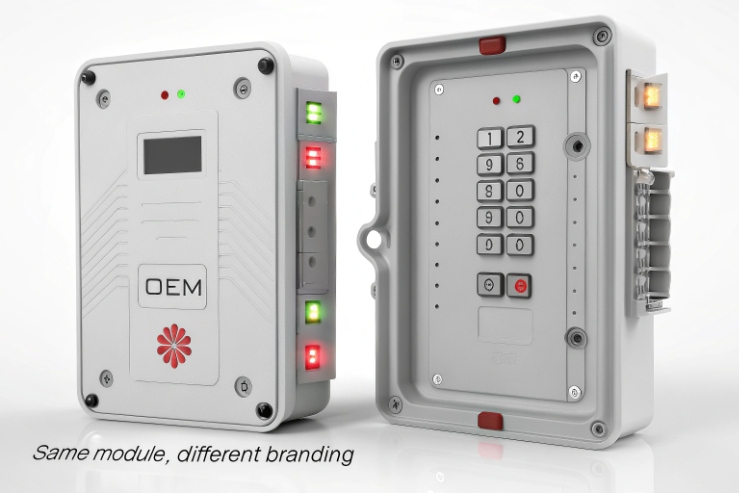
Certification: the safest rule is “tell the cert body”
For IECEx, design changes to certified equipment should be advised to the issuing ExCB. A reliable OEM process includes controlled BOMs for the I/O variant and updated internal wiring drawings.
Enclosure space: what changes when you add I/O
Inside the enclosure, I/O wiring needs proper bend radius space and strain relief so conductors are not pulled. If space is tight, field wiring gets messy, which can lead to service mistakes.
Conclusion
Yes, extra I/O is possible, but it must be planned as a certified, sealed, installable variant. For OEM details: info@sipintercommanufacturer.com.
Footnotes
-
A technical guide to selecting cable glands for safe entry into industrial electrical enclosures. ↩ ↩
-
Industry standards for 4-20 mA current loops used in analog process control and sensor signaling. ↩ ↩
-
Overview of the Modbus protocol, the standard for communication between industrial electronic devices and controllers. ↩ ↩
-
Understanding SIP event notifications for real-time monitoring of telecommunication device states and call flows. ↩ ↩
-
Detailed explanation of digital inputs and their role in discrete signal monitoring within automation systems. ↩ ↩
-
Learn how opto-isolators protect electronic circuits by transferring signals using light to prevent electrical interference. ↩ ↩