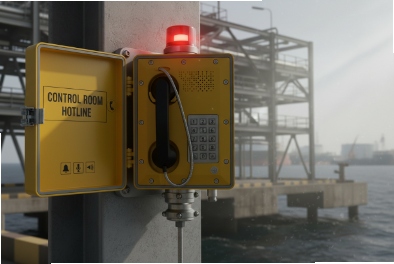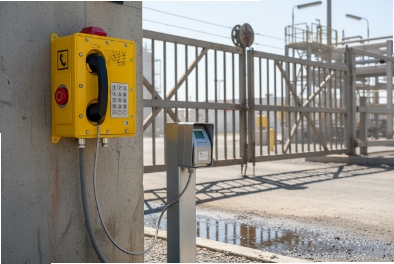
A phone can call fine and still create chaos later. If time is wrong, logs mislead teams, alarms look late, and incident reviews turn into arguments.
Yes, many explosion-proof SIP telephones support NTP/SNTP time sync, and some can learn NTP servers from DHCP. Accurate time improves logs, SIP records, and event correlation across PAGA, VMS, and SCADA.
What “time sync support” should mean for an Ex telephone
Time is a safety and maintenance feature, not a cosmetic setting
In hazardous plants, an Ex phone is often used in emergency workflows. That means NTP time synchronization 1 accuracy affects more than call history. It affects how teams prove response time, how they trace who pressed SOS, and how they link a phone event to an alarm on another system. A device that drifts 3–10 minutes can still “work,” but it breaks trust in the records.
Define time performance in the same way you define IP/IK
Many tenders specify IP66/67 and IK10, but they forget time. The result is a phone that has a clock, but it is not managed. A better approach is to define:
- time protocol support (NTPv4/SNTP)
- server redundancy and failover
- security hardening (auth, ACLs, NTS if required)
- logging format and timestamp sources
- behavior when the network is down
A practical acceptance checklist that keeps procurement simple
The easiest way to avoid debate is to request a short, measurable test.
| Item | Target requirement | Field test idea |
|---|---|---|
| Sync method | NTP/SNTP + DHCP option support | set NTP, reboot, confirm time correct |
| Accuracy | stable after 24–72 hours | compare to a trusted time source |
| Redundancy | 2–4 NTP servers | shut one server, confirm failover |
| Security | limit who can query/serve | scan and verify ACL/firewall rules |
| Logging | consistent UTC or local time policy | compare phone logs to syslog timestamps |
A simple note from real deployments: most “time problems” are not bugs in the phone. They come from blocked UDP 123, bad DNS, or a site policy that only allows local time servers.
Which time protocols are supported—NTPv4/SNTP, DHCP option 42, or SIP Date header fallback?
Most industrial SIP endpoints support SNTP or full NTP client mode, many can accept NTP servers via DHCP option 42, and some can fall back to SIP Date header time during registration. The right choice depends on network policy and security needs.

NTP vs SNTP in practical terms
Many vendors use SNTP 2 in UI wording even when the client behaves like a standard NTP client. For most Ex telephones, the difference that matters is not the label. It is:
- can the phone poll multiple servers?
- does it keep time stable through reboots and link flaps?
- does it expose sync status and last update time?
DHCP option 42: fast rollouts and less manual work
DHCP option 42 3 can deliver NTP server addresses. This is useful when many phones are deployed across units and tunnels. It allows “plug in and sync” without opening a web UI. It also fits sites where endpoint config is locked and only DHCP is allowed to set core network parameters.
A common trap is mixed DHCP scopes. One plant VLAN might hand out NTP servers. Another might not. Then phones on one unit have correct time and phones on another do not. The fix is to treat NTP server assignment as a standard part of the DHCP template.
Can multiple NTP servers be configured with authentication, stratum preference, and timezone/DST rules?
Yes, many industrial SIP phones allow multiple NTP servers, and better designs support server priority and clear failover behavior. Authentication support varies by vendor, while timezone and DST rules are usually supported as local display settings rather than affecting the actual UTC timekeeping.

Stratum: do not chase a number, chase a stable hierarchy
Stratum 4 is a useful concept, but a phone rarely needs to “choose by stratum” if the network design is correct. The better approach is:
- set the plant’s authoritative local time servers
- keep them disciplined by a GPS source or upstream reliable source
- point phones only to those local servers
How to harden NTP—ACLs, firewalls, NTS, and offline local time servers in industrial networks?
Harden NTP by limiting who can talk to time servers, using ACLs and firewalls to control UDP 123, and preferring local offline time servers in plants. NTS can add cryptographic protection, but many sites achieve strong security through segmentation and strict access rules.

NTS: when it matters and when it is too heavy
Network Time Security 5 (NTS) can protect NTP exchanges with modern cryptography. It is valuable in networks where time integrity is critical for compliance or where attackers could access segments to spoof time.
Does accurate time improve logs, syslog, SIP timestamps, and event correlation with PAGA, VMS, and SCADA?
Accurate time makes logs trustworthy: phone call records, syslog entries, SIP signaling timestamps, and alarm events align across PAGA, VMS, and SCADA. This improves incident response, compliance reporting, and maintenance efficiency.

Syslog and SIEM value depends on time
Many plants forward device logs to syslog or a central SIEM 6 monitoring platform. Time is the glue that lets a SIEM correlate events from switches, routers, SIP servers, and phones.
SIP records and call quality investigations
Accurate time helps call detail records 7 (CDR) and answered time tracking. In plant networks, this can separate “PBX issue” from “switch policy issue” in minutes by aligning quality metrics with network congestion windows.
Conclusion
Yes, Ex SIP phones can sync time with NTP/SNTP. A clear multi-server and hardening plan turns timestamps into evidence, not guesses. For support: info@sipintercommanufacturer.com
Footnotes
-
Learn how the Network Time Protocol ensures synchronized clocks across computer systems over packet-switched networks. ↩ ↩
-
A simplified version of NTP designed for devices that do not require the full complexity of the protocol. ↩ ↩
-
Technical specification for the DHCP option used to assign Network Time Protocol servers to network clients. ↩ ↩
-
Understanding the hierarchical levels of time sources in a network to determine the distance from the reference clock. ↩ ↩
-
An extension to NTP that provides cryptographic security for time synchronization to prevent packet manipulation. ↩ ↩
-
Software that provides real-time analysis of security alerts generated by applications and network hardware. ↩ ↩
-
Detailed data records produced by telephone exchanges containing information about individual telecommunication transactions. ↩ ↩