The choice between NPT and Metric threads is not a matter of "better" or "worse"; it is a matter of geography and local installation culture. Forcing the wrong thread type onto a site’s cabling infrastructure is a nightmare that involves expensive certified adapters, potential leak points, and frustrated electricians.
The decision depends entirely on the installation region: North American (NEC/CEC) projects predominantly use NPT (National Pipe Taper) threads for rigid conduit systems, while the rest of the world (ATEX/IECEx) standardizes on Metric (ISO) threads for cable gland installations.
Dive Deeper: The Taper vs. The Parallel
I have seen disastrous results when installers try to force a 1/2" NPT conduit into an M20 cable entry. They look similar to the naked eye, but they function differently.
1. NPT (National Pipe Taper)
- Design: The thread is tapered (conical). It gets tighter as you screw it in.
- Sealing: The seal is created by the deformation of the threads themselves (metal-to-metal).
- Standard: Common in the USA and Canada for connecting rigid steel conduits.
- Flamepath: The tight fit of the threads is the flamepath. It must engage at least 5 full threads to be explosion-proof.
For dimensional reference and inspection, use the ASME B1.20.1 NPT pipe thread standard 1.
2. Metric (ISO 965)
- Design: The thread is parallel (cylindrical). It screws in freely until it hits a stop.
- Sealing: It requires an O-ring or a washer at the base to create a watertight (IP) seal.
- Standard: The global standard (Europe, Asia, Middle East, South America) for screwing in cable glands.
- Flamepath: The length of the engagement provides the flame cooling path.
For tolerance and fit expectations, reference ISO 965 metric screw thread tolerances 2.
Which thread standards fit hazardous-area cable glands—NPT, M20/M25 metric, or BSPP/BSPT?
While you can technically machine any thread, the hazardous area market has settled on two dominant players.
The vast majority of explosion-proof cable glands utilize M20 x 1.5 or M25 x 1.5 Metric threads; NPT threads (1/2" or 3/4") are used primarily for direct conduit connection or specific US-spec glands, while BSPP/G threads are rare for electrical entries and usually require adapters.
Dive Deeper: The Size Standards
1. The "M20" Standard
For 90% of telephones, M20 x 1.5 is the default.
- It passes cables from 6mm to 12mm diameter (standard CAT6 or armored power cable).
- If you have a thicker armored cable, you step up to M25.
2. The North American "Hub"
In the US, we talk in inches.
- 1/2" NPT: The standard entry for a single conduit.
- 3/4" NPT: Preferred for pulling multiple wires (like Ethernet + Power) through a single pipe.
3. The BSPP/BSPT Anomaly
- BSPP (G): British Standard Pipe Parallel. You might see this on old UK equipment or hydraulic sensors.
- BSPT (R): British Standard Pipe Taper. Similar to NPT but different thread angle (55° vs 60°).
- Warning: Never try to mix NPT and BSPT. They will screw in halfway and then bind. If you force it, you destroy the flamepath rating.
If you must verify legacy taper compatibility, reference ISO 7-1 pipe threads for pressure-tight joints (BSPT) 3.
How do regional codes and suppliers influence choosing NPT vs metric on ATEX/IECEx enclosures?
The project specification usually dictates the thread, driven by the local electrical code.
In Europe and IECEx countries, Metric threads are mandated for compatibility with standard glanding; in North America, NPT is required to interface with rigid conduit systems; however, global suppliers often dual-certify enclosures or provide factory-installed adapters to meet both markets.

Dive Deeper: The "Global" Enclosure Strategy
At DJSlink, we want to sell the same phone to a customer in Houston and a customer in Hamburg. How do we do it?
A practical way to avoid “standard confusion” in procurement is to anchor documentation to the actual regimes: the EU’s ATEX Directive 2014/34/EU 4 and the international IECEx certification system 5.
Strategy A: Multiple Casting Molds
We have two versions of the casting. One is drilled and tapped for M20. The other is drilled and tapped for NPT. This is the cleanest solution but increases inventory.
Strategy B: The Adapter Solution
We manufacture everything with huge M25 entries.
- For Europe: We insert an M25-to-M20 reducer.
- For USA: We insert an M25-to-1/2" NPT adapter.
- Benefit: Flexibility.
- Drawback: It adds a potential leak point and increases the protrusion from the box.
My Advice for Procurement:
If you are buying for a project in Singapore (IECEx), specify M20.
If you are buying for a project in Texas (NEC), specify 1/2" NPT.
If you send an NPT phone to Singapore, the installer will have to buy an expensive certified adapter locally, and they will hate you for it.
When are thread adapters or reducers allowed without compromising Ex d flamepaths and IP66/67?
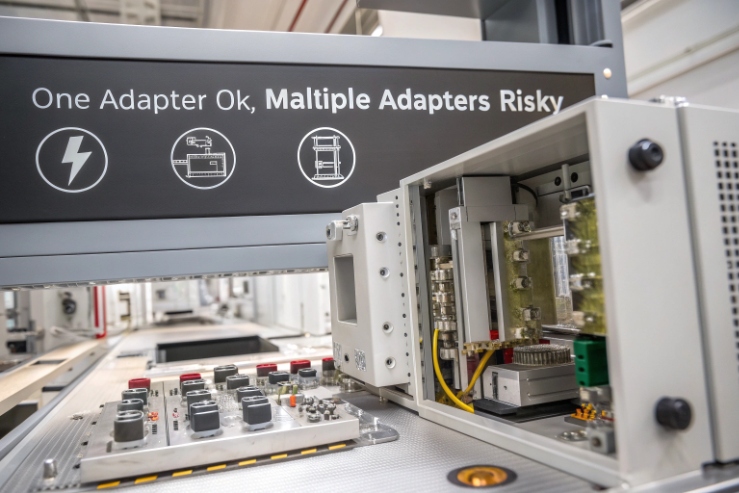
Adapters are life-savers, but in the Ex world, they are strictly regulated. You cannot just stack them like Lego bricks.
Certified Ex d/Ex e thread adapters are allowed provided they are not "stacked" (one adapter per entry only), are fully tightened to maintain the flamepath, and utilize proper sealing washers or thread sealant to preserve the IP66/67 rating.
Dive Deeper: The Rules of Adaptation
1. The "No Stacking" Rule
The adapter rule-of-thumb comes directly from IEC 60079-1 flameproof “d” requirements 6: you shall not use an adapter with another adapter.
- Illegal: M25 Box -> M25/M20 Reducer -> M20/NPT Adapter -> Cable Gland.
- Why: Every thread interface is a potential path for a flame to escape. Stacking them multiplies the tolerance errors and mechanical weakness.
2. The Certification Match
The adapter itself must be a certified component. You cannot use a plumbing bushing from Home Depot. It must have the "Ex" mark and a certificate number.
3. IP Integrity
- Metric: Requires a nylon or fiber washer between the adapter and the enclosure to seal water.
- NPT: Requires non-hardening thread sealant (grease) on the threads to stop water ingress. Do not use Teflon tape on Ex d threads (it insulates the ground connection). Use conductive anti-seize or specialized Ex-rated thread paste.
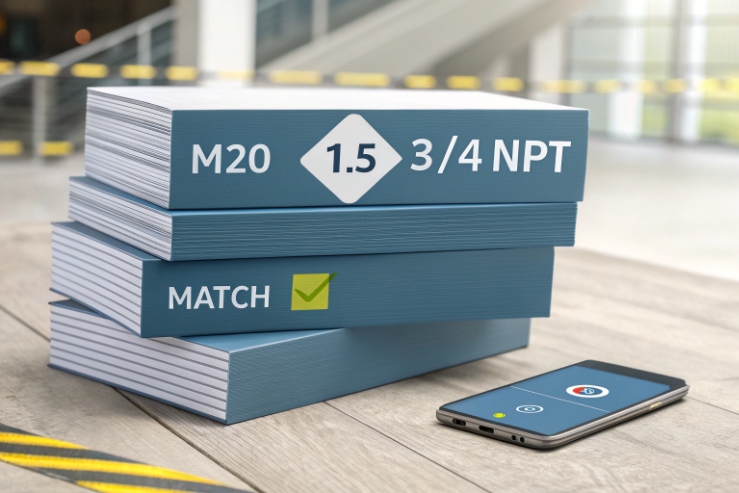
What documentation should match threads—datasheet, certificate marking, cable gland approvals, and torque specs?
The paper trail must match the metal. An inspector will check the certificate against the gland.
Datasheets must clearly specify the entry thread type (e.g., 2x M20), the equipment certificate must list the allowed thread options, and the installation manual must provide specific torque values (Nm) for glands to ensure ground continuity and ingress protection.
Dive Deeper: The Paperwork Check
Use the installation baseline in IEC 60079-14 (Ex equipment installation rules) 7 when you set torque tables, gland rules, and inspection gates—because “hand tight” is not defensible in an audit.
1. The "X" Condition on Certificates
Many Ex certificates have an "X" suffix. It often refers to the cable entry. It might say: "Cable entries must be sealed with a certified stopping plug or gland."
If you leave a spare M20 hole open, the equipment is not compliant. You must use a Certified Ex d Blind Plug. Plastic shipping plugs are NOT safe.
2. Cable Gland Selection
The gland must match the cable and the thread.
- Armored Cable (SWA): Needs an "E1W" or "CW" type gland (Metric). It terminates the armor.
- Non-Armored: Needs an "A2" type gland.
- Note: If you put a Metric gland into an NPT adapter, verify the adapter’s internal bore doesn’t restrict the cable passing through.
3. Torque is Law
"Hand tight" is not an engineering specification.
- Loose gland = Water ingress (IP fail) + Poor ground continuity (EMC fail).
- Over-tightened = Cracked casting (Ex d fail).
- We provide a table: M20 Gland = 30 Nm. Use a torque wrench.
Conclusion
Threads are the physical interface between your safe power grid and your safe equipment. Whether you are turning a tapered NPT wrench in Chicago or spinning a parallel M20 gland in Dubai, the goal is the same: a secure, flame-tight, and water-tight connection that maintains the integrity of the explosion-proof system.
Footnotes
-
Official NPT thread reference for verifying taper engagement and avoiding “almost fits” conduit mistakes. ↩︎ ↩
-
Defines metric thread tolerance language so M20/M25 entries and glands match predictably. ↩︎ ↩
-
Helps confirm BSPT legacy thread form so it isn’t wrongly mixed with NPT. ↩︎ ↩
-
The EU legal basis for ATEX equipment requirements—useful when specs must match inspections. ↩︎ ↩
-
Explains IECEx certification framework used for Ex equipment acceptance across many countries. ↩︎ ↩
-
Core flameproof “d” requirements behind adapter limits like “no stacking” and full engagement. ↩︎ ↩
-
Installation rules for glands, torque, sealing, and inspections—critical for keeping Ex and IP compliance. ↩︎ ↩