
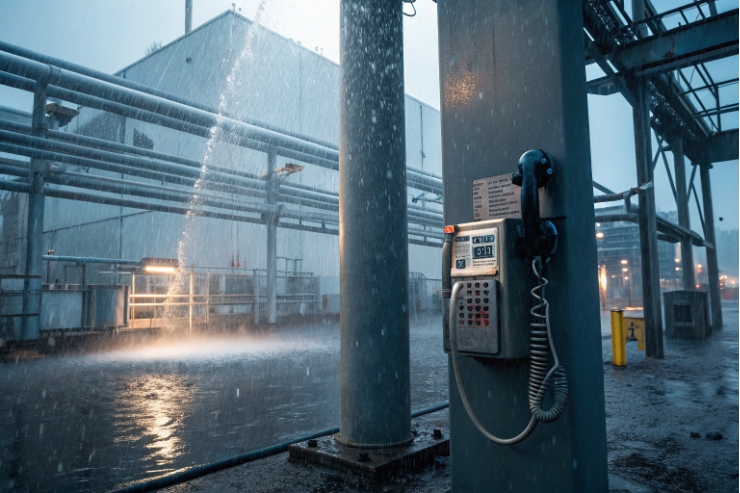
Water and electricity are a deadly combination. In a hazardous environment, water ingress does more than just short-circuit a circuit board; it can compromise the safety mechanisms that prevent a catastrophic explosion. Choosing the right Ingress Protection (IP) rating 1 is not a luxury—it is a survival requirement.
For most industrial explosion-proof telephones, an IP66 rating is the standard requirement, ensuring total protection against dust and powerful water jets, while IP67 is recommended for areas prone to temporary flooding or heavy seas.
Dive Deeper: The Shield Against the Elements
I often see tenders requesting "the highest IP rating possible," assuming that higher numbers always equal better performance. This is a misunderstanding of how the rating system works. IP ratings are specific engineering standards, not a high score in a video game.
The IP Code Breakdown
The rating consists of two digits (e.g., IP66):
-
First Digit (Solids/Dust): Ranges from 0-6. For explosion-proof gear, this is almost always 6.
- 6: Dust-tight. No ingress of dust allowed. This is non-negotiable in environments with combustible dust 2 (Zone 21/22).
-
Second Digit (Liquids/Water): Ranges from 0-9.
-
5: Low-pressure jets.
-
6: Powerful water jets (Fire hose).
-
7: Temporary immersion (1 meter depth).
-
8: Continuous immersion.
-
At DJSlink, we engineer our standard hazardous area phones to IP66 or IP67. Why not IP68 for everything? Because sealing a device against deep-sea pressure requires different engineering than sealing it against a high-pressure hose on a cleaning deck. The application dictates the rating.
Is IP66 or IP67 sufficient for hazardous-location telephones exposed to rain, dust, and salt spray?
There is a subtle debate in the engineering community: Is IP67 better than IP66? The answer might surprise you—not always.
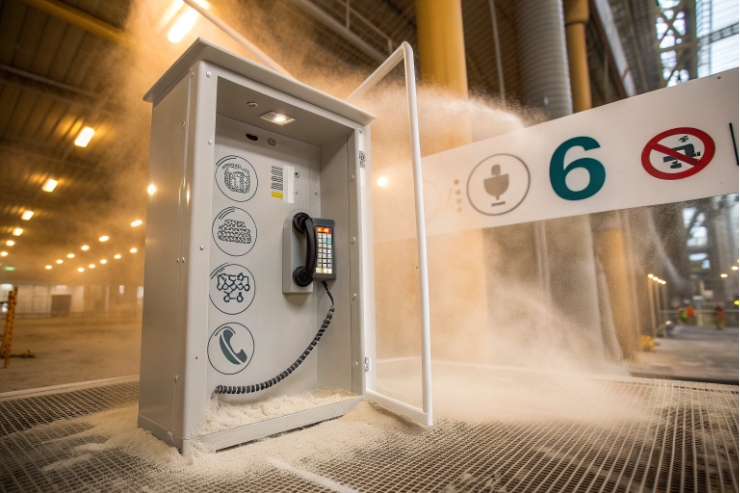
IP66 is generally the superior choice for outdoor telephones exposed to driving rain, storms, and cleaning crews using hoses, whereas IP67 is specifically designed for equipment that might be submerged in water for short periods.
Dive Deeper: The "Jet" vs. The "Dip"
I have had clients complain that their IP67 phone leaked after being power-washed. "But it’s IP67!" they argue.
Here is the catch: IP67 tests for immersion, not pressure.
-
IP66 (The Storm Shield): Tested with a 12.5mm nozzle spraying 100 liters per minute from 3 meters away. This simulates a hurricane or a worker cleaning the rig with a hose. It handles dynamic pressure.
-
IP67 (The Flood Shield): Tested by dunking the phone in a tank of water (1 meter depth) for 30 minutes. It handles static pressure.
The Real-World Implication
On an offshore oil rig 3 deck, the phone is slammed by wind-driven rain and saltwater spray. This mimics the IP66 test (jets). It rarely mimics the IP67 test (being underwater), unless the rig is sinking.
Therefore, for 90% of topside installations, IP66 4 is actually the more relevant standard. Ideally, you want a device that is "Dual Rated" (IP66/67), meaning it has passed both tests.
Salt Spray Warning:
Neither IP66 nor IP67 tells you anything about salt resistance. They only measure water penetration, not corrosion. A steel box can be IP67 and still rust shut in a week.
When should IP68 or IP69K be specified for high-pressure washdown, submersion, or mining tunnels?
Sometimes, standard protection isn’t enough. In extreme industries like mining or food processing 5, the environment is actively trying to destroy the seal.
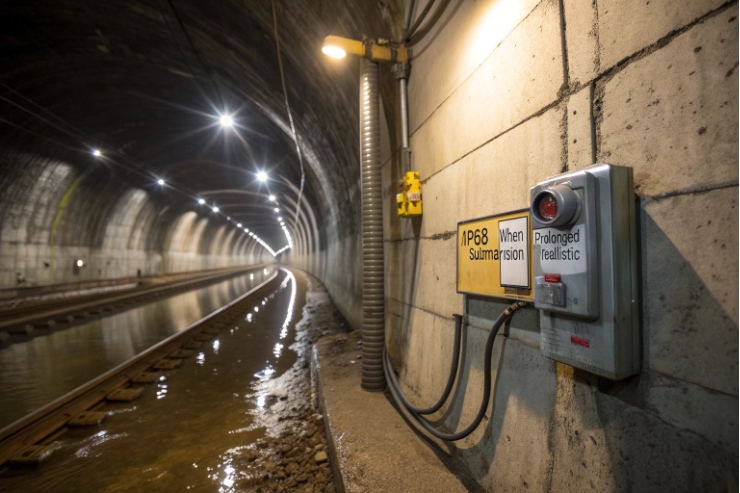
IP68 should be specified for underground mining and tunnels where equipment may be submerged for long periods due to flooding, while IP69K is mandatory for food and pharmaceutical plants where equipment is blasted with high-temperature, high-pressure steam for sanitation.
Dive Deeper: Extreme Ingress Protection
1. IP68 (The Submarine)
-
Scenario: An underground mine sump or a drainage tunnel. If the pumps fail, the water level rises. A standard phone will drown.
-
The Spec: IP68 is not a fixed standard; it is an agreement between manufacturer and user. It usually means "hermetically sealed."
-
My Advice: Unless you plan to install the phone inside a water tank, IP68 is usually overkill for wall-mounted devices. It drives up the cost significantly because we have to pot (fill) the internal cavities with resin.
2. IP69K (The Steam Blaster)
-
Scenario: A pharmaceutical plant or a food factory. Every night, the cleaning crew comes in with steam lances heated to 80°C at 1400 psi.
-
The Failure Mode: Standard rubber gaskets melt or deform under that heat and pressure.
-
The Fix: IP69K equipment uses special heat-resistant seals and enclosure geometries that deflect the water jet.
-
Note: Most "Explosion-Proof" phones are not IP69K. If you put a standard Ex d aluminum phone in a steam-clean zone, the paint will strip and the seals will fail. You need a specialized stainless steel unit.
Do ATEX/IECEx certificates state minimum IP levels, and how are ingress tests performed and documented?
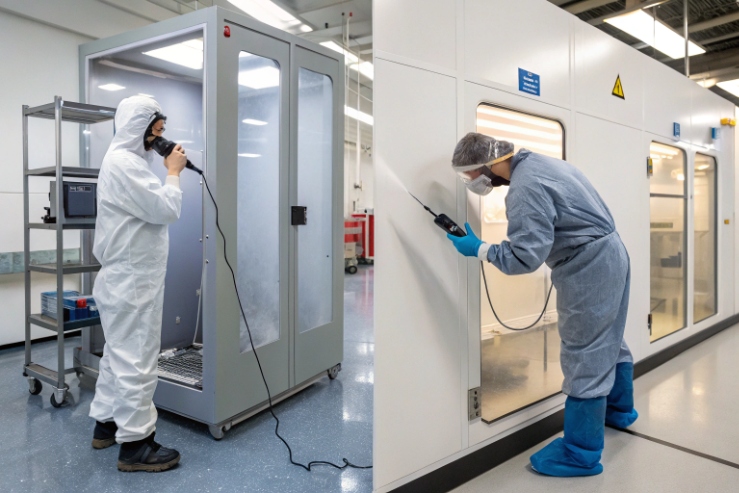
IP ratings are not just marketing claims; they are integral parts of the safety certification 6. A breach in the IP seal can invalidate the Ex protection.
Yes, ATEX and IECEx certificates explicitly list the minimum IP rating required to maintain safety (often IP54 for Gas, IP6X for Dust), and these ratings are verified through rigorous third-party lab testing during the certification process.
Dive Deeper: The Safety Link
1. Dust Ignition Protection (Ex t)
For Zone 21/22 (Dust), the IP rating is the primary protection method.
-
The concept is simple: If dust cannot get in, it cannot touch the hot electronics and ignite.
-
Requirement: The certificate will mandate IP6X (Dust Tight). If you open the phone and find dust inside, the certification is void.
2. Gas Protection (Ex d vs. Ex e)
-
Ex d (Flameproof): Technically, Ex d does not require a high IP rating to prevent explosions (the flame path does that). However, usually, a minimum of IP54 is required to prevent water from shorting the terminals.
-
Ex e (Increased Safety): Relies heavily on the enclosure keeping moisture out to prevent tracking and arcs. Minimum IP54, but usually IP64+ is the industry norm.
The "X" Condition
If you see an "X" at the end of a certificate number (e.g., IECEx 12.0001X), read the fine print! It often relates to the IP rating. It might say: "The equipment must be installed in an enclosure providing a minimum of IP65." If you ignore this and mount it exposed, you are non-compliant.
How do IP ratings compare with NEMA 4/4X requirements for offshore platforms and chemical facilities?
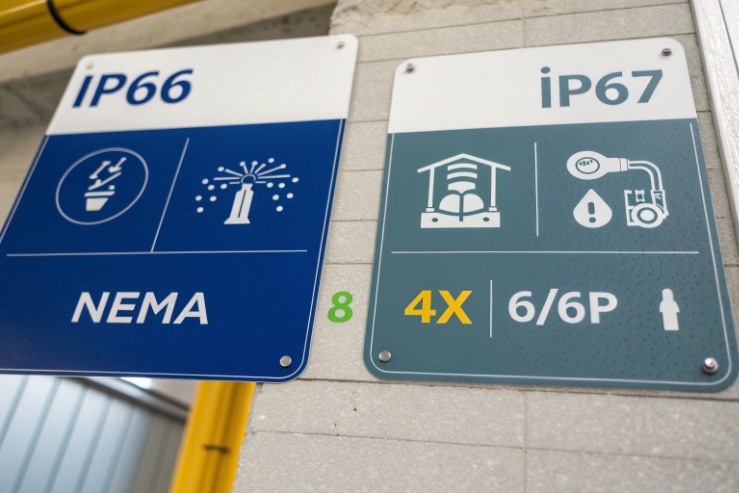
If you are working on an international project, you will see "IP66" and "NEMA 4X" thrown around interchangeably. They are similar, but one is much stricter about survival.
While IP66 and NEMA 4 both indicate protection against hose-directed water, NEMA 4X adds a critical requirement for corrosion resistance that the IP system completely ignores, making NEMA 4X the essential standard for offshore and chemical environments.
Dive Deeper: The Corrosion Gap
1. The IP Blind Spot
You can build a box out of mild steel, paint it poorly, and it can pass an IP66 test today. Two weeks later, on an oil rig, it will rust into a pile of orange flakes. The IP rating only tests the seal, not the material.
2. The NEMA 4X Gold Standard
The National Electrical Manufacturers Association (NEMA) in the USA created the "4X" rating to address this.
-
4: Watertight (Similar to IP66).
-
X: Corrosion Resistant.
To pass NEMA 4X 7, the enclosure must withstand 200 hours of salt spray testing without significant corrosion.
My Rule of Thumb:
-
Indoor / Dry Factory: IP65 / NEMA 12 is fine.
-
Outdoor (Rain only): IP66 / NEMA 4.
-
Offshore / Chemical / Coastal: You MUST specify NEMA 4X (or equivalent corrosion resistance like Stainless Steel 316).
-
Warning: An IP66 aluminum phone might be NEMA 4X compliant (if the paint is amazing), but a NEMA 4X phone is always IP66 compliant. The NEMA standard is the superset.
Conclusion
The IP rating is the guardian of reliability. While IP66 handles the storms and hoses of daily industrial life, understanding the nuances of IP67 submersion and the critical corrosion resistance of NEMA 4X ensures that your explosion-proof telephone remains a lifeline, not a waterlogged brick.
Footnotes
-
A global classification system for defining the levels of sealing effectiveness of electrical enclosures against intrusion. ↩ ↩
-
Official guidelines on the significant fire and explosion hazards posed by fine particles suspended in industrial atmospheres. ↩ ↩
-
Deep-sea drilling environments where extreme weather and corrosive salt spray demand highly specialized safety and communication gear. ↩ ↩
-
Technical definition of an enclosure that protects against powerful water jets and prevents any harmful dust ingress. ↩ ↩
-
Comprehensive overview of sanitation standards and moisture-resistant equipment requirements for safe food and beverage production. ↩ ↩
-
The international framework for ensuring equipment used in explosive atmospheres meets stringent safety and performance standards. ↩ ↩
-
Standardized NEMA requirements for electrical enclosures designed to provide superior protection against rain and severe corrosion. ↩ ↩








